Specialty Farming Professional Website Template
Bloom is a single-origin jasmine farm landing page template built for artisan botanical producers selling directly to independent perfumers, skincare formulators, and tea blenders. It follows a zigzag Origin Story layout that guides visitors through the full lifecycle of the jasmine blossom, from terroir and night harvest to distillation and product reservation, using a Forest Trust color palette and sensory-driven design.
by Rocket studio
Quick summary
Bloom is a nature-inspired landing page template designed for a family-run jasmine farm selling single-origin Jasminum sambac extracts. The template uses a zigzag alternating layout, a Forest Trust color system, and an Origin Story creative direction to walk buyers through every stage of the flowers' journey. It combines full-bleed farm photography, scroll-reveal storytelling, and a harvest reservation system to drive direct sales.
Who this template is for
This template is built for artisan botanical producers who sell directly to specialist buyers. It serves operations where provenance, craft, and traceability are the primary selling points. If your farm grows fragrant flowers and your buyers care deeply about where those jasmine flowers come from, this template gives your story the structure it deserves.
- Independent perfumers sourcing single-origin jasmine absolute, concrete, or enfleurage for their studio blends
- Small-batch skincare formulators who need traceable botanicals, batch certificates, and consistent supply from verified crops
- Tea blenders and ingredient buyers who understand that Jasminum sambac from a specific land and specific soil changes everything about the final produce
What problem this template solves
Selling rare jasmine extracts directly to specialist buyers is not like selling commodity ingredients. Buyers who source fragrant flowers for perfumery or formulation want to understand the full chain of custody before they trust a price. A generic product page cannot carry that weight. The Bloom template solves the credibility gap between artisan jasmine farms and the buyers who pay premium prices to work with them.
- There is no standard template that tells the layered story of fresh flowers moving from a predawn garden through copper stills to an amber vial, and Bloom fills that gap completely
- Buyers who shop for single-origin botanical extracts need to see soil, process, and proof before they decide, and this template structures each zigzag section to deliver exactly that reassurance
- The harvest reservation model requires a page that earns trust incrementally, section by section, so visitors understand why jasmine flowers cost what they cost by the time they reach the product cards
What you get with this template
Bloom delivers a fully structured, single-page layout that takes a visitor from first impression to purchase intent through a logical, emotionally resonant sequence. Every section is designed to display one more layer of craft and authenticity. The template is ready to populate with your farm's photography, copy, and product details.
- A full-bleed blue-hour hero with a hand-lettered headline fade-in, three zigzag storytelling sections covering terroir, night harvest, and distillation, and an asymmetric bento grid for absolute, concrete, and enfleurage product cards
- A sticky "Reserve This Harvest" call-to-action button in canopy gold that pins to the bottom of the viewport on scroll, plus a secondary "Request a Sample Set" path that captures email and shipping address for a three-vial discovery kit
- A Forest Trust color system using deep loam green, sun-through-canopy gold, petal white, and root-dark brown, paired with Fraunces serif display type and DM Sans body copy, with scroll-reveal stagger, hover transforms on product cards, and parallax depth on hero imagery
Feature list
This section details the core built-in capabilities that make Bloom a purposeful tool for jasmine farm direct sales. Each feature is drawn directly from the template's design brief and interaction model.
Full-Bleed Blue-Hour Hero Section
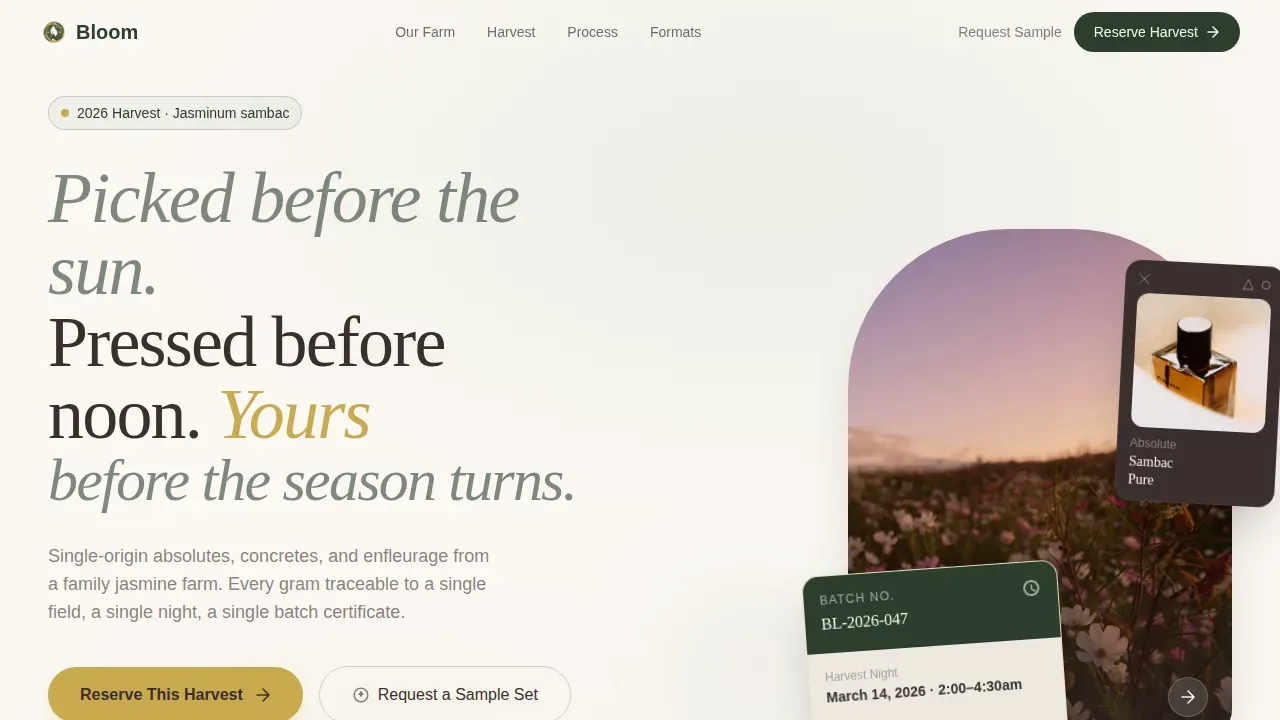
The hero opens with a cinematic full-bleed photograph taken at knee height inside the jasmine rows during blue hour. Endless white jasmine blossoms recede into soft focus. A picker's hands cup a cluster of fresh flowers in the foreground, her woven basket already half full beside her. No text appears for the first two seconds. Then a hand-lettered headline fades in over the image, creating an immediate sense of wonder and atmosphere that no plain header could achieve. Floating harvest and vial cards sit over the image to anchor the product context before the visitor scrolls. This hero section creates an emotional connection between the visitor and the jasmine flowers before a single word of copy is read.
Zigzag Origin Story Layout
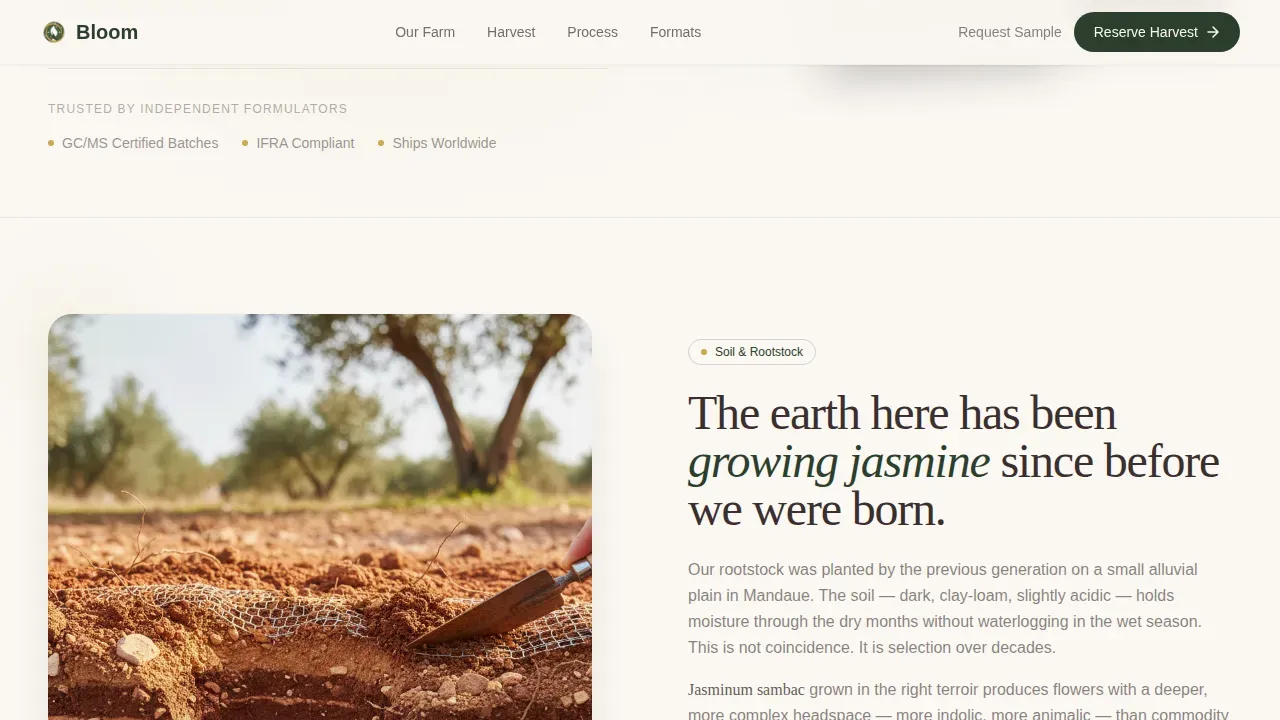
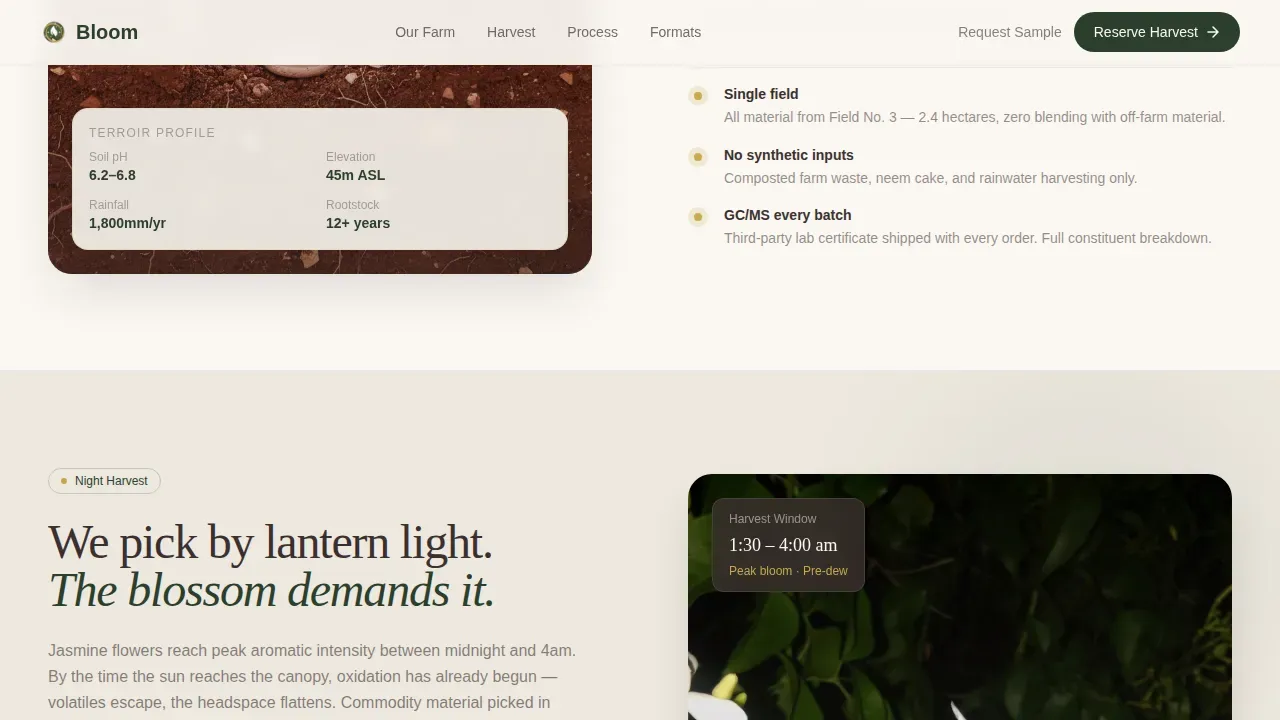
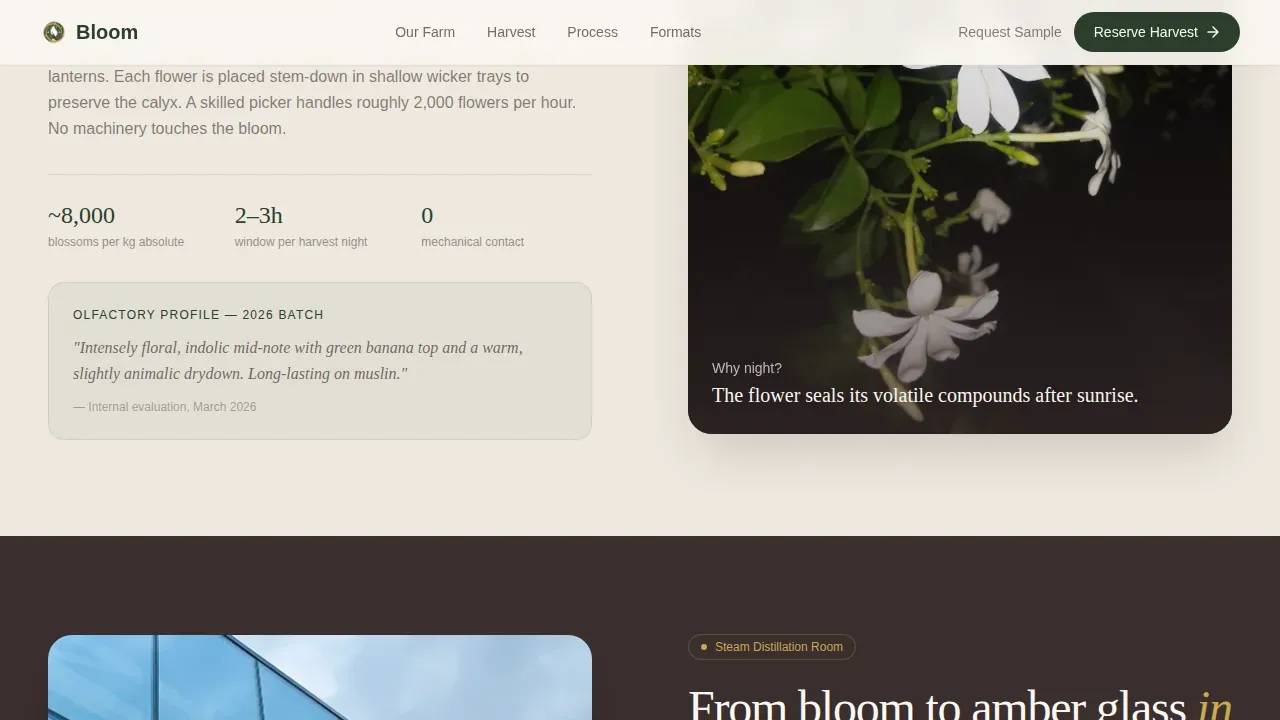
Three alternating split sections carry the visitor through the full lifecycle of a single jasmine blossom. The first zigzag pairs close-up earth and garden photography with a short terroir paragraph, letting the soil and the rootstock establish the farm's credibility. The second zigzag alternates a lantern-lit nighttime harvest photograph with the hand-picking process narrative. The third zigzag shows the copper distillation room against dark wood shelves, translating craft into trust. Each section deepens the story by one layer, so by the time the visitor sees the product cards, they already understand the entire journey from seed to vial. The zigzag format keeps the eye moving and the reader engaged across a long, detail-rich page.
Asymmetric Bento Product Grid
Three extraction formats are displayed in an asymmetric bento grid: absolute, concrete, and enfleurage. Each product card shows volume, price in USD, and estimated ship date. Hover states on each card reveal additional detail without cluttering the initial view. The grid is designed to reflect scarcity and specificity. Yield-per-acre numbers and batch certificate references sit alongside the cards to prove that the jasmine flowers in each vial come from a documented, limited harvest. The entire display is built around the idea that a visitor who has scrolled through the Origin Story sections is already emotionally prepared to reserve their allocation.
Sticky Reserve Call-to-Action
A "Reserve This Harvest" button in canopy gold first appears beneath the distillation section. It then pins to the bottom of the viewport and follows the visitor through every subsequent scroll. The button is large, high-contrast, and action-oriented. It uses the gold color from the Forest Trust palette to stand out against petal white backgrounds and loam green dividers. This persistent presence means the purchase action is always one tap or click away, whether a visitor is reading about night harvest practices or comparing extraction formats on the product grid.
Sample Set Capture Path
A secondary conversion path allows visitors who are not yet ready to reserve a full harvest allocation to request a three-vial discovery kit at cost. The form captures email address and shipping address. This path serves first-time buyers, especially independent perfumers and skincare studio formulators who want to evaluate the scent and quality of the jasmine absolute, concrete, and enfleurage before committing to a full order. It creates a low-friction entry point that keeps interested visitors connected to the farm without requiring an immediate purchase decision.
Social Proof and Provenance Anchors
Named perfumer testimonials, batch certificate references, and harvest quantity statistics are built into the page as trust anchors. These elements display alongside the product cards and distillation section to reinforce the claim that this jasmine comes from a single, traceable source. In a world where buyers of fragrant flowers are accustomed to commodity supply chains, this layer of social proof creates a meaningful distinction. The batch certificates and yield data are not decorative; they function as purchase justification for buyers who need documentation for their own formulation records.
Page sections overview
| Section | Purpose |
|---|---|
| Hero: Blue Hour | Opens with a full-bleed jasmine field photograph at blue hour, a fade-in hand-lettered headline, and floating harvest and vial cards to anchor the product context immediately |
| Origin Zigzag One | Pairs close-up earth and garden photography on the left with a terroir paragraph on the right, establishing the farm's soil story and rootstock credibility |
| Night Harvest Zigzag | Places a lantern-lit harvest photograph on the right and the hand-picking narrative on the left, showing exactly how jasmine flowers are gathered before dawn |
| Distillation Zigzag | Displays the copper still room against dark wood shelves on the left with the distillation process description on the right, translating physical craft into buyer trust |
| Product Bento Grid | Presents absolute, concrete, and enfleurage product cards in an asymmetric grid with volume, price, ship date, batch certificate reference, and yield-per-acre data |
| Footer Arc Split | Displays the farm logo and tagline on the left with navigation links on the right, using the Forest Trust color system to close the page with quiet brand authority |
Design & branding system
Bloom uses a Forest Trust color system that feels like a pressed botanical specimen inside a leather field journal. The palette is earthy, unhurried, and filled with quiet authority. Every color choice serves a functional role in guiding the eye and establishing trust with buyers who appreciate craft and detail.
- Petal white (#FAF7F2) dominates section backgrounds, giving the page generous breathing room; deep loam green (#2C3E2D) anchors the navigation bar and section dividers; sun-through-canopy gold (#C9A94E) highlights pricing, calls to action, and the sticky reserve button; root-dark brown (#3B2F2F) carries all body copy with generous leading that lets the page breathe naturally
- Typography pairs Fraunces, a warm serif display face, for headlines and section titles with DM Sans for all body paragraphs, creating a contrast between the sensory and the practical that mirrors the template's overall storytelling tone
- Animation uses medium-intensity scroll-reveal stagger on section entries, hover transforms on product cards, parallax depth on the hero image, and zigzag image reveals on the three Origin Story sections
Mobile & speed optimization
This template is desktop-first, reflecting the reality that independent perfumers and skincare formulators typically research high-value botanical ingredients on larger screens. The layout is built to display the full visual richness of the full-bleed photography, the zigzag sections, and the bento grid at desktop widths. At the same time, it includes full mobile responsiveness so visitors on any device can reach the product cards and the reserve call-to-action without friction.
- The sticky "Reserve This Harvest" button remains accessible on both desktop and mobile viewports, ensuring the primary conversion path is never more than a single tap away regardless of screen size
- Native CSS scroll-behavior handles smooth page movement without heavy JavaScript dependencies, and Server Components power the static storytelling sections so the page loads cleanly even when hero photography files are large
How this template helps you convert
Bloom is built around the insight that buyers of single-origin jasmine extracts do not impulse-purchase. They research, compare, and then decide based on provenance and proof. The template's structure is designed to answer every unspoken buyer question before the product card is reached.
- The Origin Story zigzag sequence walks the visitor through terroir, harvest, and distillation in a fixed logical order, so each section builds on the last and the cumulative effect is a sense of complete transparency. By the time the buyer sees a price, the story has already justified it.
- The sticky reserve button and the sample set capture path create two conversion exits at different commitment levels, meaning both the ready buyer and the curious first-time visitor have a clear next step that matches where they are in their decision process.
Other information about this template
The Bloom template draws on a rich context of jasmine farming realities that give its design choices extra meaning. Understanding that context helps you populate the template with copy and imagery that will resonate with the specialist buyers it is built to serve. The following points provide background that is useful for customizing your content.
- Jasmine is one of the most central and cherished ingredients in perfumery. The scent of jasmine flowers is described as multifaceted and sensual, which is exactly why independent perfumers place such high interest in provenance. When your landing page tells the full story of your jasmine flowers, it speaks directly to the values of your buyers.
- Egypt and India are the world's top two jasmine producers. Egypt's nutrient-rich Nile Delta soil is home to more than 90% of that country's jasmine fields. India has seen jasmine production decrease in recent years, leading to a market shift back to Egypt due to pricing pressures. In 2017, that shift accelerated as the price of Sambac jasmine doubled due to increased demand and reduced supply. One kilogram of fresh Sambac flowers that once cost INR 120 to 140 now costs INR 250 to 260. The Bloom template's emphasis on scarcity and traceability is directly aligned with this market reality.
- Sambac jasmine flowering can start as early as late February or early March. The peak flowering season for Sambac jasmine runs through April, May, and June. Jasmine flowers bloom for roughly seven months of the year, providing a stable seasonal income to producers and pickers. Jasmine crops need a high temperature to grow well and can yield approximately 4 tons of fresh flowers per acre. Both major species of jasmine require minimal water, using only 1 to 2 liters per hour per acre during the dry season. These facts are worth referencing on your landing page to help buyers understand the seasonal nature of your harvest reservation model.
- Jasmine is used in the production of both concrete and absolute forms, which maps directly onto the three extraction formats displayed in the Bloom product grid. Sambac jasmine is also traditionally used in Indian culture for decorative purposes and religious ceremonies, giving the species a cultural dimension that adds richness to any origin story narrative. Jasmine flowers are harvested at specific times to ensure optimal fragrance extraction, which is why the night harvest section of this template carries so much credibility when populated with the right imagery and copy.
- Sustainable farming practices are a meaningful differentiator in the specialty botanical market. Farmers who rely on sustainable plant protection measures to protect their jasmine crops from insects and pests are increasingly valued by buyers who want clean, traceable ingredients. Training programs for jasmine farmers have led to the use of organic fertilizers and insect traps in their fields, reducing chemical load on the crops and the surrounding garden and foliage. Goats are used in some jasmine fields to provide natural manure and help manage weeds without synthetic herbicides. Incorporating these sustainable farming practices into your landing page copy strengthens the brand story and appeals to formulators who need to make clean-label claims about their own products.
- The production of Grandiflorum jasmine in India has slowed as farmers in that country switch their crops to other more profitable ingredients due to rising production costs and market competition. This shift creates an opening for farms that maintain consistent, high-quality Jasminum sambac production and can document that consistency with batch certificates and yield data. The Bloom template is built specifically to display that kind of proof.
- From a design perspective, a minimalist layout with plenty of whitespace and earth-inspired color palettes enhances user experience for this kind of artisan botanical business. In 2026, high-quality sensory visuals combined with clear, benefit-driven copy remain crucial for landing pages targeting specialist ingredient buyers. Social proof and testimonials are essential for building trust and credibility in direct-to-formulator sales. A high-definition background image of the jasmine farm in the hero section establishes an emotional connection before a single line of body copy is read. The call-to-action should use action-oriented language in contrasting colors to stand out against the page background, which is exactly how the gold reserve button functions in this template. Landing page templates can be customized to fit the branding of jasmine farms, and the Bloom template is designed specifically for that level of customization.
- Farmers in Egypt rely on sustainable plant protection measures to protect jasmine crops from insects and pests. The Givaudan Foundation promotes environmentally sustainable plant protection approaches for jasmine farmers in Egypt, helping to raise the standard of sustainable farming practices across the country's jasmine fields. These practices are increasingly relevant to buyers who want assurance that the fragrant flowers in their formulations were grown responsibly.
- Jasmine plants grown on well-managed farm land with good soil health and proper compost inputs produce better-quality blossoms. Managing weeds, controlling pests, and applying compost thoughtfully are all part of maintaining a high-yield, high-quality jasmine garden. Farmers who have worked their land for many years develop an intuitive sense of how their plants respond to soil conditions, temperature changes, and seasonal rainfall. That accumulated knowledge is part of what makes a single-origin farm's produce different from commodity-sourced jasmine flowers.
- The bloom single origin jasmine farm landing page template is the subject of this full content guide, and every section in this overview is designed to help you understand both the template's design system and the farming context that should inform your landing page copy.
- The Bloom template's page type is a single-page landing structure. It is not a multi-page site. All content, from the blue-hour hero to the footer arc split, exists within a single scroll flow. That focus on a single page experience is intentional. It keeps the visitor moving through the Origin Story without distractions, branch paths, or navigation decisions that could interrupt the purchase journey.
- Jasmine blossoms that are picked by hand before dawn are at their peak oil content. Night pickers who gather fresh flowers before the sun rises understand that the moment the petals open to full bloom, the fragrance begins to dissipate. That is why the timing of harvest is everything. The Bloom template gives you a dedicated night harvest section to tell that story with photography and a short, specific paragraph that buyers of fragrant flowers will find immediately credible.
- The template supports named perfumer testimonials that display alongside the product cards. These testimonials create a sense of community around the farm's harvest and remind visiting buyers that other professionals in their world have already decided to source from this farm. Social proof of that kind is especially powerful in a specialist market where word-of-mouth and provenance matter more than advertising.
- Tips for populating the Bloom template effectively include sourcing your hero photograph during actual blue hour on the farm, writing your terroir paragraph in plain, specific language rather than poetic generality, and listing your actual yield-per-acre numbers in the product grid rather than using estimates. Real numbers inspire real trust. The template's design creates the atmosphere; your specific farm data creates the credibility.
- The template's footer uses an Arc Browser Split pattern, with the farm logo and tagline on the left and navigation links on the right. This creates a clean, professional close to the page that reinforces brand identity without adding visual noise. The footer uses the Forest Trust color system throughout, keeping the design cohesive from the first pixel of the hero to the last line of the footer.
- Jasmine garden management involves more than just picking. Pruning after the harvest season, managing foliage density, controlling weeds between the rows, and applying compost to replenish the soil are all part of the annual cycle. Farmers who maintain their jasmine plants carefully over many years develop denser, more productive bushes that produce better-quality blossoms season after season. The Bloom template's terroir zigzag section is the right place to describe that cycle in one focused paragraph.
- The intersection of nature-inspired design, an origin story creative direction, and a direct sales conversion model is what makes Bloom unusual among farm landing page templates. Most agricultural templates focus on either beauty or function. Bloom is built to achieve both at once, and the zigzag layout is the structural mechanism that makes that possible.
Theme
Nature-Inspired
Creative direction
Origin Story
Color system
Forest Trust
Style
Zigzag/Alternating
Direction
Direct Sales
Page Sections
Full-bleed Blue-hour Hero
Zigzag Origin Story Sections
Asymmetric Bento Product Grid
Sticky Reserve Call-to-action
Sample Set Lead Capture Path
Social Proof and Provenance Anchors
Related questions
Who are the ideal buyers for this landing page template?
What extraction formats does the product section display?
Can I customize the colors and fonts to match my farm's branding?
Does the template include a way to capture leads who are not ready to buy?
How does the zigzag layout help convert specialist ingredient buyers?