Agri-Tourism & Farm Experience Advanced Professional Website Template
Flutter is a gallery and detail landing page template built for butterfly and pollinator farms selling live releases direct to consumers and businesses. It walks visitors through a propagation greenhouse, emergence lab, and shipping protocol before presenting species cards with order controls. The result is a trust-first sales flow that earns the purchase through infrastructure storytelling.
by Rocket studio
Quick summary
Flutter is a single-page, gallery-and-detail landing page template designed for live butterfly farms. It guides visitors through your growing facility, emergence lab, and shipping process before presenting purchasable species cards. Every scroll section deepens credibility. By the time a visitor reaches the order controls, they already understand the system behind the shipment.
Who this template is for
This template is built for specialty farms and small agricultural businesses that sell live butterflies or pollinators directly to buyers. It serves both consumer and professional purchasing paths from one page.
- Event coordinators and wedding planners ordering bulk live releases for outdoor ceremonies
- Elementary school educators purchasing classroom life-cycle kits for student science units
- Botanical garden directors and conservatory staff sourcing large-volume monarch releases
What problem this template solves
Selling live insects online requires a level of buyer trust that a standard product page cannot build. Visitors arrive skeptical about whether live animals can survive shipping, whether the farm is legitimate, and whether the species will actually arrive on time. This template addresses all of that before the price appears.
- Buyers see the rearing infrastructure, emergence chambers, and packaging protocol before any cart element
- Species cards present arrival rates, ship-day restrictions, and emergence windows as plain specifications
- The fixed order bar and guided configurator reduce friction for both first-time and repeat buyers
What you get with this template
You get a complete, section-led landing page organized like a guided facility tour. Each section serves a distinct role in the buyer journey, from introducing the farm to closing the sale.
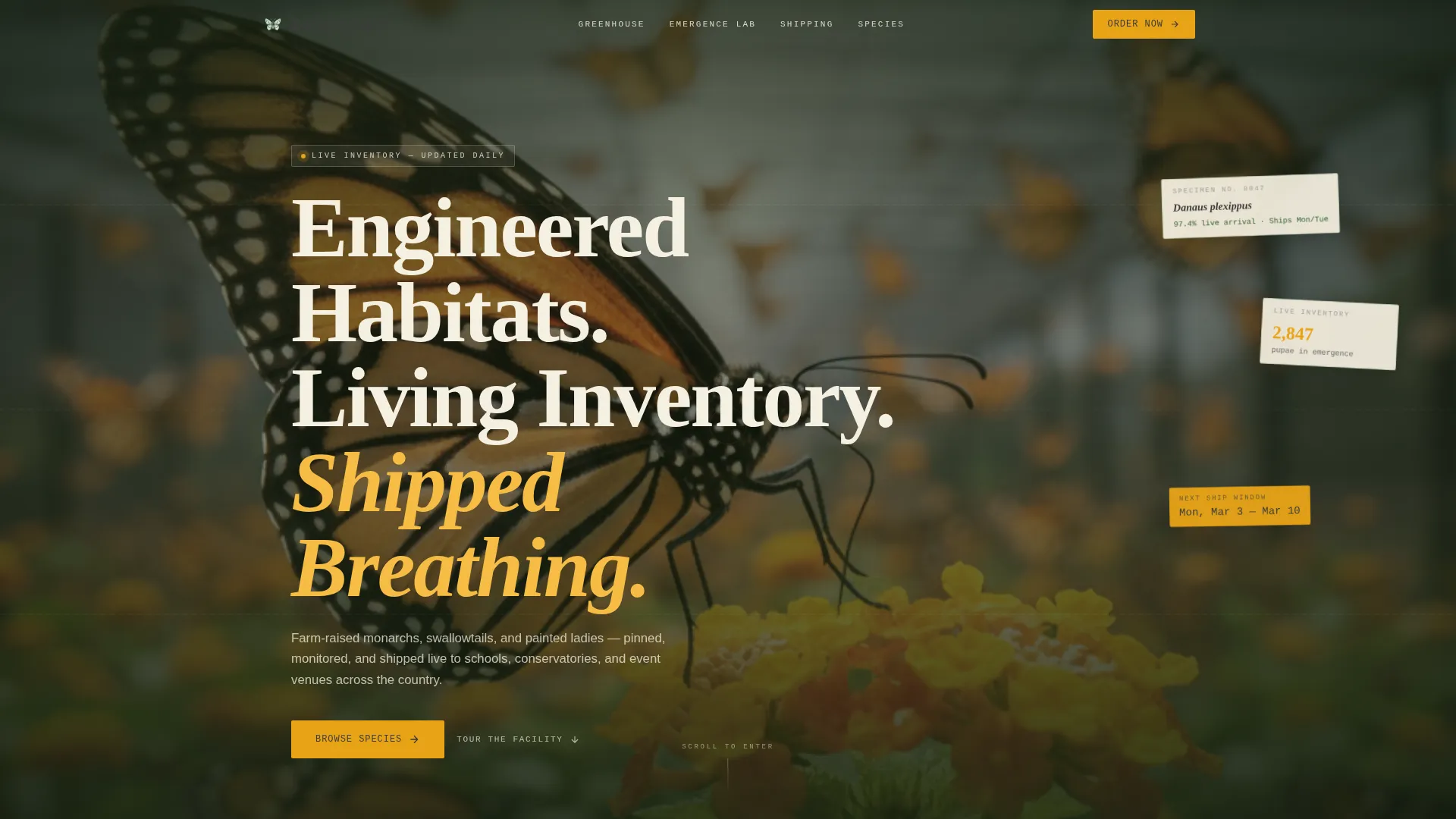
- A panoramic hero with blueprint grid overlay, monospaced specimen label headline, and Ken Burns motion on the background image
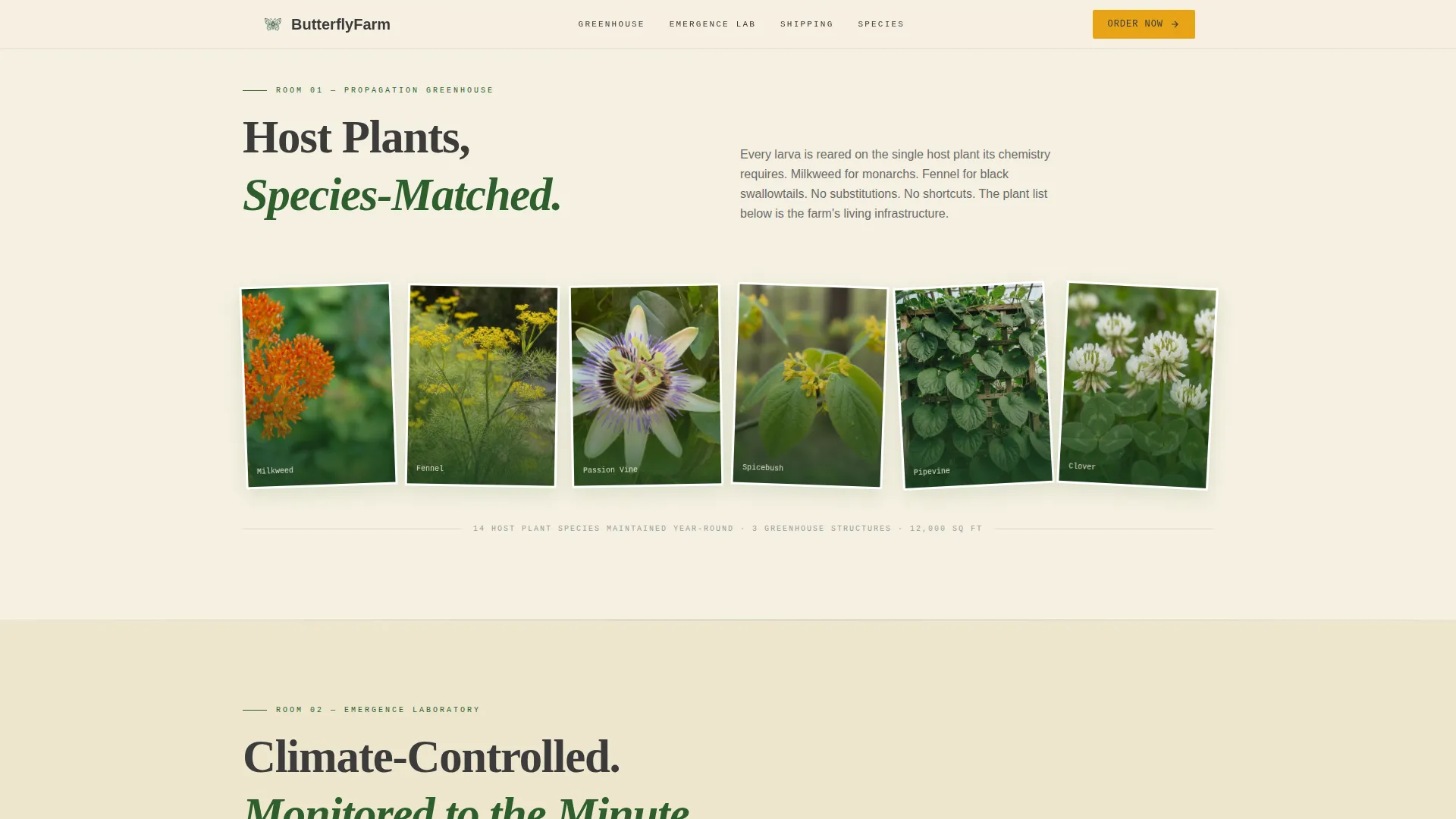
- A propagation greenhouse gallery with botanical-illustration hover states that reveal Latin names, hardiness zones, and larval host data
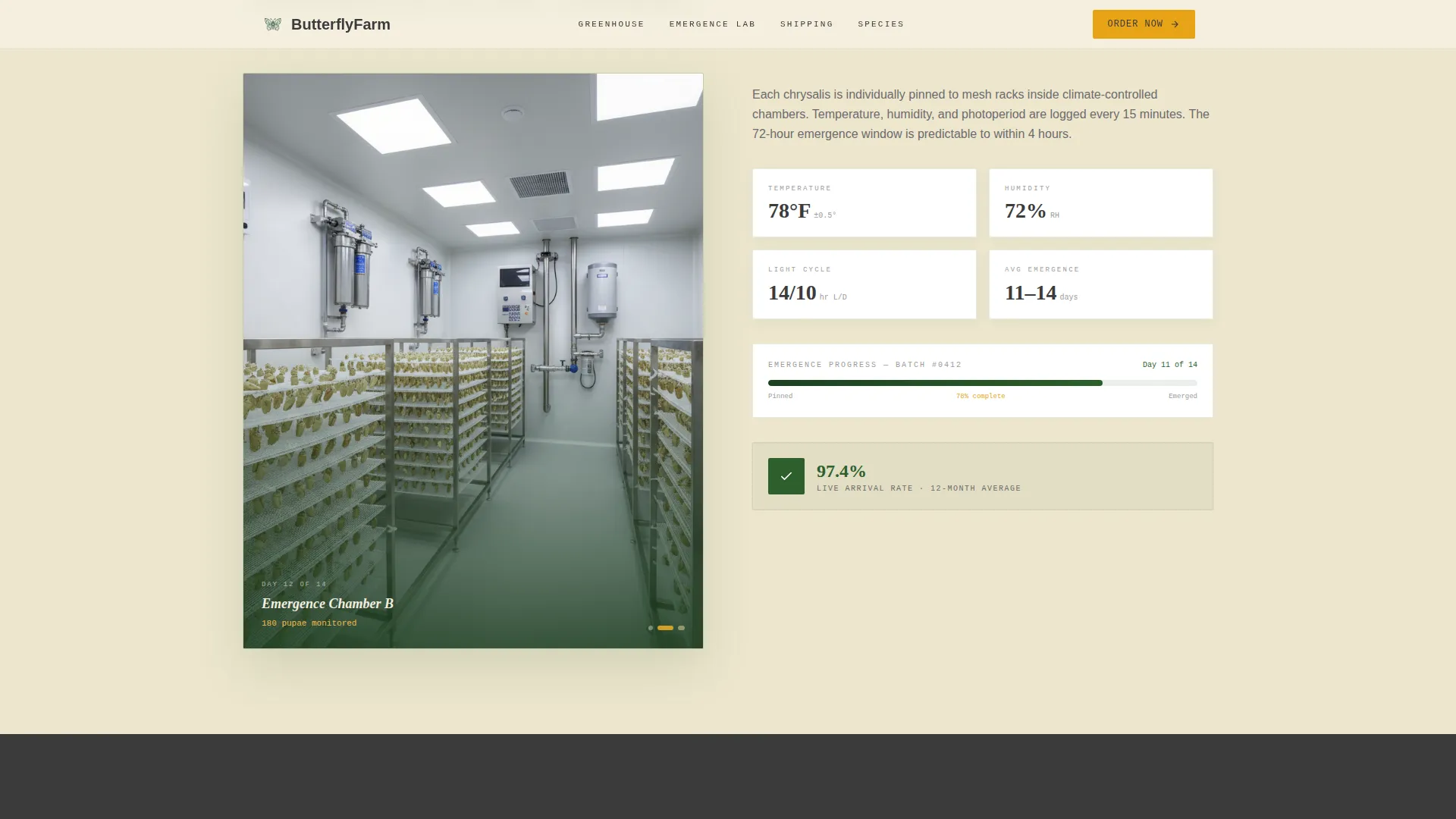
- An emergence lab section with a scroll-animated blueprint diagram that transitions into real photography
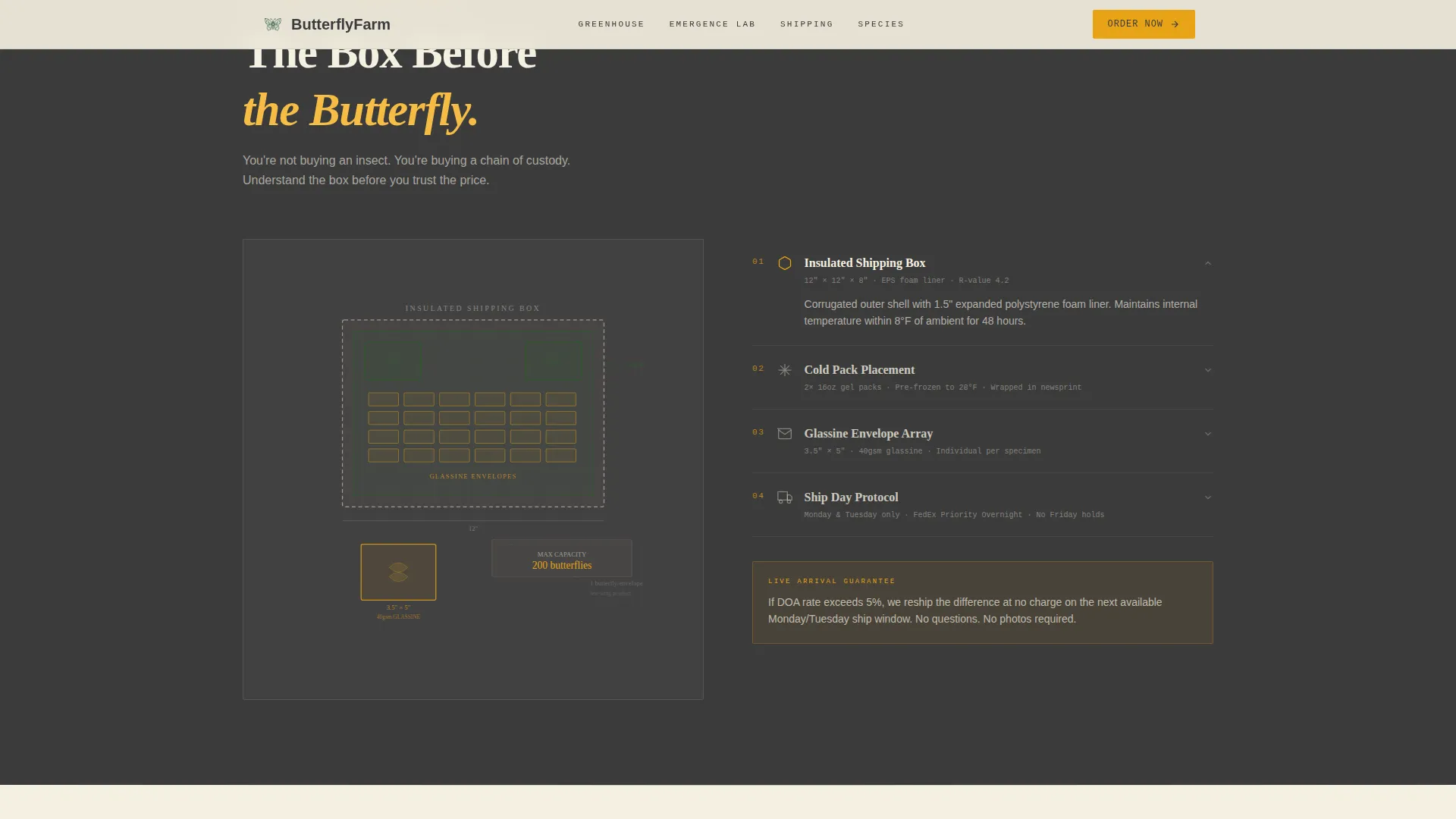
- An exploded-view shipping protocol section showing insulated box construction, cold pack placement, and glassine envelope orientation
- A species catalog with "Add to Release" buttons, quantity steppers, and a preferred ship-week calendar picker on every card
- A fixed bottom order summary bar showing live species count, estimated arrival date, and running total
- A "Build a Custom Release" configurator modal that collects event type, venue zip code, event date, and quantity before returning a quoted package
Feature list
A single paragraph introduces the feature set as a whole. This template packages a large number of interactive and visual components into one cohesive page flow. Each feature is designed to reinforce expertise at a specific point in the visitor journey.
Panoramic Hero with Blueprint Overlay
The full-viewport hero image is captured at bench height inside a screened flight house. A dashed construction-line grid maps wing venation patterns across the image. The headline reads in thin monospaced type, and the background image plays a slow Ken Burns motion on load.
Scroll-Animated Emergence Lab Diagram
The emergence lab section opens as a blueprint line-art cutaway showing chrysalis racks, temperature gauges, and humidity readers. On scroll, the diagram animates and transitions into real facility photographs. The reveal is timed to the visitor's scroll position.
Botanical Greenhouse Gallery
The propagation section displays host plant species as gallery tiles. Hovering any tile reveals a botanical illustration overlay with the plant's Latin name, hardiness zone, and which caterpillar species it feeds. This section establishes species-specific expertise early in the page flow.
Exploded-View Shipping Protocol Section
Before any price appears, a dedicated section shows an exploded-view diagram of the insulated shipping box. Cold pack placement and glassine envelope orientation are labeled as part of the diagram. The goal is to resolve logistics concerns before the buyer reaches the species catalog.
Species Catalog with Order Controls
Each species detail card presents information formatted like engineering tolerances: emergence window, ship-day restrictions, and live arrival rate. Every card includes an "Add to Release" button in saffron, a quantity stepper, and a preferred ship-week calendar picker. Cards also expand into a full detail panel on click.
Fixed Order Summary Bar and Custom Release Configurator
A persistent bar fixed to the bottom of the viewport tracks the active order. It shows current species count, estimated arrival date, and order total at all times. A secondary "Build a Custom Release" button opens a guided modal for event planners needing a quoted package.
Page sections overview
| Section | Purpose |
|---|---|
| Panoramic Hero | Establish farm identity and blueprint visual tone |
| Propagation Greenhouse Gallery | Show host plant expertise with botanical hover states |
| Emergence Lab Diagram | Demonstrate rearing process with animated blueprint reveal |
| Shipping Protocol Exploded View | Build logistics trust before presenting prices |
| Species Catalog Cards | Present purchasable species with full order controls |
| Fixed Order Summary Bar | Keep running order visible throughout the browsing session |
| Custom Release Configurator | Guide bulk buyers to a quoted package via modal flow |
| Footer | Single-row linear footer with contact and navigation |
Design & branding system
The visual identity pairs a Victorian naturalist field journal aesthetic with an engineering blueprint structure. The result feels like a specimen notebook left open in a working greenhouse: ruled lines softened by humidity, ink notations fading at the edges, pressed specimens still holding their color.
- Deep chlorophyll (#2D5F2D) is the primary brand color used for structural elements and headings
- Vellum parchment (#F5F0E1) forms the page background, giving every section a warm, aged-paper feel
- Technical graphite (#3B3B3B) is used for body text and diagram line art
- Stigma saffron (#E8A317) is reserved exclusively for price tags, cart buttons, and quantity selectors, making every purchase action visually distinct
- DM Mono handles specimen labels and specification text; Fraunces is used for display headings; Manrope carries body copy
Mobile & speed optimization
The template is built desktop-first to serve its primary audience of event planners and educators placing orders on larger screens. All interactive components, including the order bar, species detail panels, and configurator modal, remain fully functional on smaller viewports.
- Server components handle static sections like the hero, greenhouse gallery, and shipping diagram to keep initial load light
- Client components are scoped to interactive elements: the cart bar, quantity steppers, calendar picker, and configurator modal
- The fixed order bar reflows gracefully on mobile, maintaining visibility without covering key content
How this template helps you convert
The page is structured as a progressive trust sequence. Visitors move through proof of expertise before they ever encounter a price, which reduces the most common objections to buying live animals online.
- The greenhouse, lab, and shipping sections each deepen confidence in the farm's process, so the species catalog arrives with credibility already established
- Species cards present live arrival rates, ship-day windows, and emergence tolerances as plain data, turning biological uncertainty into measurable reliability
- The fixed order bar and configurator modal reduce friction for both impulse buyers picking a single species and event planners building a multi-species quoted release
Other information about this template
This template is categorized under Agriculture and Environment, with a subcategory focus on agri-tourism and farm experience. It is specifically matched to the butterfly and pollinator farm niche.
- The page direction is direct sales, meaning every section funnels toward either the species catalog or the custom release configurator
- Localization is set for the United States market, using USD currency and the MM/DD/YYYY date format throughout order and calendar controls
- The template style is Gallery and Detail, meaning each species can be browsed in grid view and expanded into a full specification panel
- Animation intensity is high: the page uses scroll-linked reveals, blueprint-to-photo transitions, card hover states, floating label animations, and Ken Burns motion on the hero
- The intersection match score for this template's niche, subcategory, and category alignment is 13, indicating a purpose-built fit for this specific farm use case
Theme
Engineering Blueprint
Creative direction
Spatial & Architectural
Color system
Botanical
Style
Gallery + Detail
Direction
Direct Sales
Page Sections
Panoramic Hero with Blueprint Grid Overlay
Scroll-animated Emergence Lab Reveal
Botanical Greenhouse Gallery with Hover States
Exploded-view Shipping Protocol Diagram
Species Catalog with Full Order Controls
Fixed Order Bar and Custom Release Configurator
Related questions
Who is this landing page template built for?
Can I use this template to sell multiple butterfly species?
How does the custom release configurator work?
Is this template suitable for classroom or educational orders?
Does the fixed order bar stay visible while browsing species cards?