Environmental Consulting Professional Website Template
Forecast is a climate risk advisory landing page template built for institutional consultancies. It uses a zigzag alternating layout to guide CFOs, insurance underwriters, and municipal treasurers through four seasonal risk chapters. The Japanese Zen visual identity, vermillion calls to action, and data-dense narratives build authority and move qualified visitors toward a methodology click-through.
by Rocket studio
Quick summary
Forecast is a single-page climate risk advisory template designed for B2B consultancies serving institutional financial clients. It structures four seasonal risk narratives inside a zigzag alternating layout, pairs cinematic photography with data callouts, and drives visitors toward a methodology click-through. The restrained Japanese Zen palette communicates authority before a single word is read.
Who this template is for
This template is built for climate risk advisory firms that need to earn the trust of financially sophisticated clients before asking for their time. It speaks the language of portfolio exposure, loss projections, and scenario analysis rather than general environmental messaging.
- CFOs at coastal real estate firms reassessing asset exposure after recent loss events
- Insurance underwriters repricing coverage zones following repeated Atlantic hurricane seasons
- Municipal treasurers whose infrastructure bond valuations now depend on long-range rainfall projections
What problem this template solves
Institutional buyers do not respond to generic environmental landing pages. They need to see that a consultancy understands their specific financial stakes. Most advisory pages fail because they lead with credentials rather than consequences.
- Visitors arrive skeptical and leave unconvinced when data is absent or too abstract
- Decision-makers need to feel the compounding urgency of seasonal risk, not just read about it
- The consultancy's methodology goes unread if trust is not built through data density first
What you get with this template
You get a complete single-page layout that takes a visitor from first impression through four escalating risk chapters and ends with an unavoidable call to action. Every section is designed to layer evidence before asking for the click.
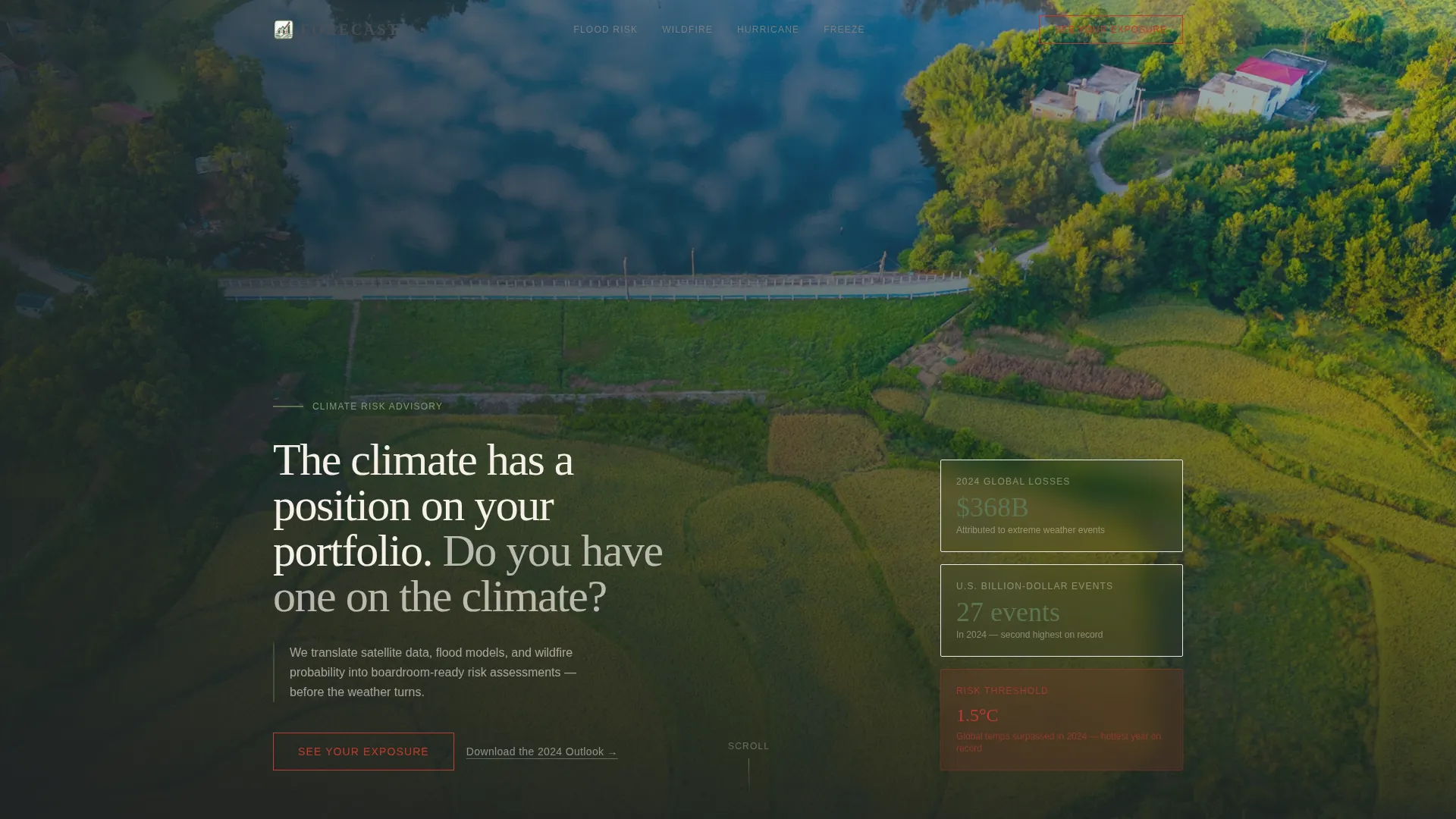
- A cinematic hero section with an asymmetric aerial photograph and a thin serif headline
- Four zigzag seasonal sections pairing full-bleed nature photography with risk narratives and data visualizations
- A primary vermillion call to action that reappears after each seasonal section and a secondary text link capturing softer intent
Feature list
This section covers the core built-in capabilities that define how Forecast works as a template.
Zigzag Alternating Section Layout
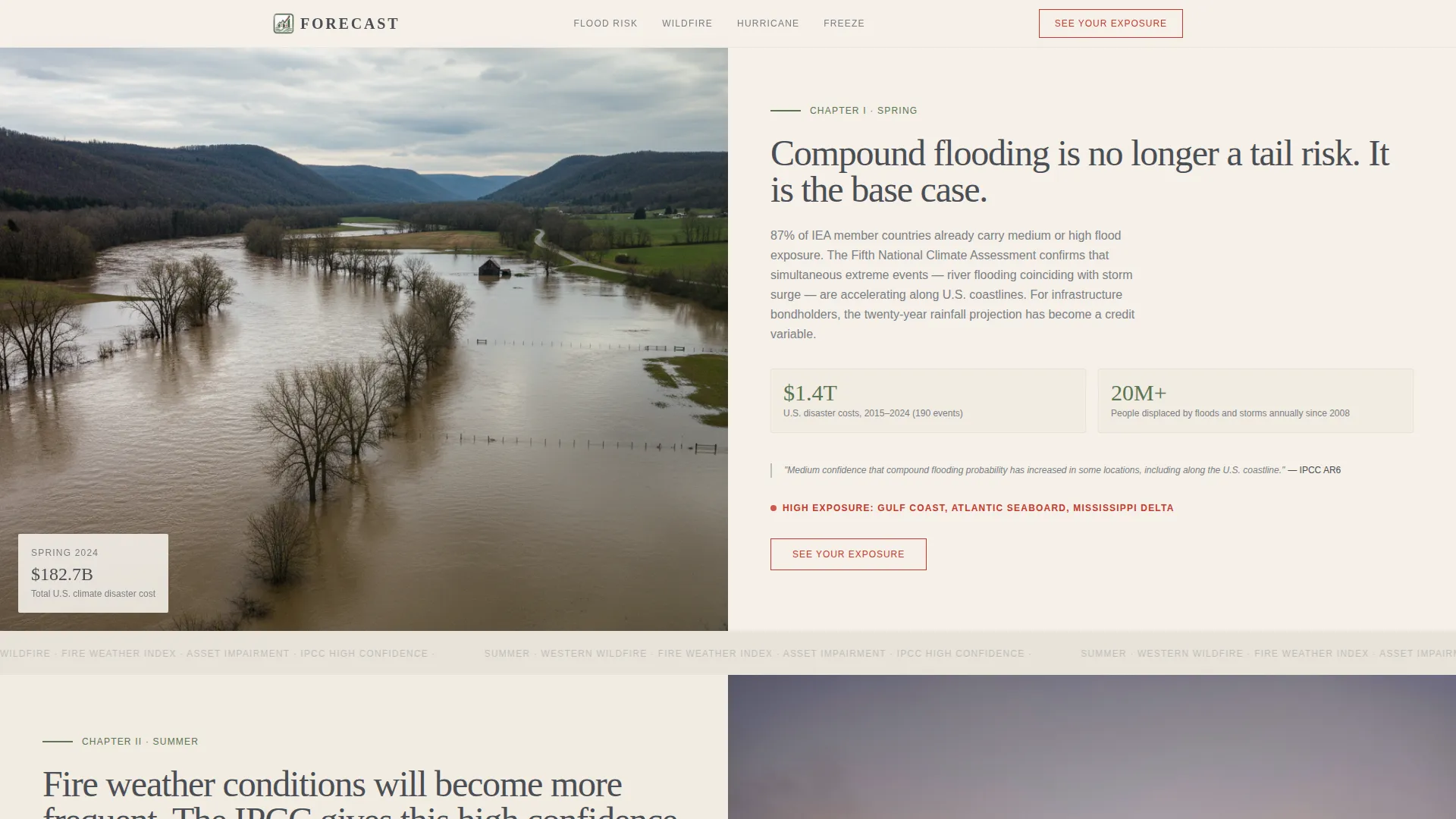
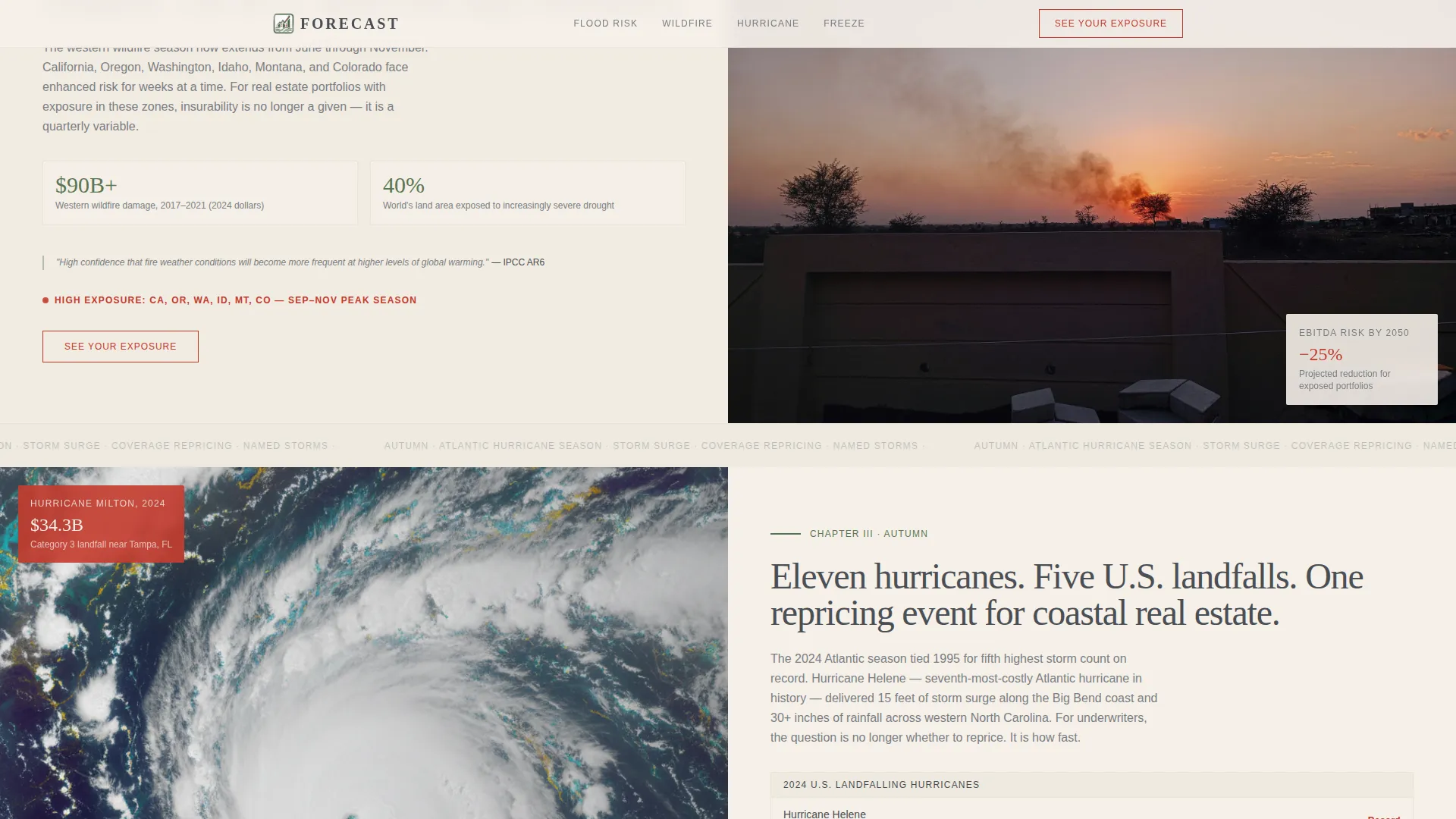
Each of the four seasonal risk chapters uses an alternating left-right composition. One section breathes with whitespace and soft landscape photography. The next tightens around heat maps and loss projections. The rhythm mirrors the oscillation between calm and disruption without requiring any custom layout work.
Seasonal Risk Narrative Structure
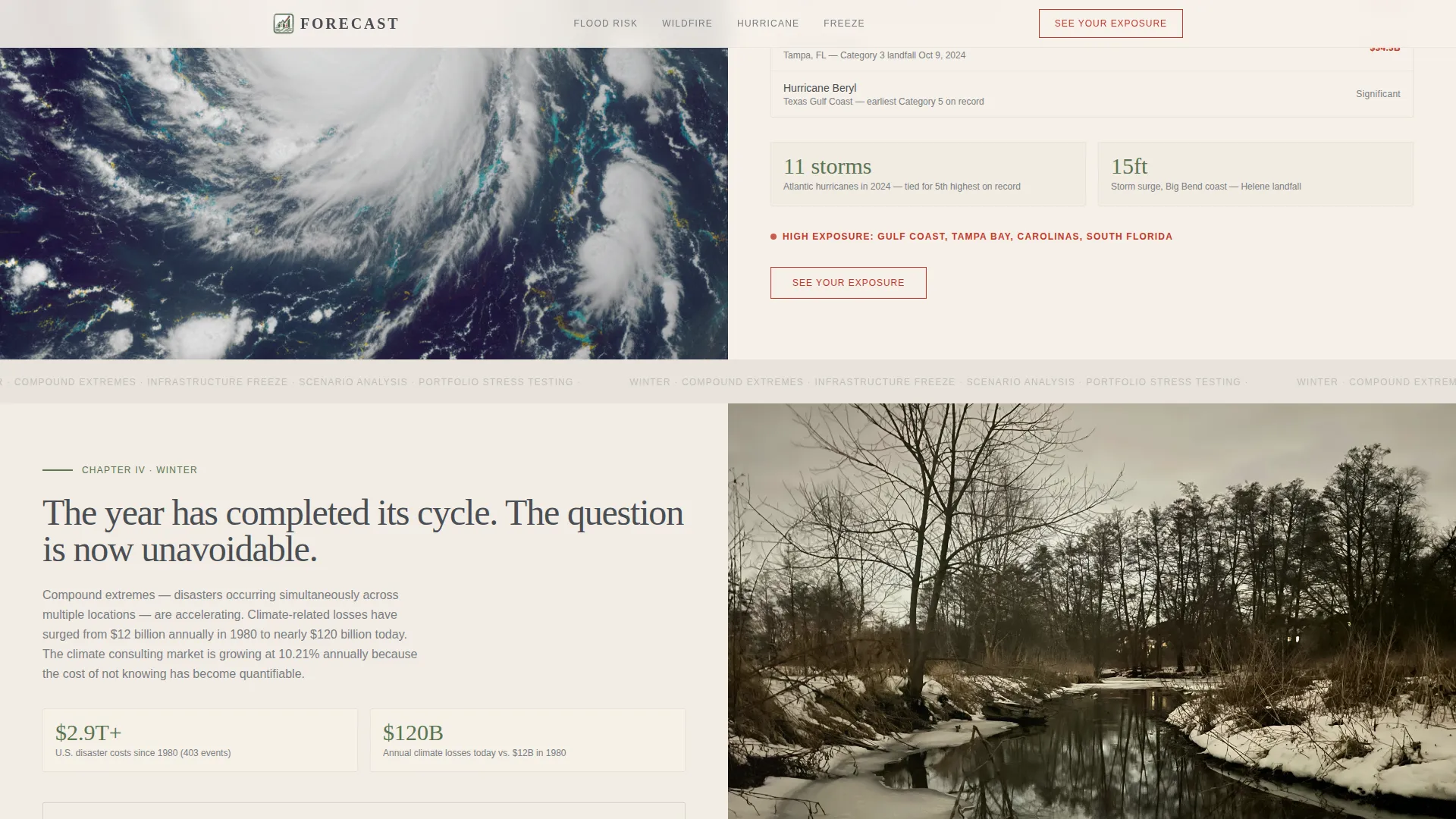
The template is pre-structured around four climate chapters: spring flooding, summer wildfire, autumn hurricane, and winter freeze. Each chapter pairs a contextual photograph with a risk narrative block and a data visualization area. The progression builds urgency naturally as the visitor scrolls.
Scroll-Triggered Reveal Animations
Sections use scroll-triggered fade and slide reveal animations with Intersection Observer staggering. Zigzag image panels zoom gently on scroll entry. Data callout numbers count up as they enter the viewport. The effect is measured and deliberate, matching the Zen restraint of the visual identity.
Repeating Vermillion Call to Action
The primary "See Your Exposure" call to action appears first below the hero as a ghost-outline button in vermillion. It then resurfaces after each seasonal section as the stakes compound. This placement strategy means every visitor encounters the prompt multiple times at the right emotional moment.
Data-Dense Trust Architecture
Each seasonal section includes named geographic zones, cited loss figures, and benchmark references. The $182.7 billion in 2024 flood losses, $90 billion in western wildfire costs, and named hurricane data are built into the narrative blocks. This specificity does the trust work that credentials alone cannot.
Secondary Soft-Capture Link
A secondary text link, "Download the 2024 Outlook," is included for visitors not yet ready to click through to the methodology page. It captures engaged readers who are willing to exchange an email for the annual climate risk report, without adding a form to the main page flow.
Page sections overview
| Section | Purpose |
|---|---|
| Hero with headline | Sets cinematic authority and introduces the primary call to action |
| Spring Flooding section | Opens seasonal narrative with compound flood risk and loss data |
| Summer Wildfire section | Shifts to fire weather probability and western loss projections |
| Autumn Hurricane section | Names real storms with verified costs and Atlantic season context |
| Winter Freeze section | Closes the year with compound extremes and final exposure framing |
| Arc Browser Split footer | Anchors the page with logo, tagline, and navigational links |
Design & branding system
The visual identity follows a Japanese Zen approach where restraint itself communicates authority. Every color choice is deliberate, and the single flash of vermillion lands with precision because nothing else competes for attention.
- Stone garden gray (#4A4E54) for primary body text, washi paper cream (#F5F0E8) for open backgrounds, and moss after rain (#5B7553) for section accents and data callouts
- Lacquer vermillion (#C33B2E) reserved exclusively for risk indicators and the primary call to action button
- Fraunces in thin-weight display serif for headlines, paired with DM Sans for body copy and interface elements
Mobile & speed optimization
The template is built desktop-first to match the workstation habits of its institutional audience. Full mobile support is included so no visitor is turned away on a smaller screen.
- Scroll-triggered animations use Intersection Observer with no Lenis dependency, keeping the motion layer lightweight
- Server Components handle static sections, and CSS scroll-behavior manages smooth scrolling without additional libraries
- The zigzag layout reflows cleanly for mobile viewports while preserving the alternating visual rhythm
How this template helps you convert
The page is structured as a click-through funnel with no form. Trust is built through evidence first, then the commitment is asked for. This mirrors how institutional buyers actually make decisions.
- The hero establishes the stakes immediately with a cinematic aerial photograph and a headline that reframes climate as a financial position, prompting the first call to action before the visitor has scrolled.
- Each seasonal section compounds the evidence with real loss figures and geographic specificity, then closes with the "See Your Exposure" prompt so the decision feels earned rather than pressured.
- The secondary "Download the 2024 Outlook" text link catches visitors who need more runway, keeping them inside the consultancy's ecosystem without forcing a premature commitment.
Other information about this template
Forecast is categorized under Agriculture & Environment, with a specific focus on Environmental Consulting and the Climate Risk Advisory niche. It is well-suited to consultancies operating at the intersection of climate science and institutional finance.
- The template uses US-centric geographic data and USD figures as defaults, with global IPCC framing that supports international positioning
- The footer follows the Arc Browser Split pattern: logo and tagline on the left, navigational links on the right
- Subtle parallax motion is applied to the hero image for depth, while hover states are included on all call-to-action elements
- The design and section structure support a desktop-first institutional audience while remaining fully responsive for mobile browsing
Theme
Nature-Inspired
Creative direction
Seasonal/Moment
Color system
Japanese Zen
Style
Zigzag/Alternating
Direction
Click-Through
Page Sections
Zigzag Alternating Section Layout
Seasonal Risk Narrative Structure
Scroll-triggered Reveal Animations
Repeating Vermillion Call to Action
Data-dense Trust Architecture
Secondary Soft-capture Text Link
Related questions
Does this template include a contact form?
Can I update the loss figures and geographic data in each section?
Is this template suitable for a non-US climate risk practice?
How many times does the primary call to action appear on the page?
What kind of consultancy is this template best suited for?