Expert Forestry & Timber Professional Website Template
Pulpwood is a single-column landing page built for FSC-certified eucalyptus and acacia plantations supplying fiber to Southeast Asian paper mills. It guides procurement directors, pulp traders, and sustainability officers through a chronological plantation journal, from founding to current harvest data, earning trust through accumulation of seasons, yield charts, and traceable certification detail before delivering a clear call to action.
by Rocket studio
Quick summary
This template turns a pulp plantation's full story into a structured, scroll-driven landing page. A hand-illustrated topographic map opens the page. A chronological journal narrative follows, moving from founding through harvest cycles to live yield data and FSC certification detail. Every section earns the visitor's trust before asking for a click.
Who this template is for
This template is built for B2B forestry and agricultural supply businesses that need to convert serious industrial buyers, not casual browsers.
- Procurement directors at packaging conglomerates who need tonnage specs and grade consistency
- Pulp traders managing quarterly supply contracts across Southeast Asia
- Sustainability officers who require FSC-certified, GPS-traceable fiber supply chains
What problem this template solves
Industrial fiber buyers arrive skeptical. A generic page with stock imagery and vague claims fails immediately. This template replaces that with a patient, evidence-led narrative that reads like a plantation journal.
- Buyers cannot verify scale, location, or certification without clear visual and data anchors
- Procurement decisions stall when specification documents are hard to access
- Sustainability officers cannot approve suppliers lacking traceable chain-of-custody detail
What you get with this template
You get a complete single-column landing page designed specifically for pulp and paper plantation suppliers targeting industrial buyers in Southeast Asia.
- SVG topographic hero map with pin-drop animation and coordinate reveal
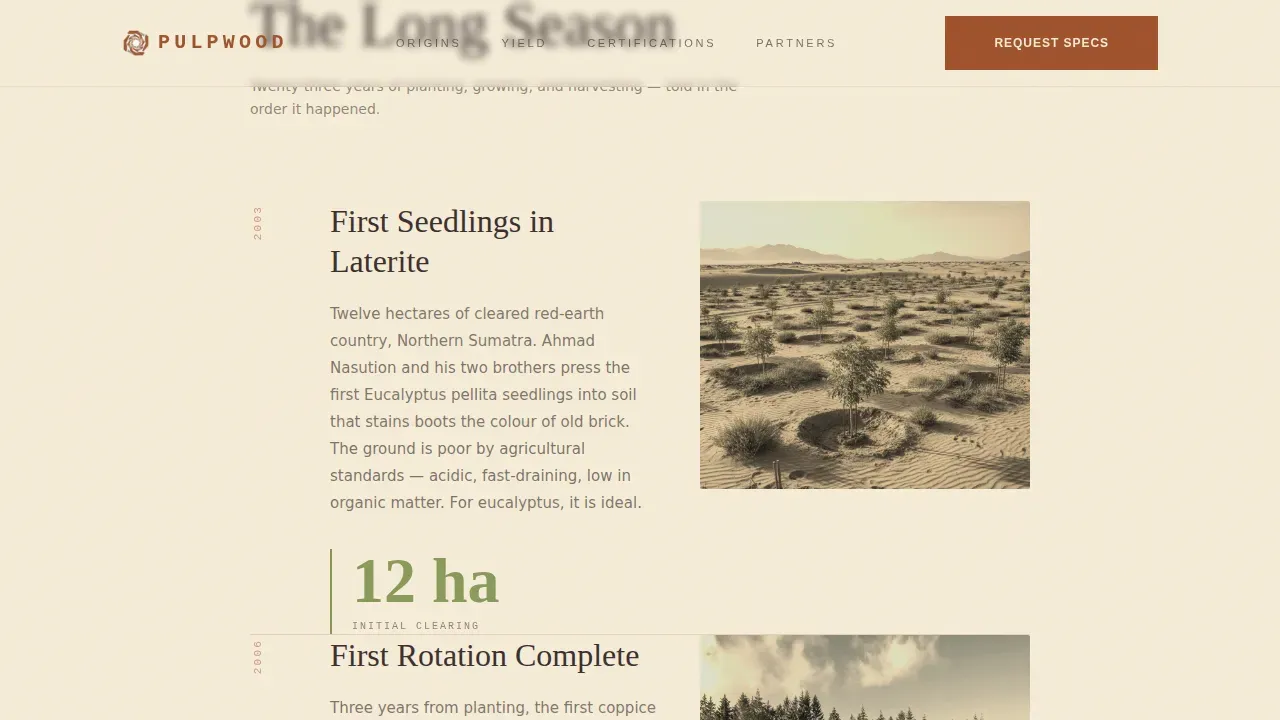
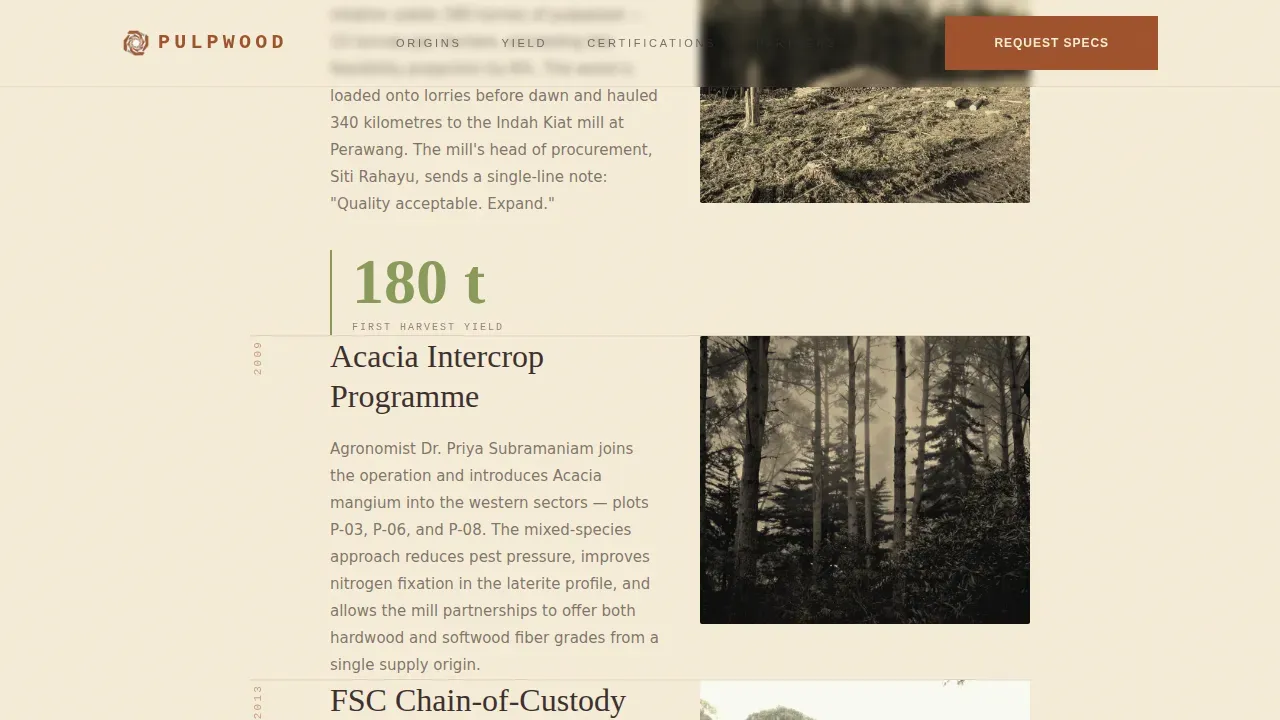
- Chronological origin timeline with year markers, rust rule dividers, and sepia-to-color image transitions
- Animated yield and growth data charts, FSC certification section, mill partnership display, and dual call-to-action placement
Feature list
This template includes purposeful features designed around the real decision-making process of procurement and sustainability teams.
Topographic Map Hero
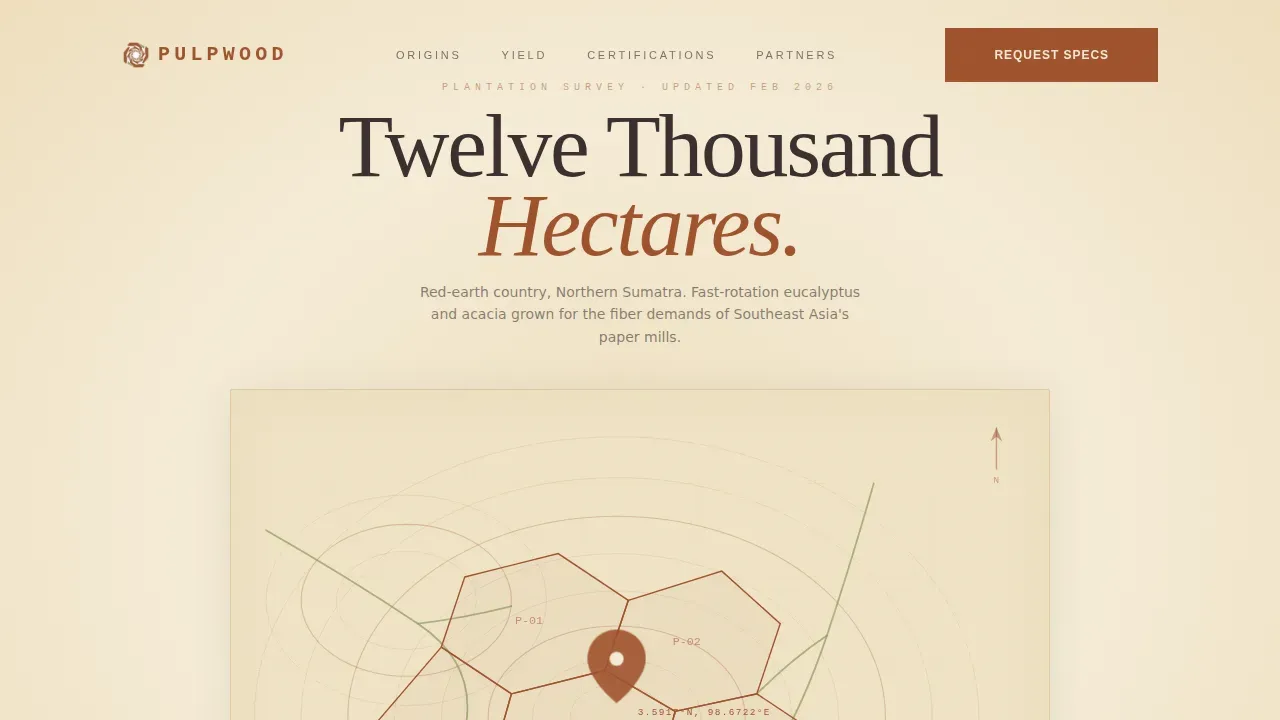
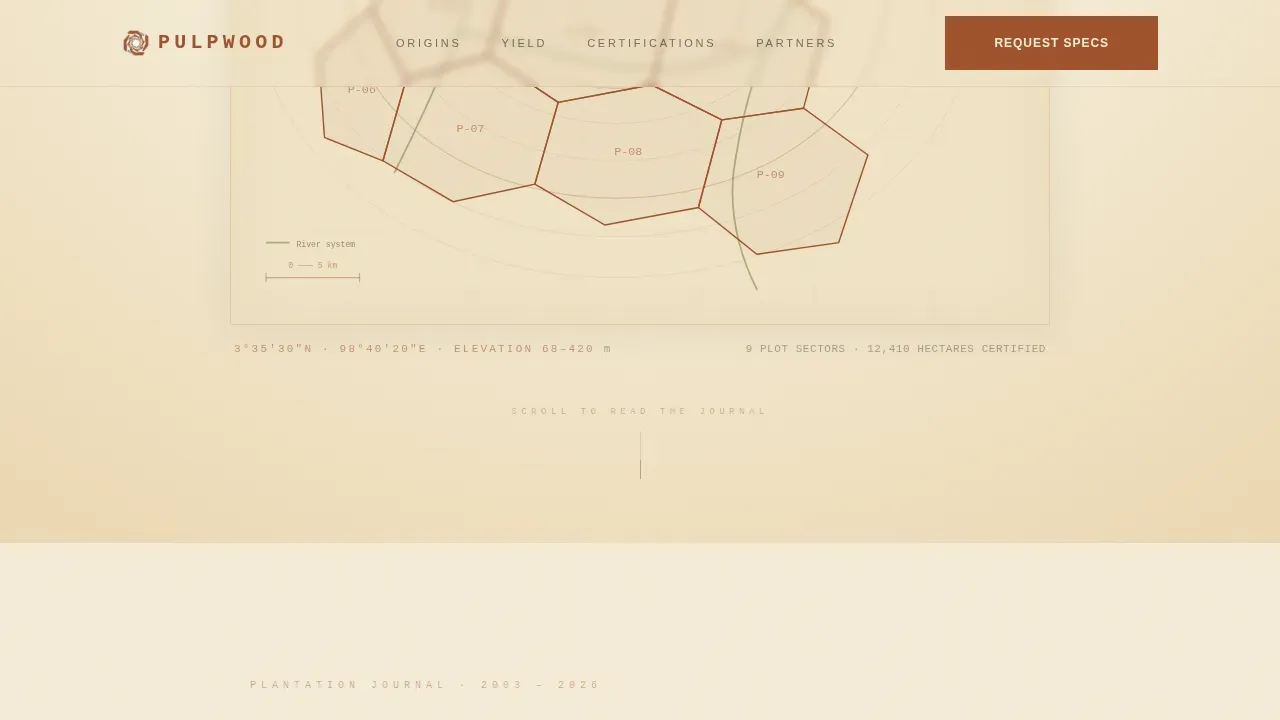
The header renders a hand-illustrated SVG topographic map of the plantation in rust ink on parchment. Concentric elevation lines, river systems in sage, and numbered plot boundaries respond to hover. A pin drops on page load, and GPS coordinates fade in below in a monospaced typeface.
Chronological Origin Timeline
The page scrolls like a plantation journal. Year markers sit in the left margin. Thin rust rules separate each era. Photographs transition from sepia-toned archival images to full-color aerial canopy views as the timeline reaches the present, building credibility through documented history.
Animated Yield and Growth Charts
Current harvest statistics appear as hand-drawn style charts that animate on scroll using GSAP ScrollTrigger. Pulpwood harvests are central to demonstrating plantation productivity, and these charts make that data tangible and memorable for procurement teams reviewing supply options.
FSC Certification and Traceability Section
A dedicated section presents FSC certification numbers, GPS-traceable plot data, and audit trail information. Systematic thinning and selective harvesting practices are documented here, showing that pulpwood harvests serve as planned management operations, not incidental extraction.
Dual Call-to-Action Placement
A rust-colored "Request Supply Specifications" button appears directly after the current-year harvest data section and repeats at the page close. A secondary text link, "Download Plantation Profile (PDF)," sits beneath each button for procurement officers who need a document for internal sourcing memos.
Mill Partnerships Display
Named mill partners across Southeast Asia are listed to provide social proof. Tonnage contract context reinforces supply scale and reliability without requiring the visitor to ask.
Page sections overview
| Section | Purpose |
|---|---|
| Hero Topographic Map | Establish scale, location, and terrain through illustrated cartography |
| Origin Timeline | Build trust chronologically through plantation journal narrative |
| Yield and Growth Data | Present current harvest statistics with animated hand-drawn charts |
| Certifications and Traceability | Display FSC certification, GPS plot data, and audit trail |
| Mill Partnerships | Confirm supply relationships and industrial-scale credibility |
| Primary Call to Action | Drive clicks to gated spec sheet portal after harvest data |
| Closing Call to Action | Repeat request button and PDF download link at page end |
| Footer | Linear single-row footer with essential contact and legal elements |
Design & branding system
The visual identity follows a Pastoral Calm theme built around a Parchment and Rust color system. The aesthetic is deliberately warm and analog, like a deed document left on a farmhouse windowsill.
- Parchment (#F5ECD7) as the dominant background, Rust (#A0522D) for headlines and primary call-to-action elements, Loam (#3B2F2F) for body text, and Sage (#8A9A5B) reserved for data callouts and hover states
- Typography pairs Fraunces serif headlines with DM Sans body text and JetBrains Mono for coordinates and data figures
- No stock photography or drone footage in the hero; illustration-first design communicates land ownership and precision
Mobile & speed optimization
The template is designed desktop-first to match the workstation context of procurement officers, with full mobile support built in throughout.
- Server Components handle static sections for efficient delivery; Client Components manage the animated map and chart interactions
- GSAP ScrollTrigger powers chart draw-on animations, SVG path reveals, image transitions, and cursor-tracking interactions
- All animated elements degrade gracefully on smaller screens without breaking the page's narrative flow
How this template helps you convert
Every design decision is built around moving an industrial buyer from curiosity to a qualified click, without a form on the page itself.
- The topographic map hero communicates scale and location before any copy is read, establishing authority immediately
- The chronological journal scroll makes the buyer feel they have already walked the rows and reviewed the growth data, reducing friction before the call-to-action moment
- The dual placement of the "Request Supply Specifications" button and the PDF download link gives procurement officers two natural exit paths matched to how they actually make sourcing decisions
Other information about this template
This template sits within the Agriculture and Environment category, under the Forestry and Timber subcategory, with a specific focus on the Pulp and Paper Plantation niche.
- Pulpwood harvesting is the primary economic driver for pulp plantations growing fast-rotation monocultures of eucalyptus or acacia; this template is built to communicate that economics clearly to buyers
- A pulpwood pastoral harvest involves cutting smaller, crowded, or lower-quality trees from a stand; sustainable management uses these harvests as thinning operations, allowing high-value trees to grow larger for future harvests
- Thinning improves overall forest health by removing diseased or suppressed trees, enhances biodiversity by opening the canopy for understory growth, and increases carbon storage by allowing remaining trees to sequester more carbon over time
- Carbon sequestration in sustainable practices is maintained because forests are regrown continuously, allowing ongoing carbon dioxide absorption even after harvesting events
- Pulpwood harvest typically targets trees with a diameter at breast height (DBH) of 6 to 9 inches, using smaller or lower-quality material efficiently and reducing waste
- Pulpwood harvesting provides an early income stream for landowners, supporting continued land management and discouraging conversion to agriculture or development
- Environmental risks from large-scale plantations replacing native woodlands with exotic monocultures are a known concern; this template's traceability and certification sections directly address the scrutiny sustainability officers apply to new suppliers
- This pulpwood pastoral harvest pulp plantation landing page template is also discoverable among other forestry and environmental landing page references shared on platforms such as Dribbble, where plantation landing page design inspiration is commonly exchanged
Theme
Pastoral Calm
Creative direction
Origin Story
Color system
Parchment & Rust
Style
Single Column Flow
Direction
Click-Through
Page Sections
Topographic Map Hero with Animation
Chronological Plantation Journal Timeline
Animated Yield and Growth Data Charts
FSC Certification and GPS Traceability Section
Dual Call-to-action with PDF Download
Named Mill Partnerships Display
Related questions
Who is this landing page template designed for?
Does the page include a contact form?
Can I adapt the timeline and yield data sections to my plantation's history?
How does the template handle FSC certification and traceability display?
Is this template suitable for plantations growing species other than eucalyptus?