Automotive OEM Supplier Landing Page Template
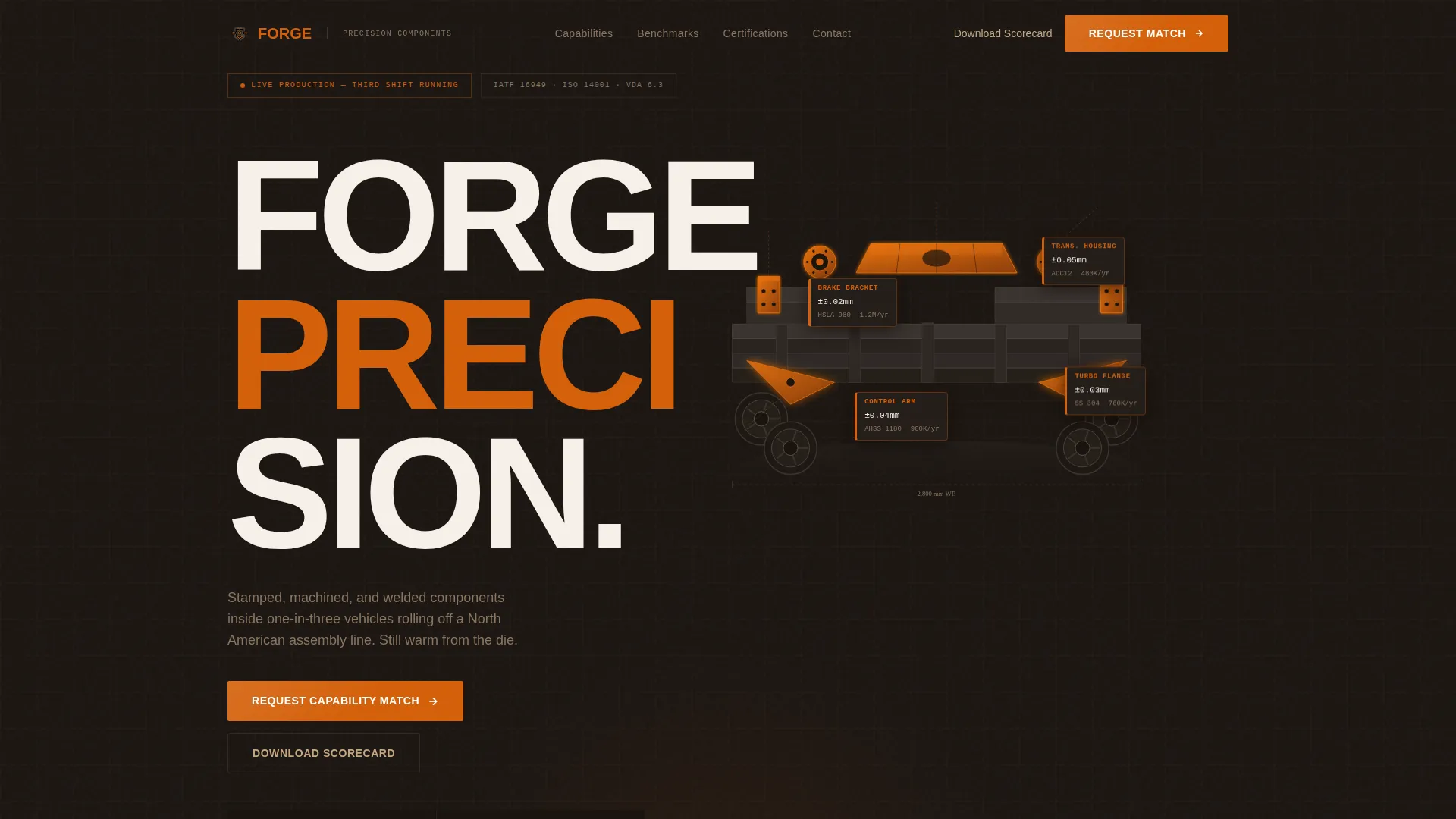
Forge is a precision automotive supplier landing page built for Tier 1 manufacturers. It combines a dark industrial palette with a dashboard-style data grid layout, isometric vehicle illustration, and benchmark-driven content flow. Procurement engineers and plant managers can scan capability specs, compare performance metrics, and submit a quote request or download a supplier scorecard PDF without friction.
by Rocket studio
Quick summary
Forge is a single-page template built for automotive precision parts suppliers. It uses a dark foundry palette, isometric vehicle cutaway header, and a capability comparison grid to present manufacturing specs with authority. The page is designed to move procurement professionals from capability review to quote request in one scroll session.
Who this template is for
This template is built for manufacturers who supply stamped, machined, cast, or assembled components to automotive OEM programs. If your buyers are engineers comparing supplier quotes on a deadline, this layout speaks directly to them.
- Tier 1 precision parts suppliers sourcing new platform programs
- Plant operations teams needing to communicate quality metrics externally
- Automotive contract manufacturers targeting procurement and program buyers
What problem this template solves
Most industrial supplier pages bury the numbers buyers actually need. A procurement engineer comparing three quotes on a Tuesday afternoon does not have time to read paragraphs. They need specs, certifications, and delivery data at a glance.
- Capability data is scattered across PDFs instead of being scannable in one place
- Suppliers lose shortlist consideration because their page offers no benchmark context
- Quality and capacity proof points arrive too late, after the buyer has moved on
What you get with this template
You get a full single-page layout structured like a supplier scorecard that fills itself in as the visitor scrolls. Every section is designed to accumulate evidence before asking for contact details.
- Isometric vector header with exploded vehicle cutaway and component data tags
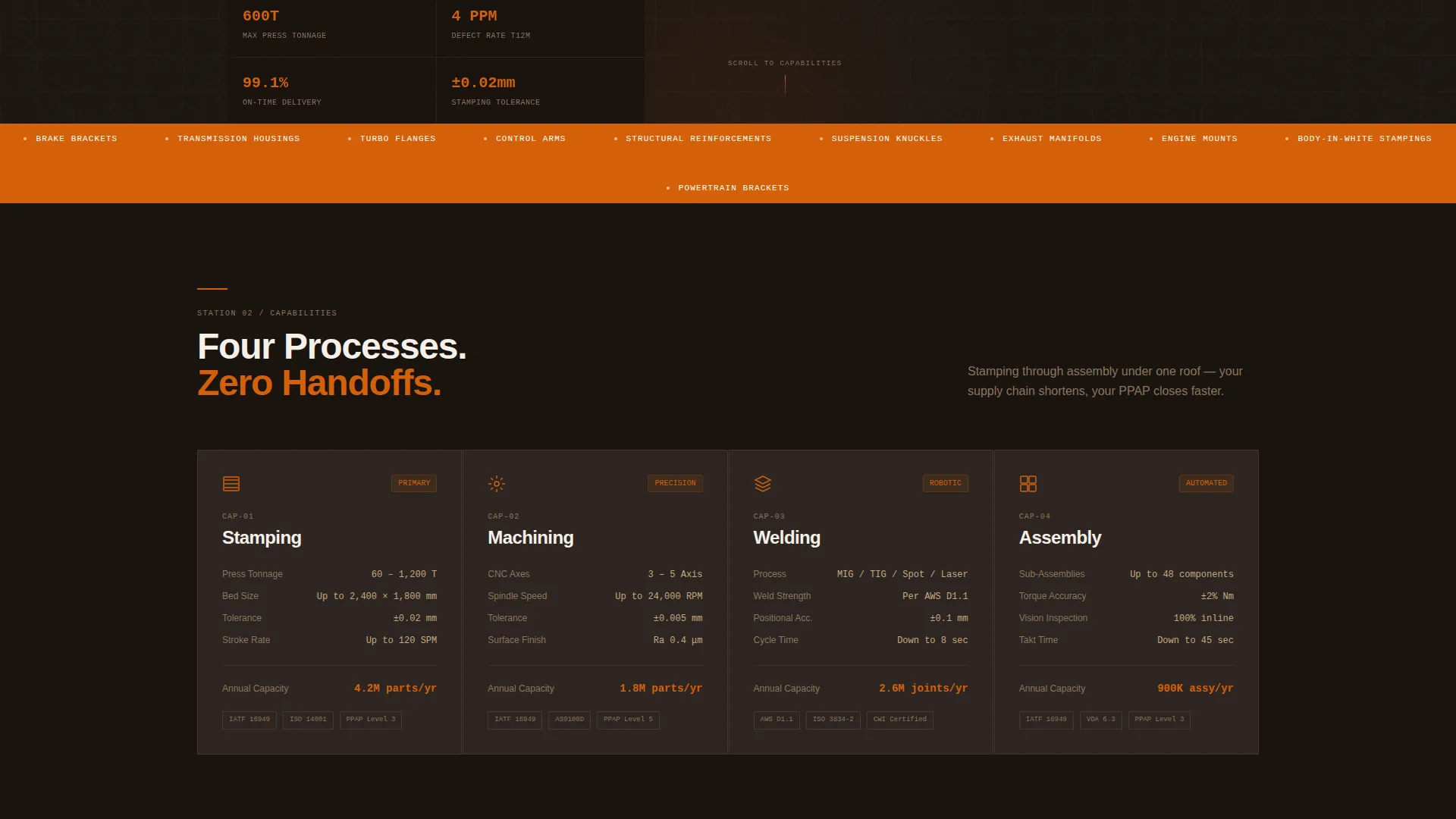
- Capability comparison grid across stamping, machining, welding, and assembly
- Dual conversion paths: a detailed quote request form and a gated scorecard PDF download
Feature list
This template includes a focused set of components built specifically for industrial supplier credibility and comparison-led conversion.
Isometric Vehicle Cutaway Header
The header renders an exploded isometric view of a vehicle platform. Each component the supplier makes is highlighted in molten orange with data tags showing tolerance, material grade, and annual volume. The illustration responds subtly to scroll, keeping the experience mechanical and diagrammatic rather than decorative.
Capability Comparison Grid
Four columns cover stamping, machining, welding, and assembly. Each column contains spec cards with tonnage ranges, tolerance figures down to plus or minus 0.02 millimeters, material certifications, and capacity data. The grid lets buyers compare process capabilities side by side without leaving the page.
Benchmark Data Section
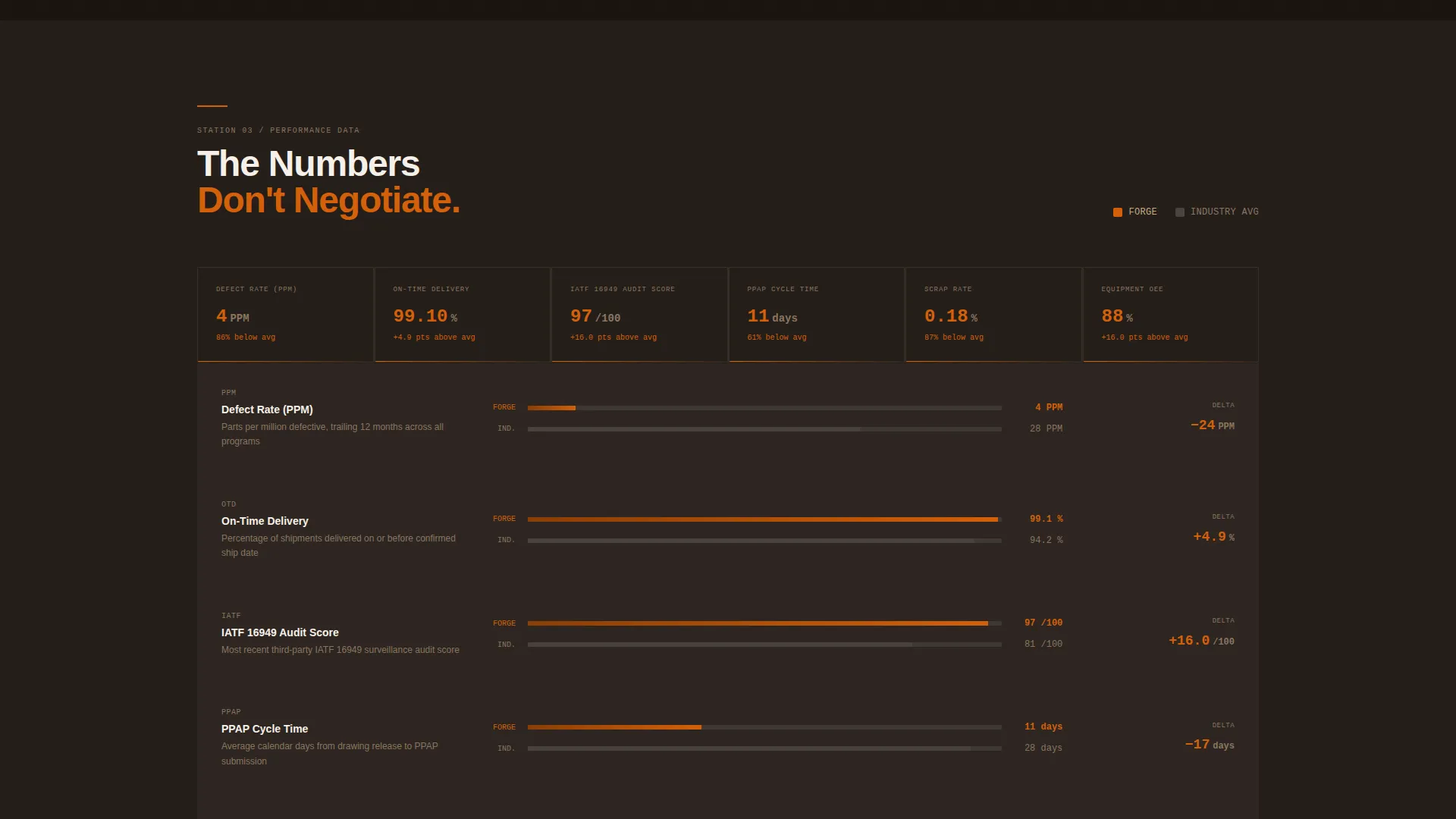
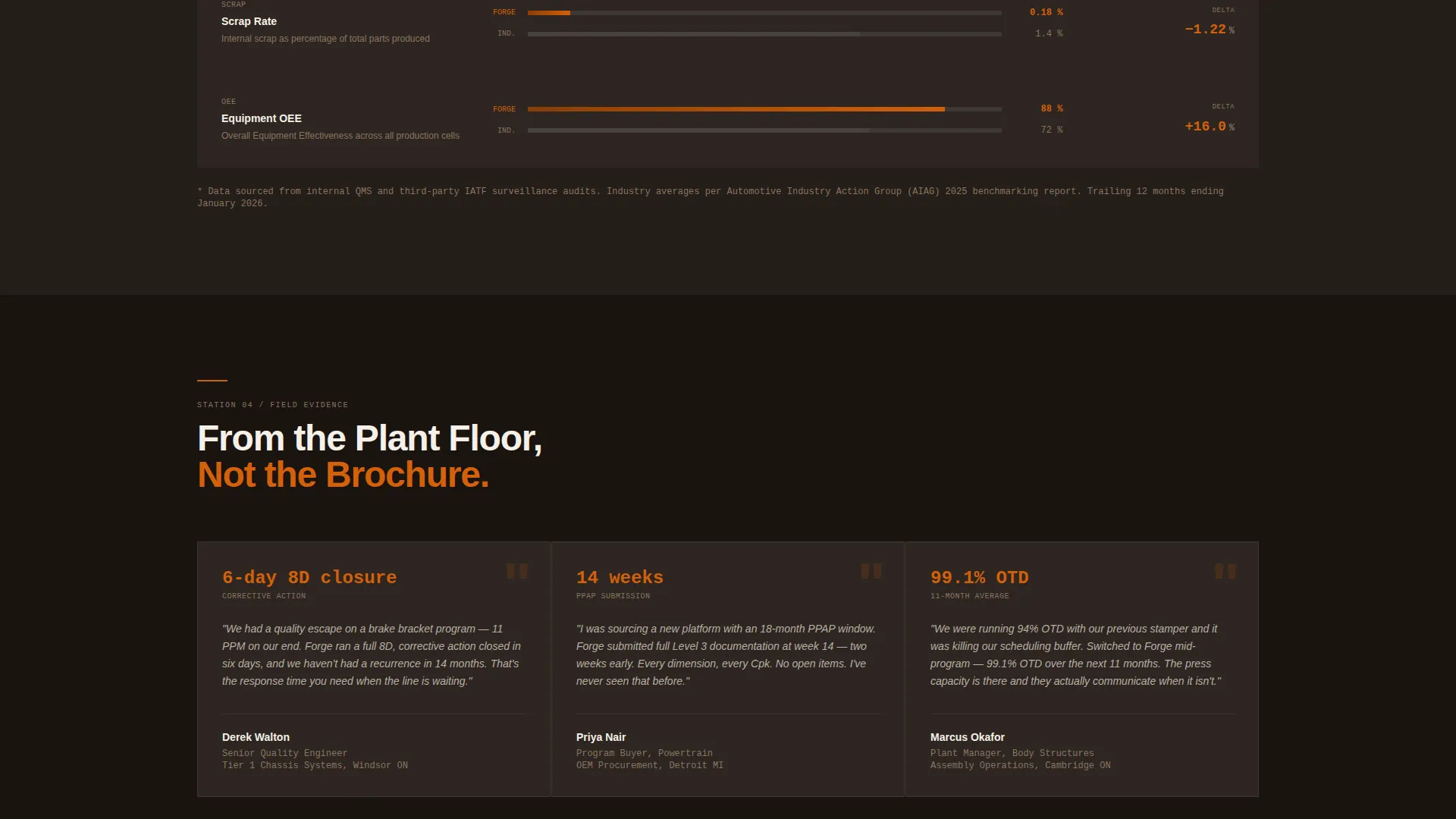
The page moves from broad capability into a head-to-head comparison against industry benchmarks. Metrics include audit scores for quality management system certification, on-time delivery percentages, and average parts-per-million figures over the trailing twelve months. Evidence builds before any call to action appears.
Quote Request Form
The primary conversion form collects part type via dropdown, annual volume range, current supplier pain point, and a drawing upload field. It is positioned after the benchmark grid, where the data has already made the case for engagement.
Scorecard PDF Download Gate
A secondary conversion path captures the procurement engineer who is not ready to quote but needs internal ammunition. Only an email address and company name are required, lowering the barrier for early-stage sourcing research.
Spatial Scroll Architecture
Each scroll section is treated as a distinct room in the facility. White space acts as factory floor between data clusters. The layout tightens from broad capability overview into granular performance evidence as the visitor moves down the page.
Page sections overview
| Section | Purpose |
|---|---|
| Isometric Header | Introduce supplier scope via exploded vehicle diagram with component data tags |
| Capability Grid | Display stamping, machining, welding, and assembly specs in comparable columns |
| Benchmark Comparison | Show audit scores, delivery rates, and PPM data against industry figures |
| Quote Request Form | Capture part type, volume, pain point, and drawing upload from ready buyers |
| Scorecard PDF Gate | Collect email and company name for buyers in early supplier review phase |
Design & branding system
The visual identity follows a Service Utility theme built on a Fire and Earth color system. Every color choice references a physical material from the foundry floor, making the palette feel earned rather than styled.
- Foundry black (#1A1410) as the primary background, forged iron gray (#4A4440) on card surfaces and data containers
- Molten orange (#D4600A) on call-to-action elements and key metric highlights, andite clay (#C4A882) for secondary text and divider lines
- No lifestyle photography or stock imagery; the isometric geometry and data grid carry all visual weight
Mobile & speed optimization
The dashboard grid layout adapts for smaller screens without losing the data hierarchy that procurement engineers rely on. Spec cards and comparison columns restack cleanly so critical figures remain readable on any device.
- Capability grid columns collapse to a vertically stacked card format on mobile viewports
- Data tags on the isometric header remain legible at reduced sizes
- The quote form and scorecard gate maintain clear tap targets and field labels across screen sizes
How this template helps you convert
The page is structured as a Comparison and Versus conversion flow. Buyers are shown the numbers before they are asked for anything in return.
- The benchmark grid places your quality and delivery data directly alongside industry reference points, giving procurement engineers the comparison context they need to build an internal business case.
- The dual-path conversion design captures buyers at two stages: ready-to-quote visitors use the detailed request form, while earlier-stage researchers opt in for the scorecard PDF with minimal friction.
Other information about this template
Forge is a strong fit for suppliers preparing for a new platform launch or re-qualifying on an existing program. The layout is purpose-built for the automotive manufacturing segment and reflects the documentation-heavy, evidence-first buying process common in OEM supplier selection.
- The template style is Dashboard and Data Grid, suited for displaying structured manufacturing data clearly
- Creative direction is Spatial and Architectural, using scroll depth to simulate moving through a production facility
- The header concept is Isometric, using clean vector geometry instead of photography for a technical, diagrammatic feel
- The landing page direction is Comparison and Versus, positioning the supplier against benchmarks before requesting any contact information
Theme
Service Utility
Creative direction
Spatial & Architectural
Color system
Fire & Earth
Style
Dashboard/Data Grid
Direction
Comparison/Versus
Page Sections
Isometric Vehicle Cutaway Header
Capability Comparison Grid
Benchmark Performance Section
Quote Request Form with Drawing Upload
Gated Scorecard PDF Download
Spatial Scroll Architecture
Related questions
Who is the primary audience for this template?
What are the two conversion paths included in the template?
Can I replace the placeholder metrics with my own performance data?
Does the template use photography or stock imagery?
Is this template suitable for a supplier preparing for a new program launch?