Web3 Developers Community Blog Website Template
Forge is an editorial magazine landing page template built for a Web3 developers mastermind group. It combines a parallax user-generated content photo wall, scroll-reveal manifesto sections, magazine-style member profiles with inline code snippets, cohort stat cards, and a sticky call-to-action bar, all styled in an analog-warm, editorially precise layout designed to turn curious visitors into cohort applicants.
by Rocket studio
Quick summary
Forge is a single-page editorial template for a Web3 developers mastermind community. It opens with a mosaic photo wall and a bold serif headline, then guides the reader through a manifesto, real member profiles, cohort data cards, and a sticky conversion bar. The tone is quietly intense, like sitting down at a long table full of people who are actually building.
Who this template is for
This template is built for community founders, cohort organizers, and developer advocates who run structured peer groups for mid-level Web3 builders. It is the right fit if your offer sits somewhere between a course and a community, something with real accountability, real output, and a small committed group.
- Founders running cohort-based mastermind programs for Solidity or smart contract developers
- Web3 community leads who need a landing page that earns trust before asking for a signup
- Developer advocates launching structured peer accountability circles for protocol builders
What problem this template solves
Mid-level Web3 developers face a specific kind of stall. They have completed tutorials, bridged testnet tokens, and read the documentation, but they hesitate when real stakes arrive. Most landing pages for developer communities look like SaaS marketing. That disconnect loses the exact person you are trying to reach.
- Generic community pages fail to speak to developers who are technically literate but conversion-skeptical
- Course-style layouts undersell the peer accountability and live-audit value of a mastermind format
- There is no standard template that pairs editorial depth with developer-specific social proof like deployment timestamps and code snippets
What you get with this template
The template delivers a full single-page editorial layout that reads like a magazine feature and converts like a focused landing page. Every section is purposeful. Every design decision points toward one outcome: getting the right developer to click "See the Next Cohort."
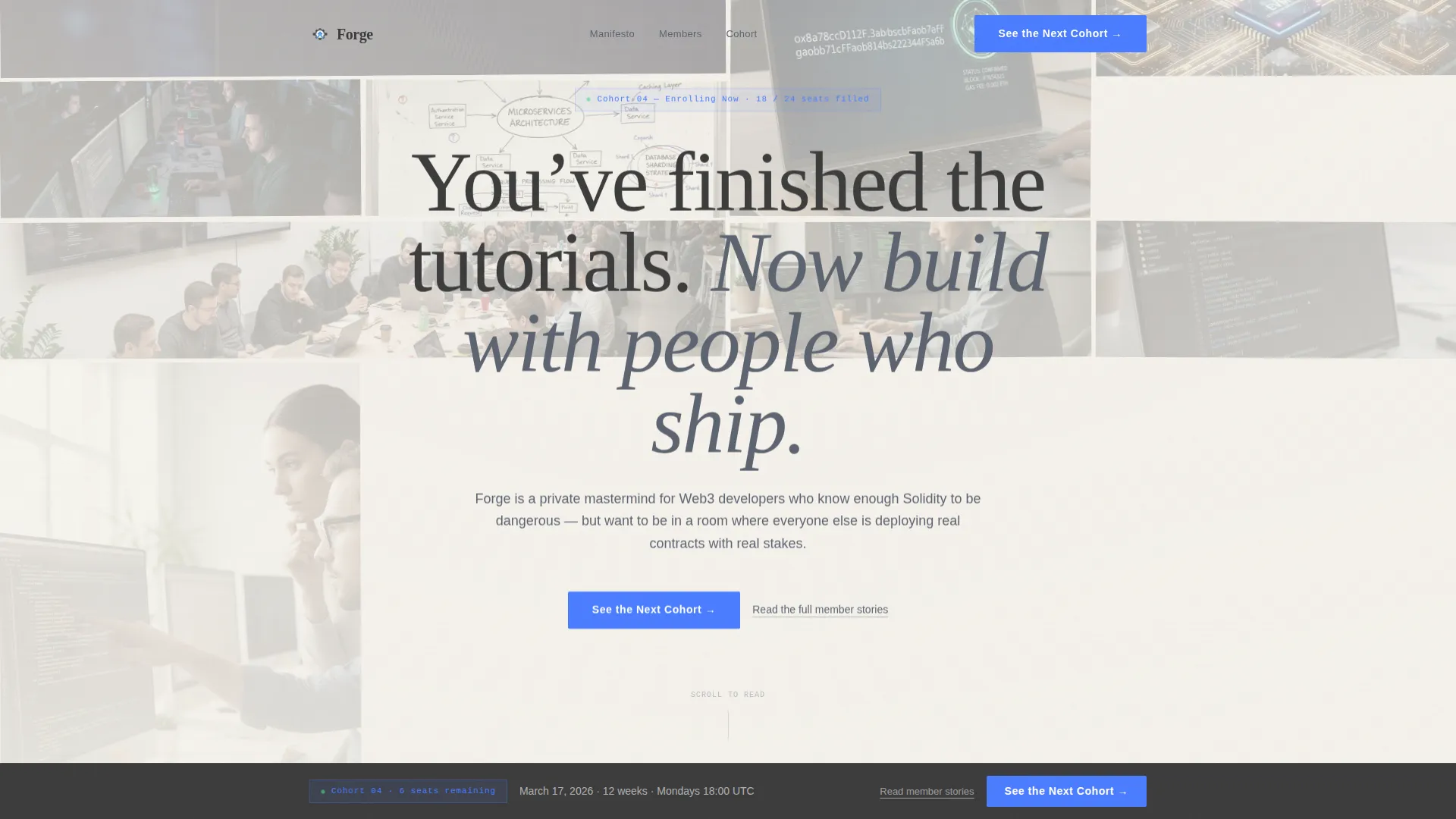
- A parallax user-generated content photo wall hero with a large editorial serif headline and scroll depth
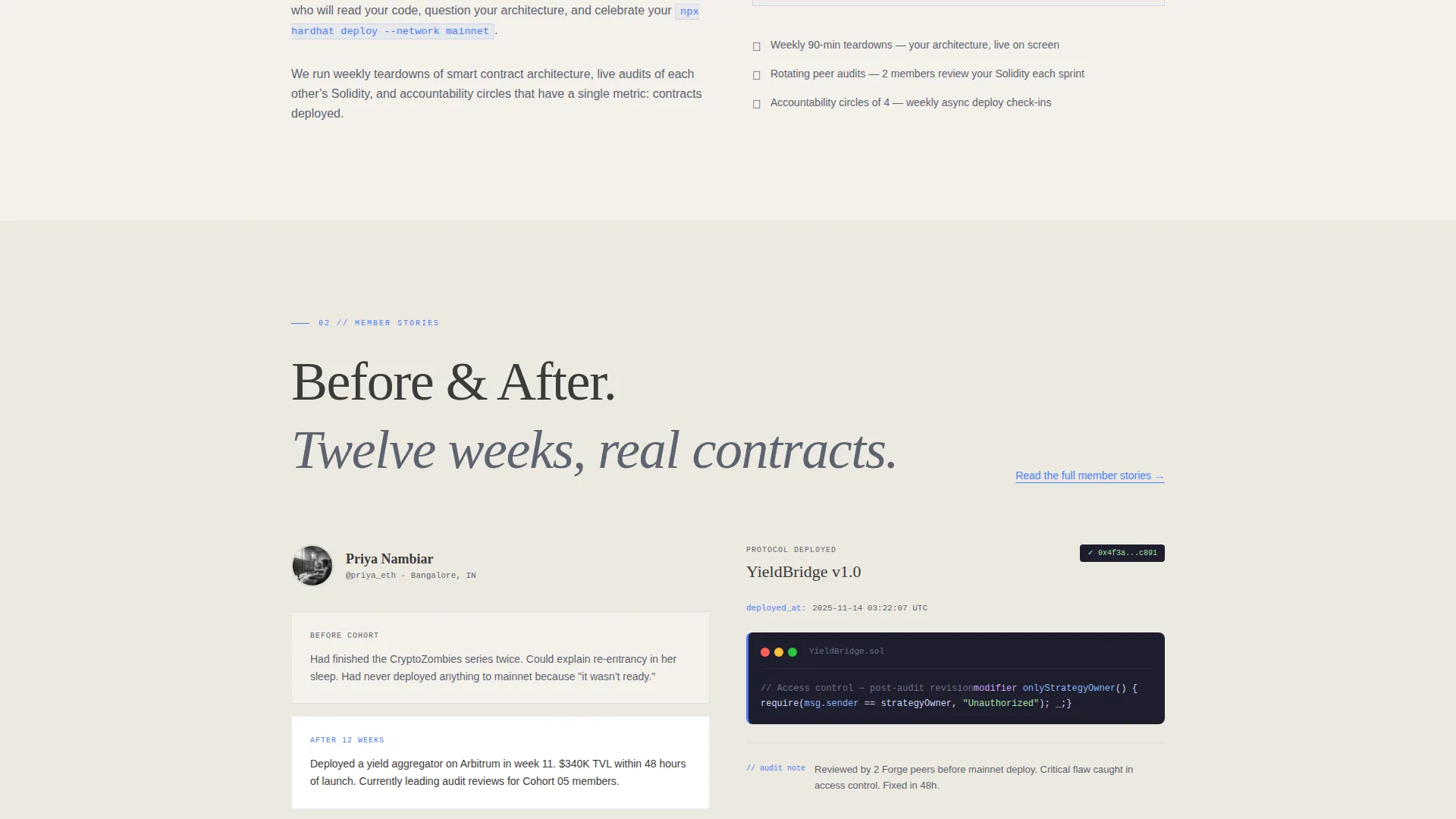
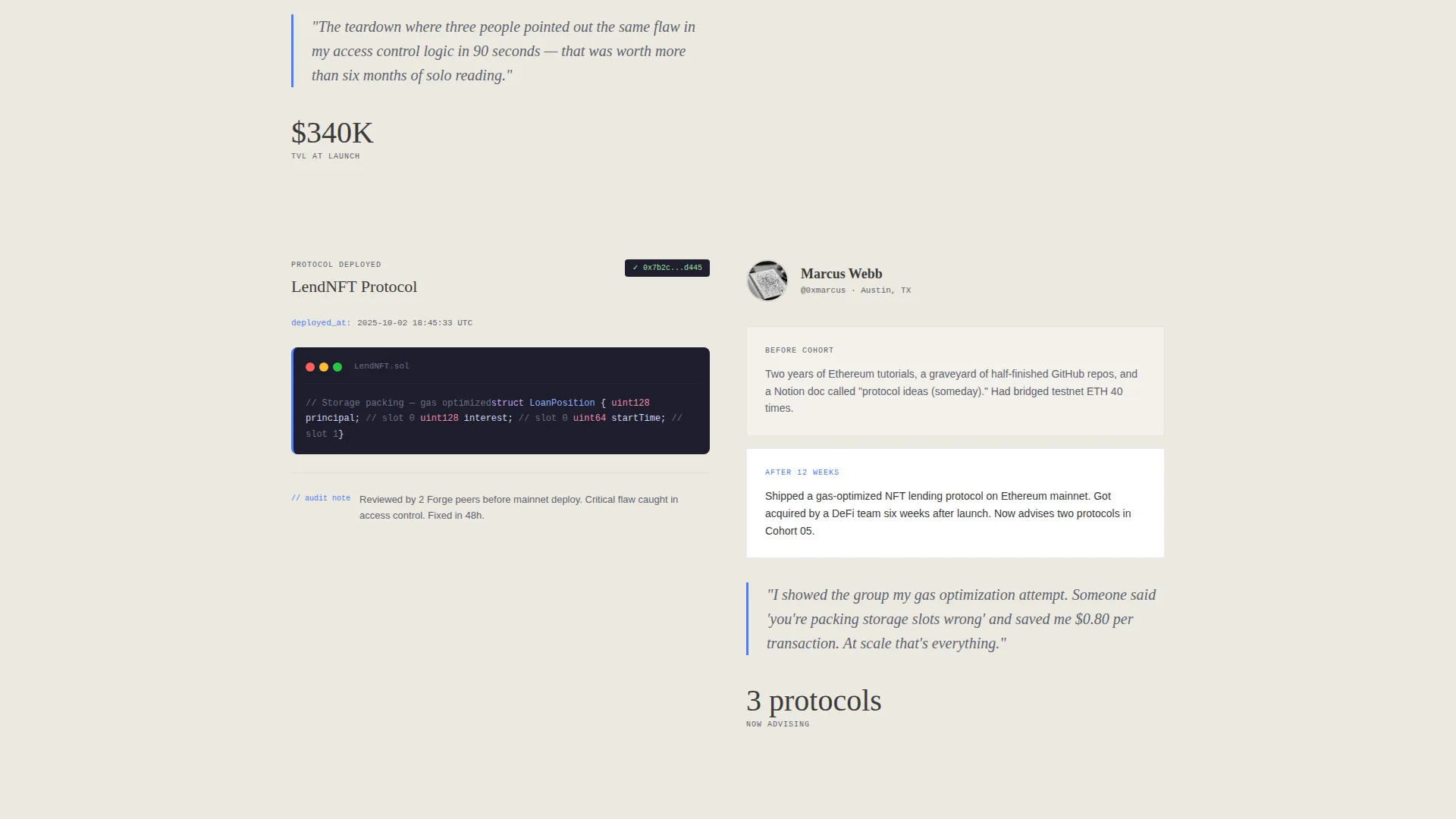
- Magazine-spread member profile sections with pull quotes, inline code blocks, and deployment timestamps
- Cohort stat data cards, a sticky bottom conversion bar, and a scroll-triggered call-to-action system
Feature list
Parallax UGC Photo Wall Hero
The hero section uses a mosaic grid of real member screenshots and photos, terminal windows, handwritten architecture diagrams, Etherscan confirmations, and 2 AM commit selfies. The wall parallax-scrolls behind a single large serif headline, creating editorial depth without visual noise.
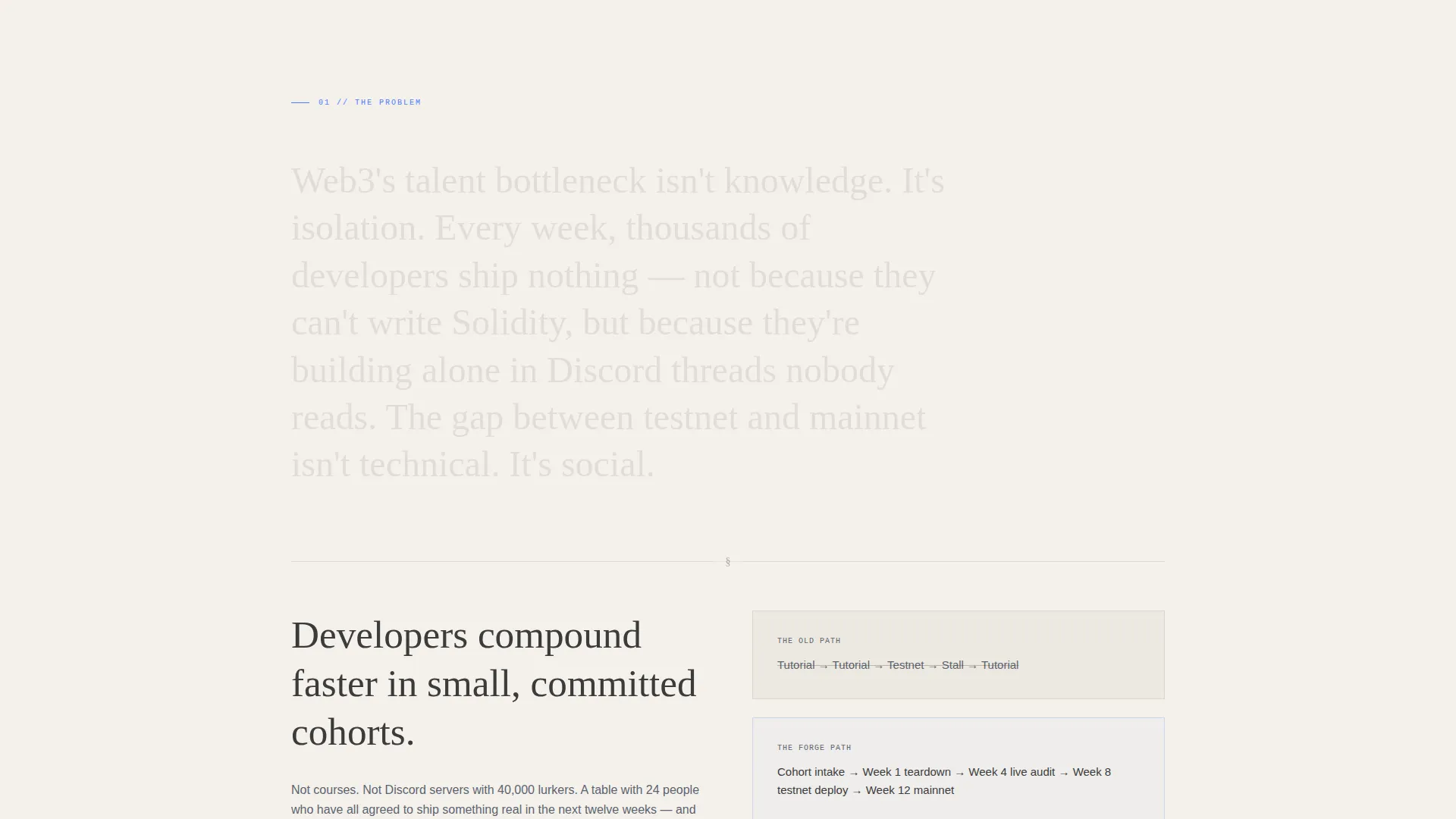
Scroll-Reveal Manifesto Section
A full editorial longform section unfolds as the reader scrolls. It opens with the problem, isolation as Web3's real talent bottleneck, and builds toward the thesis that small committed cohorts compound developer output faster than solo work or passive Discord threads.
Magazine-Spread Member Profiles
Three member profiles are each laid out like a magazine feature spread. Each profile includes a pull quote, inline code snippets from actual contracts, and a deployment timestamp showing the before-and-after trajectory from solo side-project builder to mainnet deployer.
Cohort Stats Data Cards
Tight data cards display key cohort proof points, contracts deployed, audits completed, protocols launched. Counter animations bring the numbers to life on scroll, giving the section a dynamic, verifiable feel without overloading the reader.
Sticky Conversion Bar and call to action System
The primary call-to-action button, "See the Next Cohort," appears after the member profiles and again in a sticky bottom bar that activates after the reader scrolls past the stats. A secondary text link, "Read the full member stories," gives curiosity-driven visitors a path deeper before they commit.
Editorial Typography and Code Styling
The template uses Fraunces for editorial serif headings, DM Sans for clean body text, and JetBrains Mono for inline code blocks. Code snippets inside member profiles are styled in the protocol blue accent color, making them visually distinct and immediately readable.
Page sections overview
| Section | Purpose |
|---|---|
| Hero Photo Wall | Mosaic parallax grid with editorial headline |
| Manifesto Problem Block | Scroll-reveal isolation thesis editorial |
| Member Profile Spreads | Magazine layout with code snippets and timestamps |
| Cohort Stats Cards | Animated data proof cards for social proof |
| Next Cohort call to action | Primary conversion section with cohort details link |
| Sticky Bottom Bar | Persistent call-to-action after stats scroll |
| Footer | Linear single-row footer with minimal links |
Design & branding system
The visual identity follows an Educational Guide theme expressed through a Cloud Canvas color palette. The overall feeling is an analog Moleskine notebook sitting open beside a terminal window, warm, legible, and precise without being flashy.
- Colors: soft cumulus white (#F4F1EB) background, pencil-sketch graphite (#3B3B3B) body text, chalkboard slate (#5C6370) secondary headings, and protocol blue (#4A7CFF) for links, buttons, and code blocks
- Typography: Fraunces serif for editorial headlines, DM Sans for body copy, JetBrains Mono for all inline code and technical elements
- Visual texture: slightly uneven image sizes and saturation in the photo wall give a corkboard, handmade quality; no stock photography and no over-polished user interface
Mobile & speed optimization
The template is built desktop-first, reflecting the reality that the target audience, developers working at laptops, will primarily encounter it on larger screens. Responsive breakpoints adapt the layout cleanly for mobile without sacrificing editorial quality.
- Server components handle all static content sections, keeping initial load lightweight for text-heavy editorial blocks
- Client components are scoped specifically to animated elements: the parallax photo wall, GSAP ScrollTrigger reveals, counter animations, and the magnetic call-to-action button
- The sticky bottom bar and hover states on member cards are handled as client-side interactions without affecting the performance of static sections
How this template helps you convert
The conversion flow is designed to earn the click rather than demand it. Every section builds emotional and rational trust before a signup prompt appears.
- The member profile spreads show visitors a version of themselves, developers who were stuck in the same place, then reveal what changed after twelve weeks in the cohort, making the offer feel like a logical next step rather than a pitch.
- The sticky bottom bar ensures the primary call-to-action stays reachable after the reader has consumed the evidence, catching high-intent visitors at the exact moment they are ready to act.
Other information about this template
This template is part of the Community and Nonprofit category, specifically designed for the Web3 developers community subcategory and the Web3 developers mastermind group niche. It carries an intersection match score of 13, indicating a highly specific alignment between the template design system and the target audience.
- The creative direction follows a Movement and Cause approach, the scroll reads like a manifesto, building a cause around closing the gap between Web3 learners and Web3 builders
- The header concept is a user-generated content photo wall, a deliberate choice to signal authenticity over polish to a developer audience that is skeptical of marketing
- Animation is handled via GSAP ScrollTrigger for parallax, scroll-linked reveals, counter animations, and a magnetic call-to-action button
- The template style is Editorial Magazine, and the theme is Educational Guide, an unusual pairing that gives the page both the credibility of a long-form editorial and the warmth of a learning-focused resource
- Localization is set to English with USD pricing references and a global Web3 community audience in mind
Theme
Educational Guide
Creative direction
Movement & Cause
Color system
Cloud Canvas
Style
Editorial/Magazine
Direction
Click-Through
Page Sections
Parallax UGC Photo Wall Hero
Scroll-reveal Manifesto Editorial
Magazine-spread Member Profiles
Animated Cohort Stats Cards
Sticky Conversion Bar and Dual Call to Action
Editorial Typography with Code Styling
Related questions
Can I customize the member profiles with my own cohort members?
Is this template suitable if I am just launching my first cohort?
What happens when a visitor clicks the primary call-to-action button?
Does the sticky bottom bar appear as soon as the page loads?
Can this template be adapted for developer communities outside of smart contract development?