Specialist Agricultural Equipment Manufacturing Comparison Website Template
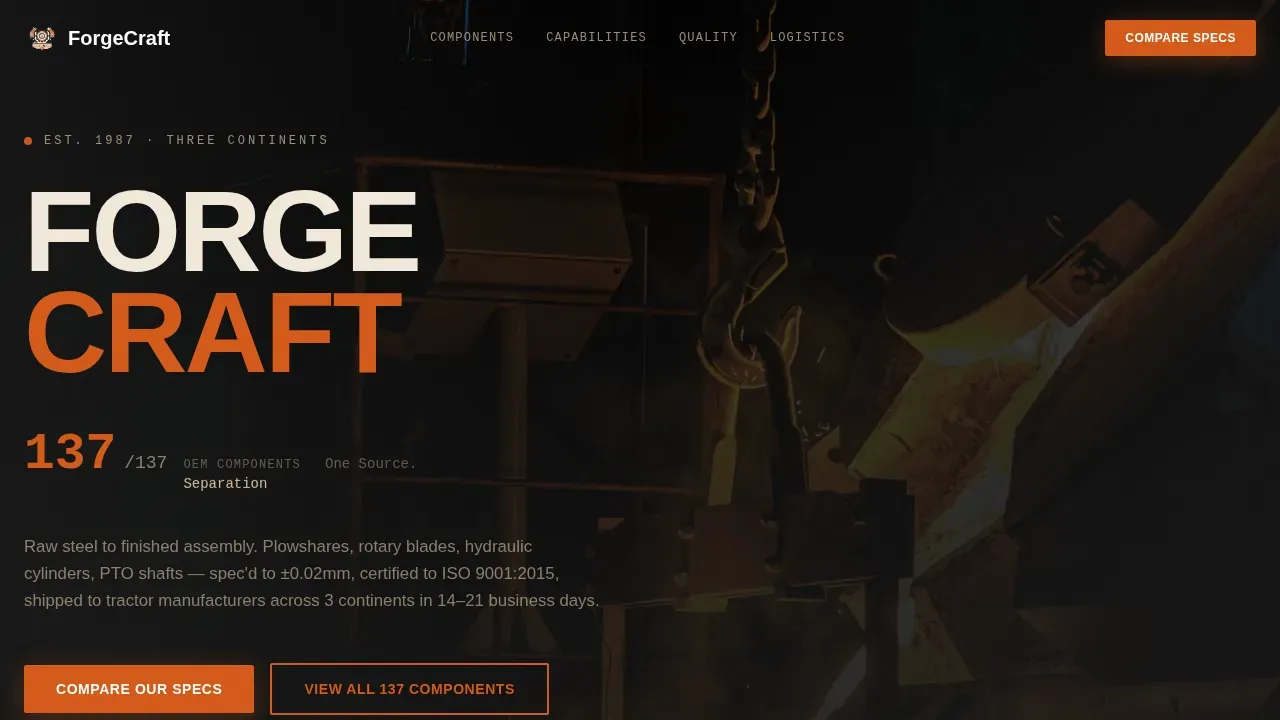
Forgecraft is a card grid landing page built for agricultural equipment OEM suppliers. It displays raw material certifications, CNC tolerance data, quality control rejection rates, and logistics lead times across layered card modules. A combine harvester infographic anchors the hero, and a sticky comparison tool gives procurement managers the verified specs they need to make confident purchasing decisions.
by Rocket studio
Quick summary
Forgecraft is a single-page, modular card grid template designed for agricultural equipment OEM suppliers. It leads with a technical infographic, walks visitors through each stage of the forging process, and closes with a sticky comparison tool. Every section prioritizes verified data over sales copy, earning trust before asking for contact.
Who this template is for
This template is built for industrial B2B suppliers who manufacture forged components, machined assemblies, and replacement spare parts for agricultural machinery. The audience is not casual browsers. They are specialists who read spec sheets before they read headlines.
- Procurement managers at tractor manufacturers who need to verify alloy steel grades, surface finish ratings, and lead times before raising a purchase order
- Regional dealer network directors sourcing replacement assemblies and spare parts for active fleets across multiple territories
- Agricultural co-op engineers specifying custom power take-off shafts, connecting rods, steering knuckles, and tie rod ends for next-season equipment builds
What problem this template solves
Procurement managers and engineers lose confidence in a supplier the moment they cannot find real numbers. Most supplier pages hide rejection rates, gloss over production schedules, and bury lead times in a PDF that requires a sales call to access. That opacity costs deals. Buyers move on to whoever publishes the data first.
- Inconsistent supply chains create quality issues and delay production lines, especially when raw materials sourcing is opaque and cast parts specs are unverified
- Supply chain delays in casting and forging industries stretch manufacturing cycles to six months or longer, making published lead times a critical purchasing signal
- Engineers require detailed capability data, surface quality ratings, and tolerance ranges to evaluate a supplier before committing to full scale production volumes
What you get with this template
This template gives you a complete, data-forward landing page that mirrors a precision parts catalog. Every row of cards peels back one layer of the manufacturing journey, from raw materials intake to global logistics dispatch. The layout is desktop-first, built for procurement teams reviewing specs on workstations.
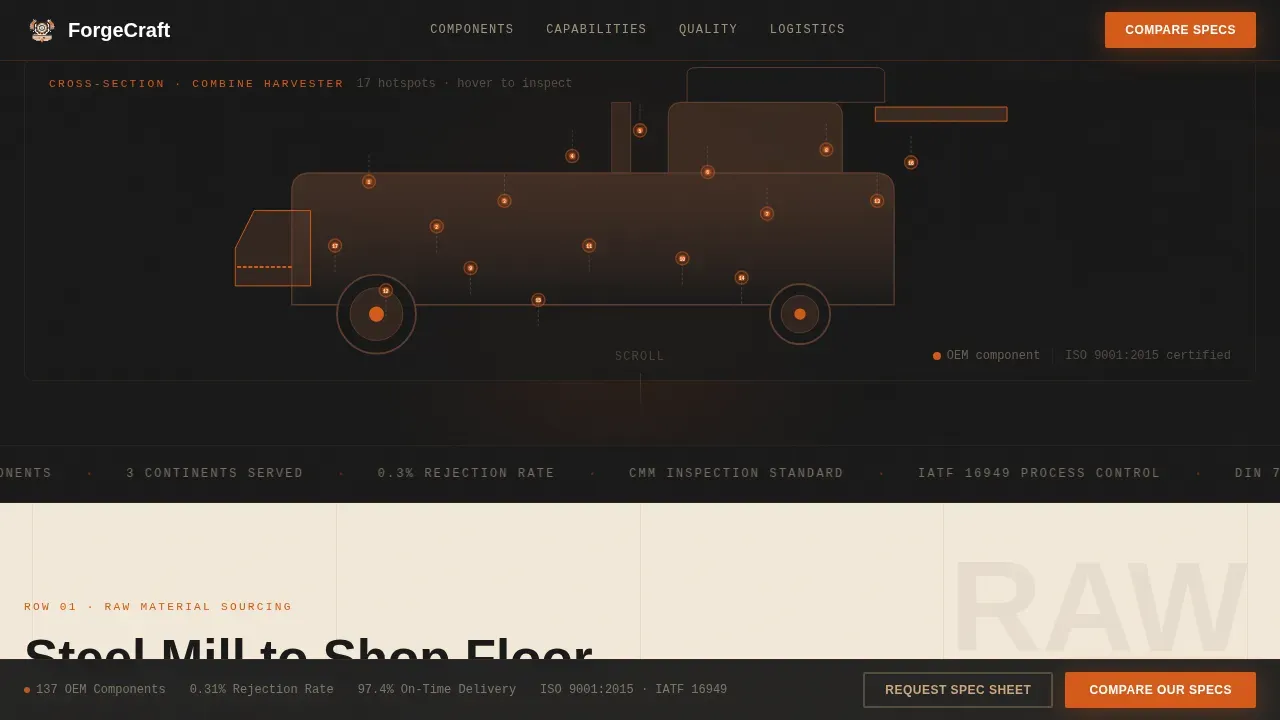
- A full-width combine harvester infographic hero with seventeen interactive hotspots, each displaying micro-specs such as tensile strength, material grade, and annual production volume
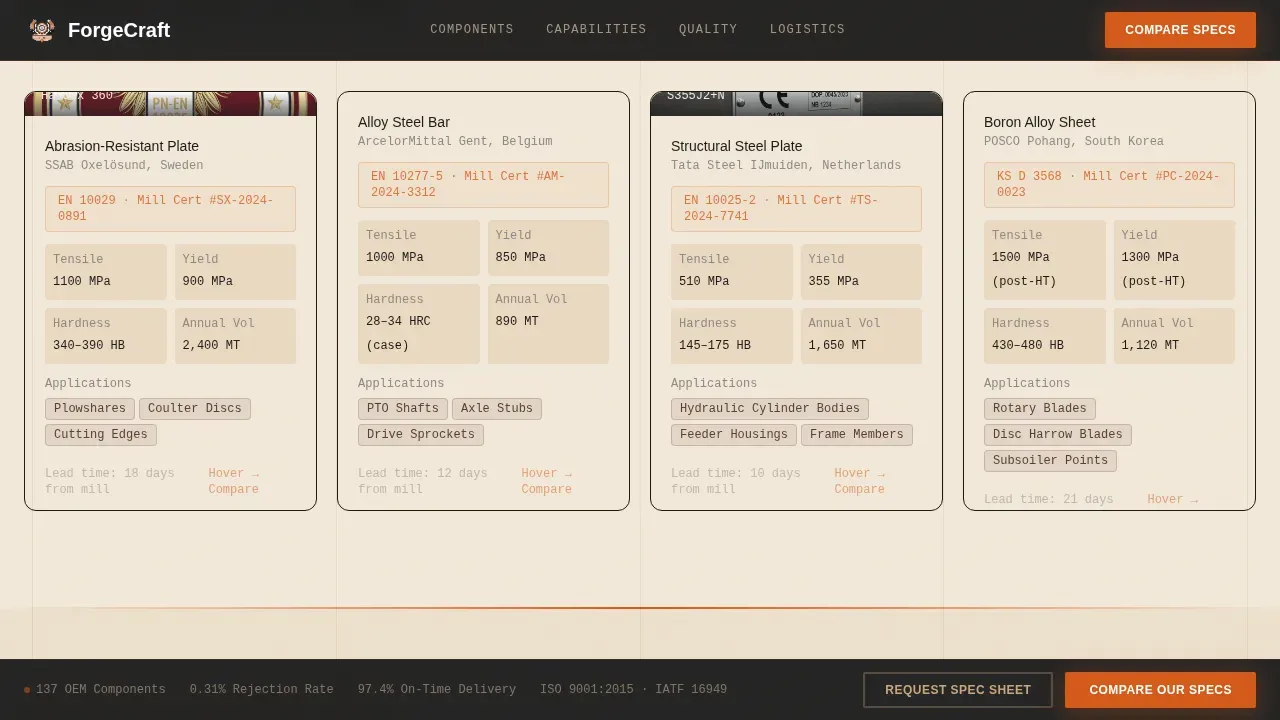
- Four rows of flip cards covering raw material sourcing, machining and fabrication, quality control inspection, and logistics with port locations and lead-time calendars
- A sticky bottom bar anchoring the primary call to action, plus a two-column comparison tool and a custom spec sheet request form with fields for part number, annual volume, and delivery region
Feature list
This section describes the core built-in capabilities of the Forgecraft template as defined in the design brief.
Combine Harvester Infographic Hero
The above-the-fold area features a full-width technical cross-section of a combine harvester. Seventeen numbered hotspots connect to forged components this supplier manufactures. Each hotspot displays callout lines with micro-specs: tensile strength values, metal grade classifications, and annual production volume figures. A counter at the top ticks through part categories, reading "137 OEM Components. One Source." The illustration is rendered in the Fire and Earth palette with a subtle grain texture, giving it the warmth of a kraft-paper printed parts catalog while staying technically precise.
Modular Flip-Card Grid
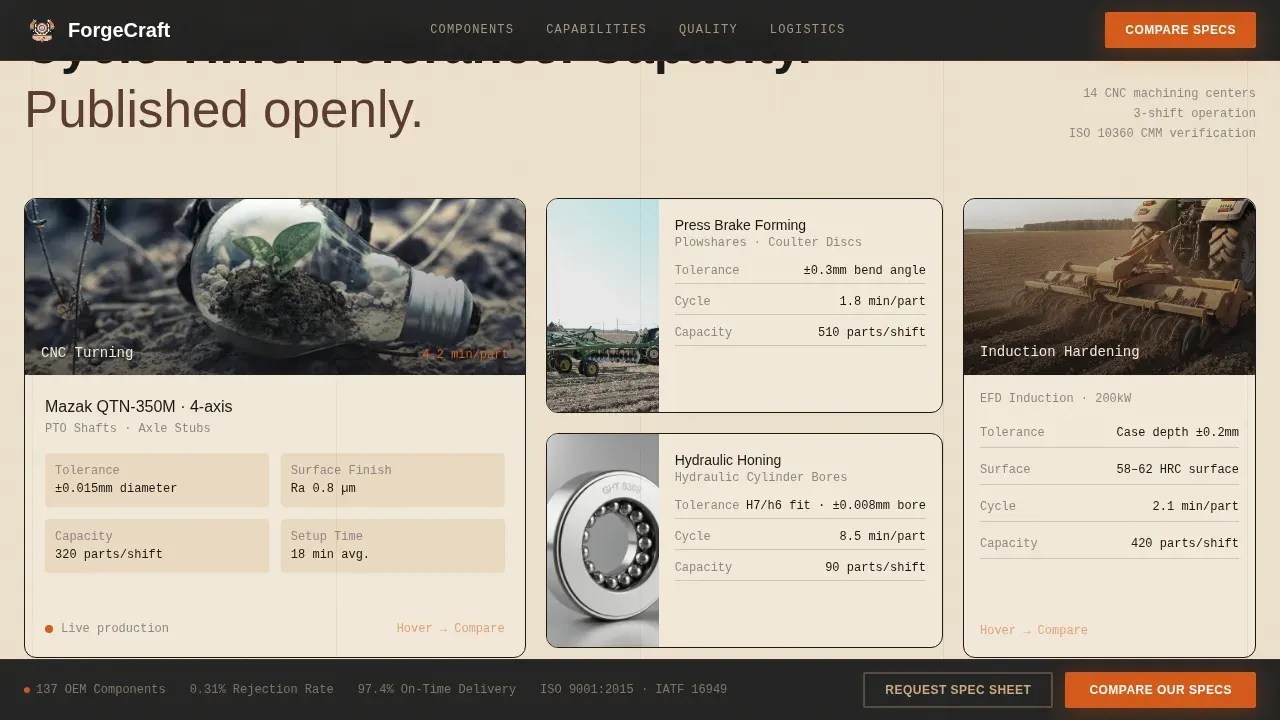
Four rows of modular cards carry the Transparent Process narrative from raw materials to delivery. Row one shows steel mill certifications and alloy steel sourcing data. Row two displays machining and fabrication cards with CNC tolerance ranges and cycle-time figures. Row three presents quality control data, including rejection rates, coordinate measuring machine (CMM) inspection photography, and ISO certification stamps. Row four covers logistics with port locations, lead-time calendars, and packaging cross-sections. Every card flips on hover to reveal a side-by-side comparison: this supplier's numbers versus published industry averages.
Sticky Comparison Tool Bar
A sticky bottom bar follows the scroll across the entire page. The primary call to action, "Compare Our Specs," anchors the bar. Clicking opens a two-column comparison modal where visitors select a competitor category such as cast quality, delivery window, minimum order quantity (MOQ), or warranty terms. The modal displays this supplier's verified data against published industry benchmarks, with no editorializing. The forging process data shown is real, not rounded or softened for marketing purposes.
Custom Spec Sheet Request Form
A secondary conversion path offers "Request a Custom Spec Sheet." The form requests only essential information: part number or description, annual volume estimate, and delivery region. This minimalist structure keeps the form accessible at any stage of the purchasing cycle, from early supplier evaluation through to deep-funnel quote requests. Engineers can submit a blueprint file for complex geometries that require custom hot forging or precision machining.
Fire and Earth Visual System
The entire layout uses a four-color system grounded in forge and farmland imagery. Furnace orange (#D45A1B) drives primary action elements and data callouts. Plowed-soil brown (#5C3D2E) provides secondary accent. Kiln-black (#1A1A1A) governs typography and card borders. Sun-dried clay (#C8A882) fills the warm neutral background. Typography pairs Manrope for headings and data labels with IBM Plex Mono for specs, tolerances, and numeric values, keeping the industrial editorial aesthetic consistent across every card and section.
Staggered Animation and Interactivity Layer
Card reveals use staggered animation to guide the eye through the manufacturing journey without overwhelming the viewer. The hero counter ticks through component categories on load. Hotspot tooltips open on click to surface micro-specs inline. Shimmer effects highlight data cells during the comparison modal interaction. Interactive elements use client-side rendering while static content sections use server components to maintain performance balance across the page.
Page sections overview
| Section | Purpose |
|---|---|
| Hero Infographic | Introduce 137 OEM components via a cross-section combine harvester diagram with 17 hotspot callouts |
| Raw Materials Row | Display steel mill certifications, alloy steel grades, and sourcing data on flip cards |
| Machining and Fabrication Row | Show CNC tolerance ranges, cycle-time data, and precision machining capability cards |
| Quality Assurance Row | Present rejection rates, CMM inspection photos, and ISO certification stamps |
| Logistics and Delivery Row | Cover port locations, lead-time calendars, and packaging specification cross-sections |
| Sticky Comparison Bar | Anchor the primary call to action and open the two-column spec comparison modal |
| Custom Spec Form | Capture part number, volume, and delivery region for qualified lead conversion |
| Footer | Linear single-row pattern with brand and contact information |
Design & branding system
The visual identity follows a Service Utility theme, designed to feel functional and unapologetic. Every design choice earns its place by doing a job: directing attention, surfacing data, or building confidence in the supplier's capabilities. Nothing decorative survives that does not also work.
- Color system: furnace orange (#D45A1B) for calls to action and data highlights, plowed-soil brown (#5C3D2E) for accents, kiln-black (#1A1A1A) for typography and borders, and sun-dried clay (#C8A882) as the warm neutral background across all card modules
- Typography: Manrope for headings and data display, IBM Plex Mono for specifications, tolerance values, and numeric outputs, maintaining a parts-catalog aesthetic throughout
- Texture and illustration: the hero infographic uses subtle grain texture rendered on a kraft-paper-style surface, blending technical precision with forge-and-farmland warmth
Mobile & speed optimization
The template is designed desktop-first, matching how procurement managers and engineers typically review supplier specs on workstations. However, mobile responsiveness is maintained to support purchasing officers who research on tablets or phones between site visits. The layout adapts card grids and comparison tools to narrower viewports without losing data legibility.
- Static content sections use server components for efficient delivery, while interactive elements such as flip cards, the comparison modal, and hotspot tooltips use client-side rendering
- Staggered reveal animations and shimmer effects are calibrated at a medium intensity, ensuring visual engagement without creating performance drag on data-heavy card rows
- The sticky comparison bar and spec sheet form remain accessible and usable across all screen sizes, keeping the primary conversion path available throughout the full scroll
How this template helps you convert
B2B buyers in industrial purchasing value verifiable data over sales claims. This template is structured to show data first and ask for contact second. By the time a procurement manager reaches the call to action, they have already reviewed rejection rates, tolerance specifications, and lead times that most competitors would never publish.
- The infographic hero establishes immediate relevance above the fold, surfacing production volume figures and component categories in the first seconds of the visit, reducing bounce before a single card is read
- The four-row flip-card grid builds trust progressively, matching the way engineers evaluate a supplier: raw materials first, then machining capability, then quality assurance, then logistics reliability, each stage reinforcing customer satisfaction before the next begins
- The sticky comparison tool removes the final objection by letting visitors measure this supplier's published data against industry benchmarks on their own terms, making the decision to request a custom spec sheet feel like a conclusion, not a leap of faith
Other information about this template
The Forgecraft precision OEM parts supplier landing page template draws on established principles from precision forging applications and industrial supply chain management. The card grid layout reflects how procurement teams actually evaluate a new supplier: sequentially, by evidence, and with skepticism toward anything unverifiable.
- Precision forging commonly uses carbon steel, alloy steel, stainless steel, and aluminum. Carbon steel suits high-volume forging because of its strength and cost profile. Alloy steel handles extreme stress and high-temperature environments. Aluminum serves aerospace and automotive applications where a strong strength-to-weight ratio reduces component mass and supports fuel efficiency targets.
- The forging process refines the internal grain structure of metal, delivering superior mechanical properties including improved fatigue resistance and tensile strength. Hot forging in particular enables the production of forged components with complex geometries and tight dimensional tolerances, often within 0.1 mm to 0.3 mm, reducing the need for post-process machining.
- Precision forged critical parts such as connecting rods, steering knuckles, and tie rod ends are widely used across automotive and agricultural industries because they deliver the durability and performance requirements that cast parts cannot consistently match. The forging process yields superior surface quality compared to many casting alternatives, and forged components typically demonstrate better fatigue resistance in high-cycle applications.
- Supply chain challenges in casting and forging industries are well-documented. Raw material lead times for high-grade materials are tightening due to geopolitical pressures and shifting demand. Supply chain delays that extend manufacturing cycles create real costs for OEM production schedules. This template addresses that buyer anxiety directly by putting lead-time calendars, sourcing certifications, and logistics data front and center.
- 3D printing and additive manufacturing are reshaping how OEMs think about printed parts and spare parts inventory. Additive manufacturing can significantly reduce lead times for low-volume critical parts by enabling on-site production without physical inventory. OEMs can upload part designs to a digital warehouse for customers to purchase licenses to 3D print parts, supporting complex geometries through technologies such as Selective Laser Sintering (SLS), Stereolithography (SLA), and Fused Deposition Modeling (FDM). This template can support messaging around both traditional forged components and digitally enabled printed parts within its card grid layout.
- Industries including aerospace, automotive, oil and gas, and large-scale agricultural equipment manufacturing all rely on reliable forging and machining supply chains. Ensuring safety at full scale production demands that every supplier demonstrate engineering expertise, rigorous quality control, and seamless integration with the buyer's production schedules.
- The global leader position in agricultural OEM supply is earned through transparency, not claims. This template is built on that principle: show the data, publish the numbers, and let procurement teams reach the conclusion themselves. For companies looking for a cost effective solution to communicating manufacturing credibility, global logistics capability, and extreme precision tolerances in a single-page format, this template provides the structure to do it.
- The gold standard for industrial supplier pages is verifiable specificity. This template is designed to meet that standard by making every card, every flip reveal, and every comparison modal earn the click that follows it.
Theme
Service Utility
Creative direction
Transparent Process
Color system
Fire & Earth
Style
Card Grid (Modular)
Direction
Comparison/Versus
Page Sections
Combine Harvester Infographic Hero
Four-row Flip-card Grid
Sticky Comparison Tool Bar
Custom Spec Sheet Request Form
Fire and Earth Visual Identity
Staggered Animation and Interactivity Layer
Related questions
Who is this landing page template built for?
What sections are included in the template?
Does the template include a comparison tool?
What materials and forging types does the template content reference?
Can this template support both traditional forging and additive manufacturing messaging?