Bauhaus Architecture Blog Website Template
A storybook landing page for Bauhaus interior designers who lead with restraint and earn every client through craft. The template builds a full editorial scroll experience, moving visitors from an empty room to a completed interior while serving two conversion paths: a fixed consultation tab with a three-field form, and a PDF lookbook capture for early-stage prospects still gathering inspiration.
by Rocket studio
Quick summary
This is a single-page editorial landing page built for a Bauhaus interior design studio. It uses a scroll-linked room-building narrative, a collage hero, and a monochrome steel palette with selective yellow accents. Two conversion paths capture both ready-to-commit clients and early-stage visitors browsing for inspiration.
Who this template is for
This template is designed for interior designers and studios working within the Bauhaus tradition. It suits practices that position their work through restraint, geometric clarity, and editorial confidence rather than trend-driven portfolios.
- Creative directors and architects aged roughly 35 to 55 who furnish loft offices or restore mid-century apartments
- Art collectors seeking residential spaces curated to gallery-level precision
- Interior design studios that need a lead-generation page capable of qualifying clients through taste rather than budget
What problem this template solves
Generic portfolio sites force Bauhaus-influenced studios into layouts built for maximalist decoration. The result is a mismatch: the design philosophy is minimalist and principled, but the presentation feels cluttered and unconvincing. This template solves that gap directly.
- It removes decorative noise and lets the work carry the argument, mirroring the studio's own design values
- It provides two structured conversion paths so studios capture both consultation-ready leads and early-stage prospects in one page
- It frames the designer's point of view editorially, building trust before asking for a click
What you get with this template
You get a complete storybook landing page structured around a cinematic scroll narrative. Every section has a defined role: from the collage hero through the room-building journey to the final consultation call to action.
- A fixed consultation tab that expands into a focused three-field form covering project type, approximate square footage, and an open-ended brief prompt
- A PDF lookbook capture module titled "Principles Before Palette" for visitors still in the inspiration phase
- An asymmetric bento grid for selected works with material annotations, editorial pull-quotes, and an ultra-minimal footer
Feature list
This section covers the core built-in capabilities the template delivers out of the box.
Scroll-Linked Room-Building Narrative
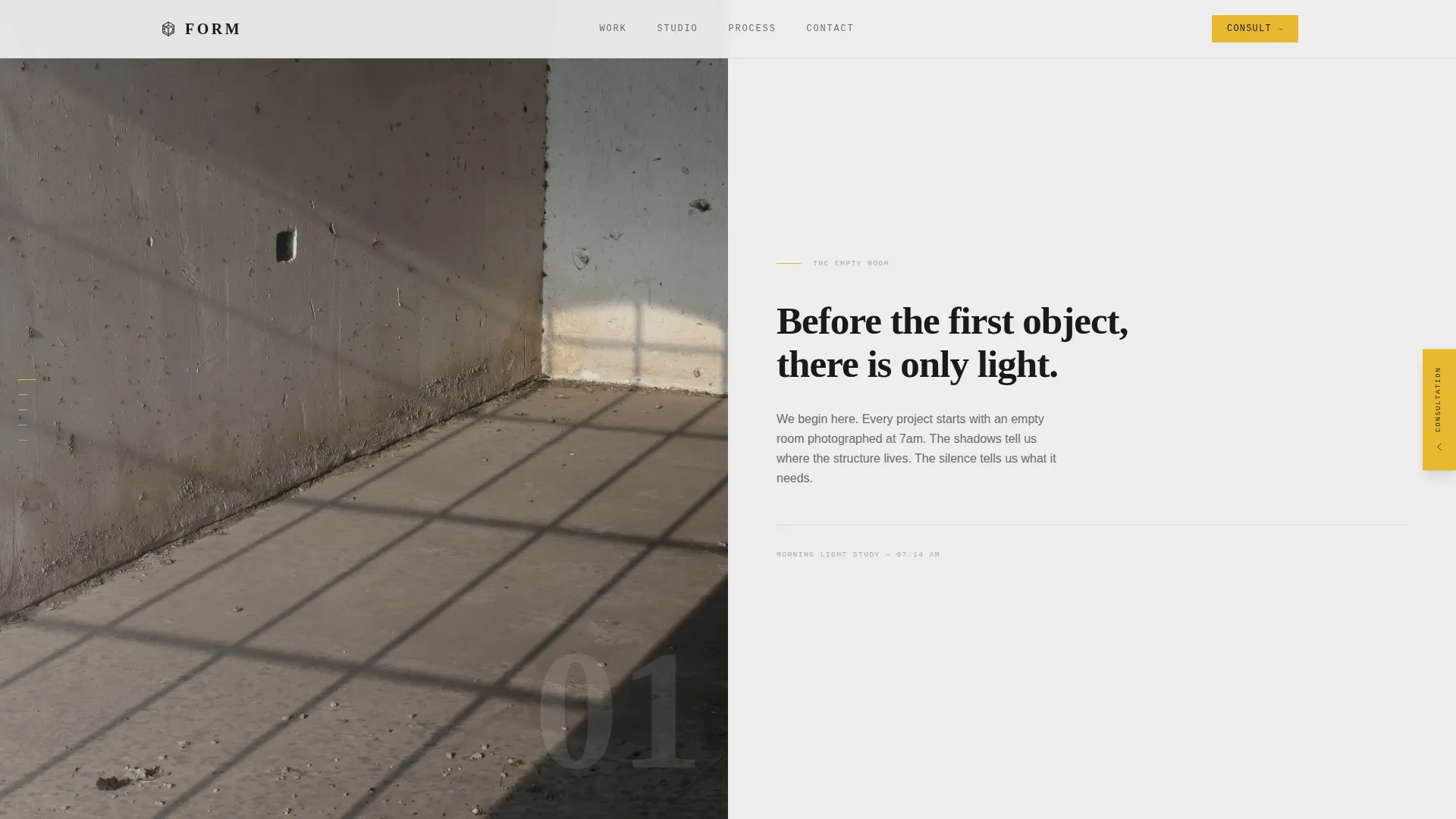
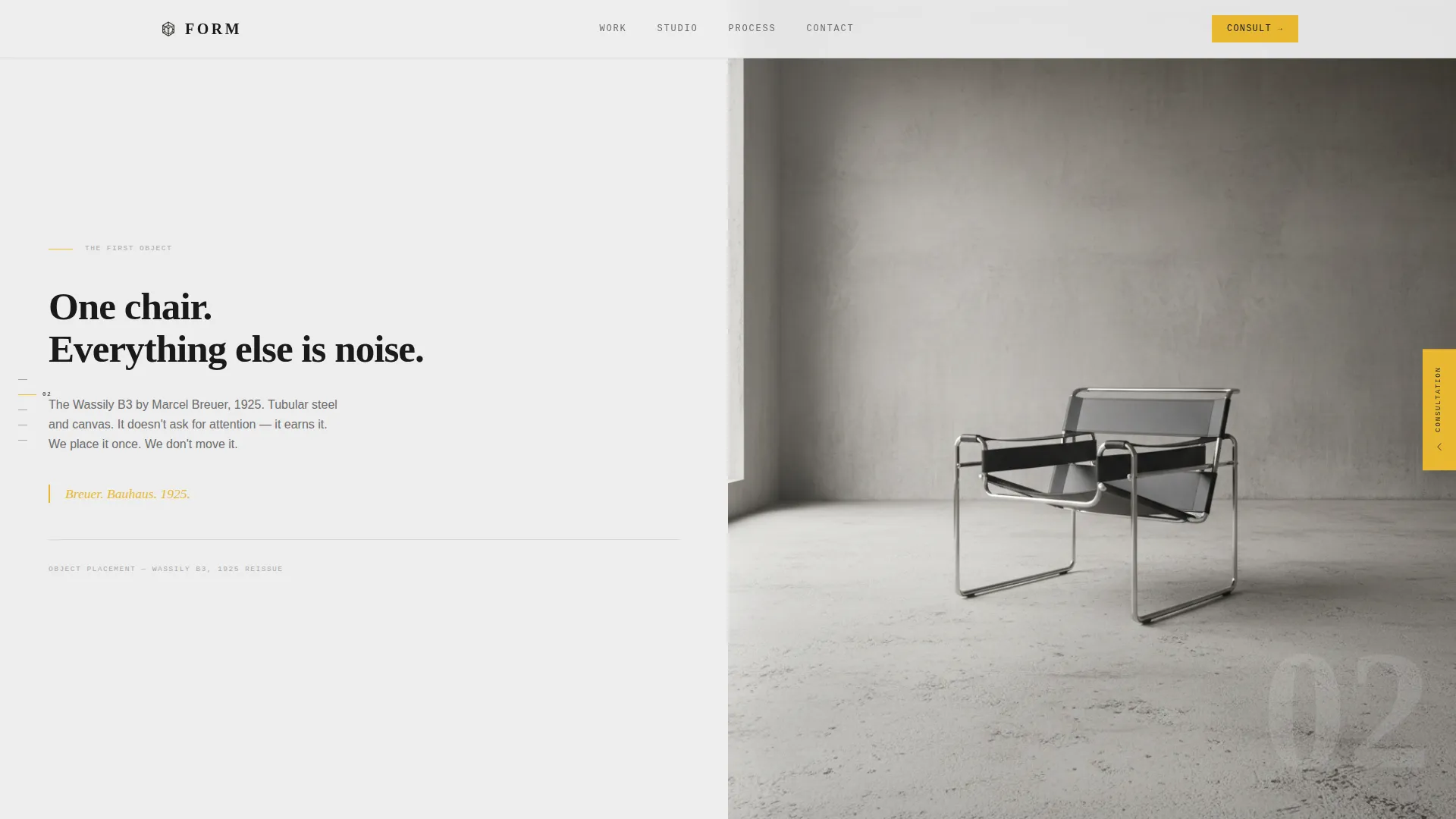
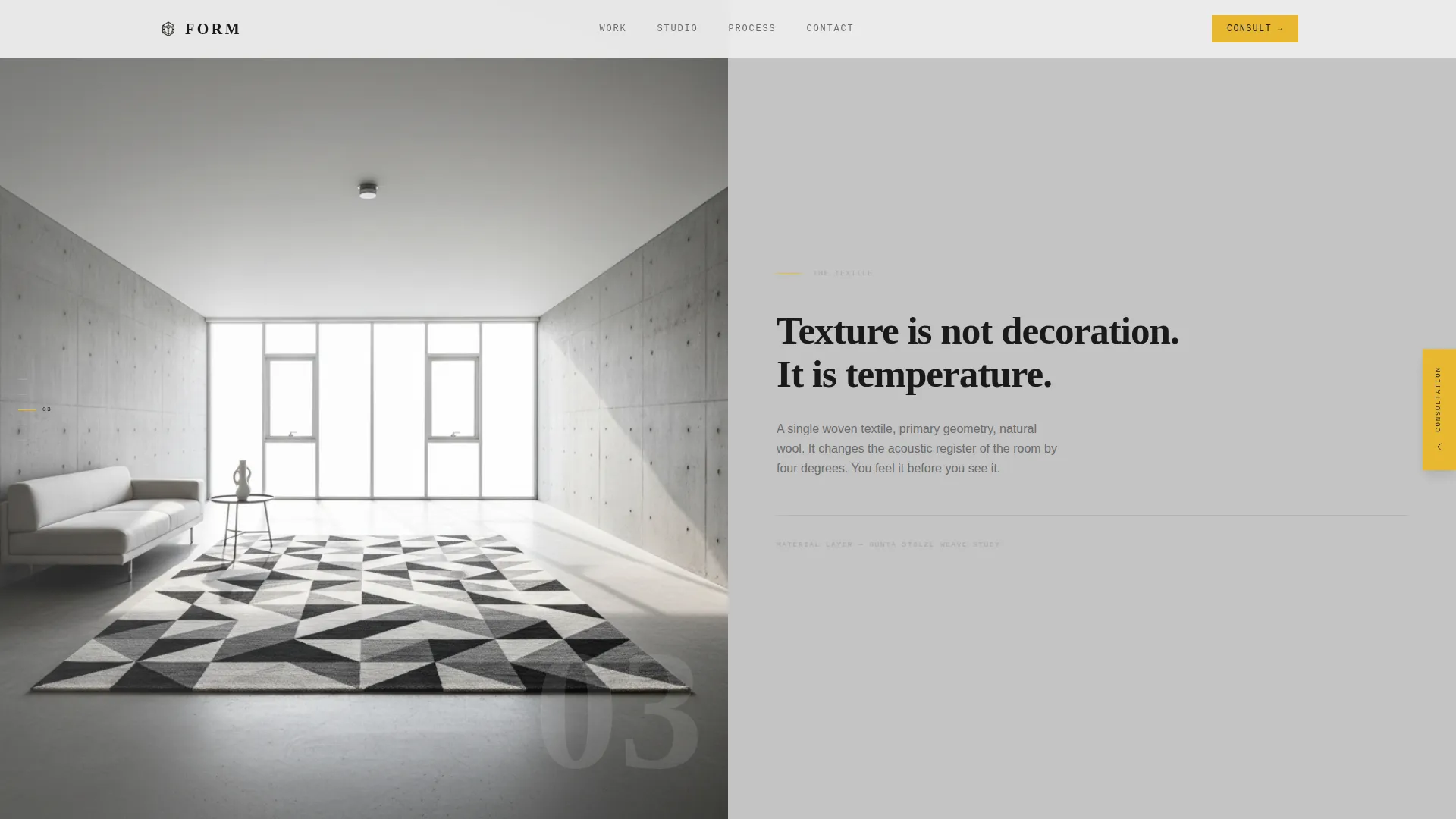
The page unfolds as a sequence of full-page spreads. Each spread adds one layer to a room: from an empty space with morning light, to a single Wassily chair, to successive additions of textiles, fixtures, and material samples, culminating in a full-bleed completed interior photograph.
Collage Hero with Scrapbook Composition
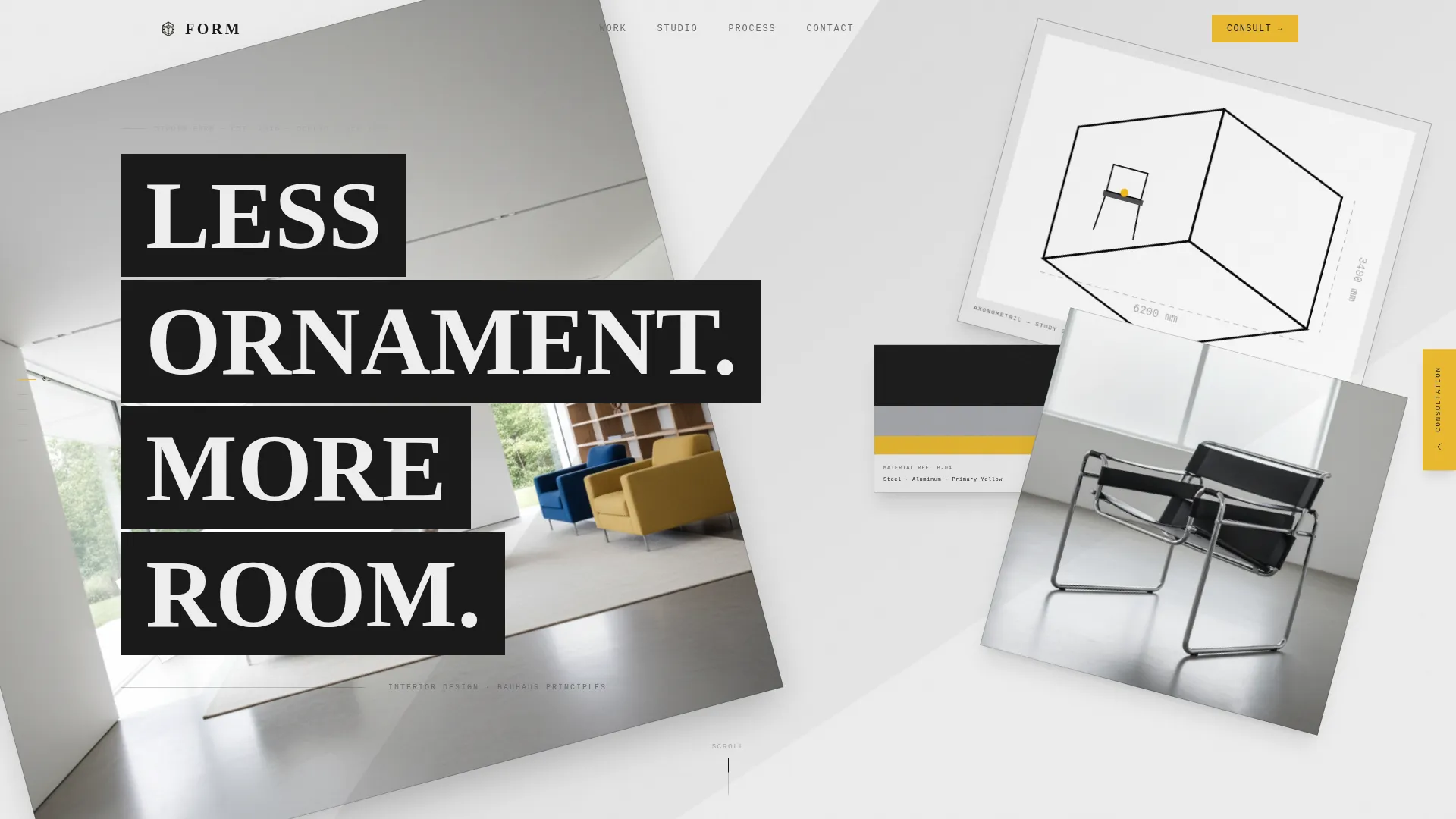
The header layers real project photography, material swatches, hand-drawn axonometric sketches, and torn specification sheets at precise Bauhaus angles. Every overlap is deliberate, every rotation divisible by fifteen degrees, and a hard diagonal shadow anchors the assemblage typographically.
Fixed Consultation Tab with Three-Field Form
A minimal tab sits at the viewport edge throughout the scroll. On click, it expands into a compact form asking for project type (residential, commercial, or renovation), approximate square footage, and a single open-ended prompt: "Describe how you want the room to feel."
PDF Lookbook Lead Capture
A secondary conversion path offers visitors the "Principles Before Palette" PDF lookbook in exchange for an email address. This catches prospects still gathering ideas before they are ready to book a consultation.
Editorial Pull-Quote System
Pull-quotes interrupt the scroll in the style of editorial marginalia. They are set in Breuer yellow against the dark palette, creating visual punctuation that reinforces the studio's philosophical positioning without adding decorative noise.
Asymmetric Bento Works Grid
Selected project photography is displayed in an asymmetric bento grid layout with material annotations. Each project entry supports hover states, giving visitors a tactile sense of the studio's material thinking before they engage directly.
Page sections overview
| Section | Purpose |
|---|---|
| Hero Collage Header | Establishes editorial identity and anchors the headline "LESS ORNAMENT. MORE ROOM." |
| Fixed Consultation Tab | Keeps the primary call to action accessible throughout the entire scroll |
| Room Journey Spreads | Builds emotional investment through a layered, cinematic room narrative |
| Selected Works Grid | Presents project photography with asymmetric layout and material annotations |
| Philosophy Pull-Quotes | Reinforces design values through editorial marginalia-style typographic accents |
| Consultation Form Section | Full-bleed dark section housing the three-field form and the lookbook capture |
| Minimal Footer | Closes the page with a clean horizontal flow pattern |
Design & branding system
The visual identity is built on an Editorial Magazine theme interpreted through a Monochrome Steel color system. Every color decision earns its place, and the single accent color is held back for moments of genuine interaction or editorial emphasis.
- Four-color palette: forge black (#1A1A1A), rolled aluminum (#A8A9AD), drafting-paper white (#EDEDED), and Breuer yellow (#E8B830) reserved exclusively for interactive elements and pull-quotes
- Typography uses Fraunces at display weight for editorial headers, DM Sans for body copy, and JetBrains Mono for captions and material annotations
- Angles, overlaps, and spatial compositions follow strict Bauhaus geometry; no decorative randomness is introduced
Mobile & speed optimization
The template is designed desktop-first to honor the wide-viewport editorial magazine spreads at the heart of the layout. Responsive behavior ensures the experience remains coherent on smaller screens.
- The storybook spreads and bento grid collapse gracefully for mobile viewports without breaking the narrative sequence
- Scroll-linked animations and parallax layers are handled by client-side components, while static editorial sections use server-side rendering for faster initial delivery
- The consultation tab and lookbook capture module remain functional and accessible at all viewport sizes
How this template helps you convert
The conversion architecture is built around the idea that a qualified lead proves their taste before they ever submit a form. The page earns the click rather than demanding it.
- The fixed consultation tab maintains a persistent but unobtrusive call to action throughout the scroll, so the invitation is always present without interrupting the editorial experience
- The three-field form qualifies prospects by project type and spatial scale rather than budget, attracting clients who align with the studio's values from the first interaction
- The "Principles Before Palette" lookbook capture creates a secondary funnel for visitors still in the research phase, building the studio's email audience while delivering genuine value
Other information about this template
This template sits within the Architecture and Design category, specifically targeting the Bauhaus interior designer niche. It is well-suited for studios that operate as creative services businesses in the luxury segment, where the conversion journey is long and trust is built visually before any form is ever opened.
- The template style is Storybook and Full-Page, making it one of the more immersive formats available for design-led practices
- Project dates are formatted as MM/YYYY to suit editorial annotation conventions used throughout the material captions
- The footer follows a horizontal flow pattern: ultra-minimal, with no decorative additions that could undercut the page's studied restraint
- Institutional references embedded in the page's conceptual framework (such as the Dessau campus and the 1928 Bauhaus journal aesthetic) reinforce authority for clients who already recognize those cultural touchstones
- The lookbook PDF and the consultation form are separate conversion paths that can serve different audience segments without competing with each other
Theme
Editorial Magazine
Creative direction
Atmosphere & Mood
Color system
Monochrome Steel
Style
Storybook/Full-Page
Direction
Lead Generation
Page Sections
Scroll-linked Room-building Narrative
Collage Hero with Bauhaus Geometry
Fixed Consultation Tab and Form
PDF Lookbook Lead Capture
Editorial Pull-quote System
Asymmetric Bento Works Grid
Related questions
Who is this landing page template built for?
How does the consultation form qualify leads without a budget field?
What is included in the secondary conversion path?
Is this template suitable for non-Bauhaus interior design studios?
How does the template handle mobile viewports?