Manufacturing Processes Site Maintenance Website Template
Foundry is a single-column landing page template built for sand casting service providers. It guides mechanical engineers, maintenance managers, and product designers through a process-driven visual narrative, comparing sand casting against competing methods at every stage. The template is designed to qualify serious buyers and convert them through a focused part-comparison form.
by Rocket studio
Quick summary
Foundry is a precision-built landing page template for sand casting shops. It uses an engineering blueprint visual language, a Charcoal and Amber color system, and a section-by-section comparison strategy to position sand casting as the smart choice for the right geometry, volume, and timeline.
Who this template is for
This template is built for sand casting service providers who sell to technical buyers. It speaks the language of engineers and procurement managers, not general consumers.
- Foundry operators offering short-run aluminum, bronze, iron, or zinc castings to industrial clients
- Sand casting shops competing against die casting, investment casting, or CNC-from-billet suppliers
- Precision casting businesses looking to qualify inbound leads before the first sales call
What problem this template solves
Sand casting is often dismissed as the low-tech option. Buyers default to die casting quotes or CNC pricing without understanding the cost and lead-time advantages of sand casting for the right part. This template solves that perception problem directly.
- It walks buyers through the full sand casting process so they arrive informed, not skeptical
- It shows side-by-side comparisons at each stage, making the case on cost, lead time, minimum order, and design freedom
- It qualifies every lead by asking which competing process the buyer is currently considering
What you get with this template
This template delivers a complete single-column landing page layout structured around a process narrative and a conversion-focused comparison strategy. Every section is purposeful and sequenced.
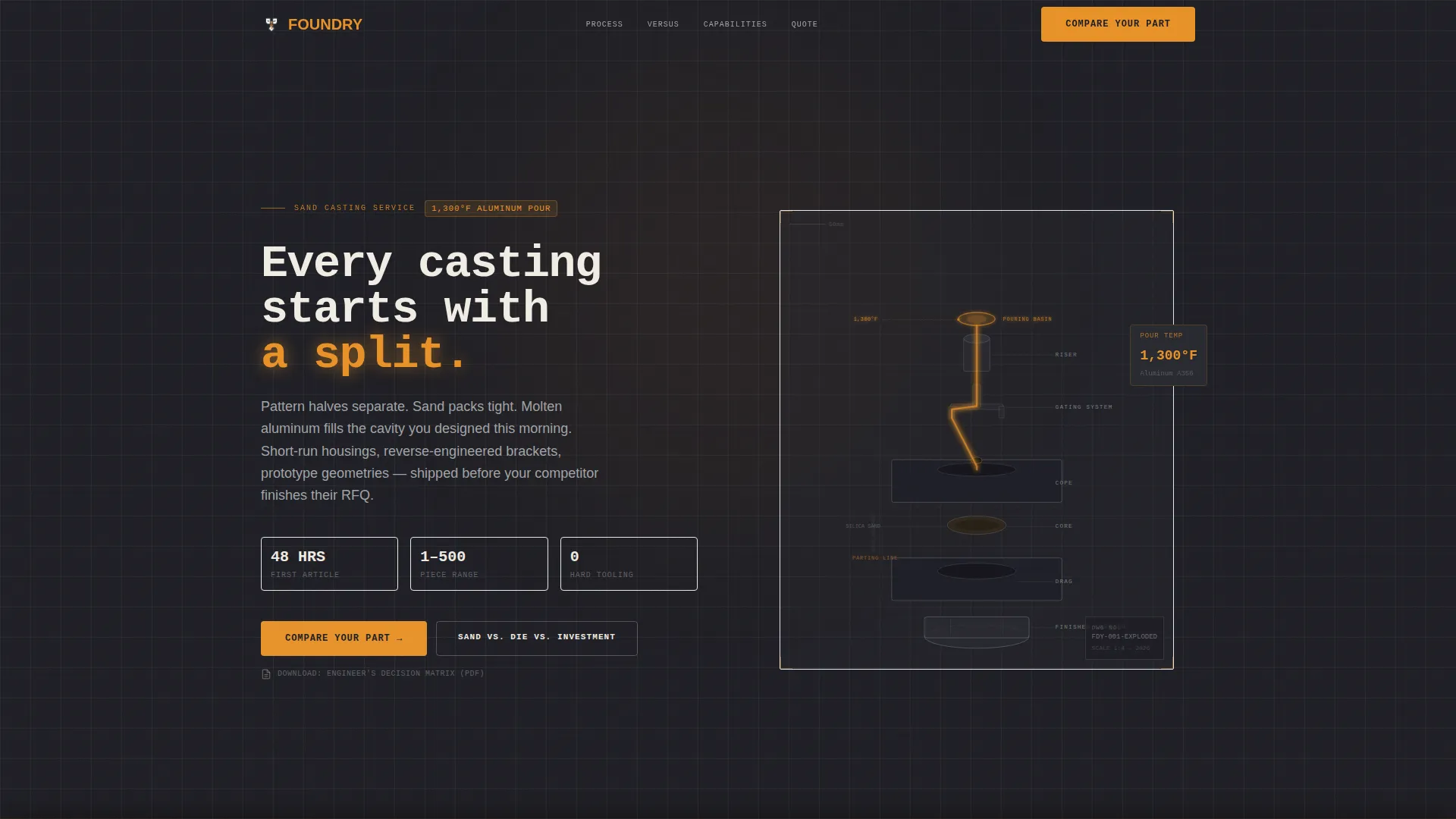
- An exploded-view header illustration with animated amber pour-channel line and monospaced headline
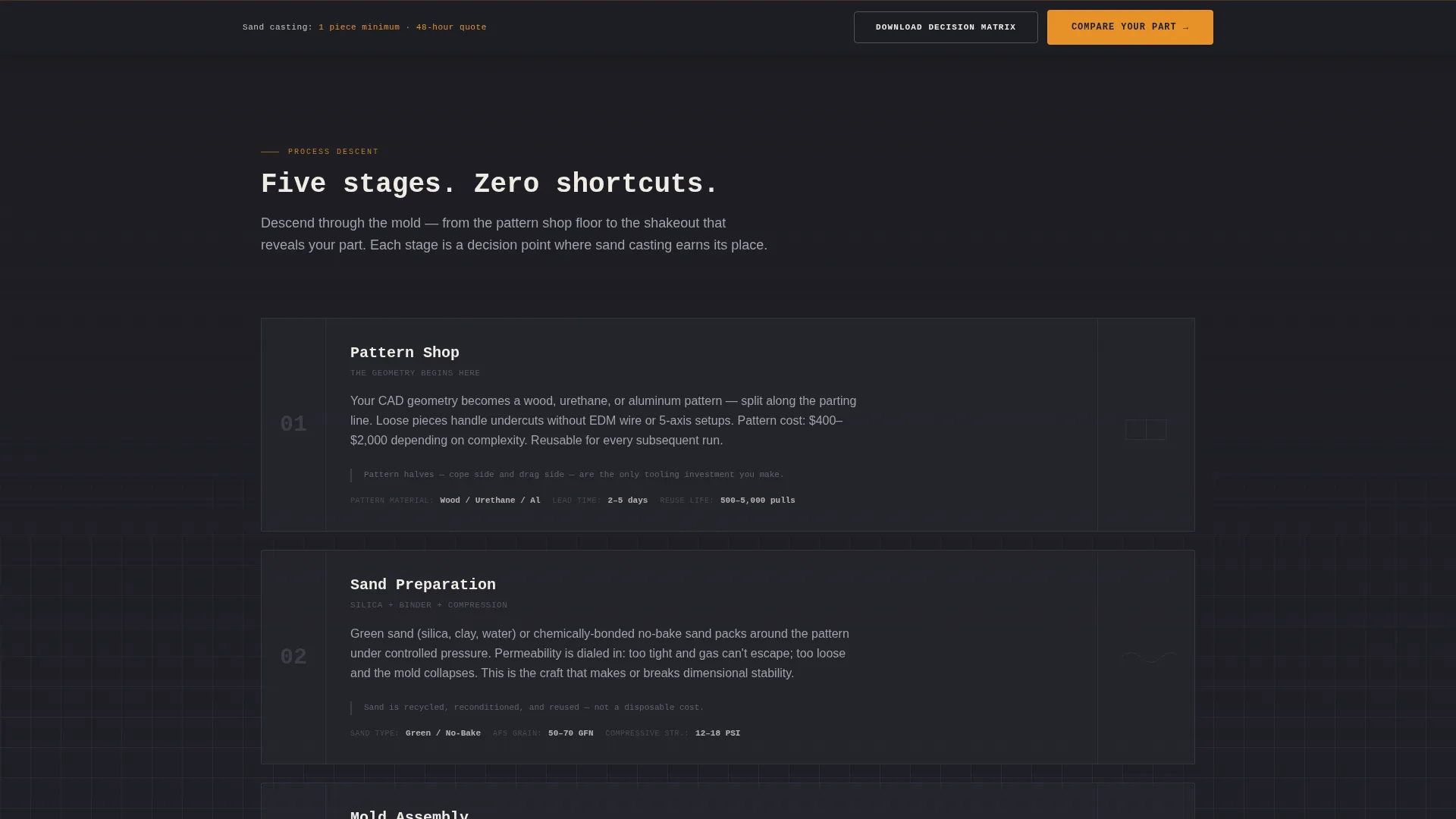
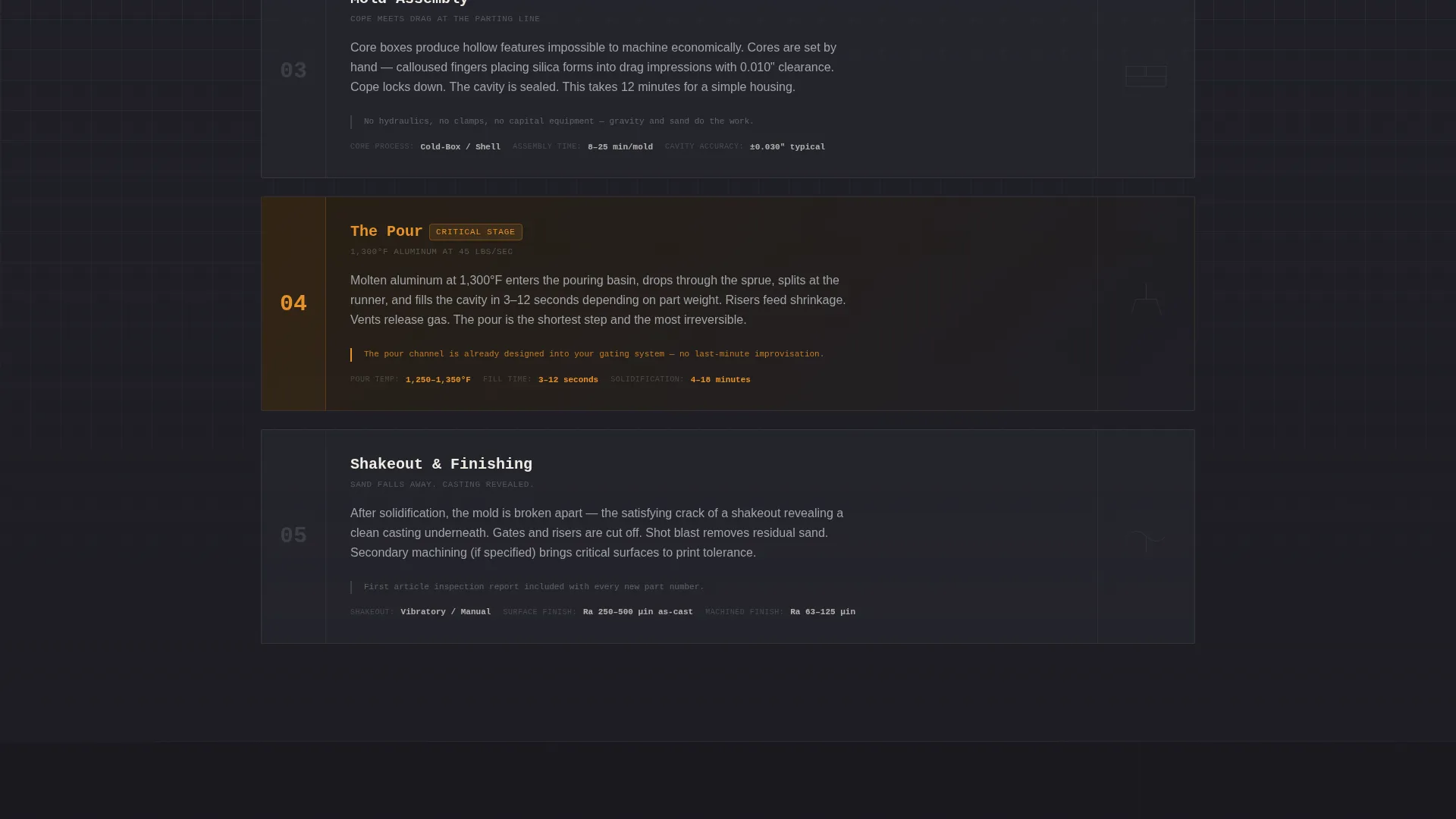
- Five process-stage sections rendered as blueprint cross-sections, each paired with a versus comparison column
- A part-comparison intake form, a sticky repeat call to action bar, and a gated PDF download path
Feature list
The template includes a tightly scoped set of components built specifically for a technical industrial audience. Each feature below maps directly to a described section or interaction in the template.
Exploded View Header with Animated Pour Line
The header presents a technical illustration of a complete sand casting assembly, with every layer labeled: cope, drag, core, gating system, riser, and finished casting. A single animated line traces the pour path from basin through runner to cavity, glowing amber as it travels.
Side-by-Side Process Comparison Columns
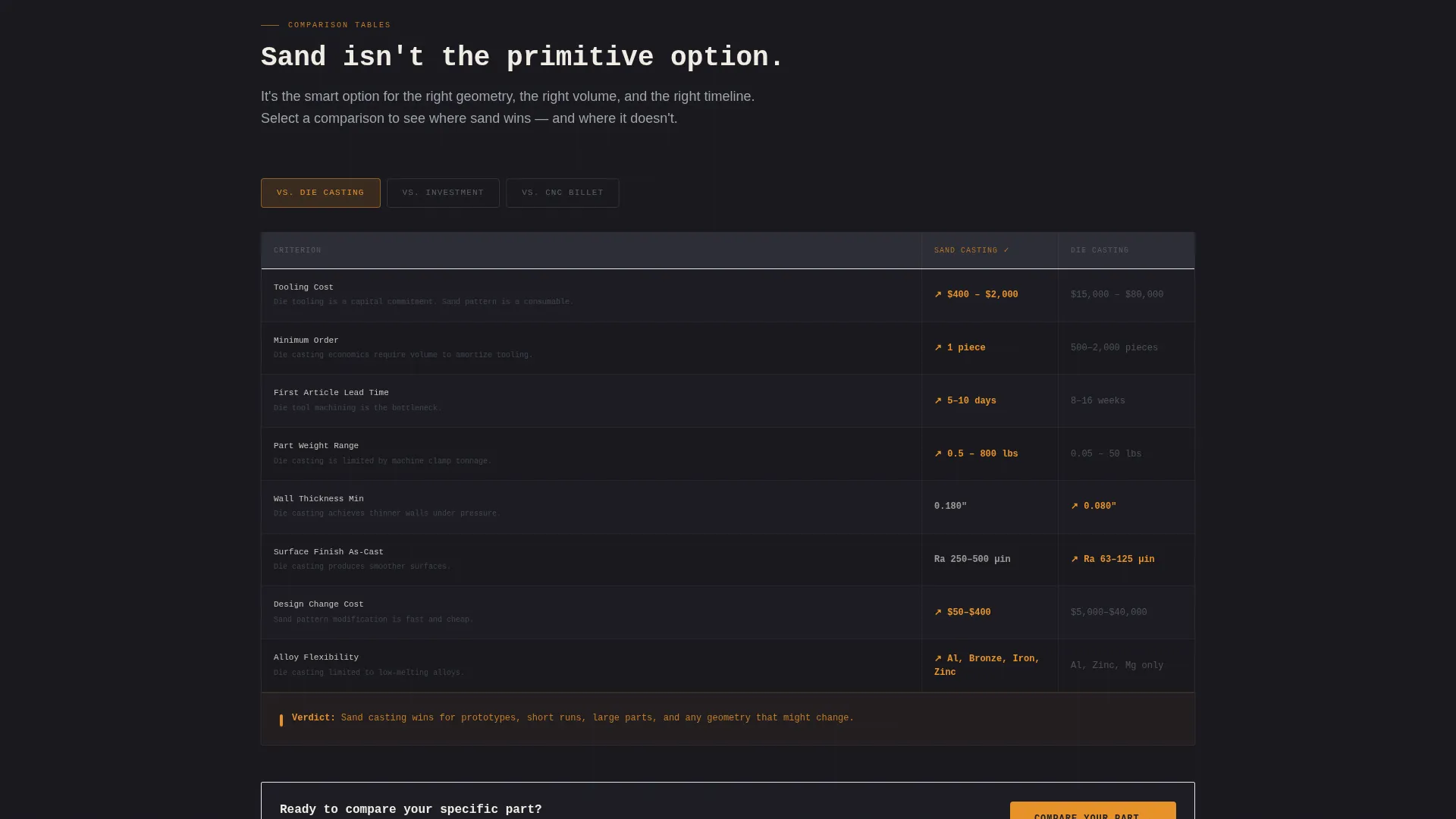
At each of the five process-stage sections, a two-column layout places sand casting directly against a competing method such as die casting, investment casting, or CNC-from-billet. The comparison covers cost, lead time, minimum order quantity, and design freedom.
Part Comparison Intake Form
The primary conversion form asks buyers for part material via dropdown (aluminum, bronze, iron, or zinc), quantity range, a drawing or STEP file upload, and a single qualifying text field asking which process the buyer is comparing against. This field is designed to give the sales team an immediate objection-handling advantage.
Sticky Repeat call to action Bar
After the second scroll, a sticky bottom bar repeats the primary call to action "Compare Your Part." This keeps the conversion path visible without interrupting the process narrative.
Gated PDF Download Path
A secondary conversion path offers a downloadable decision guide gated behind an email address only. The guide covers the sand versus die versus investment casting decision for engineers evaluating process options.
Blueprint Section Architecture
Each of the five process stages is rendered as an architectural cross-section illustration in the Engineering Blueprint style. White linework on graphite backgrounds with amber highlights gives every section a consistent, technical identity that reinforces the foundry-floor tone.
Page sections overview
| Section | Purpose |
|---|---|
| Exploded View Header | Introduce the sand casting assembly and set the technical tone |
| Pattern Shop Stage | Explain the pattern-making step with a process comparison column |
| Sand Preparation Stage | Show sand mixing and preparation alongside competing process equivalent |
| Mold Assembly Stage | Walk through mold setup with a side-by-side comparison |
| Pour Stage | Illustrate the aluminum pour at temperature with a versus comparison |
| Shakeout and Finishing | Show the final extraction and finishing step with comparison |
| Primary Comparison Form | Capture part details and qualifying process comparison from the buyer |
| Gated PDF Offer | Present the engineer decision matrix download behind email gate |
| Sticky call to action Bar | Repeat the Compare Your Part call to action after second scroll |
Design & branding system
The visual identity follows an Engineering Blueprint theme that feels like a machinist's reference manual scorched at the edges by foundry heat. Every color decision is deliberate and grounded in the foundry-floor environment.
- Deep graphite (#1E1E24) serves as the primary background, technical pencil gray (#A0A4A8) handles body text and grid lines, and cope-line white (#F0ECE3) defines section breaks and callout cards
- Molten amber (#E8922A) appears sparingly on hover states, call-to-action borders, and temperature callouts, always suggesting liquid metal in motion
- All header illustration work uses white linework on graphite in an architectural section-cut drawing style, with no stock photography anywhere on the page
Mobile & speed optimization
The single-column flow layout is naturally suited to smaller screen sizes. The vertical scroll narrative translates cleanly from desktop to mobile without losing its spatial logic.
- The five process-stage sections stack in sequence on narrow screens, preserving the top-to-bottom descent metaphor that drives the page narrative
- The sticky call to action bar and the part-comparison form remain accessible at all viewport sizes, keeping the conversion path reachable throughout the scroll
How this template helps you convert
This template is designed around a specific buying psychology: the technical buyer who arrives skeptical and needs to be convinced by evidence, not enthusiasm. Every structural decision serves that goal.
- The side-by-side comparison columns do the selling before the form ever appears, so the buyer arrives at the call to action already persuaded rather than uncertain
- The qualifying text field in the intake form captures the buyer's current alternative, giving the sales team a precise starting point for every follow-up conversation
Other information about this template
This template is categorized under Manufacturing and Industrial, specifically within the Manufacturing Processes subcategory for sand casting service providers. It is designed as a single-column flow landing page.
- The template is built for a niche audience with high technical literacy, so all copy and visual direction should remain precise and process-grounded
- The Engineering Blueprint theme and Spatial and Architectural creative direction are matched intersection context fields that shaped every layout and visual decision in this template
- The Comparison/Versus landing page direction means the entire page is structured as a progressive argument, not a features list or a portfolio showcase
Theme
Engineering Blueprint
Creative direction
Spatial & Architectural
Color system
Charcoal & Amber
Style
Single Column Flow
Direction
Comparison/Versus
Page Sections
Exploded View Header with Animated Pour Line
Five-stage Blueprint Process Sections
Side-by-side Process Comparison Columns
Qualifying Part Comparison Form
Sticky Repeat Call to Action Bar
Gated Engineer Decision Matrix PDF
Related questions
Who is this landing page template designed for?
What conversion paths are included in the template?
Does the template include the illustrated exploded view header artwork?
Can this template work for other metal casting processes?
What information does the intake form collect from buyers?