Norway Travel Booking Website Template
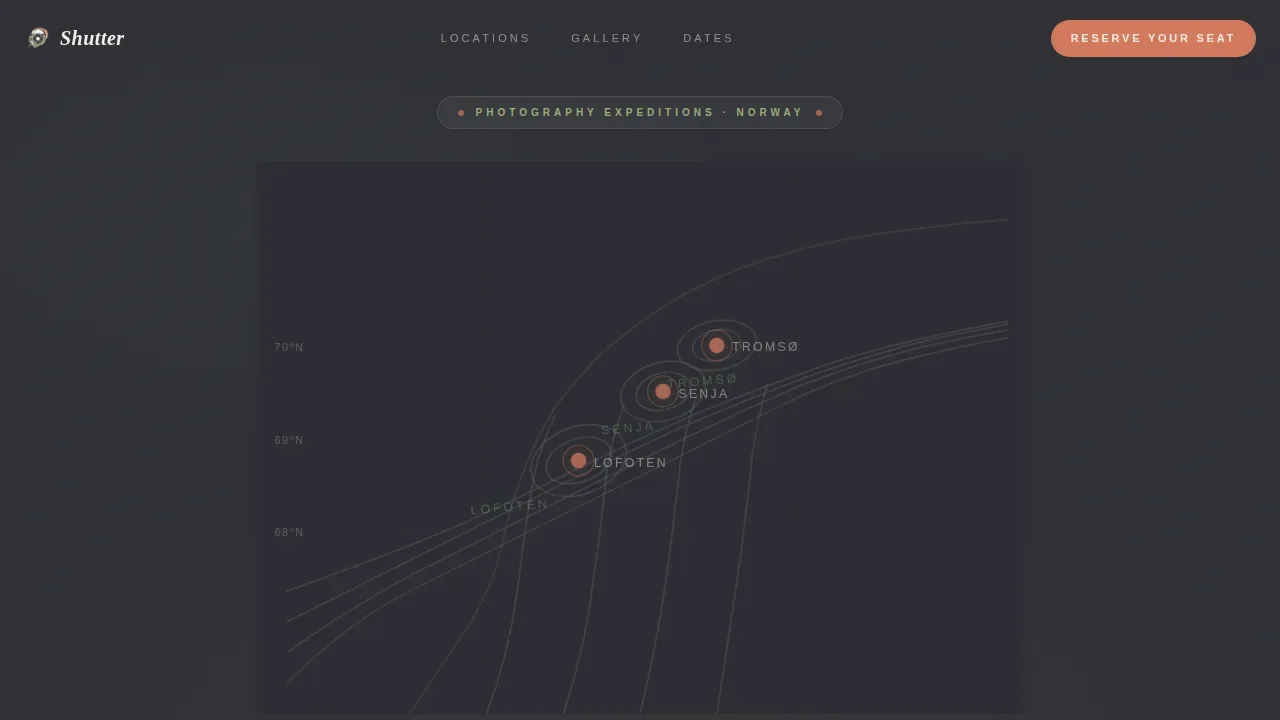
Shutter is a masonry-layout landing page template built for Norway photography tour operators. It opens with an interactive SVG topographic map of Lofoten, Senja, and Tromsø, then flows into an asymmetric image cascade that moves from dawn through aurora. A stepped booking form and a shot-list lead magnet work together to convert serious photographers into confirmed bookings.
by Rocket studio
Quick summary
Shutter is a single-page, masonry-style landing page template designed specifically for Norway photography tour operators. It combines an animated topographic map header, an organic image cascade with embedded field notes, location detail cards, and a stepped booking form. The result is a page that feels as cinematic as the northern lights themselves, and is built to earn reservations from serious photographers.
Who this template is for
This template is built for a very specific kind of operator and a very specific kind of buyer. If you run guided photography tours in northern Norway, this layout speaks your clients' language from the first scroll. It is not a generic travel template dressed up with a few fjord photographs. Every design decision, every section, and every interaction reflects the needs of photographers who travel to capture the northern lights, the dramatic mountains of the Lofoten Islands, and the blue-hour stillness of Tromsø.
The primary buyer is a serious amateur or semi-professional landscape photographer who has outgrown group holidays and beginner photography workshop experiences. They are typically between forty and sixty years old, they already own good camera gear, and they want to come home with portfolio-grade work rather than snapshots. The secondary buyer is a retired professional photographer or a mid-career creative chasing one transcendent portfolio piece, a single photograph that justifies the flight, the cold, and the 2 a.m. alarm.
- Photography tour operators running small-group experiences across the Lofoten Islands, Senja, and Tromsø who need a conversion-focused page that does the selling visually.
- Serious amateur landscape photographers who have researched northern lights photography extensively and need proof, not promises, before committing a week and a significant budget.
- Professional and semi-professional photographers looking for a structured photography journey with expert field guidance, technical instruction, and post processing support built into the schedule.
What problem this template solves
Most photography tour pages look like generic travel sites. They list bullet points of locations, paste in a stock hero image, and hope a contact form does the rest. That approach fails with experienced photographers. A landscape photographer with a full frame camera, a sturdy tripod, and three trips already under their belt is not going to book based on a stock photo and a paragraph about "breathtaking scenery." They need visual proof. They need to feel the quality of the light before they commit.
Shutter solves that trust gap. It leads with the most compelling evidence first, real photographs from real shooting locations, embedded in an immersive, hand-laid masonry grid. It gives the visitor a sense of what standing in that arctic wilderness actually feels like, long before the booking form appears. The stepped form itself is designed to feel like the beginning of the experience, not a checkout page.
- Trust deficit: Most photography tour pages fail to show enough visual evidence to convince experienced photographers. Shutter frontloads stunning images from every key location across twelve pre-scouted sites.
- Conversion friction: A single long form discourages commitment. The stepped booking flow, date selection, experience level, then contact details, reduces friction at each stage and mirrors how photographers actually think about a trip.
- Lead leakage: Visitors who are not yet ready to book leave with nothing. The "Download the Shot List" lead magnet captures emails from undecided visitors by offering genuine value: GPS coordinates and recommended focal lengths for every location.
What you get with this template
Shutter delivers a complete, production-ready landing page layout for a Norway photography tour. Every section has been designed to serve a specific conversion or trust-building purpose. The visual language, the Organic Flow layout direction, the Sunset Mesa color palette, the Fraunces serif headlines paired with DM Sans body text, creates a page that feels like a darkroom meets a mountain hut. Nothing is arbitrary. The charcoal grounds the reading experience, the cream breathes between image tiles, and the alpenglow coral marks every action the visitor needs to take.
- Seven structured sections flowing from the animated map header through the masonry grid, location cards, aurora call-to-action panel, booking form, and footer, each with a distinct visual weight and purpose.
- Interactive SVG topographic map of Norway's northern coast, with pulsing coral pins at each shooting location and Polaroid-bloom hover states that reveal actual photographs from that exact spot.
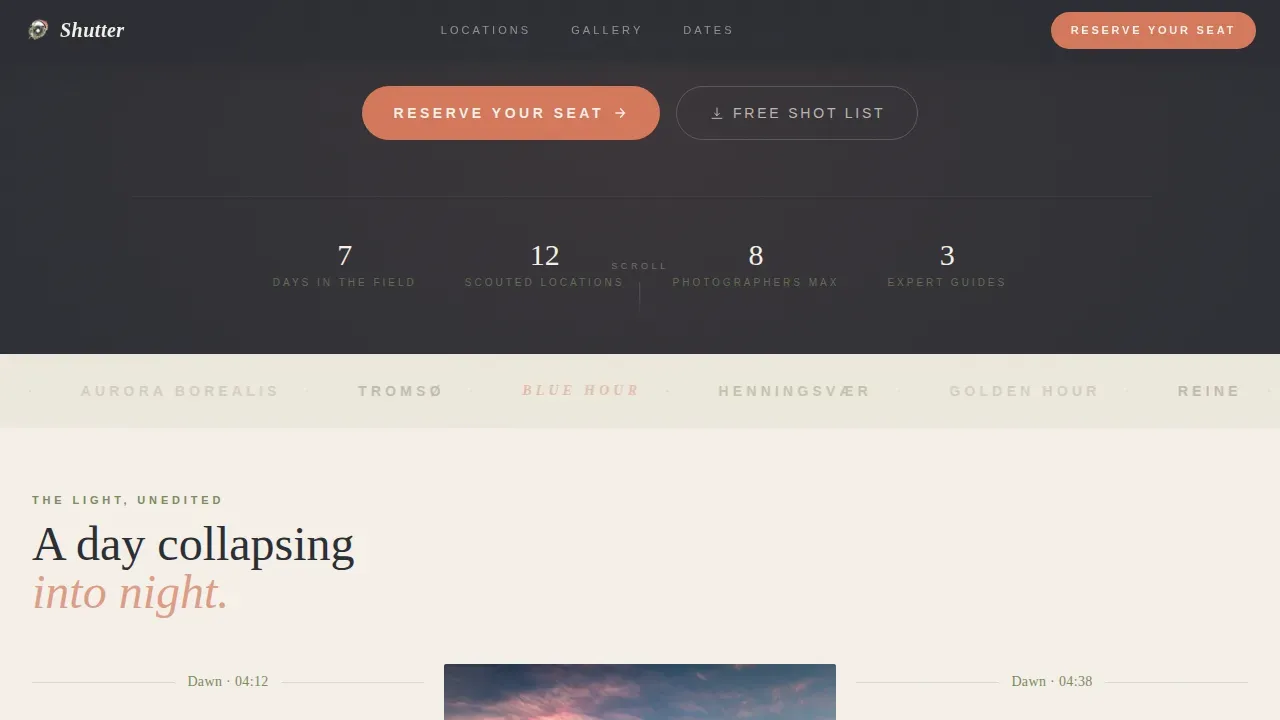
- Stepped three-stage booking form with a visual calendar showing remaining spots per departure, an experience-level selector, and a minimal contact capture, plus a secondary lead magnet path for the "Download the Shot List" PDF.
Feature list
The features below reflect what is built into the Shutter template as described in the source brief. Each one serves the dual purpose of delivering a cinematic visual experience and driving photography tour bookings.
Interactive Topographic Map Header
The header is a hand-illustrated SVG topographic map of Norway's northern coast, rendered in cream linework over fjord charcoal. Coral pins pulse at each of the twelve shooting locations across the Lofoten Islands, Senja, and Tromsø. When a visitor hovers a pin, a thumbnail photograph from that precise location blooms outward in a Polaroid-style animation, showing the real image they could capture there. The map breathes slowly, as if the landscape itself has a heartbeat, and a single tagline floats below: "Seven days. Twelve locations. Your best work." This header is just what a photography tour page needs, it makes the case for the light before a single word of copy is read.
Organic Flow Masonry Image Grid
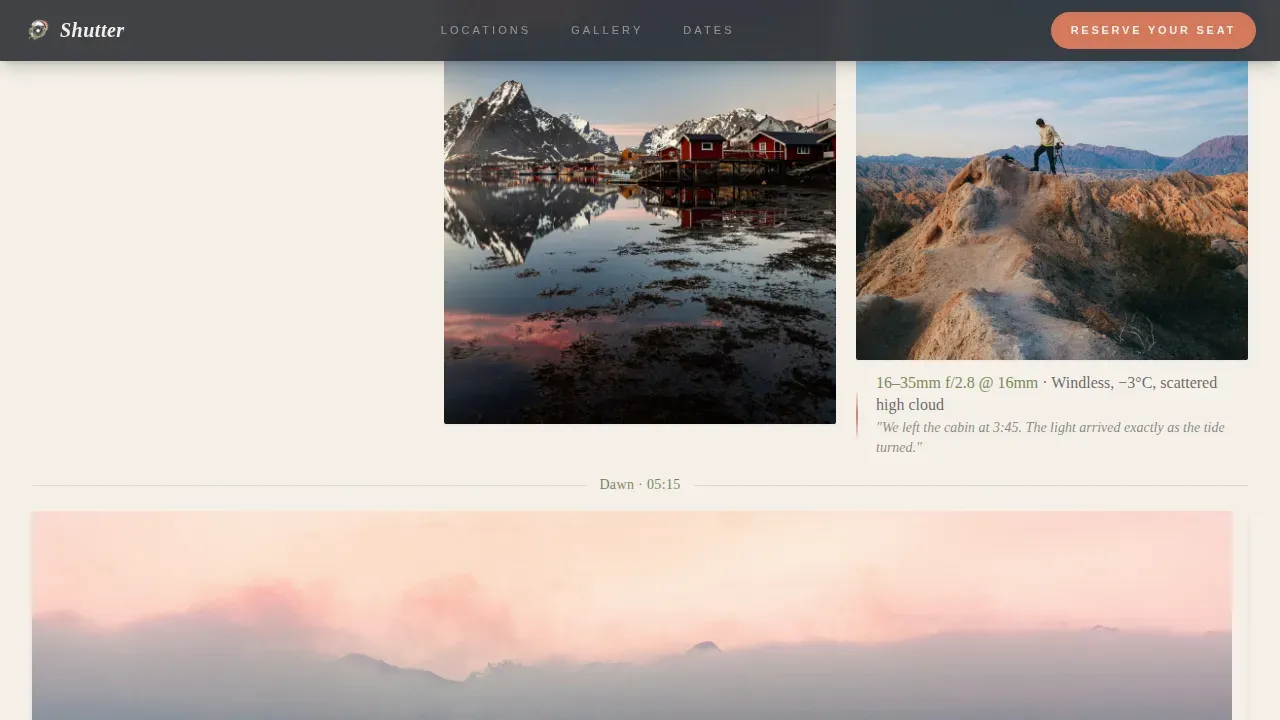
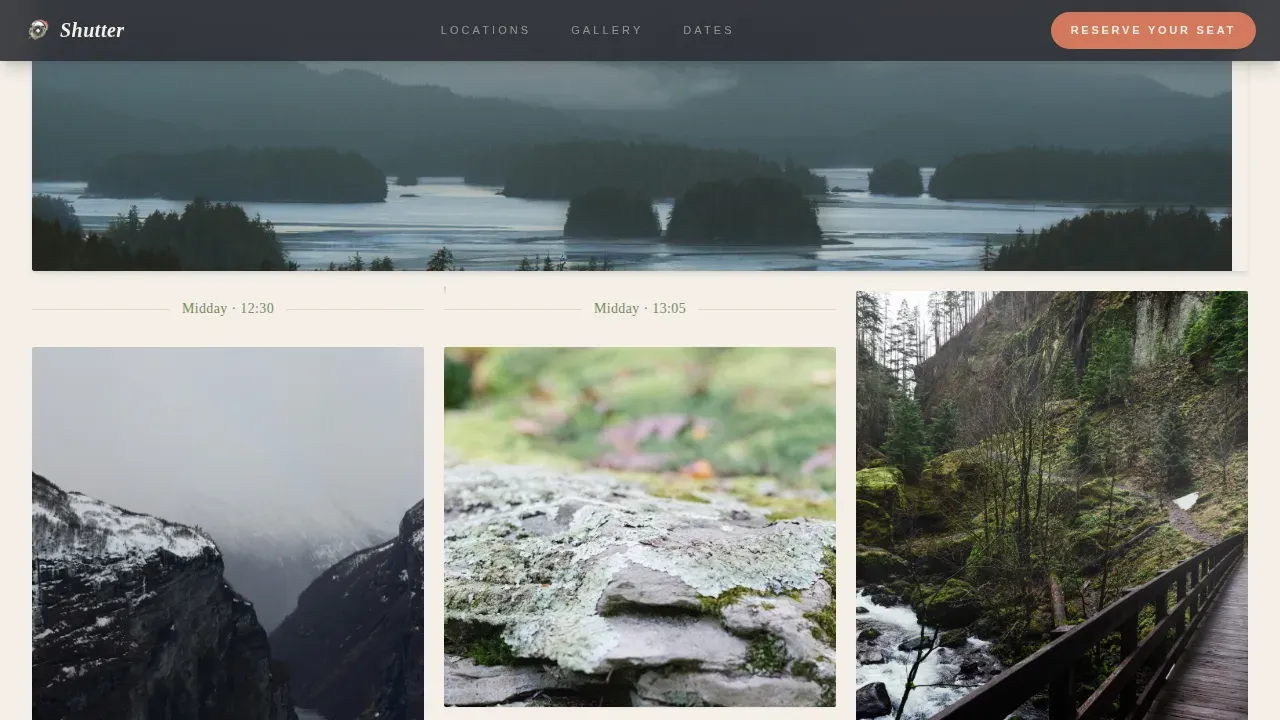
Below the map, the template drops the visitor into a full-color, asymmetric masonry cascade. Images appear at varying scales, wide panoramas spanning two columns, intimate detail shots filling a single square. There are no hard grid snaps; the Organic Flow direction means tiles feel placed by hand on a lightbox. Each row shifts the time of day in sequence: dawn, midday, golden hour, blue hour, and finally the northern lights. The scroll itself becomes a compressed day collapsing into night, with the aurora images appearing at the bottom to pull the visitor deeper. Short field notes in handwritten-style typography appear between image clusters, noting the lens used, lighting conditions, and the story behind the frame.
Pulsing GSAP Scroll Animations
The template uses GSAP ScrollTrigger throughout to animate the masonry grid, the map pins, and section transitions. The Polaroid bloom effect on map pin hover, the parallax drift of the masonry tiles, and the subtle breathing animation on the topographic map are all part of the interaction layer. These animations are purposeful rather than decorative, each one directs attention toward the photographs and toward the booking call to action.
Stepped Booking Form with Visual Calendar
The primary conversion tool is a three-stage booking form. Stage one shows a visual calendar with remaining spots displayed per departure date, creating real scarcity cues. Stage two asks the visitor to select their experience level, enthusiast, advanced, or professional, so guides can tailor instruction before the tour begins. Stage three captures name and email. The form is minimal by design: fewer fields mean fewer reasons to abandon. A coral "Reserve Your Seat" button appears first after the map header and again after the aurora section, so the call to action is never more than a screen away.
Shot List Lead Magnet Path
Not every visitor is ready to book. The secondary conversion path, "Download the Shot List", offers a free PDF containing GPS coordinates and recommended focal lengths for every location on the tour. This captures emails from landscape photographers who are still in the research phase and keeps the tour operator in their inbox. It is a genuinely useful offer that builds trust even before a booking is made, because it demonstrates that the guides know exactly where to stand and what camera settings to bring.
Location Detail Cards with Shooting Specs
Three location cards, Lofoten, Senja, and Tromsø, sit between the masonry grid and the aurora call-to-action section. Each card presents the location's character, the best light conditions available there, and practical photographic details. These cards are the closest thing on the page to a technical brief, bridging the visual storytelling of the grid and the decision-making logic of the booking form.
Page sections overview
| Section | Purpose |
|---|---|
| Topographic Map Header | Sets the scene with an interactive SVG map of Lofoten, Senja, and Tromsø; coral pins bloom into Polaroid previews on hover |
| Masonry Image Grid | Delivers visual proof through an asymmetric dawn-to-aurora image cascade with embedded field notes in handwritten-style type |
| Location Detail Cards | Presents shooting specs and location character for Lofoten, Senja, and Tromsø to help visitors assess the tour's photographic value |
| Aurora Call-to-Action Panel | Full-bleed northern lights image with the second "Reserve Your Seat" coral button, placed at peak emotional engagement |
| Stepped Booking Form | Three-stage form: visual departure calendar, experience-level selector, and contact capture with minimal field count |
| Footer | Arc-pattern footer with logo and tagline left, navigation links right |
Design & branding system
The Shutter template uses the Sunset Mesa color system applied through an Organic Flow visual direction. The overall effect is described as a weathered wooden tripod planted on a moss-covered ridge at golden hour, warm light bleeding into cold stone, everything softened by mist and distance. Typography pairs Fraunces serif headlines with DM Sans body text, giving the page cinematic weight in the headings and clean readability in the field notes and form labels.
- Fjord charcoal (#2B2D33) grounds all primary typography and the topographic map background, creating the visual weight of cold stone at night.
- Alpenglow coral (#D4785C) activates every call-to-action button and hover state, including the booking form submit button and the map pin glow, the single warm color that says "act here."
- Lichen moss (#7A8B5E) anchors secondary text, section dividers, and field note labels, behaving like tundra creeping between rocks.
- Snow-bright cream (#F5F0E8) provides the open breathing space between masonry tiles and renders the map linework, the visual equivalent of clear skies over granite.
Mobile & speed optimization
Shutter is designed desktop-first, which makes sense for the target audience: a landscape photographer comparing photography tour options is almost certainly researching on a large screen where the masonry grid and the topographic map can be fully appreciated. However, the layout is built to remain fully functional and readable on mobile devices, so visitors who encounter the page on a phone are not turned away.
- Desktop-first responsive layout that preserves the masonry grid's organic asymmetry at wide viewports while reflowing gracefully to single-column stacks on smaller screens.
- Server Components for static sections handle the location cards, field notes, and footer, keeping the non-interactive portions of the page lean, while Client Components manage the interactive map pins, Polaroid bloom animations, and stepped booking form.
- Optimized image delivery across the masonry grid keeps the visual-heavy cascade from degrading the experience, so stunning images load in a way that feels as smooth as the scroll itself.
How this template helps you convert
A high-converting landing page for a photography tour must do two things simultaneously: make an emotional case through stunning visual proof, and make a rational case through clear, practical information. Shutter is built around this dual logic. The page earns the booking by showing, frame after frame, the undeniable reality that this light exists and these guides know exactly where to stand.
- Visual proof before the ask. The topographic map header and the full masonry grid both appear before any booking call to action. By the time the coral "Reserve Your Seat" button is in view, the visitor has already seen twelve locations' worth of photographic evidence. The emotional case is closed before the rational one begins.
- Friction-reduced booking flow. The stepped form separates the decision into three small commitments rather than one large one. Choosing a departure date feels smaller than filling out a full booking form. Selecting an experience level feels like personalizing the trip, not signing a contract. Name and email come last, when the visitor is already invested.
- Lead capture for undecided visitors. The shot list PDF offer means that visitors who leave without booking still give the operator their email. Every landscape photographer who downloads that GPS-tagged list is a warm lead who has already demonstrated serious intent.
Other information about this template
Shutter sits at the intersection of travel and hospitality design, photography education, and experiential booking, a combination that makes it genuinely unusual in the template marketplace. The brief behind this template was shaped by the real commercial challenges of selling high-end photography tours: convincing experienced photographers to commit a week and a significant sum to a guided experience they could theoretically attempt independently.
The template draws on a well-documented body of knowledge about what makes northern lights photography successful. Guides on this kind of photography tour work around the reality that northern lights photography demands a DSLR or mirrorless camera with full manual controls. A wide angle lens with an aperture of f/2.8 or faster is the standard recommendation for gathering as much light as possible during a northern lights photography session. A sturdy tripod is non-negotiable for long exposure work, and a remote shutter release or a two-second timer delay eliminates camera shake during those exposures. Cold temperatures drain batteries rapidly, so spare battery management is a genuine operational concern, one that experienced guides on this kind of photography tour build into their field briefings.
Night photography in the arctic requires the ability to manually focus accurately in near-darkness. Autofocus systems struggle in low light, so photographers who want to frame camera shots of the aurora need to know how to set their focus manually before the northern lights appear. A headlamp with a red light setting is standard kit for adjusting camera settings in the field without destroying night vision. Manual mode is the only reliable way to control shutter speed, aperture, and ISO simultaneously when exposure settings need to shift quickly as the northern lights move across the night sky.
The Lofoten Islands specifically are renowned for their dramatic fjords, jagged peaks, and charming fishing villages that carry genuine cultural significance. The iconic red rorbuer cabins along the waterfront are famous photographic backdrops as well as cozy, authentic accommodation that adds warmth to the experience of arriving back from a cold midnight shoot. The Lofoten archipelago sits above the arctic circle, making it one of the best locations in the world for northern lights photography during winter months when nights are longest and clear skies expose the full night sky. The Lofoten Islands provide photographic opportunities that range from snow-covered beaches and wild coastlines to frozen lakes in sheltered valleys and dramatic mountains rising directly from the sea.
Post processing is covered as part of the workshop schedule. Shooting in RAW format is standard practice on this kind of photography tour, since RAW files preserve the dynamic range needed to recover detail in northern lights photography during post processing sessions. Participants can expect instruction covering exposure settings, color grading, and how to approach long exposure blending for aurora borealis images. The ability to produce images that hold up to professional scrutiny is a central promise of the tour, and the post processing component is where raw files become the stunning images participants came for.
The Shutter template is specifically designed to highlight a maximum of seven participants per departure, which is central to the small-group value proposition. This small group size enables the level of personalized field guidance and individual attention that separates a genuine photography workshop from a group holiday with cameras. The itinerary structure is designed to be flexible in response to unpredictable weather, which is a real and practical concern in northern Norway where conditions can shift within hours. The template's location card section makes it straightforward to communicate that the tour itinerary can adapt without undermining the promise of reaching the best shooting locations under the best light available.
From a competitive positioning standpoint, this template is built to serve operators who want to distinguish their Norway photography tour from alternatives in destinations like Costa Rica or Iceland. The visual language of the Organic Flow direction and the Sunset Mesa palette are specific to the Norwegian light, they could not be easily mistaken for a Costa Rica rainforest tour or a tropical wildlife photography experience. That specificity is itself a conversion asset, because serious photographers know the difference, and they are looking for an operator who knows it too.
The page also supports the kind of social proof that serious buyers respond to: field notes with real lens and condition data, embedded directly in the masonry grid between image clusters, function as authentic testimonials from the field rather than polished marketing copy. A professional photographer evaluating a photography tour is far more persuaded by a note that reads "24mm, f/2.8, ISO 3200, 15-second exposure, Lofoten Islands, 1:47 a.m." than by a generic five-star review. The template is built to carry that kind of honest, technical credibility throughout the scroll.
The template also acknowledges the wildlife photography potential of the region, arctic foxes, sea eagles, and coastal birds are present in northern Norway, and while the photography tour is primarily oriented toward landscape photography and northern lights photography, operators can reference these additional photographic opportunities in the field notes and location cards. The rich tapestry of northern Norway's natural environment gives even a week-long tour genuine breadth.
The shot list PDF lead magnet is designed around the principle that amazing locations deserve to be found, not guessed at. By offering GPS coordinates and optimal focal lengths for every photo location on the tour, the template positions the operator as a genuine expert. That generosity is the conversion logic behind the lead magnet, when a photographer receives a document that genuinely improves their next shoot, they remember who gave it to them.
For buyers wondering about the difference between this template and a general travel booking page: the distinction is specificity. Shutter is built around the understanding that a landscape photographer who travels to iconic locations like the Lofoten Islands for the northern lights is making a different kind of purchase decision than a leisure tourist. They are investing in their craft. The template respects that by leading with evidence, following with education, and closing with a booking flow that feels like the beginning of an unforgettable journey rather than the end of a transaction.
- The template uses the "Shutter Immersive Norway Photography Tour Landing Page Template" name as its product identity within the marketplace, designed around the Organic Flow and Sunset Mesa system.
- National geographic-quality visual storytelling is the aesthetic benchmark the template's masonry grid and field note typography are designed to evoke.
- Adobe Photoshop post processing workflows are part of the photographic education the tour operator can communicate through the template's field notes and workshop section content.
- The template supports communication about the difference between shooting with a full frame camera versus a crop-sensor body for northern lights photography, a technical distinction that matters to experienced photographers evaluating whether the tour is calibrated to their level.
Theme
Organic Flow
Creative direction
Immersive Visual
Color system
Sunset Mesa
Style
Masonry/Pinterest
Direction
Booking/Scheduling
Page Sections
Interactive SVG Topographic Map Header
Dawn-to-aurora Masonry Image Cascade
Stepped Three-stage Booking Form
Shot List PDF Lead Magnet
Location Detail Cards with Shooting Specs
GSAP Scrolltrigger Animation Layer
Related questions
What kinds of photographers is this template designed to attract?
Does the template include the booking form and lead magnet functionality?
Can the tour operator customize the location cards and field notes?
Is this template suitable for photography tour operators in other destinations?
What animation library powers the interactive elements in this template?