Custom Home Builder Website Template for Luxury Construction
Frameout is a hero-dominant landing page template built for custom home builders who work with exposed steel, raw concrete, and precision timber. It pairs a full-viewport lifestyle shot with a scroll-driven build narrative, a progressive lead-capture form, and a fixed "Start Your Build" call-to-action bar, all wrapped in an Industrial Raw visual identity that earns trust before asking for a name.
by Rocket studio
Quick summary
Frameout is a single-page lead generation template for custom home builders. It opens with a full-viewport lifestyle hero shot, then walks visitors through each phase of a build, site, structure, enclosure, and finished life, before surfacing a three-step progressive form. The Industrial Raw design system grounds every section in warmth and craft.
Who this template is for
This template is built for builders and professionals who work at the high end of custom residential construction. If your clients are design-conscious and your projects demand a serious visual presentation, Frameout fits the job.
- Custom home builders who work with steel, concrete, and timber
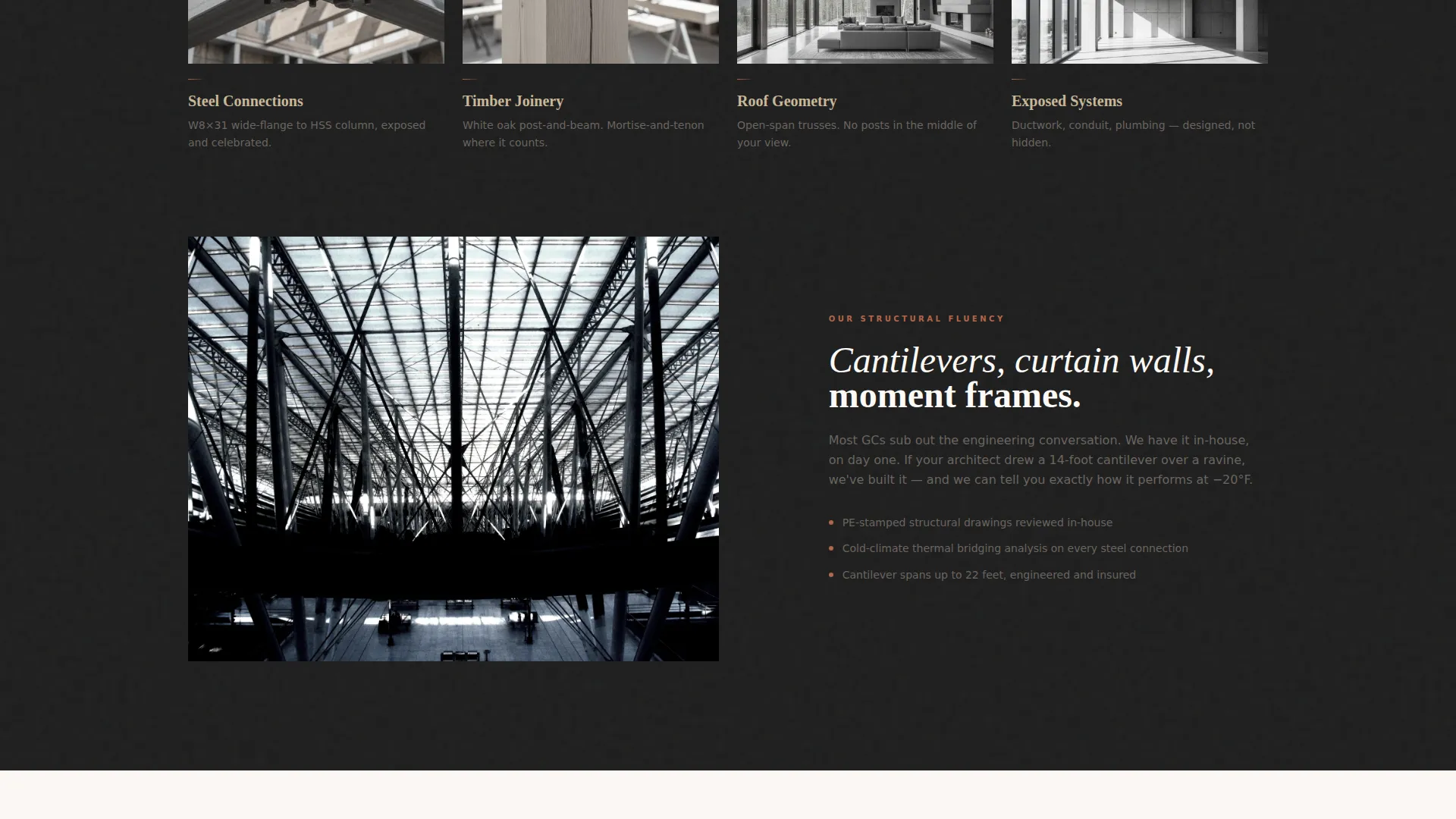
- General contractors fluent in complex builds like cantilevers and curtain walls
- Architects looking for a builder partner who can communicate craft visually
What problem this template solves
Most builder websites look like they were built for volume, not vision. They lead with price ranges and contact forms before showing a single detail worth trusting. Frameout fixes that by letting the photography do the qualifying first.
- Visitors leave before converting because trust is never established early enough
- Generic contractor pages fail to communicate craftsmanship or material sophistication
- Progressive lead forms feel abrupt when the page has not yet earned the visitor's attention
What you get with this template
You get a complete single-page layout that moves like a guided site walk. Every section is purpose-built to carry the visitor from curiosity to commitment without pressure.
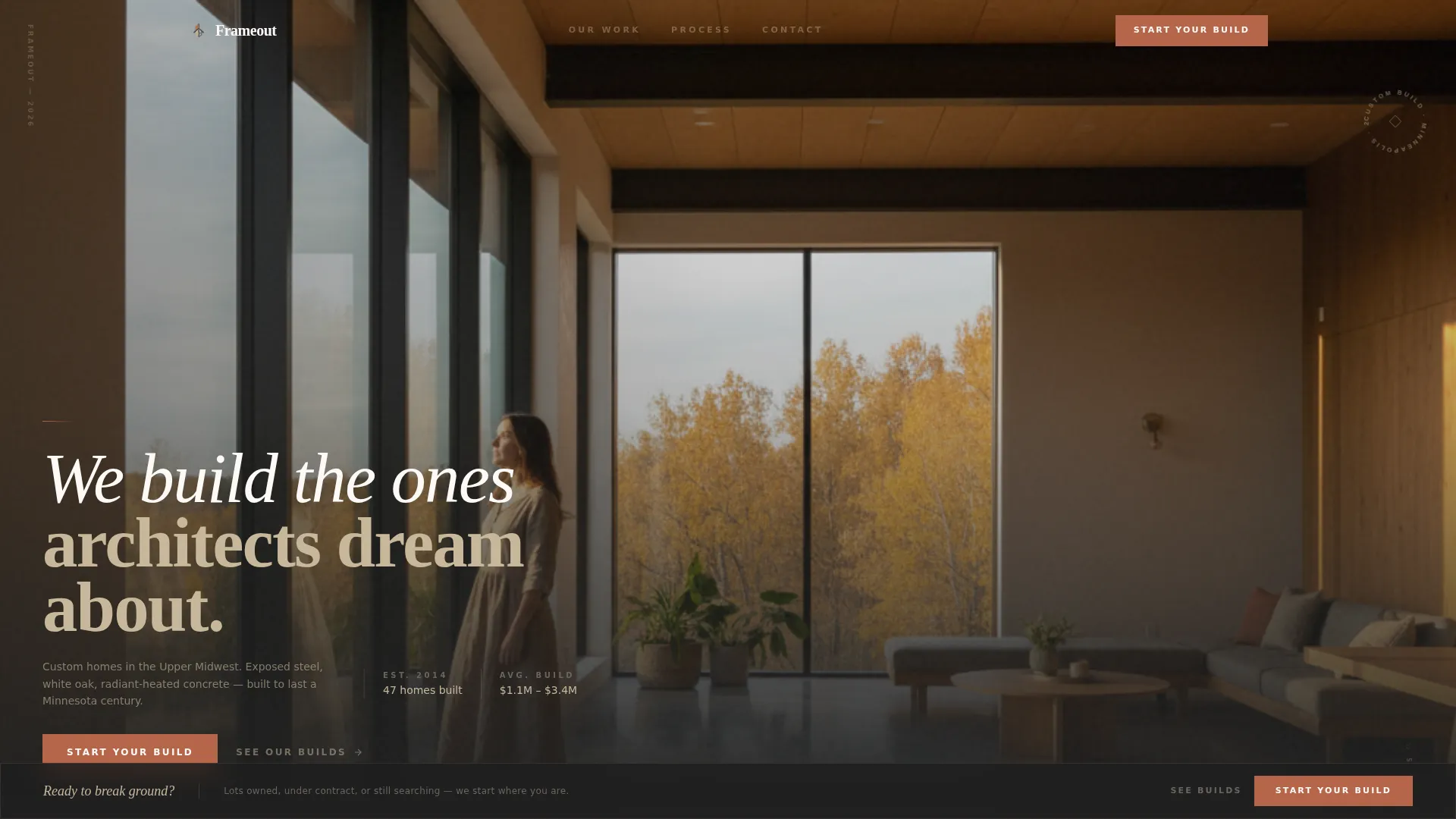
- A full-viewport hero with a single headline rising from a lifestyle photograph
- A scroll-driven build narrative covering four construction phases, site, structure, enclosure, and life
- A three-screen progressive lead form and a fixed "Start Your Build" bottom bar that activates after the second scroll section
Feature list
This template is built around a small number of components, each doing real work. Nothing is decorative for its own sake.
Full-Viewport Hero Section
The header fills the entire screen with a lifestyle photograph of a finished great room. No navigation, no logo, just the image and a single line of sans-serif type that rises from the bottom: We build the ones architects dream about. The shot is composed wide at hip height so the architecture commands the frame.
Scroll-Driven Build Narrative
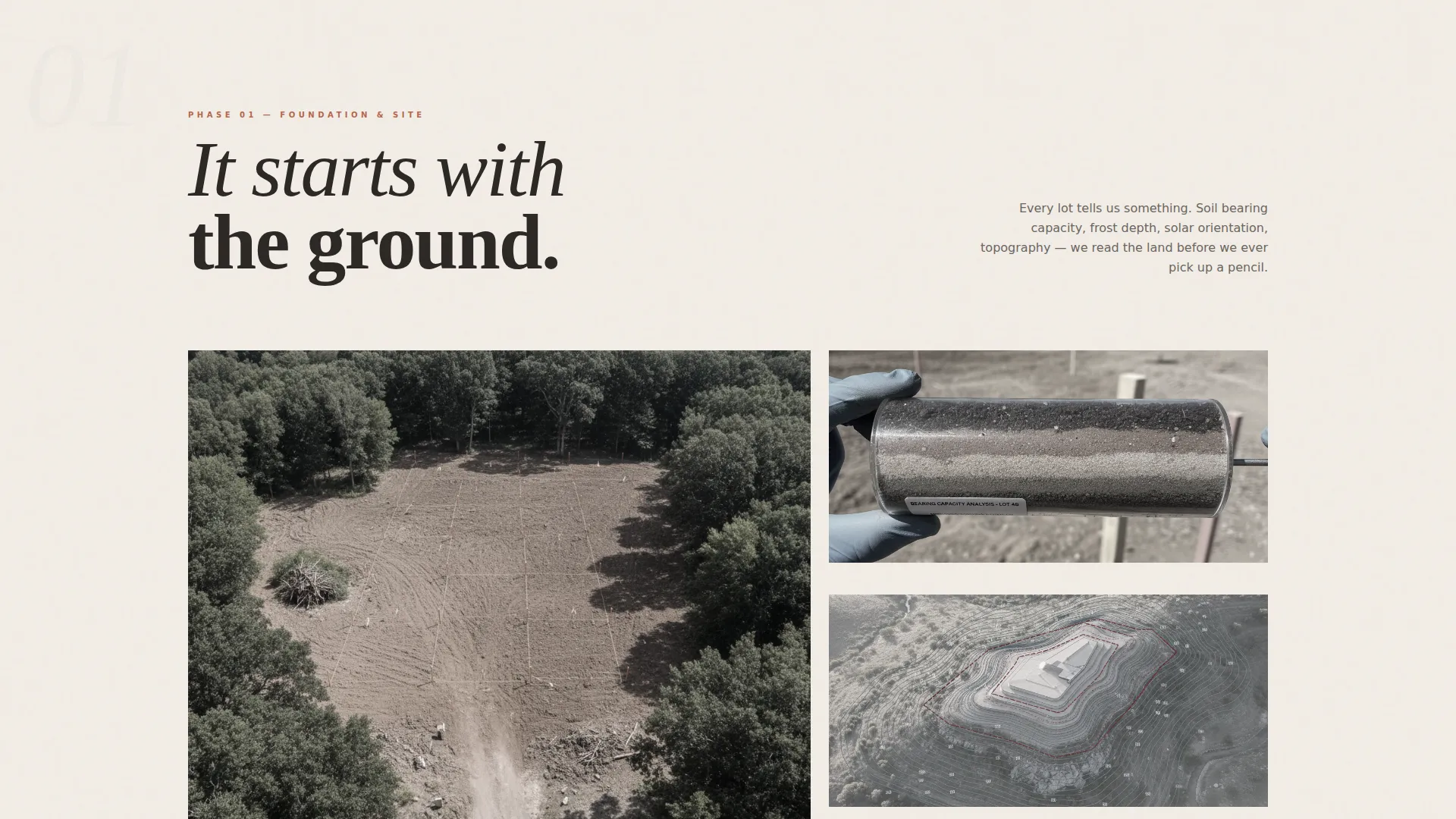
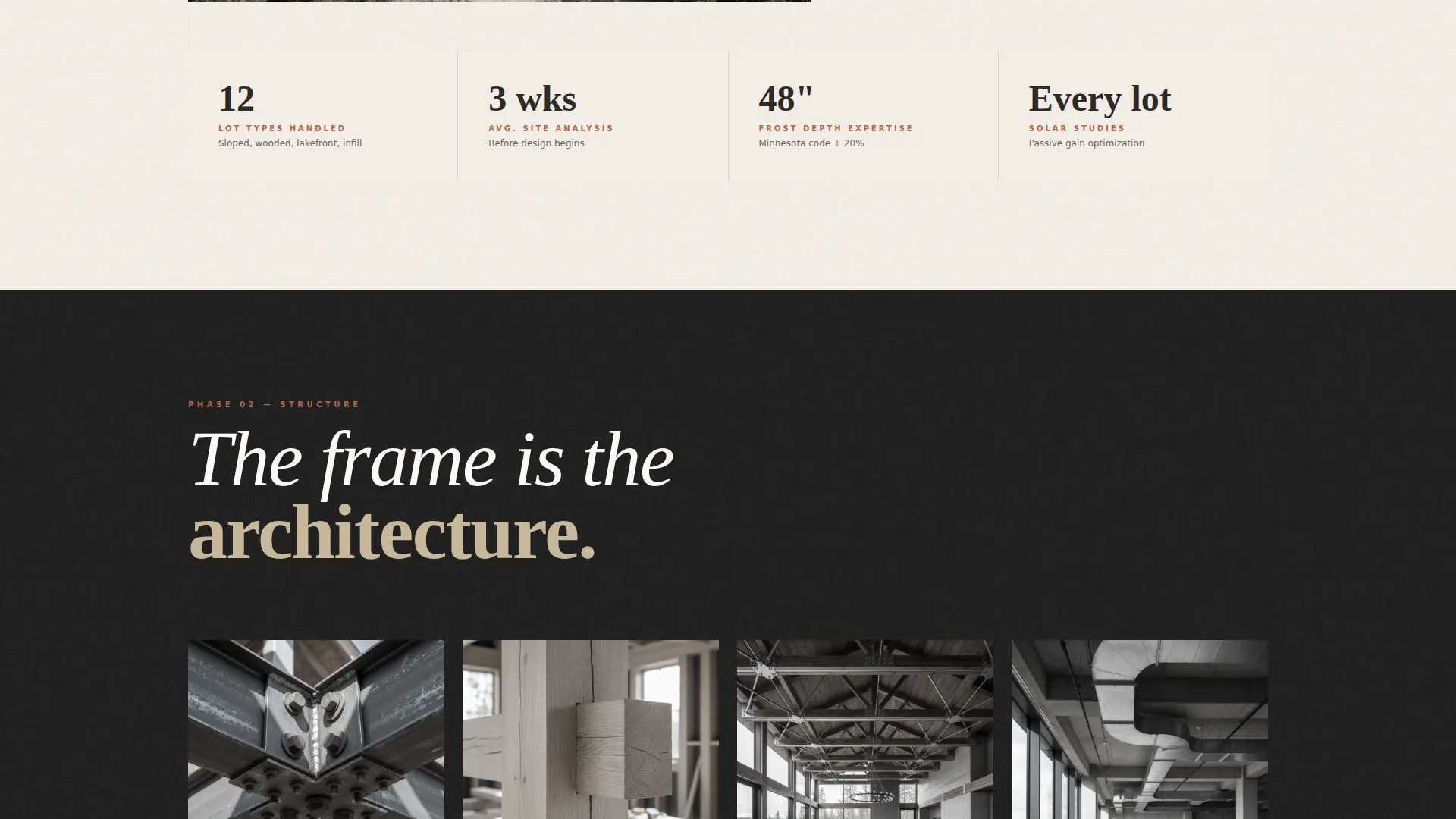
Four sequential sections advance through the phases of construction. Site and foundation come first with aerial drone stills and topographic overlays. Structure follows with close-up details of steel connections and roof truss geometry. Enclosure shows windows, cladding, and threshold moments. Life closes the sequence with inhabited, daylight-lit finished rooms.
Progressive Three-Step Lead Form
The form opens with lot status, owned, under contract, or still looking. The second screen asks for approximate square footage and style preference. The third captures name, email, and zip code. Breaking the form into steps lowers the friction of the first answer and keeps momentum going.
Fixed "Start Your Build" Bottom Bar
After the visitor passes the second scroll section, a persistent bottom bar appears with the primary call-to-action. It stays visible without interrupting the narrative, so the path to the form is always one tap or click away.
Secondary "See Our Current Builds" Gallery Path
A secondary call-to-action routes visitors to a gallery of active projects. The gallery closes back into the lead form, so curiosity-driven browsing still ends at a conversion point.
Industrial Raw Color and Typography System
The Warm Stone palette uses quarried limestone, exposed aggregate gray, blackened steel, and kiln-fired accent clay. Headlines punch in near-black. Body text sits in aggregate gray. Accent clay appears on buttons, hover states, and section dividers. Backgrounds alternate between deep blackened steel and pale limestone washes.
Page sections overview
| Section | Purpose |
|---|---|
| Full-viewport hero | Opens with a lifestyle photograph and a single headline |
| Site and foundation | Aerial drone stills, soil types, topographic overlays |
| Structure details | Steel connections, timber joinery, roof truss geometry |
| Enclosure and threshold | Windows, cladding, inside-meets-outside moments |
| Finished life rooms | Inhabited rooms lit by real daylight |
| Gallery secondary path | Showcases current builds, loops back to the form |
| Progressive lead form | Three-step form capturing lot status, preferences, and contact details |
| Fixed bottom bar | Persistent "Start Your Build" call-to-action |
Design & branding system
The visual identity is built around an Industrial Raw theme with a Warm Stone color system. Every color decision references a physical material, quarried stone, poured concrete, blackened steel, kiln-fired clay. The palette feels grounded and warm without softening into something residential-generic.
- Colors: quarried limestone (#C8B89A), exposed aggregate gray (#6B6560), blackened steel (#1E1E1E), and kiln-fired accent clay (#B5654A) for buttons and interactive states
- Backgrounds alternate between deep blackened steel and pale limestone washes to create section rhythm
- Typography uses sans-serif headlines in near-black and body text in aggregate gray, delivering contrast that reads clearly against both dark and light backgrounds
Mobile & speed optimization
The hero-dominant layout is intentionally minimal in component count. Fewer interactive elements mean less to load and less to break on smaller screens. The fixed bottom bar is especially useful on mobile, where it stays reachable without requiring a scroll back to the top.
- The full-viewport hero and scroll sections are image-led, making them straightforward to adapt to portrait screen dimensions
- The progressive form's three-step structure works naturally on mobile, one question group per screen keeps inputs uncluttered
- The fixed bottom call-to-action bar provides persistent access to the lead form without blocking content on any screen size
How this template helps you convert
Frameout is built around a specific conversion logic: earn trust through craft, then ask for the lead. The page never rushes the visitor.
- The scroll-driven build narrative shows months of construction expertise in roughly sixty seconds of reading, so the visitor arrives at the form already convinced of the builder's capability.
- The progressive lead form lowers commitment at each step, lot status first, preferences second, contact details last, which reduces drop-off compared to a single long form.
- The gallery secondary path catches visitors who are not ready for the form and routes their curiosity back into a conversion moment instead of letting them leave.
Other information about this template
Frameout is designed for the intersection of construction craft and design ambition. It fits naturally into a wider marketing workflow for builders who want a high-end digital presence without a custom development budget.
- The template targets clients who reference publications like Dwell and expect second-home quality in primary residence builds
- It is suited to projects in climates with demanding performance requirements, where material choices and build quality are central selling points
- The 90/10 hero-dominant layout means photography carries most of the persuasive load, high-resolution project imagery will produce the strongest results
- Page type: single-page landing page with a linear scroll structure and no sub-page navigation
Theme
Industrial Raw
Creative direction
Spatial & Architectural
Color system
Warm Stone
Style
Hero-Dominant (90/10)
Direction
Lead Generation
Page Sections
Full-viewport Lifestyle Hero
Scroll-driven Build Narrative
Progressive Three-step Lead Form
Fixed 'start Your Build' Bottom Bar
Secondary Gallery Conversion Path
Industrial Raw Color System
Related questions
Who is this landing page template designed for?
Do I need professional photography to use this template?
How does the progressive lead form work?
What is the 'Start Your Build' bottom bar?
Can this template work for builders whose clients include architects?