Authentic Japanese Tattoo Landing Page Template
The Irezumi template is a gallery and direct-sales landing page built for Japanese tattoo studios. It pairs a dark editorial aesthetic with a marketplace grid, letting collectors browse seasonal flash designs, view mythology-organized portfolio work, and claim limited one-of-one tattoos with a deposit. The result is a living gallery that moves serious buyers from inspiration to booking in a single scroll.
by Rocket studio
Quick summary
The Irezumi template is a single-page gallery and direct-sales experience designed for Japanese tattoo studios working at collector level. It presents traditional irezumi as a living art form, organized by mythological narrative and curated by season. Visitors browse flash designs with visible pricing, claim pieces instantly, or start a custom commission, all without leaving the page.
Who this template is for
This template is built for serious studios where the work speaks for itself and the client already understands what they are committing to. It matches studios whose waitlist has a waitlist, and whose clients treat their body as a canvas across multiple years and sessions.
- Established Japanese tattoo artists offering traditional irezumi, backpieces, sleeves, and full-body suits
- Studios attracting tattoo collectors, returning expats, and first-timers who have spent years planning their first large piece
- Artists who want to sell flash designs directly online and accept custom commission inquiries through a structured consultation flow
What problem this template solves
Most studio pages bury the work behind contact forms and generic booking widgets. They separate pricing from the portfolio, hide scarcity, and give serious collectors no reason to act today. For a studio offering one-of-one flash designs and mythology-grade commissions, that structure costs real revenue.
- Collectors cannot see pricing, session counts, or design availability at a glance, so they leave without committing
- Studios have no way to signal scarcity or urgency for limited flash pieces, losing the conversion moment
- Custom commission inquiries arrive without reference images or budget context, creating back-and-forth that delays booking
What you get with this template
This template hands you a complete, opinionated gallery built around the grammar of traditional Japanese tattoos. Every section earns its place, from the monumental hero portrait down to the commission consultation form.
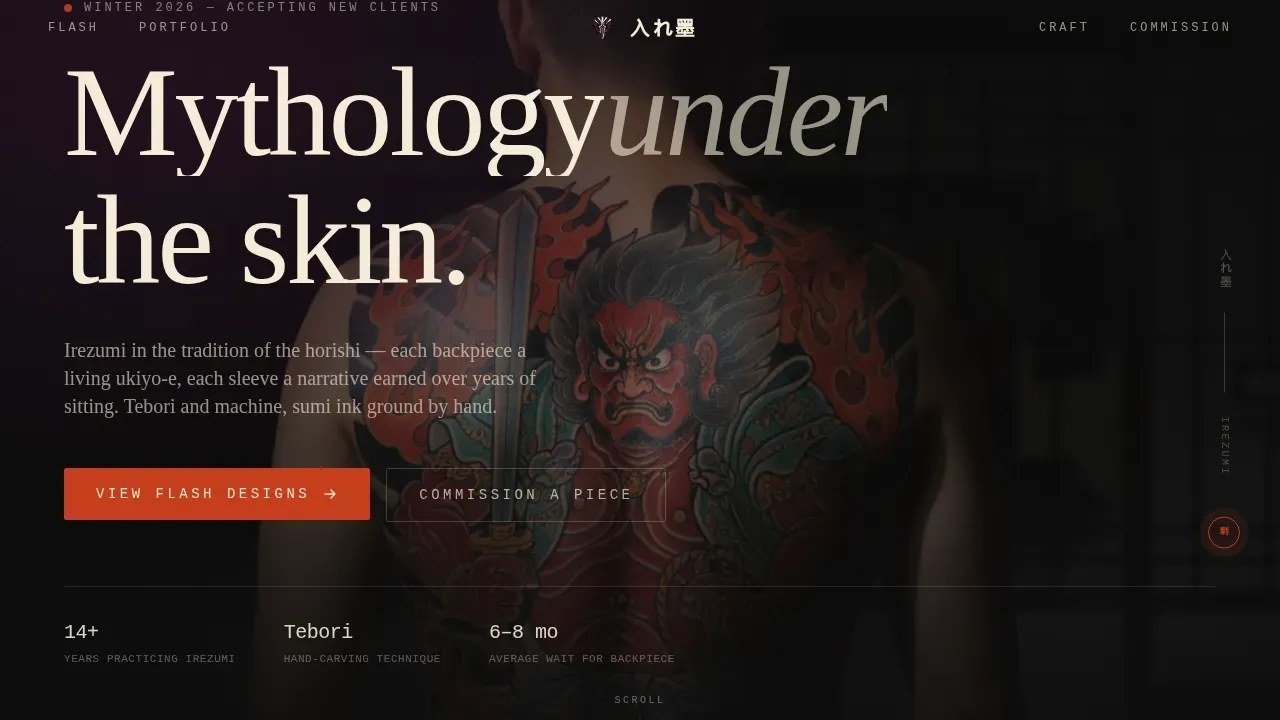
- A full-height hero section displaying a completed backpiece in Rembrandt-style portrait lighting, with the studio name running vertically in kanji and roman type
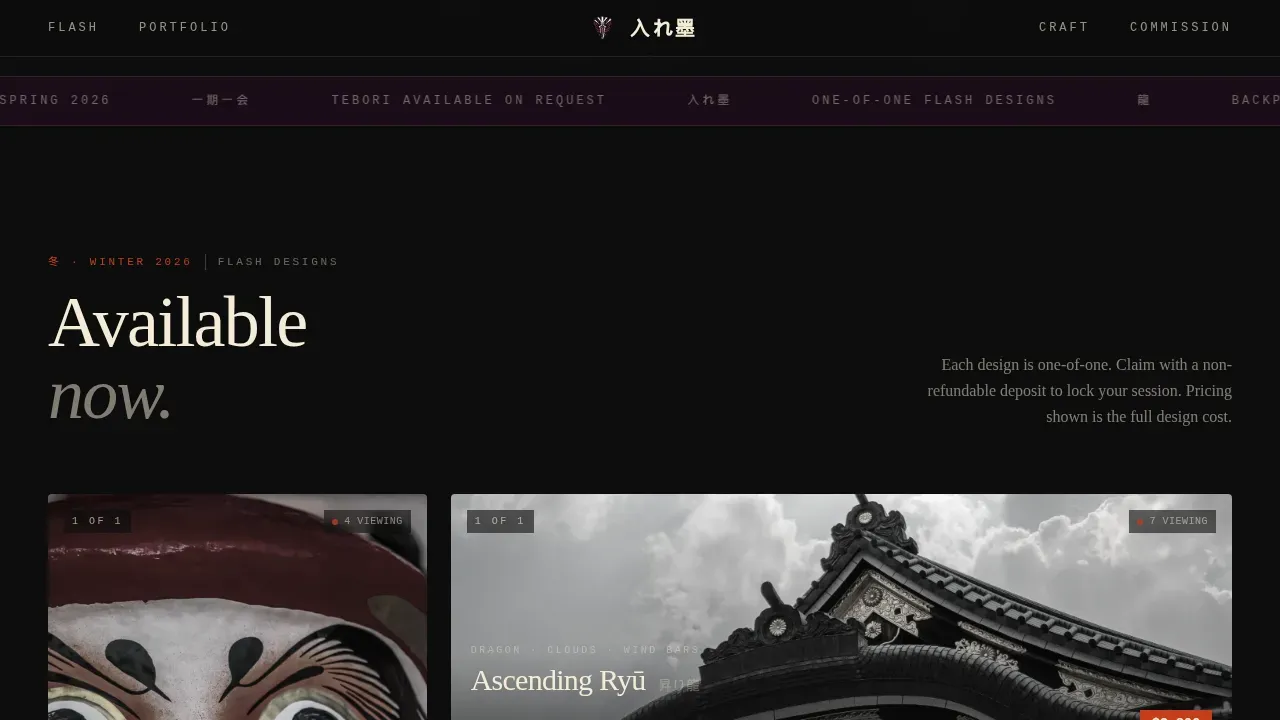
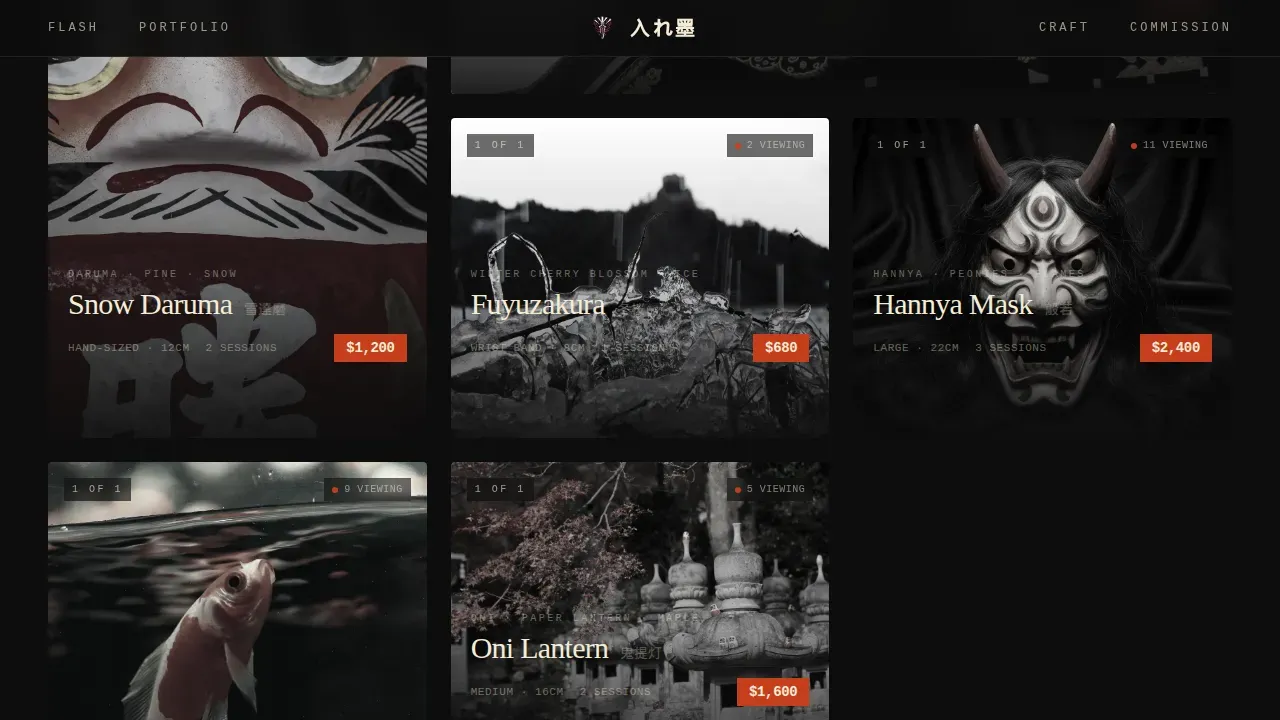
- A seasonal flash marketplace grid with visible USD pricing, one-of-one scarcity indicators, live viewer counters, and a "Claim This Design" call to action that opens a deposit modal with a calendar selector
- A mythology-organized portfolio with expandable thumbnail cards, healed photography at six months, and iconographic story text for each narrative category
Feature list
This section covers the core capabilities delivered inside the template, drawn directly from its design and interaction system.
Seasonal Flash Marketplace Grid
The flash marketplace is the commercial heart of the page. Each card in the grid displays the design name, USD price, size estimate, session count, and a "1 of 1" scarcity label. A live counter shows how many people are currently viewing each design. Clicking a card opens a claim modal with an embedded payment field, an auto-filled design name, a body placement selector, and a live calendar showing the artist's next open sessions.
Mythology-Organized Portfolio Gallery
The portfolio is structured by narrative, not by body part. Sections for dragons, phoenixes, oni, and Buddhist deities each contain expandable thumbnail cards. Clicking a thumbnail opens a detail view with high-resolution closeup linework, healed photos at six months, and written context explaining the iconography and the story behind each piece. This depth builds trust with collectors who already know their japanese tattoo designs.
Custom Commission Consultation Form
The secondary conversion path begins with a "Commission a Custom Piece" call to action. The form collects reference image uploads, preferred placement, and a budget range starting at the deposit minimum. This structured intake replaces scattered email threads, giving the artist the information they need before the first conversation.
Vertical Portrait Hero with Studio Identity
The hero section uses a single full-height portrait photograph: a client standing with their back turned, a completed Fudo Myoo backpiece filling the frame from nape to waist. Rembrandt lighting from the upper left makes the skin glow against a lacquered black background. The studio name runs vertically along the right edge in both kanji and roman type, functioning like a signature on a woodblock print.
Seasonal Narrative Content System
The page opens in the current season and curates available flash designs and open booking windows around seasonal Japanese motifs. Spring surfaces cherry blossom sleeve designs and koi ascending waterfalls. Winter brings snow-covered Daruma and pine compositions. Each seasonal pass refreshes the grid's editorial mood without rebuilding the page structure.
Parallax Scroll and Interactive Animations
The template includes high-intensity animation: parallax scroll, text mask reveals, grayscale-to-color hover transitions on portfolio cards, and a marquee element for studio messaging. The flash card expansion, claim modal, calendar selector, and portfolio lightbox are all built as interactive client components, while static sections use server rendering for stability.
Page sections overview
| Section | Purpose |
|---|---|
| Hero Portrait | Full-height Fudo Myoo backpiece photograph with vertical studio name in kanji and roman type |
| Seasonal Flash Grid | Marketplace cards with pricing, scarcity labels, viewer counters, and "Claim This Design" action |
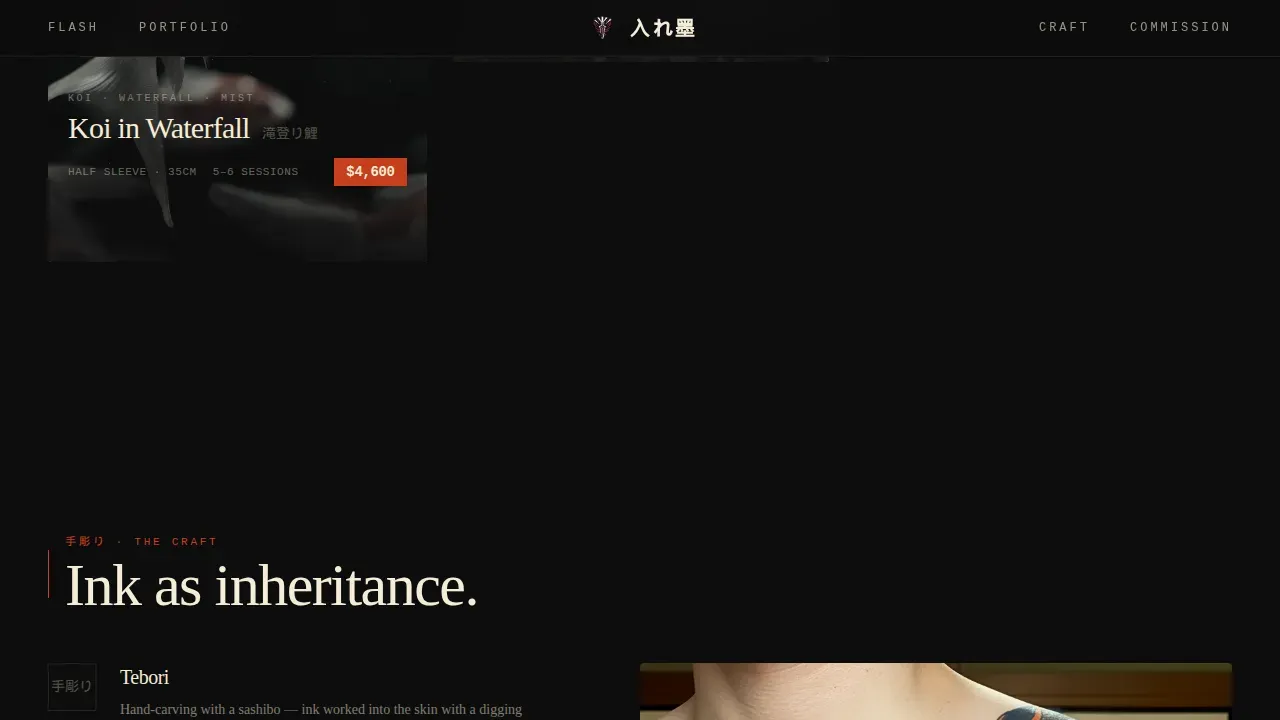
| Craft and Technique | Tebori versus machine explanation, authenticity proof, and technique narrative |
| Portfolio by Mythology | Dragon, phoenix, oni, and Buddhist deity galleries with expandable detail and healed photography |
| Commission Path | Custom consultation form with reference uploads, placement selector, and budget range |
| Footer Flow | Horizontal footer pattern with studio contact and brand identity elements |
Design & branding system
The visual identity draws from the inside of a collector's tansu chest: dark paulownia wood, silk wrapping cloths, and the shock of red cord tying a scroll shut. Every color decision serves a functional purpose, not just an aesthetic one.
- Palette: deep murasaki plum (#4A1942), lacquered black (#0D0D0D), aged washi cream (#F5ECD7), and vermillion red (#C73E1D) reserved exclusively for price tags, booking buttons, and the studio's hanko seal mark
- Typography: DM Serif Display for headings, Fraunces for editorial body text, and IBM Plex Mono for labels and price displays, creating a layered reading hierarchy that feels both literary and precise
- Style: dark lacquered editorial meets ukiyo-e woodblock print, with kanji accents integrated as typographic elements rather than decorative afterthoughts
Mobile & speed optimization
The template is built desktop-first, reflecting the research habits of serious collectors who study portfolio work carefully on large screens. Full mobile support is included so that browsing, viewing, and inquiring work cleanly at any screen size.
- Desktop-first layout with full responsive support across tablet and mobile viewports
- Server components handle static sections for stability; client components are scoped to interactive elements like the flash card expansion, claim modal, and portfolio lightbox
- High-animation interactions including parallax, text mask reveals, and hover transitions are implemented as client-side components, keeping the static content delivery efficient
How this template helps you convert
The conversion architecture is built around three psychological levers: scarcity, depth, and immediacy. Each section moves the visitor one step closer to committing.
- Scarcity and social proof work together in the flash marketplace: the "1 of 1" label combined with a live viewer counter creates urgency without manufactured pressure, and session count estimates let collectors plan their commitment before clicking "Claim This Design"
- Portfolio depth earns trust at the consideration stage: healed photography at six months, closeup linework, and iconographic story text answer the collector's real questions about technique, healing, and cultural meaning before they ever contact the studio
- The dual-path conversion structure captures both ready buyers and longer-horizon planners: the direct claim flow with an embedded deposit closes flash sales immediately, while the custom commission form with budget selector and reference image uploads starts the relationship for clients whose piece will take years to complete
Other information about this template
The template is rooted in the full cultural and historical context of traditional irezumi, and that depth shows throughout the copy framework and portfolio organization. Understanding this context helps studios present their work with the seriousness it deserves.
- During the Edo period (1603 to 1868), japanese tattoos became deeply connected to ukiyo-e woodblock prints, which shaped the intricate designs and bold compositions we recognize in traditional irezumi today
- The japanese government outlawed tattooing during the Meiji period (1868 to 1912) to align with western counterparts' ideals, which drove the art form underground and contributed to its later association with the Yakuza; this historical significance is part of the story many clients want told through their tattoos
- Traditional irezumi was originally worn as a mark of good fortune by laborers and fishermen; its common themes of protection, bravery, and strength connect to a continuous lineage that tattoo collectors find deeply meaningful
- The japanese dragon carries profound meaning distinct from chinese dragons: japanese dragons are typically depicted with three claws, while chinese dragons have four or five; in japanese mythology, koi that ascend longmen falls are transformed into dragons, making the koi fish and japanese dragon tattoo a single continuous narrative of overcoming obstacles
- A fu dog (also spelled foo dog), known as Komainu in japanese, represents fierce protection and appears alongside other mythical creatures like the hannya mask and kitsune in traditional japanese tattoo designs; the fu dog and foo dog are the same protective figure, drawn from japanese folklore and temple guardian traditions
- The hannya mask is one of the most recognized symbols in japanese tattoo art, representing a woman consumed by jealousy and transformed by grief; it carries powerful symbolism about the consequences of obsession and the complexity of human emotion
- Cherry blossoms, maple leaves, and wind bars are essential background elements in traditional irezumi compositions; cherry blossoms represent the fleeting nature of life, while wind bars and swirling patterns give the artwork movement and cohesion across the body's natural contours
- A lotus tattoo carries profound meaning in the buddhist traditions that run through japanese tattoo art: rising from muddy water into beauty, it represents personal journey, spiritual overcoming, and the quiet contemplation that serious collectors bring to every commission decision
- Tebori, the traditional hand-poking method using a bamboo or wooden rod tipped with needles, predates the modern tattoo machine by centuries; mastering tebori takes years and is typically learned under a master tattooist in the lineage of artists like horiyoshi iii, whose influence on traditional irezumi is recognized worldwide
- Horiyoshi iii is widely regarded as one of the most important living practitioners of traditional irezumi; his approach to the tattooing process, his use of mythological narrative, and his dedication to tebori represent the standard that collectors reference when seeking an artist who understands the grammar of japanese composition
- In earlier centuries, tattooed workers were sometimes banned from public baths and hot springs in japan due to the stigma surrounding irezumi; today that same visual power is sought by collectors as a mark of commitment, artistry, and personal meaning
- Clay figurines called Haniwa, excavated from ancient japanese burial sites, are among the earliest evidence of body marking in japanese culture; they connect the art form's roots to ritual and symbolic elements that predate written history
- Life's journey, embodying wisdom, and changing seasons are woven into the symbolic language of traditional japanese tattoos, making each commission a collaboration between the artist's craft and the client's own story
Theme
Marketplace Grid
Creative direction
Seasonal/Moment
Color system
Plum Executive
Style
Gallery + Detail
Direction
Direct Sales
Page Sections
Seasonal Flash Marketplace Grid
Mythology-organized Portfolio Gallery
Custom Commission Consultation Form
Vertical Portrait Hero Section
Parallax Scroll and Animation System
Craft and Technique Narrative Section
Related questions
What types of clients is this template designed for?
How does the flash design sales flow work?
Can the portfolio be organized by mythological subject rather than body part?
Does the template support custom commission inquiries?
Is the template suitable for Japanese tattoo studios outside Japan?