Podcasters Peer Advisory Board Landing Page Template
Gather is an editorial landing page template built for independent podcasters launching a peer advisory board. It guides serious creators through a longform origin-story scroll, pulls them in with manifesto typography and warm analog design, and moves them toward a three-field application form. The result is a page that feels earned, not sold.
by Rocket studio
Quick summary
Gather is a single-page editorial template designed for a podcasters peer advisory board. It opens with a manifesto headline set in large serif type, unfolds through a longform narrative scroll, surfaces member pull-quotes with real download counts, reveals the board structure, and closes with a focused application form. Every design choice slows the reader down on purpose.
Who this template is for
This template is built for founders running a curated community or peer advisory board aimed at independent podcasters. It suits anyone who needs their page to do quiet, trust-building work rather than loud conversion tactics.
- Independent podcast producers launching a private peer cohort or membership board
- Community founders who want editorial depth and an application-based registration flow
- Creators targeting podcasters pulling roughly 10,000 to 50,000 downloads per episode
What problem this template solves
Independent podcasters at a mid-career plateau rarely have a space to speak candidly about stalled growth, sponsor fatigue, or creative isolation. Generic community pages do not convey the intimacy that kind of honesty requires. Gather solves the mismatch between the depth of the offer and the shallowness of typical event registration pages.
- Most community landing pages lead with features and pricing, which creates distance instead of trust
- Podcasters who've outgrown casual Facebook groups need to feel the room before they apply
- A standard form-first layout does not communicate the selective, peer-curated nature of the board
What you get with this template
You get a complete, single-page editorial layout with five distinct content sections, a sticky application call-to-action bar, and a three-field registration form. The page is desktop-first with a mobile fallback, and every section is structured to deepen reader trust before the ask arrives.
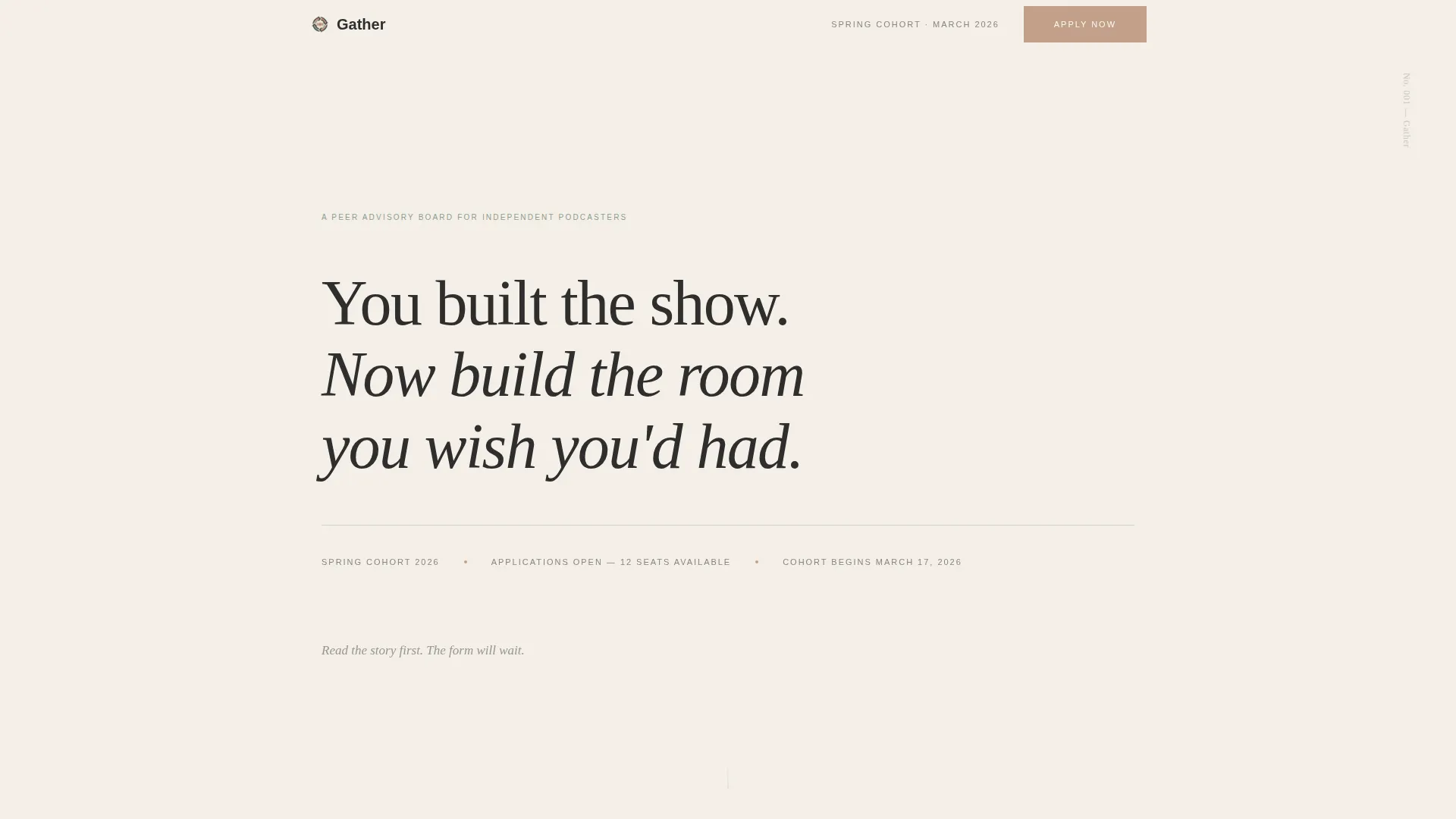
- A hero section with a manifesto headline, thin sage rule, and cohort dateline
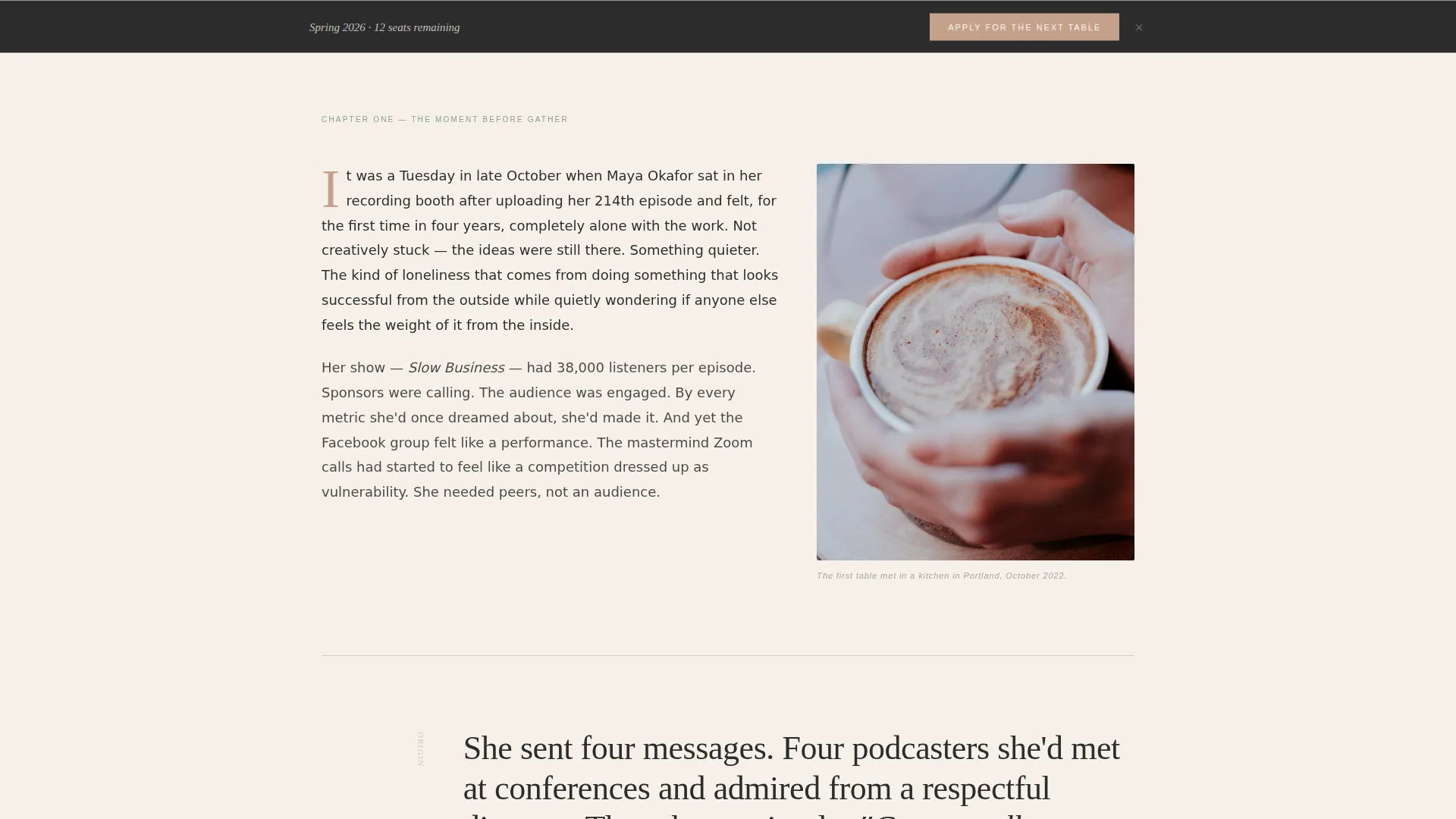
- A longform origin story scroll with member pull-quotes, quiet photography placeholders, and a board structure reveal
- A three-field application form asking for show name, average downloads, and one open-ended vulnerability question
Feature list
A paragraph introduces this section: every feature below is drawn directly from the template brief and reflects what is built into the layout.
Editorial Manifesto Hero
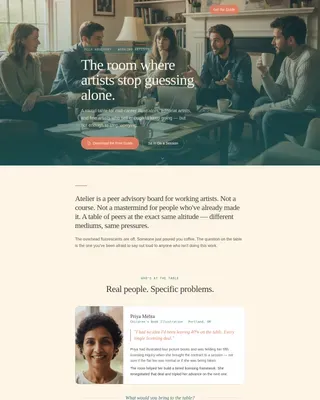
The hero carries a single bold headline in large Fraunces serif type set against warm parchment with no image or video behind it. A thin muted sage rule sits below the headline, followed by a dateline-style subhead naming the next cohort start date. The restraint is intentional and signals the tone of the entire page.
Longform Origin Story Scroll
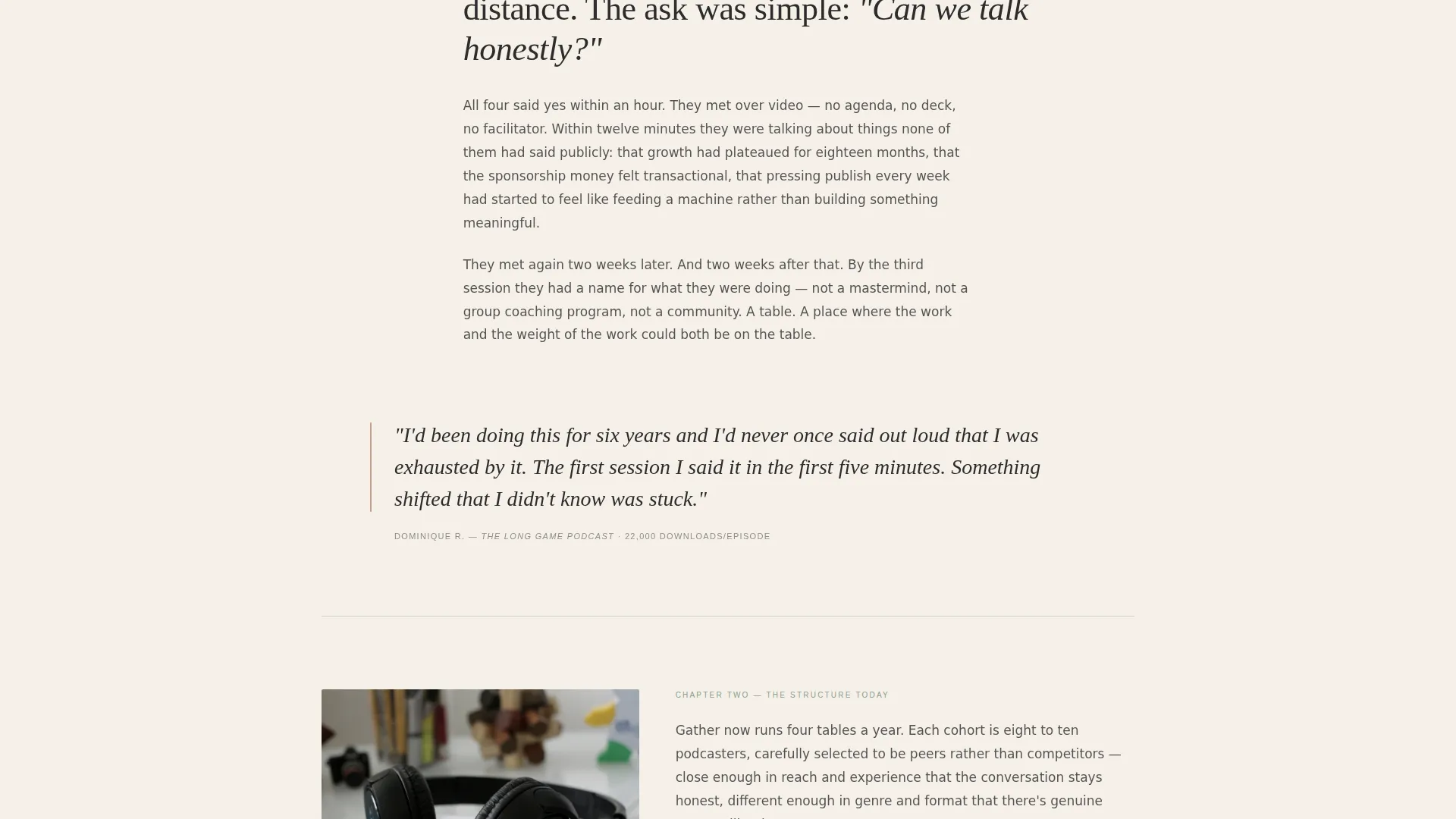
The page body unfolds like a magazine feature across three narrative beats: the founder's moment of isolation, the first board forming around a kitchen table, and the structure as it exists today. Each scroll section pairs a narrative paragraph with a member pull-quote attributed by first name, show title, and download count.
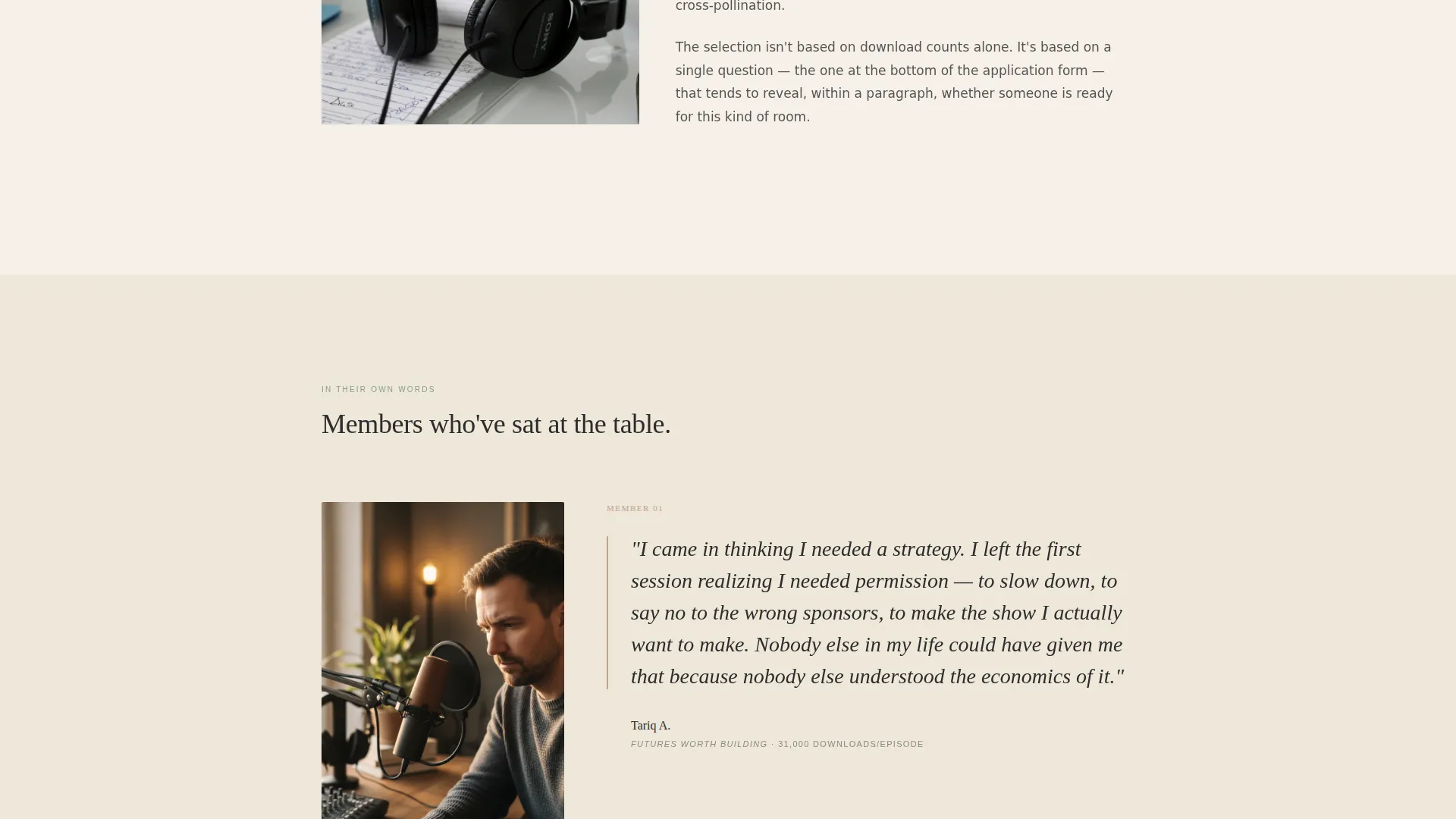
Member Pull-Quote System
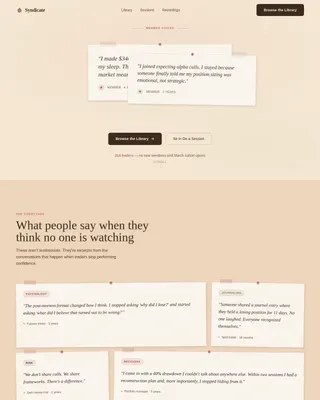
Pull-quotes are formatted with first name, show name, and episode download count, giving social proof a grounded, specific quality. Quiet photography placeholders showing hands, headphones, and notebooks appear alongside each quote to reinforce the analog warmth of the space.
Sticky Application Call-to-Action Bar
A sticky bottom bar carrying the primary call-to-action label appears only after the visitor has scrolled past 60 percent of the page. This timing ensures the prompt arrives after the reader has moved through the full trust arc, not before.
Three-Field Application Form
The form asks for show name first, then average episode downloads, then a single open-ended question: "What's the conversation you can't have anywhere else?" The open field self-selects for applicants ready to engage honestly and gives the board founder everything needed to curate the next cohort.
Scroll-Triggered Reveal Animations
Paragraph content fades in on scroll at a slow, deliberate pace. The animation cadence matches the unhurried editorial tone and keeps the reading experience feeling intentional rather than transactional.
Page sections overview
| Section | Purpose |
|---|---|
| Hero Manifesto | Sets editorial tone and cohort date |
| Origin Story Scroll | Builds trust through narrative arc |
| Member Voices | Social proof via attributed quotes |
| The Table | Reveals board structure and format |
| Application Form | Converts readers into applicants |
| Footer | Minimal single-row site close |
Design & branding system
The visual identity follows a Healing Space theme built on the Cloud Canvas color system. Typography drives the layout rather than imagery, and every color choice references analog materials over digital polish.
- Color palette: warm parchment (#F5F0E8) background, deep charcoal (#2C2C2C) body text, muted sage (#A3B5A6) accents and rules, soft fog gray (#D6D1CA) borders, dusty rose (#C4A08A) on interactive elements and calls-to-action
- Typography: Fraunces serif for all display headlines and pull-quotes; DM Sans for body copy and form labels
- Visual style: editorial and magazine-paced, deliberately unhurried, analog warmth, no hero imagery or video
Mobile & speed optimization
The template is designed desktop-first to support the longform editorial reading experience, with a mobile fallback layout included. JavaScript use is kept minimal to preserve load performance.
- Static content areas use server components to reduce unnecessary client-side rendering
- Animations are low-to-medium weight, relying on slow word fades and scroll-triggered paragraph reveals rather than heavy effects
- The sticky call-to-action bar is lightweight and appears only after the 60 percent scroll threshold is reached
How this template helps you convert
Gather converts through earned trust rather than urgency tactics. Every structural choice is calibrated to make the reader feel like they already belong before the form appears.
- The origin story arc takes the reader through a three-part narrative that builds personal connection and credibility before any ask is made, so the application feels like a natural next step rather than a cold prompt.
- The open-ended form question filters applicants by intent, meaning the people who complete it are already self-selected for vulnerability and seriousness, which improves cohort quality for the founder and reduces friction for the right candidate.
Other information about this template
This template sits inside the Community and Nonprofit category and is specifically matched to the Podcasters Community subcategory and Podcasters Peer Advisory Board niche. It is built for a B2C community membership application flow with an editorial and magazine visual style.
- The template style is Editorial/Magazine with a Healing Space theme and a Cloud Canvas color system
- The creative direction follows an Origin Story structure, opening with a personal founder moment and widening outward
- The header concept is Quote/Manifesto, placing a single editorial sentence as the entire visual anchor of the hero
- The landing page direction is Event Registration, optimized for cohort-based application conversion
- This layout is a strong fit for founders who want their community page to read like a thoughtful feature article rather than a typical sign-up funnel
Theme
Healing Space
Creative direction
Origin Story
Color system
Cloud Canvas
Style
Editorial/Magazine
Direction
Event Registration
Page Sections
Editorial Manifesto Hero Section
Longform Origin Story Scroll
Attributed Member Pull-quotes
Sticky Application Call-to-action Bar
Three-field Application Form
Scroll-triggered Paragraph Reveals
Related questions
What kind of community is this template designed for?
Can I update the cohort date and member quotes myself?
Is the sticky call-to-action bar always visible on the page?
Why does the application form only ask three questions?
Does the template support mobile visitors?