Ancestral Lands Tribal Parks Fundraising Landing Page Template
The Gather Ancestral Lands Tribal Parks Fundraising Landing Page Template is a single-column fundraising layout built for tribal parks authorities. It uses a hand-drawn cartographic hero map, live budget visuals, tiered donation cards, and community voice storytelling to help diaspora donors, community allies, and foundation grant officers give with full confidence in how every dollar is used.
by Rocket studio
Quick summary
Gather is a fundraising landing page template designed for tribal parks and recreation authorities that steward ancestral lands. It combines a parallax cartographic hero map, a live stacked budget bar, individual project cards with progress rings, and an inline donation form to move visitors from curiosity to contribution. The Community Hearth color system and earthy typography make the page feel grounded, honest, and human.
Who this template is for
This template serves organizations that care for indigenous land and want to raise funds transparently. It is built for communities that need to show every dollar's destination before asking for a gift.
- Tribal parks authorities maintaining ceremony grounds, trails, riverside pavilions, and sacred places on ancestral lands
- Fundraising coordinators reaching diaspora donors in urban areas, community allies, and foundation grant officers who require documented accountability
- Indigenous communities and native communities launching or renewing public-facing conservation fund campaigns tied to specific, named projects
What problem this template solves
Many fundraising pages for indigenous peoples and tribal nations ask for trust without earning it first. Donors who give to land stewardship causes, especially those supporting indigenous land held since time immemorial, need to see the receipts before they reach for their wallets.
- Generic donation pages hide budget details, leaving grant officers and diaspora donors skeptical about where public funding actually goes
- Pages built without mobile-first design fail to reach donors on the go, and a mobile-optimized layout can increase donation yields by over 30 percent
- Scattered navigation and distracting links pull attention away from the giving decision, reducing conversions
What you get with this template
You get a focused, distraction-free fundraising landing page that puts the land at the center of every scroll beat. The layout removes main navigation and unrelated links, keeping the visitor's attention on the cause and the call to action.
- A full single-column flow across six sections: a parallax map hero, a completed projects timeline, a live budget breakdown bar, individual project funding cards, a community voice section, and a linear footer
- An inline donation form with three to four tiered giving levels named after real project components, a recurring gift checkbox, a gift dedication field, and a single email field for receipts
- A "Share This Map" secondary call to action that generates a unique link so donors can show others exactly what they helped build, extending the reach of the campaign through personal networks
Feature list
This template includes purpose-built components drawn directly from the project brief. Each one addresses a specific donor trust barrier or conversion need.
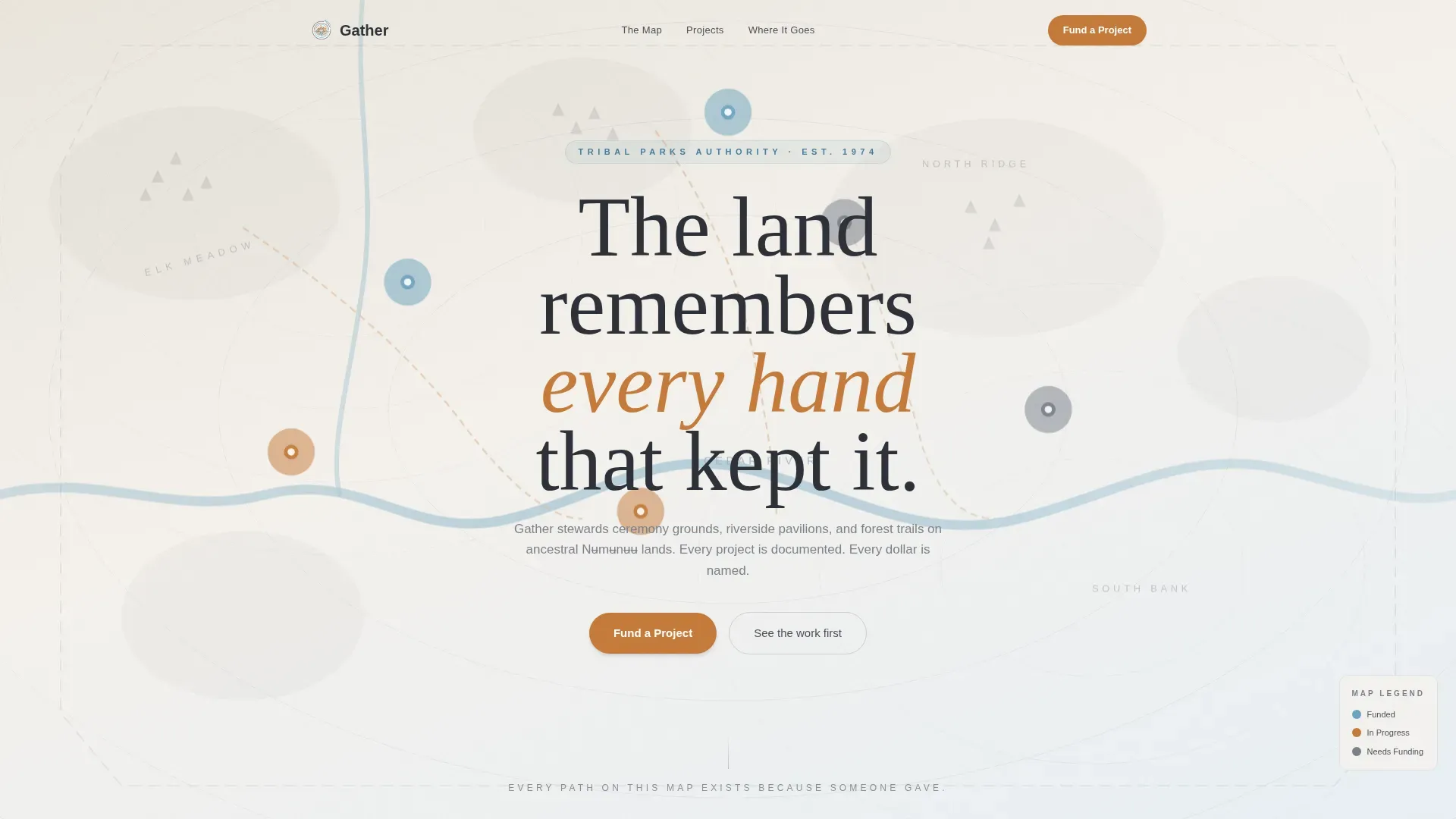
Parallax Cartographic Hero Map
The header is a stylized, hand-textured aerial illustration of the tribal territory. Named parks, trail networks, waterways, and sacred places appear with pulsing pin markers. Each pin carries a tooltip showing the project name, its funding status, and its cost. Layered parallax depth makes the land feel dimensional rather than flat, and a single anchored tagline, "Every path on this map exists because someone gave", roots the emotional ask before any text below the fold appears.
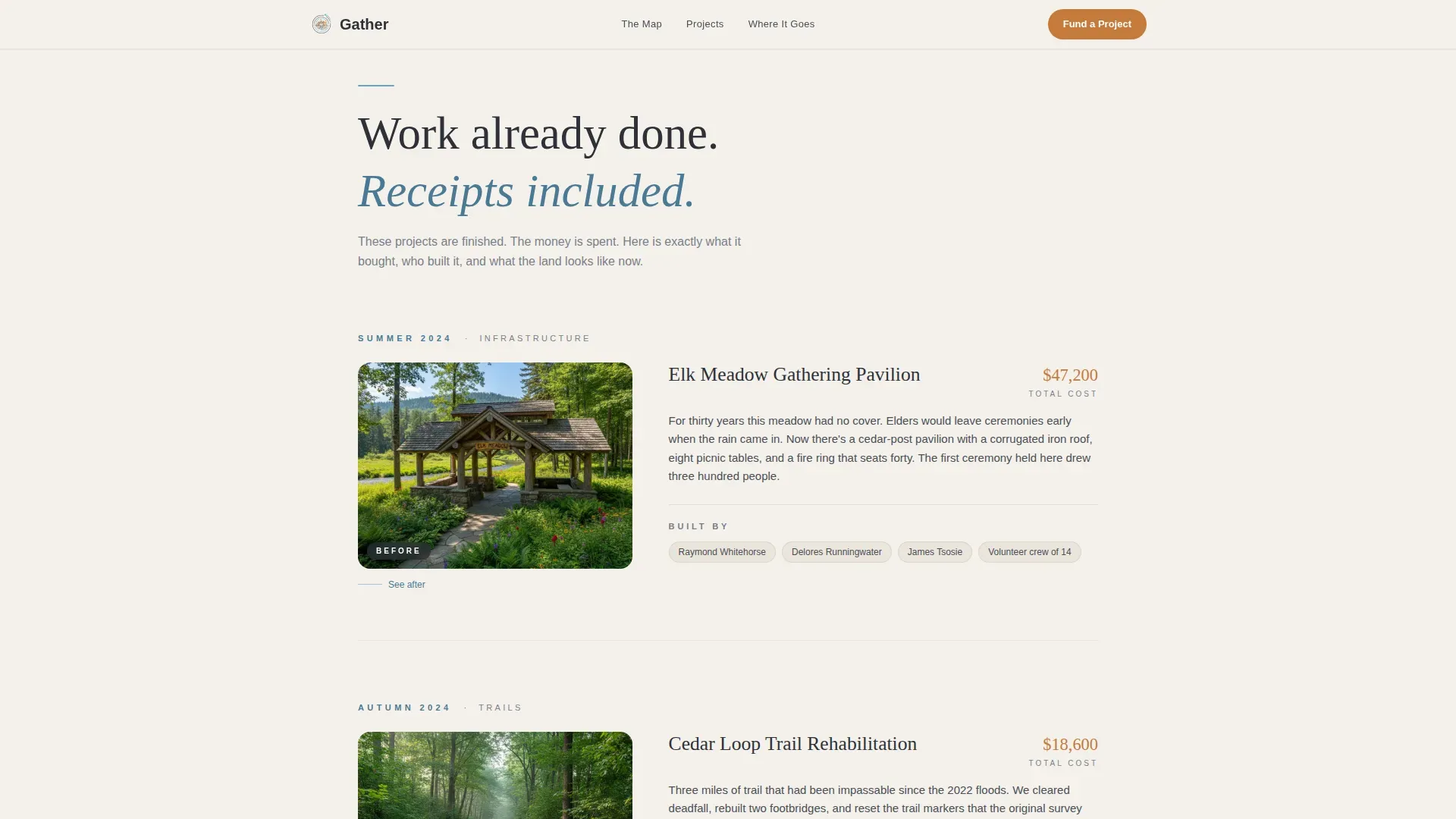
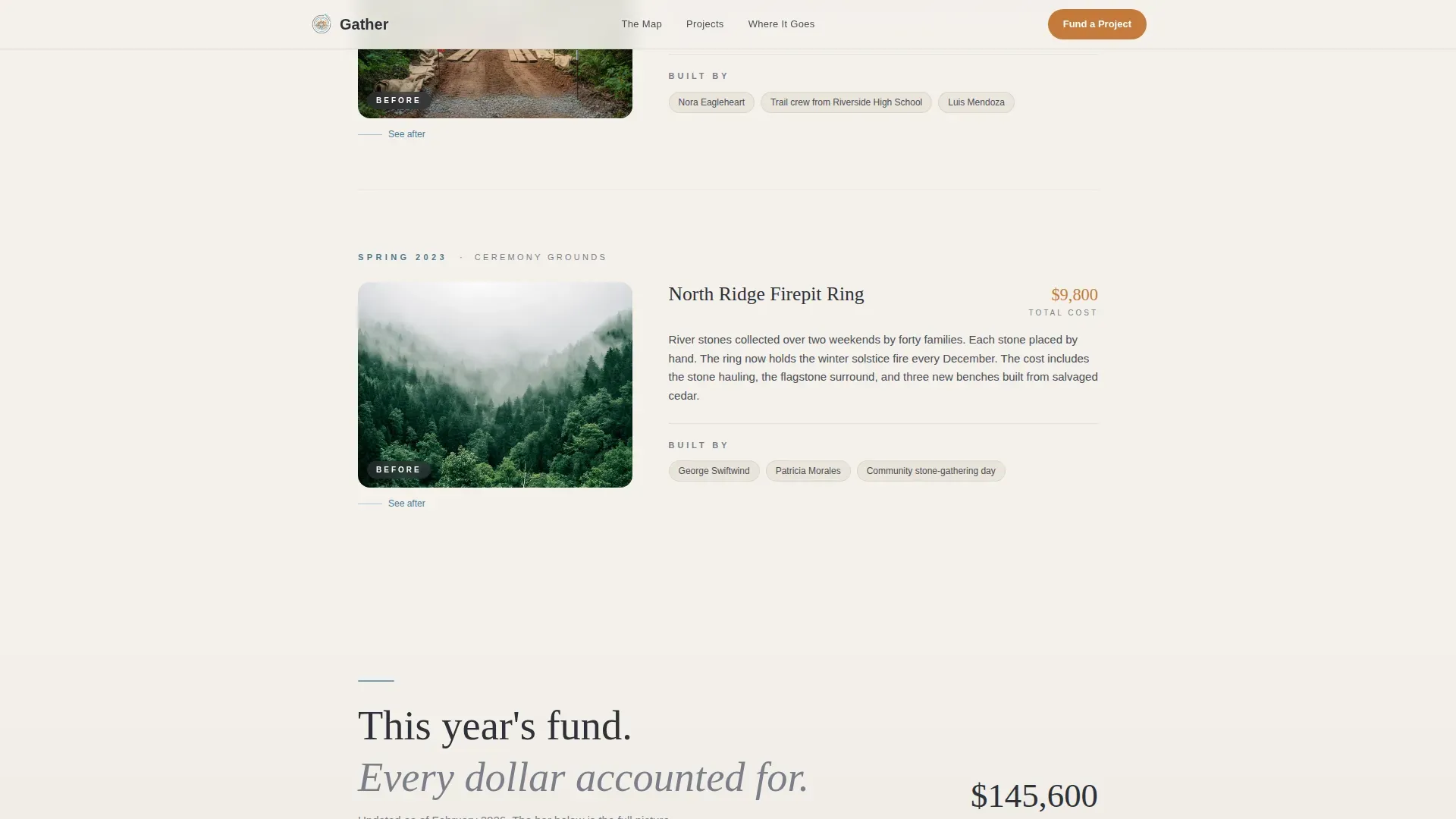
Completed Projects Timeline
A before-and-after timeline displays last year's finished work with photos, exact costs, and the names of the community members who built each project. This section makes the organization's track record visible and specific. Seeing real dollar amounts next to real names builds the kind of credibility that no logo badge alone can provide.
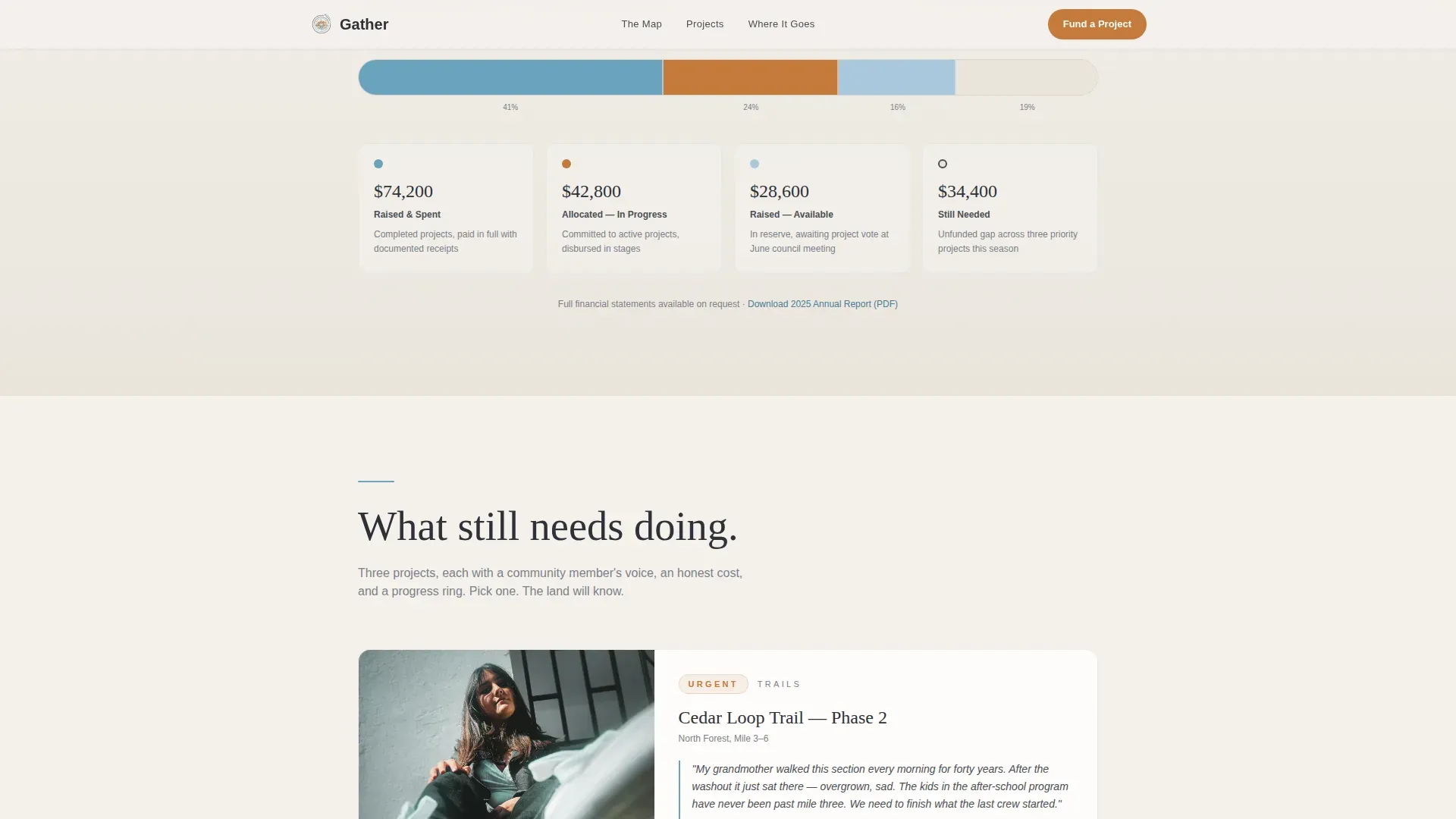
Live Budget Breakdown Bar
A horizontal stacked bar shows the current year's conservation fund split into three segments: funds raised, funds allocated, and funds remaining. The bar updates in real time, giving diaspora donors and grant officers an honest, at-a-glance view of the organization's financial position. Real-time fundraising progress indicators create urgency and demonstrate momentum toward the campaign goal.
Project Cards with Progress Rings
Individual project cards unfold one by one as the visitor scrolls. Each card shows a photo, a paragraph written in a community member's voice, a cost figure, and a circular progress ring showing how close the project is to its funding target. A "Fund a Project" button in hearth ember anchors the bottom of every card, triggering the inline donation form without leaving the page.
Inline Donation Form with Tiered Levels
The donation form opens directly on the page, eliminating extra clicks. Preset giving tiers are named after project components, for example, "$25 Trail Marker," "$75 Firepit Stone," "$250 Pavilion Beam", so donors immediately understand the impact of each amount. The form also includes a checkbox for recurring monthly gifts, which converts one-time donors into long-term supporters, and closes with a heartfelt thank-you message on submission.
Share This Map Secondary call to action
A secondary call to action labeled "Share This Map" generates a unique shareable link tied to the donor's contribution. This lets supporters show their networks exactly what they helped fund, turning each donor into a campaign ambassador. Incorporating this kind of social sharing can help extend campaign reach well beyond the initial audience.
Page sections overview
| Section | Purpose |
|---|---|
| Hero Map | Parallax cartographic illustration with pulsing project pins, status tooltips, and anchored tagline |
| Completed Projects | Before-and-after timeline showing exact costs and builder names from last year's work |
| Live Budget Bar | Horizontal stacked bar with real-time raised, allocated, and remaining fund totals |
| Project Funding Cards | Individual scroll-reveal cards with progress rings and inline "Fund a Project" call to action |
| Community Voice | Donor quote and "Share This Map" secondary call to action |
| Linear Footer | Single-row footer with essential links and organization details |
Design & branding system
The Slate and Sky color system draws from river stones and bleached cotton. Every color choice serves a functional role: grounding trust, directing attention, and signaling warmth without sentimentality.
- Four-color palette: morning frost (#F4F1EC) as the prevailing background, weathered basalt gray (#4A4E56) for primary text and section dividers, open-sky blue (#6BA3BE) for interactive elements and progress indicators, and hearth ember (#C47A3A) on donation buttons and highlighted cost figures
- Typography pairing: Fraunces serif headlines carry cultural weight and gravitas, while DM Sans body text keeps reading easy and unhurried across long scroll distances
- Visual style: earthy cartographic, hand-textured, and fire-pit warm, the aesthetic aligns with the land stewardship mission and reflects environmental protection values without relying on stock photography clichés
Mobile & speed optimization
Diaspora donors are primarily on mobile devices, often giving from cities far from the land they are supporting. The template is built mobile-first to meet them where they are.
- Single-column flow adapts cleanly to small screens; scroll-reveal animations use the Intersection Observer API so sections load only when they enter the viewport
- Smooth scroll behavior uses native CSS, keeping transitions fluid without heavy JavaScript overhead
- The donation form is kept on the page rather than redirected to an external URL, reducing friction and keeping the mobile experience contained and fast
How this template helps you convert
The template follows a need-outcome-proof-action model. Every scroll beat earns the next ask rather than leading with it. By the time a visitor reaches the donation form, they have already seen the organization's track record, its current budget, and the specific project their money will support.
- The hero map and completed projects timeline establish credibility before any donation ask appears, showing indigenous peoples and allied donors alike that the organization is accountable and that lands and waters under its care are actively maintained
- The live budget bar and project cards present transparent, specific financial information, exact costs, progress rings, named builders, so grant officers and foundation donors can confirm that natural and cultural resources are managed with documented responsibility
- Tiered giving levels with named impact descriptions, a recurring gift option, and a single-click share tool give every visitor a clear, low-friction path to contribute and to bring others along
Other information about this template
The broader context around indigenous land and public land stewardship shapes why a template like this matters. Every national park site in the United States sits on ancestral lands, and national parks and monuments often occupy sacred places that indigenous peoples managed since time immemorial. The Lakota People's Law Project has launched an intertribal fund to financially compensate tribal nations whose homelands are occupied by national park and national monument designations. The Lakota People's Law Project's initiative distributes 100 percent of visitor donations to participating tribes, one example of how compensation models are evolving alongside conservation fund efforts.
Organizations including the Conservation Fund have partnered with tribal governments and public agencies to complete land transactions that protect culturally significant sites, while the National Park Service has made strides toward appointing native americans to leadership roles and allowing traditional plant gathering. Collaborative agreements like the one governing Bears Ears National Monument show how indigenous partners and the federal government can share stewardship of public land. Similar efforts exist at sites including Grand Canyon National Park, Wind Cave National Park in South Dakota, and Grand Teton National Park, where the real history of displacement is finally being acknowledged alongside environmental protection commitments.
The Indian Land Tenure Foundation, the Sogorea Te Land Trust, and the Native American Land Conservancy each play a role in supporting efforts to return ancestral homelands to indigenous communities. Land trusts operated by and for native communities help ensure access to sacred waters, traditional gathering areas, and ceremony grounds that otherwise risk loss. The indian land tenure foundation and similar grassroots organizations provide technical support to first nations and tribal communities navigating land trusts and legal title processes. The nature conservancy and other conservation organizations have also engaged as indigenous partners in restoration work, though the pace of the conservation fund work must increase to meet community needs.
This template is designed for any tribal authority, intertribal council, or indigenous-led grassroots organization that wants to create a fundraising presence worthy of the cause. It can serve communities engaged in controlled burns for forest health, trail maintenance through forests where bald eagles and diverse bird species nest, and the protection of native plants along riverbanks. It fits the work of the Yurok Tribe, dakota people managing public land in the Great Plains, lakota people stewarding lands in South Dakota, native hawaiians protecting ancestral homelands, and other native americans whose connection to the land predates any designation.
The template's design philosophy draws from indigenous wisdom about land stewardship: show the land honestly, tell the truth about the painful history of displacement, and let the proof of work already done speak for future generations. Whether an enrolled member of a tribal nation is launching a campaign, or an indigenous women's leadership group is raising funds for a new pavilion, this template provides a clear, trustworthy container for that work. Environmental justice, human rights, and the complex history of how native youth came to be separated from their ancestral homelands are woven into the context this page addresses, not as slogans, but as the honest reason the campaign exists.
- Ideal for tribal authorities, intertribal councils, and indigenous-led conservation organizations
- Supports campaign types tied to named physical projects: trails, pavilions, ceremony grounds, and sacred places
- Compatible with annual powwow fundraising pushes, grant officer review seasons, and diaspora giving campaigns
- Pairs well with the Community Hearth theme for organizations whose mission centers on land, community, and cultural resources
- Suited to organizations working alongside public agencies, other nonprofits, and conservation organizations on shared land stewardship goals
Theme
Community Hearth
Creative direction
Transparent Process
Color system
Slate & Sky
Style
Single Column Flow
Direction
Donation/Fundraising
Page Sections
Parallax Cartographic Hero Map
Completed Projects Timeline
Live Budget Breakdown Bar
Project Cards with Progress Rings
Tiered Inline Donation Form
Share This Map Secondary Call to Action
Related questions
Can I customize the donation tiers and project names?
Does the template include the cartographic map illustration?
Is the live budget bar connected to a real-time data source?
Who is the primary audience this template is designed to reach?
Can this template support recurring monthly donations?