Textile & Garment Factory Professional Website Template
Gauge is a card grid landing page template built for technical knitwear and hosiery manufacturers. It uses a Data Command visual theme and a Carbon Fiber color palette to present performance specs, side-by-side comparisons, and a transparent production timeline. Every section is designed to build buyer confidence and drive a spec-for-spec inquiry from procurement-ready visitors.
by Rocket studio
Quick summary
Gauge is a modular card grid landing page for industrial knitwear and hosiery manufacturers. It leads with an exploded-view product header, stacks versus comparison cards row by row, and closes each section with a primary call to action. The design feels like an instrument panel, dark, data-forward, and built for buyers who read spec sheets before they make calls.
Who this template is for
This template is built for manufacturers and suppliers operating in technical knitwear and hosiery. It speaks to buyers who evaluate products by data, not brand story.
- Private-label sportswear brands sourcing minimum order quantities for performance socks and compression sleeves
- Procurement officers at workwear distributors comparing denier ratings, pill-resistance results, and abrasion cycle data
- Direct-to-consumer founders who understand needle cylinder specifications and need a manufacturing partner who does too
What problem this template solves
Most textile manufacturer pages describe capabilities in vague language. Buyers who work with technical specs need evidence, not adjectives. This template closes that gap.
- Generic manufacturer pages bury performance data or omit it entirely, forcing buyers to ask basic questions before a conversation can start
- Comparison shopping across suppliers is slow when no one shows their numbers publicly
- Qualified buyers leave pages that cannot prove a product claim before asking for their contact details
What you get with this template
You get a full single-page layout structured to show your manufacturing credentials through stacked evidence rather than marketing copy. Every section earns the next.
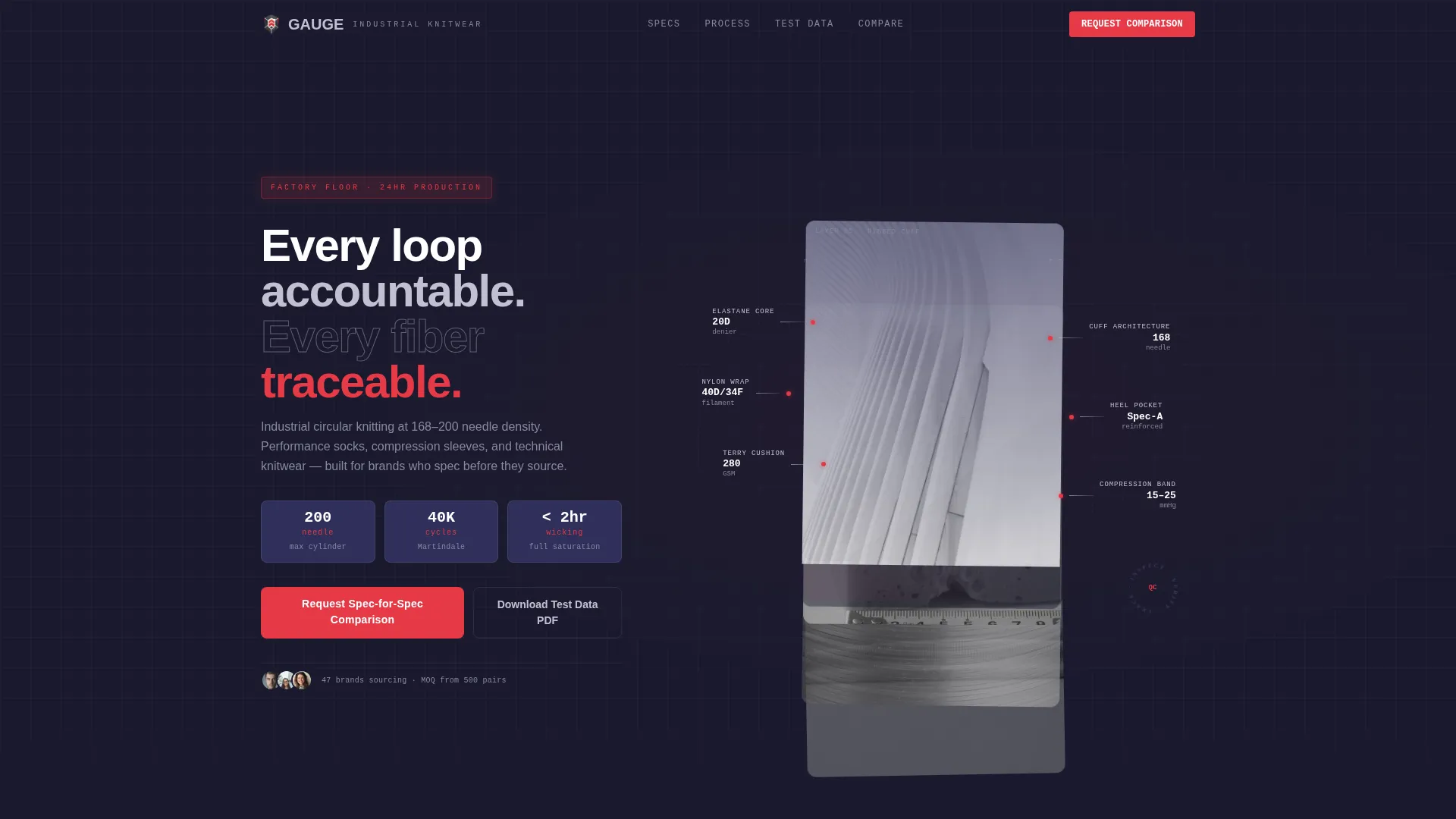
- An isometric exploded-view header that deconstructs a performance sock into labeled layers, each with spec callouts
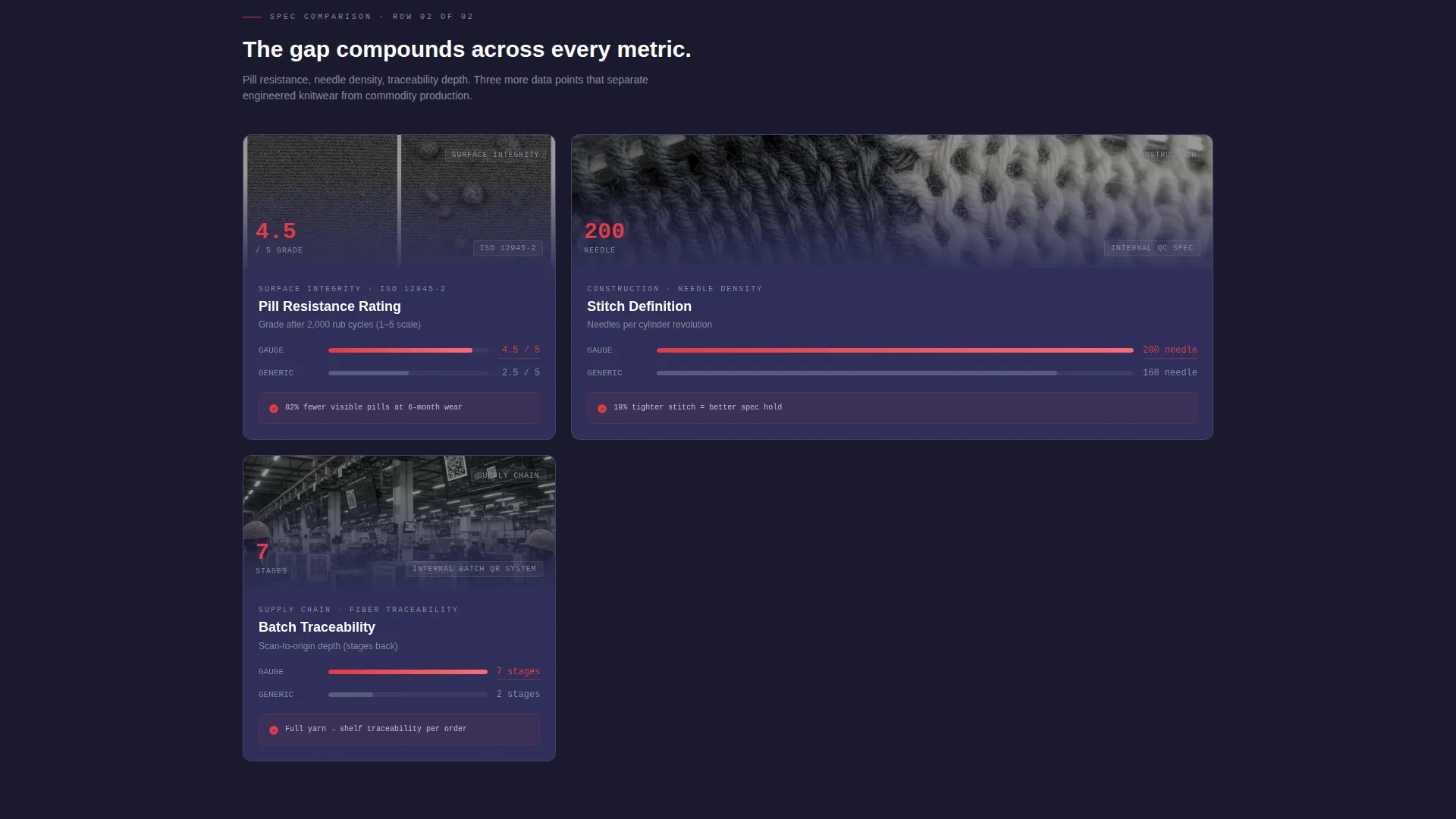
- A modular card grid of versus modules comparing your engineered knit against a generic baseline across measurable metrics
- A horizontal production timeline strip linking each stage, from yarn sourcing to quality control, to factory-floor photography and batch data
- Two conversion paths: a detailed spec-for-spec request form and a gated test data download requiring only an email address
Feature list
This section covers the core built-in components and layout capabilities included in the Gauge template.
Exploded View Product Header
The header renders a single performance sock deconstructed into its component layers in isometric space against a carbon black background. Each layer, from the elastane core and nylon wrap to the terry loop cushion zone and reinforced heel pocket, floats apart with labeled spec callouts. The composition applies a subtle scroll-driven rotation, giving visitors the feeling of orbiting the product on a digital inspection table.
Versus Comparison Card Grid
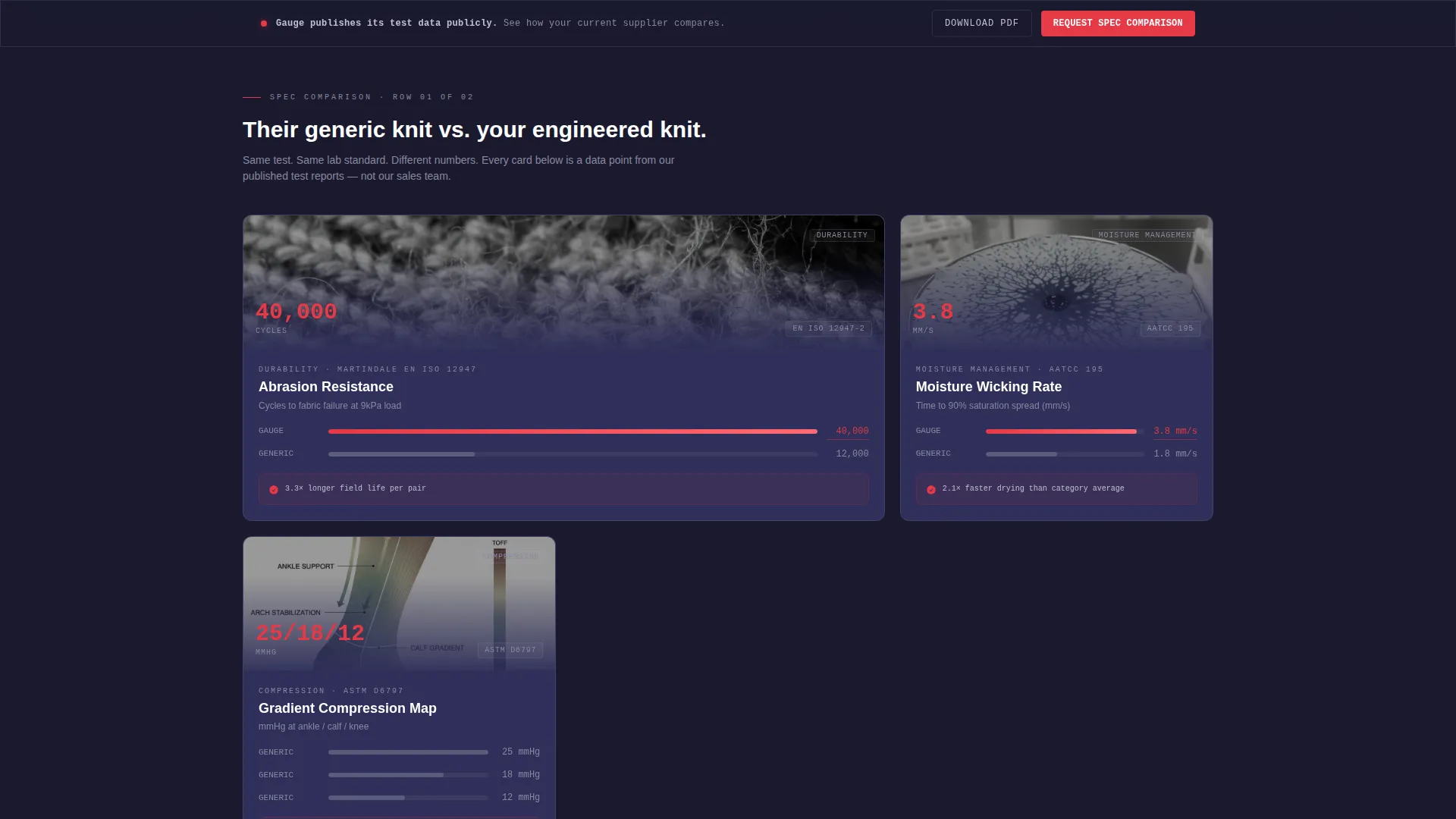
The modular card grid presents each metric as a head-to-head comparison between a generic knit and an engineered knit. Cards cover abrasion resistance using the Martindale test cycle count, moisture-wicking rate shown through a time-lapse micro-video of dye spreading through fabric, and compression gradient mapping at ankle, calf, and knee. Diagnostic red activates only where the engineered result wins, making the performance gap impossible to overlook.
Transparent Production Timeline Strip
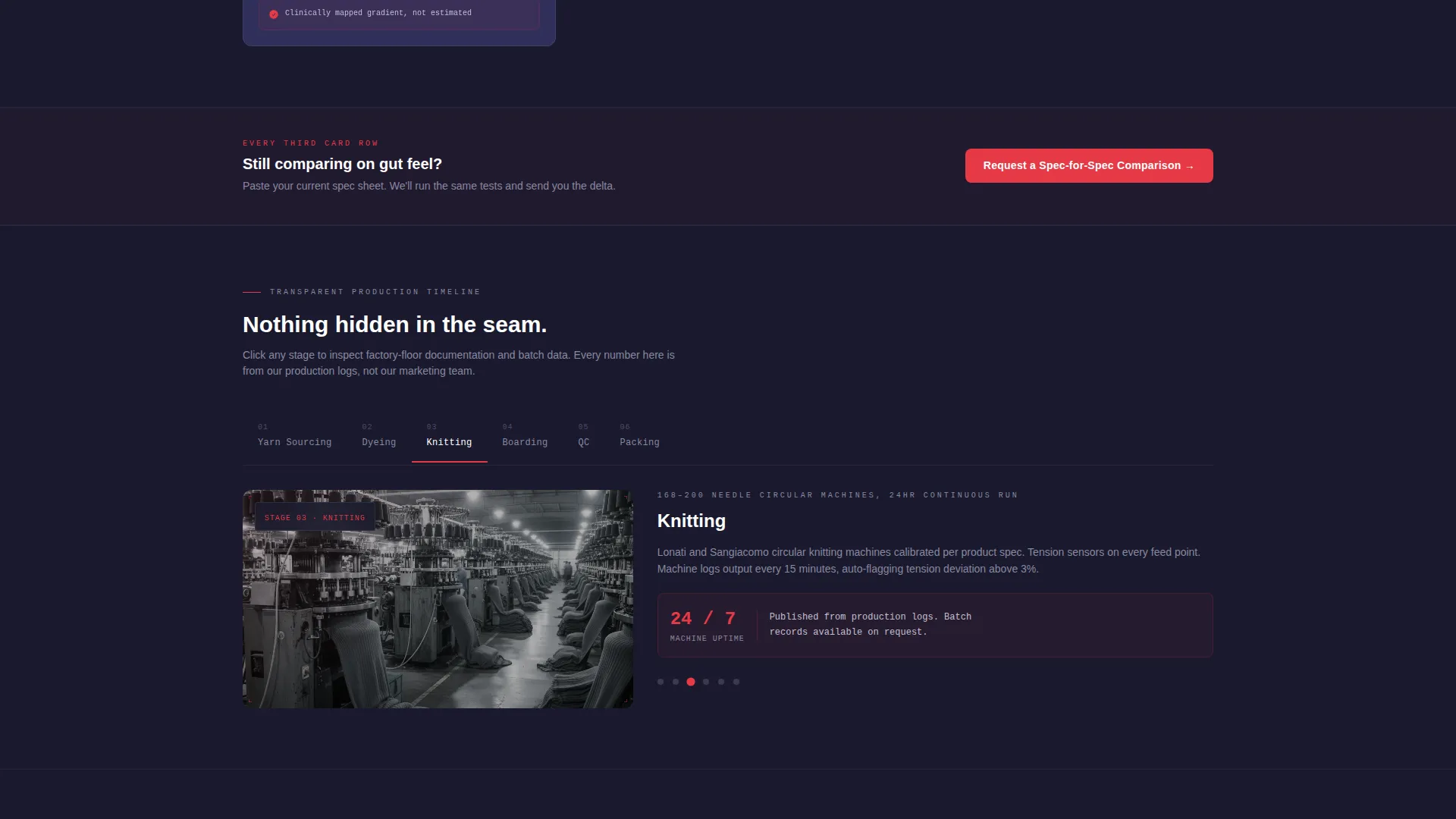
A horizontal strip between card rows maps the full production sequence: yarn sourcing, dyeing, knitting, boarding, quality control, and packing. Each stage is clickable and reveals factory-floor photography alongside batch data, giving procurement buyers a traceable view of the manufacturing process before they ever request a quote.
Dual Conversion Path System
The primary call to action, "Request a Spec-for-Spec Comparison," appears as a sticky bottom bar and repeats after every third card row. The form collects current supplier information, product category, annual unit volume via a slider, and a free-text field for pasting a current spec sheet. A secondary path offers a downloadable test data document gated behind an email address, giving lower-commitment visitors a reason to stay engaged.
Data Command Visual Theme
The Carbon Fiber color system uses deep carbon black for backgrounds, machined graphite for floating cards with a one-pixel filament silver border, and silver body text on dark surfaces. Diagnostic red is reserved strictly for comparison highlights and interactive toggle states. The result is an instrument-grade palette that communicates precision without decoration.
Modular Card Layout
The card grid is structured to stack evidence progressively as visitors scroll. Each card functions as a standalone data point, and the layout supports additional metric cards without breaking the visual system. The modular structure makes it straightforward to add or reorder comparison categories to match your specific product range.
Page sections overview
| Section | Purpose |
|---|---|
| Exploded View Header | Deconstructs a performance sock into labeled spec layers with scroll rotation |
| Versus Card Row 1 | Compares abrasion resistance using Martindale cycle counts |
| Primary call to action Bar | Sticky "Request a Spec-for-Spec Comparison" form anchored to bottom |
| Versus Card Row 2 | Shows moisture-wicking rate via time-lapse micro-video comparison |
| Production Timeline Strip | Links each factory stage to photography and batch data |
| Versus Card Row 3 | Maps compression gradient at ankle, calf, and knee against generic baseline |
| Inline call to action Repeat | Repeats spec comparison form after third card row |
| Secondary call to action Block | Offers gated test data download requiring only an email address |
Design & branding system
The visual identity follows a Data Command theme built on a Carbon Fiber color system. Every color decision has a purpose, and nothing decorative is added without a functional reason.
- Carbon black (#1A1A2E) sets all backgrounds; machined graphite (#30305A) floats cards with a one-pixel filament silver (#C0C0D0) border for depth and precision
- Body text runs filament silver on dark surfaces for high contrast without harshness, and diagnostic red (#E63946) activates only on winning data points or interactive toggle states
- The isometric header and technical-drawing rendering style reinforce an instrument-grade aesthetic, consistent with the precision manufacturing story the page is built to tell
Mobile & speed optimization
The modular card grid layout is structured to restack cleanly at smaller viewport widths. Performance considerations are built into the layout decisions rather than added after the fact.
- The card grid collapses from multi-column rows to a single-column stack on narrow screens, keeping each versus module fully readable without horizontal scrolling
- The sticky bottom bar call to action remains visible and tappable on mobile, ensuring the primary conversion path is always within reach
- Micro-video elements in comparison cards are contained within their card boundaries, preventing layout shifts as content loads
How this template helps you convert
The Gauge template is built around a Comparison/Versus conversion strategy. It earns buyer trust by showing real performance numbers before asking for any contact information.
- The exploded header and stacked comparison cards establish technical credibility immediately, giving procurement-ready buyers a reason to stay on the page rather than returning to a search results list.
- The dual conversion path separates intent levels: serious buyers complete the detailed spec form, while early-stage visitors download the test data document and enter the qualification funnel at a lower friction point.
- Repeating the primary call to action after every third card row means the inquiry option is always visible at the moment a data point closes the argument, reducing the distance between conviction and conversion.
Other information about this template
Gauge is suited for manufacturers who sell to technically literate buyers across performance apparel, medical compression, and occupational workwear categories. The template's structure supports a range of technical knitwear product lines without modification to the core layout.
- The versus card system can present any measurable textile metric, including tensile strength, colorfastness rating, or stitch density count, as long as comparative data is available
- The production timeline strip supports up to six clickable stages, matching a typical knitwear manufacturing sequence from raw material intake through finished goods dispatch
- The template works well for manufacturers operating circular knitting lines producing performance socks, hosiery, compression sleeves, and related technical knit goods
Theme
Data Command
Creative direction
Transparent Process
Color system
Carbon Fiber
Style
Card Grid (Modular)
Direction
Comparison/Versus
Page Sections
Exploded View Isometric Header
Versus Comparison Card Grid
Transparent Production Timeline
Dual Conversion Path Layout
Data Command Carbon Fiber Palette
Modular Card Architecture
Related questions
Who is this landing page template designed for?
Can I add more comparison cards to the grid?
What does the secondary conversion path include?
How does the production timeline strip work?
Is diagnostic red used throughout the color palette?