Auctioneer Compliance FAQ & Resource Landing Page
Gavel is an editorial-style auctioneer resource landing page built around a Legal Shield visual identity. It answers the compliance questions independent auctioneers, estate attorneys, and new auction school graduates actually search for, covering surety bonding, bid-calling regulations, estate sale compliance, and liability exposure, all wrapped in a serious, reference-quality design that earns trust before asking for a click.
by Rocket studio
Quick summary
Gavel is a single-page auctioneer FAQ and compliance resource template. It uses an editorial magazine layout to walk visitors through licensing basics, bonding requirements, and liability gray areas. The design feels like a well-organized legal reference journal. Every section builds credibility, and the call to action earns its place only after the reader already trusts the source.
Who this template is for
This template is built for auctioneer professionals and their legal advisors who need a credible, content-rich resource page. It serves people who ask hard compliance questions and need clear, trustworthy answers before making decisions.
- Independent auctioneers renewing surety bonds or confirming bid-calling regulations in their state
- Estate attorneys vetting auction liquidation partners for compliance and liability coverage
- First-year auction school graduates researching errors and omissions (E&O) insurance requirements before their first catalog sale
What problem this template solves
Auctioneers operate in a patchwork of state-by-state licensing rules, bonding thresholds, and fraud statutes. Finding reliable, organized answers online is genuinely difficult. This template solves the problem of scattered, untrustworthy information by presenting compliance guidance in a structured, editorial format that feels authoritative rather than rushed.
- No single resource currently organizes surety bond requirements, bid-calling regulations, and estate sale compliance in one readable place
- First-time auctioneers cannot easily find whether they need an E&O policy before their first sale
- Visitors with high-stakes legal questions abandon generic pages; this template holds them with visible expertise and structured answers
What you get with this template
You get a complete editorial landing page layout designed specifically for auctioneer compliance content. Every design decision, from the typographic scale to the call to action placement, supports a visitor who arrives with a serious question and leaves with a reason to act.
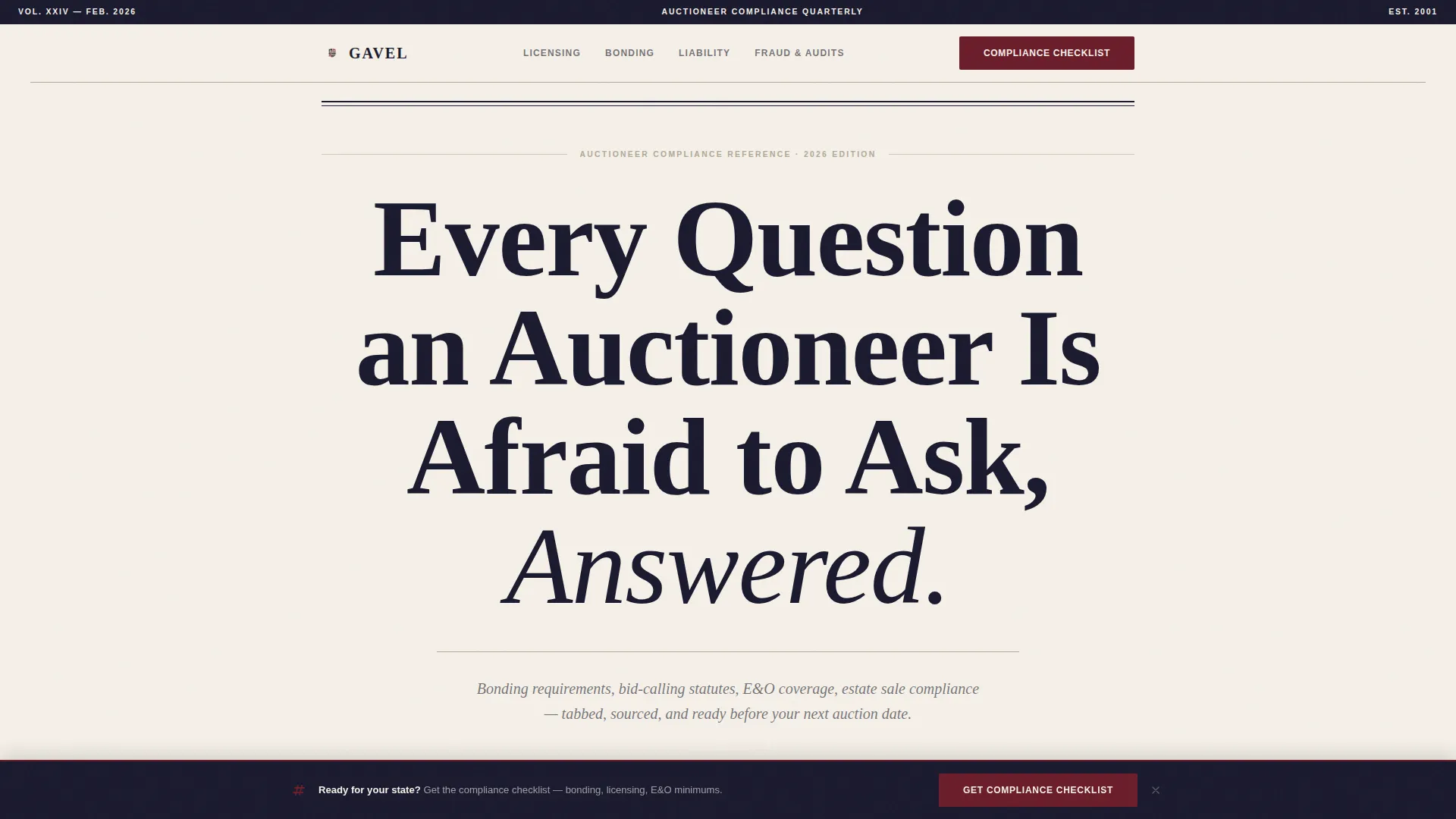
- A full-bleed parchment cream header with an enormous centered serif headline and a single ruling-line separator
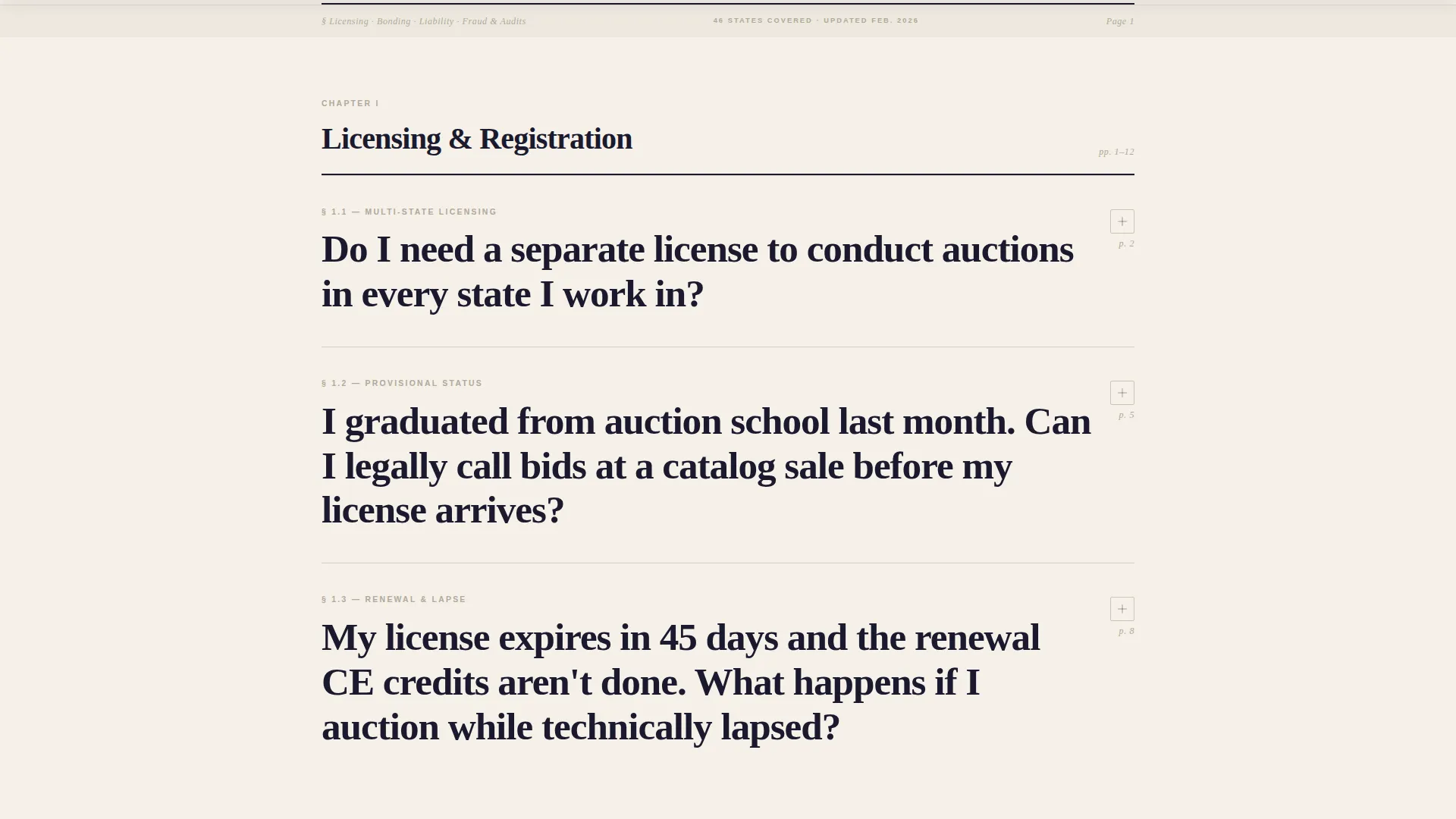
- FAQ-driven scroll sections with pull quotes, inline citation styling, and "State-by-State Alert" sidebar callout cards
- A sticky bottom-bar call-to-action and a full-width editorial call to action break, both routing visitors to a dedicated compliance checklist page
Feature list
A brief overview of the core capabilities this template delivers, all grounded directly in the design and layout brief.
Giant Headline Centered Header
The header fills the viewport with oversized serif type set in deep documentary black against full-bleed parchment cream. A thin ruling line separates the headline from a single italic subhead. A small burgundy arrow pulses downward, inviting the visitor to scroll into the content.
FAQ-Driven Scroll Sections
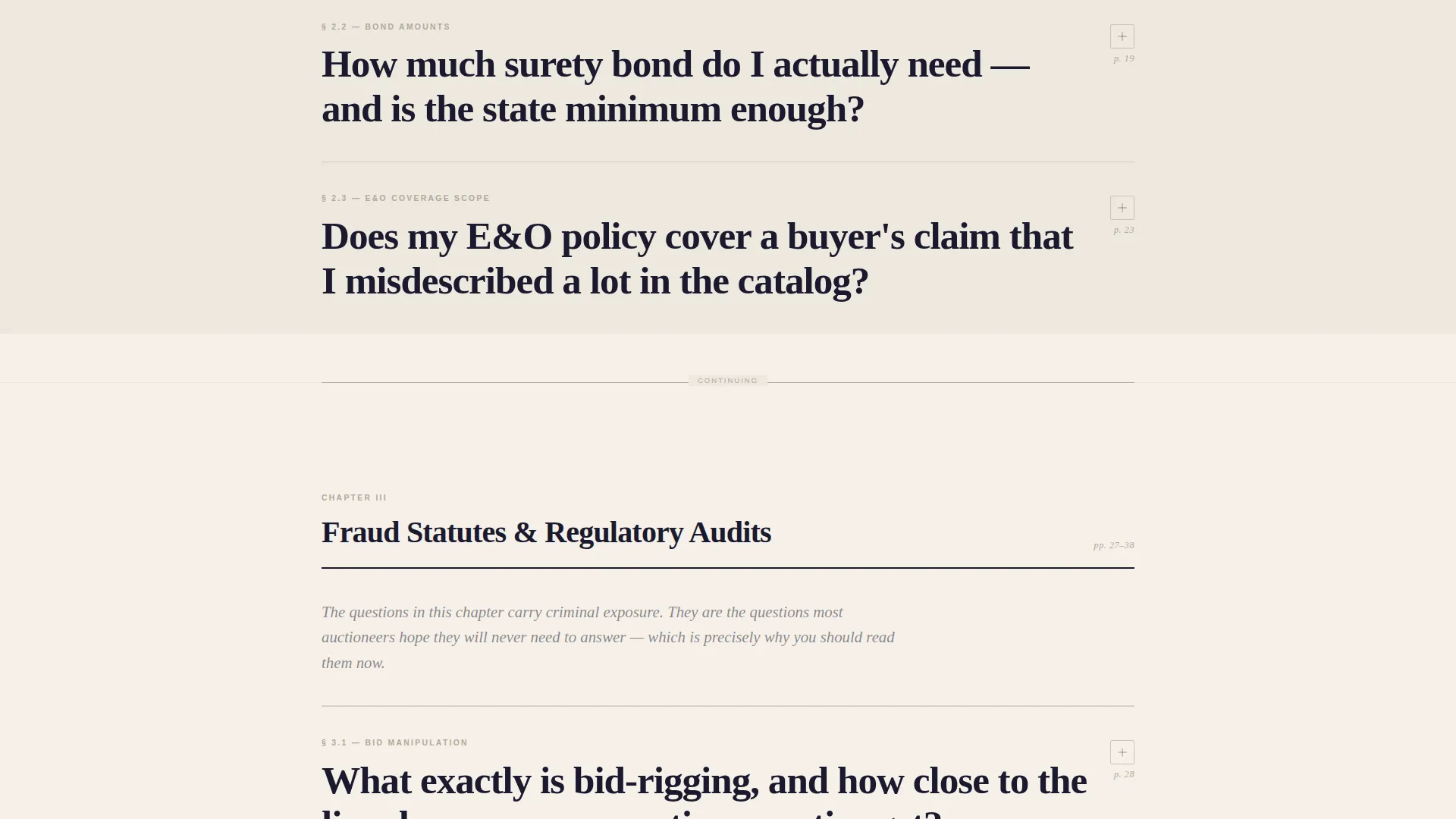
Each scroll section opens with a single bold question in oversized type. A magazine-style editorial answer follows, complete with pull quotes styled in notary-seal burgundy and inline citations formatted like legal footnotes. The rhythm alternates between dense answer blocks and open breathing room.
State-by-State Alert Cards
Sidebar callout boxes are formatted as "State-by-State Alert" cards. They surface jurisdiction-specific compliance notes without interrupting the main editorial flow. These cards are designed to catch visitors who are scanning for their specific state's rules.
Escalating Content Structure
The FAQ sequence follows a deliberate stakes progression. Early questions cover licensing basics, middle sections address liability and bonding gray areas, and final sections tackle auction fraud statutes and regulatory audit exposure. This structure keeps the visitor engaged and increasingly invested.
Dual Call-to-Action Placement
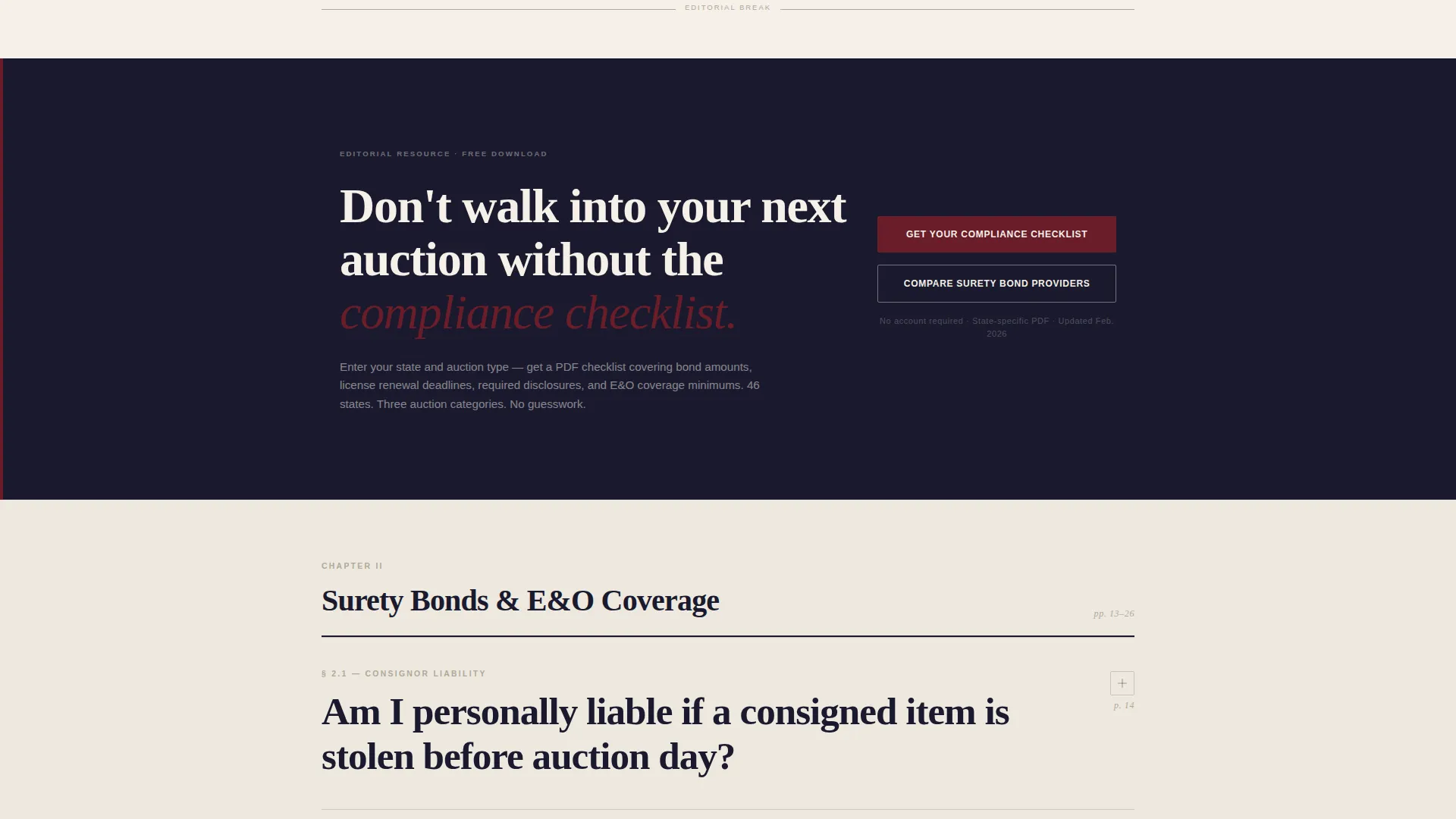
The primary call-to-action, "Get Your Compliance Checklist," appears first as a sticky bottom bar after the third FAQ and again as a full-width editorial section break. No form appears on this page; both placements route the visitor to a dedicated conversion page.
Footnote-Style Secondary Link
A secondary conversion path, "Compare Surety Bond Providers," is styled as an inline footnote reference link. It catches visitors who are already past the awareness stage and ready to evaluate bonding options directly.
Page sections overview
| Section | Purpose |
|---|---|
| Full-Bleed Header | Establish authority with an oversized serif headline and parchment layout |
| Italic Subhead Strip | Deliver a single orienting sentence below the ruling line |
| FAQ Block 1 | Cover licensing basics and state credential requirements |
| FAQ Block 2 | Address surety bond thresholds and renewal obligations |
| FAQ Block 3 | Explain E&O policy need for first-time catalog sales |
| Sticky call to action Bar | Surface "Get Your Compliance Checklist" after third FAQ |
| Liability FAQ Block | Tackle consignment liability and stolen-item scenarios |
| State Alert Cards | Highlight jurisdiction-specific compliance variations |
| Bonding Gray Areas | Explore edge cases in bonding and bid-calling rules |
| Full-Width call to action Break | Reinforce checklist offer as a full editorial section |
| Fraud Statutes Block | Cover auction fraud statutes and regulatory audit exposure |
| Footnote call to action Link | Offer "Compare Surety Bond Providers" as inline reference |
Design & branding system
The visual identity follows a Legal Shield theme built on an Ink and Paper color system. Every design choice reinforces the feeling of a freshly notarized document: thick paper, deliberate ink, and an embossed seal that signals permanence.
- Color palette: deep documentary black (#1A1A2E) for body type, parchment cream (#F5F0E8) for backgrounds, ruling-line gray (#B0A999) for dividers, and notary-seal burgundy (#6B1D2A) reserved for links, badges, and call-to-action elements
- Typography: enormous serif type at headline scale, italic for subheads and pull quotes, and a tracked-wide broadsheet treatment for the main headline
- Layout rhythm: wide-tracked masthead type, thin horizontal ruling lines between sections, and alternating dense-and-open column spacing that mimics a well-designed reference journal
Mobile & speed optimization
The editorial layout is built to remain readable and navigable on smaller screens. The sticky call to action bar is particularly useful on mobile, where it stays visible without interrupting the reading experience.
- The FAQ scroll sections stack cleanly on narrow viewports, keeping question headings and answer blocks legible at mobile type sizes
- Sidebar "State-by-State Alert" cards reflow below the main column on smaller screens rather than competing for horizontal space
- The full-bleed parchment header scales gracefully, maintaining the broadsheet impact of the centered headline across screen widths
How this template helps you convert
This template earns the click rather than demanding it. The conversion strategy is built into the editorial structure itself, so visitors are primed to act before they ever see a button.
- The escalating FAQ sequence builds credibility progressively, so the visitor feels informed and grateful by the time the first call-to-action appears after the third FAQ block.
- The dual placement of "Get Your Compliance Checklist" as both a sticky bar and a full-width editorial break captures visitors at two different intent levels without using aggressive pop-ups or inline forms.
- The footnote-styled "Compare Surety Bond Providers" link catches higher-intent visitors already evaluating options, creating a secondary conversion path that feels like a natural editorial recommendation.
Other information about this template
Gavel is categorized under Professional Services and specifically targets the Auctioneer Online Presence subcategory. It is well-suited for content creators, compliance consultants, and auction industry educators building resource hubs.
- Template style: Editorial and Magazine layout, designed for content-heavy professional service pages
- The FAQ-Driven creative direction means the template is structured around questions, making it naturally compatible with long-form compliance content and reference journalism formats
- The Click-Through landing page direction means no form is embedded; all lead capture happens on a separate page the visitor reaches after clicking the call to action
- The header concept is Giant Headline Centered, which works especially well for content pages where the subject matter itself carries weight and needs no supporting imagery
- This template fits auctioneer licensing content, surety bond comparison resources, estate sale compliance guides, and auction school graduate onboarding pages
Theme
Legal Shield
Creative direction
FAQ-Driven
Color system
Ink & Paper
Style
Editorial/Magazine
Direction
Click-Through
Page Sections
Giant Headline Centered Header
Faq-driven Editorial Scroll Sections
State-by-state Alert Callout Cards
Escalating FAQ Content Structure
Dual Call-to-action Placement
Footnote-style Secondary Conversion Link
Related questions
Can I use this template for a real estate auction compliance page?
Does this template include a form or lead capture on the page?
Can I customize the FAQ questions and answers for my specific state's rules?
Is the sticky call-to-action bar always visible while the visitor scrolls?
Who is the secondary footnote-style link intended for?