Expert Beer Education Landing Page Template
Malt is a gallery-and-detail landing page template built for craft beer education platforms. It blends agrarian visual storytelling with a structured, multi-course marketplace layout. The cinemagraph hero, expandable course cards, sticky cart bar, and three-question quiz modal create a browse-then-enroll experience that earns the purchase before it asks for one. Every design choice traces back to the grain bill.
by Rocket studio
Quick summary
Malt is a single-page education marketplace template rooted in the sensory world of craft brewing. It is designed for platforms that teach beer science through grain, hops, and hands-on technique. The page guides visitors from an immersive cinemagraph hero through a gallery of expandable course cards, certification tracks, and instructor profiles, then closes with a guided quiz that builds a personalized curriculum bundle.
Who this template is for
This template serves educators, institutions, and independent instructors who run beer education or certification programs. It is built for people who want to sell multiple courses and workshop bundles on a single, beautifully structured page without needing a separate storefront.
- Assistant brewers preparing for Cicerone certification who need a credible, content-rich platform to explore and enroll in technical modules
- Craft bar owners and advanced homebrewers seeking self-paced, practical beer education they can browse at their own pace before committing money
- Independent brewing educators and brewery training programs that want to showcase instructor expertise, curriculum depth, and certification tracks in one place
What problem this template solves
Most beer education pages bury their best content behind walls of plain text or generic course listings. Visitors cannot feel the depth of the curriculum before they are asked to sign up or spend money. The result is low trust and high drop-off, especially for higher-priced certification tracks.
- People cannot evaluate course quality from a title and a short description alone, so they leave before they reach the call to action
- Platforms that list many courses without a guided path make it hard for brewers to understand which modules fit their experience level and professional goal
- Instructors and brewery training programs struggle to communicate their real expertise through standard course-page templates that feel like fluorescent-lit classrooms rather than working malting floors
What you get with this template
This template gives you a complete, production-ready landing page structure for a multi-course beer education and certification marketplace. Every section is purpose-built to create desire through immersion before it asks for a purchase.
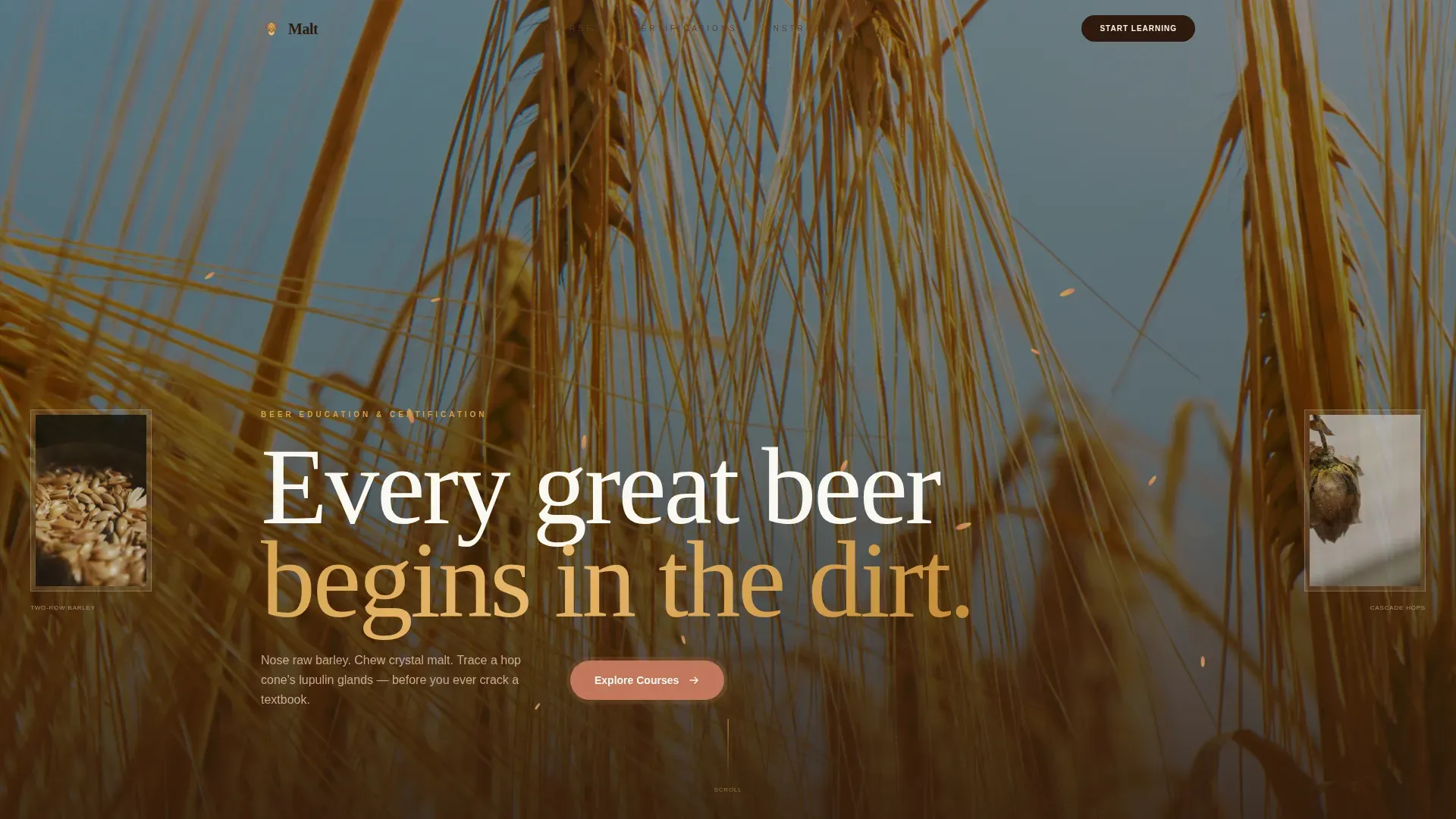
- A cinemagraph hero section with a falling-grain CSS loop, a four-second delayed hand-lettered headline reveal, and decorative side grain images that visually connect agriculture to the final product
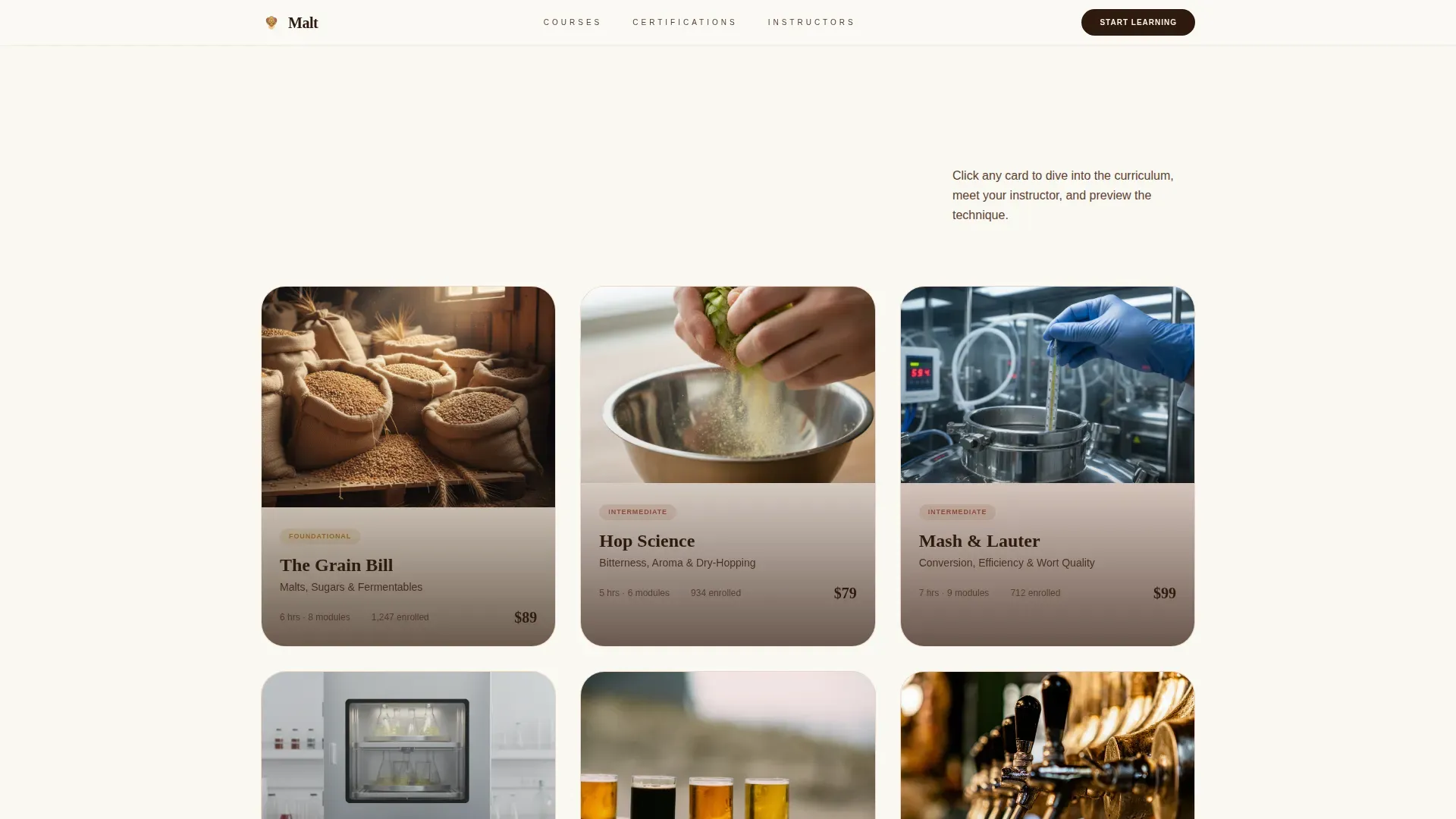
- An expandable course gallery where each card opens a detail panel with curriculum breakdowns, instructor bios, and short looping video previews, plus a sticky cart bar and a three-question quiz modal that builds a personalized certification path
- A philosophy scroll-reveal section, an asymmetric bento-grid certification tracks section, and a split-layout instructors section with brewery portraits, all anchored by a structured footer
Feature list
This template packs a focused set of high-impact features. Each one is grounded in the source design brief and built to serve the browse-then-enroll user journey.
Cinemagraph Hero with Delayed Headline Reveal
The header is a still, golden close-up of raw barley ears set against a soft-focus farmscape. One grain detaches and falls in an infinite CSS keyframe loop. No headline appears for the first four seconds. Then hand-lettered type rises from the bottom of the frame. This stillness forces the visitor to slow down and notice texture, creating an immediate sensory connection to craft beer education that no loud beer brand imagery can match.
Expandable Course Gallery with Detail Panels
The gallery grid presents course modules as rich, full-frame photographic cards. Each image shows a real brewing moment: a mash tun thermometer, a hand rubbing hop pellets, a refractometer catching light, a chalkboard of IBU calculations. Clicking any card slides a detail panel over the gallery. The panel reveals curriculum breakdowns, an instructor bio shot in a working brewery, and a short looping technique video. Visitors browse, dive, then browse again, building desire with every opened card.
Sticky Cart Bar and Quiz Modal
A persistent sticky bar sits at the bottom of the page. It tallies all selected modules in real time and displays a secondary call-to-action: "Build Your Certification Path." Clicking that button opens a three-question quiz modal that asks about experience level, professional goal, and preferred format (self-paced, cohort, or in-person intensive). The quiz returns a personalized curriculum bundle at a packaged price, making the path to enrollment feel tailored rather than generic.
Philosophy Scroll-Reveal Section
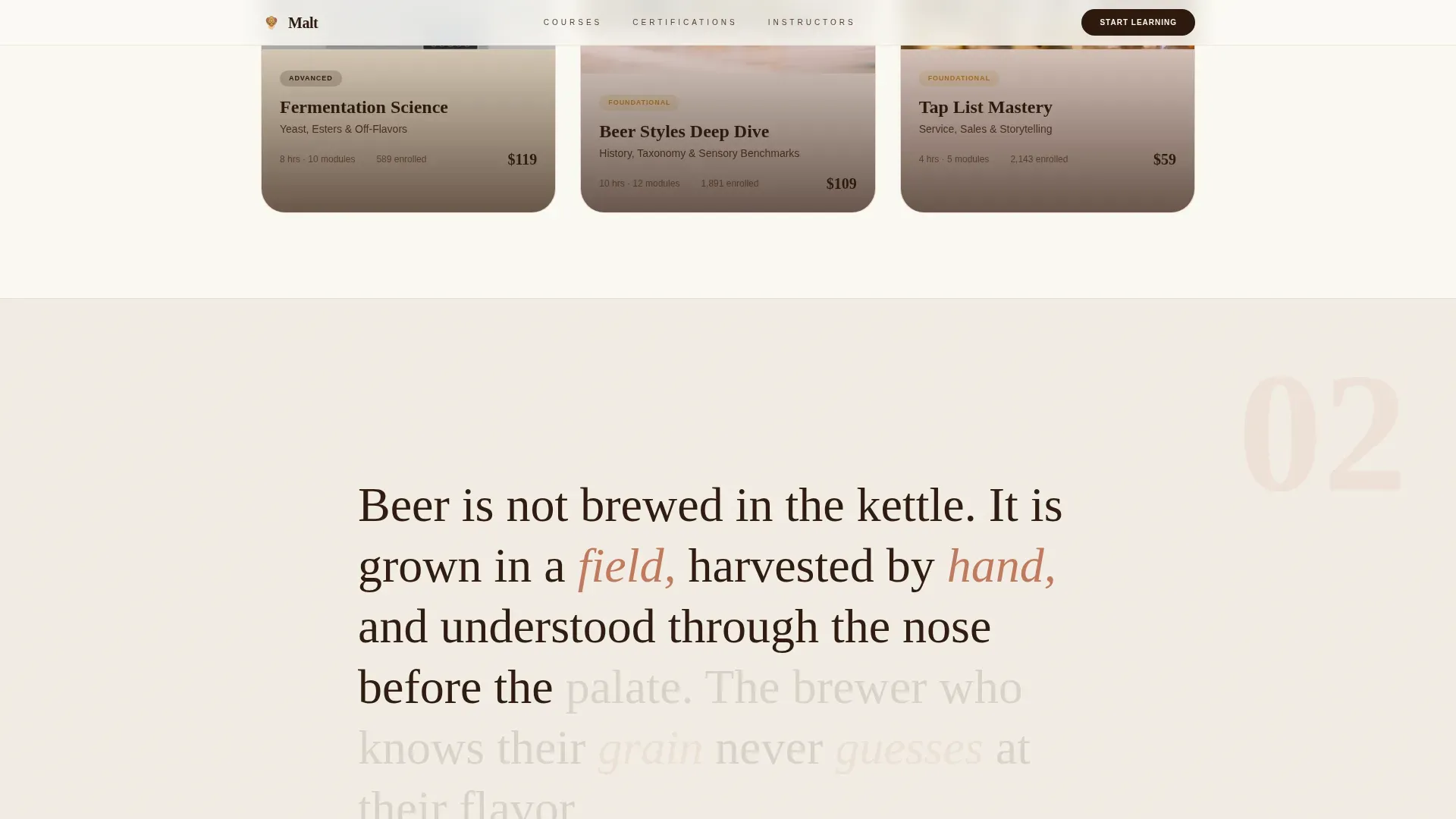
A word-by-word opacity reveal is driven by scroll progress. As the visitor scrolls through this section, each word of the platform's philosophy statement fades into full visibility in sequence. The effect is meditative and editorial, matching the quiet discipline of a craft that starts in soil. It gives the page a natural breath point between the gallery and the certification tracks.
Certification Tracks in Asymmetric Bento Grid
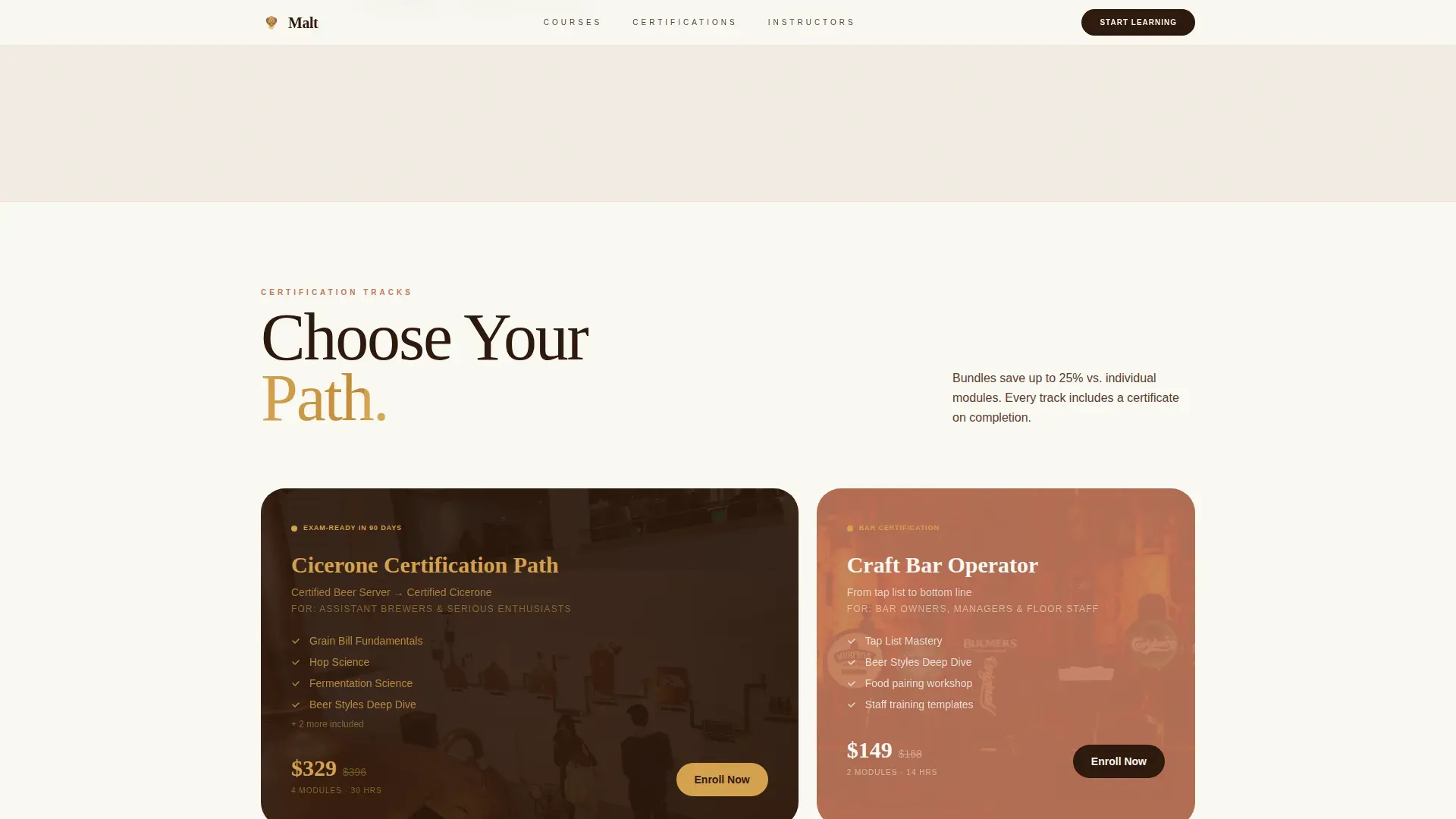
Three certification paths are displayed in a bento grid layout where card sizes vary to create visual weight and hierarchy. Each track card can carry enrollment counts, completion stats, and a prominent "Enroll in This Module" call to action. The asymmetric arrangement encourages exploration and makes the collection of tracks feel curated rather than catalogued.
Instructors Section with Brewery Portraits
A split-layout instructors section pairs each instructor's profile text with a full-frame portrait shot inside a working brewery. Instructor credentials are surfaced as social proof. Testimonials from past students and professional reviews add a layer of dynamic credibility. This section helps people trust the education platform before they sign up or add a module to their cart.
Page sections overview
| Section | Purpose |
|---|---|
| Cinemagraph Hero | Opens with falling-grain animation and delayed headline to create sensory immersion |
| Course Gallery Grid | Browse full-frame course cards that expand into curriculum detail panels |
| Philosophy Scroll-Reveal | Word-by-word opacity reveal communicates platform values through scroll |
| Certification Tracks | Asymmetric bento grid displays three certification paths with varied card sizes |
| Instructors Split Layout | Brewery portraits and credentials build trust through visible expertise |
| Sticky Cart Bar | Persistent bottom bar tallies selected modules and triggers the quiz modal |
| Footer Pattern | Horizontal footer with dot separators closes the page cleanly |
Design & branding system
The visual identity follows an Agrarian Root theme. Every color, typeface, and layout decision reinforces the connection between raw agriculture and the refined craft of brewing. The palette feels like a handful of two-row malt held up against a desert sunset: warm, dry, earthen, and alive.
- Color system uses sun-bleached terracotta (#C2785C) for active states and progress indicators, dried-barley gold (#D4A24E) for certification milestones and earned credentials, deep loam (#2E1A0E) anchoring all body text and navigation, and dusty blush (#E8C4B8) washing across card backgrounds and section dividers so the page breathes like a field rather than a classroom
- Typography pairs Fraunces, a display serif with warmth and editorial weight, with DM Sans for clean, readable body copy; together they balance agrarian luxury with practical clarity
- Animation style is high-intentionality: falling grain CSS keyframes, scroll-linked word reveals, blur-up image load transitions, zoom-on-hover course images, and panel slide-overs all run on GPU-accelerated transform and opacity properties to keep motion smooth and purposeful
Mobile & speed optimization
The template is desktop-first by design, because the immersive gallery experience benefits from a wider viewport. A full mobile fallback is built in so the page remains navigable and readable on smaller screens, which is important for brewers and farmers who access resources on their phones in the field.
- All course images are lazy-loaded so the initial page load stays light even when the gallery section carries a large number of high-resolution photographs
- All animations run on GPU-accelerated transform and opacity properties only, meaning motion stays smooth without triggering expensive layout recalculations on any device type
- The sticky cart bar and quiz modal are both touch-friendly and scale correctly across screen sizes so mobile visitors can still build their certification path and sign up without friction
How this template helps you convert
The browse-then-dive gallery structure is the core conversion engine. It earns the purchase by letting visitors taste the depth of each module visually before the page ever asks for money. This is how the template moves people from curiosity to enrollment in a natural, unhurried sequence.
- The cinemagraph hero slows the visitor down and creates sensory trust through authentic imagery, so they arrive at the course gallery in a receptive frame of mind rather than a skeptical one. Testimonials from professional brewers and enrollment counts on each card add social proof that encourages continued exploration.
- Each expanded detail panel delivers curriculum depth, instructor credibility, and a looping technique video, giving visitors enough information to make a confident purchase decision on a single module before the page asks them to build a full certification path.
- The sticky cart bar and personalized quiz modal remove decision paralysis by guiding visitors through three focused questions and returning a packaged bundle price, making the final step to sign up feel like a recommendation rather than a sales push.
Other information about this template
The Malt template is built for a broad range of people and organizations operating in the craft beer education and brewery training space. Understanding the wider industry context helps you use the template to its full potential.
- Malt is a key ingredient in the brewing process, primarily derived from barley. Its production involves soaking grains in water, allowing them to germinate, and then drying them in a kiln. Different types of malt, such as pale, caramel, and roasted malts, contribute unique flavor, color, and aroma characteristics to the beer. The history of malt production dates back thousands of years, with evidence of its use in ancient civilizations for brewing, and the craft beer movement has revived interest in traditional malt production methods and diverse malt varieties.
- The brewing process involves several steps, including malting, mashing, boiling, fermenting, conditioning, and packaging. Malt provides the fermentable sugars necessary for alcohol production, and the number of malt types available to modern brewers gives any brewery a wide creative palette. The history of brewing is closely tied to the agricultural practices of growing barley and other grains used for malt, and this connection to agriculture is exactly what the Malt template celebrates visually and editorially.
- Women have historically played significant roles in the craft beer industry, often managing breweries after their husbands' deaths. Women have been involved in brewing since ancient times, often as the primary producers of beer in their communities. Women in brewing have often been overlooked in historical narratives, despite their significant contributions to the industry. The craft beer movement has seen a resurgence of women in brewing roles, with many women now owning and operating breweries across the United States. A figure like Margaret Beck, one of the few women who owned and operated a brewery in Oregon during the late 19th century, represents a lineage of people whose contributions deserve to be part of any serious beer education curriculum.
- The Pink Boots Society was founded in 2007 to support women in the brewing industries through scholarships and support networks. It has inspired initiatives like Barley's Angels, an organization that focuses on increasing craft beer appreciation among female consumers. These organizations represent a part of the broader beer education and community-building space that the Malt template is well positioned to serve.
- The Oregon Brew Crew is one of the oldest and largest home brewing clubs in the United States. The Oregon Brewers Guild was founded in 1992 as a non-profit organization dedicated to advocating for and promoting the state's brewing industry. The Oregon Brewers Festival has been held annually since July 1988 at the Tom McCall Waterfront Park in downtown Portland. Fred Eckhardt was a well-known advocate, critic, educator, mentor, and historian in the beer community. These organizations and figures reflect the kind of credible institutional heritage that an education platform built on this template can draw on and reference in its course content and marketing materials.
- The Pennsylvania Malt and Brewed Beverage Industry Promotion Program supports increasing production of Pennsylvania-made malt and brewed beverages. The funds from this program are to be used only for enhancing the malt and brewed beverage industries through promotion, marketing, and research-based programs and projects. New funding is made available each year, and the request for proposals is usually released in January. The Pennsylvania Liquor Control Board can give up to one million dollars in funds per year to this program. Platforms that publish research-backed beer education and use the Malt template to collect enrollment submissions may find these types of industry programs a relevant source of support for development and production costs.
- Beer website templates, including those used for education platforms, often include features like integrated contact forms, ecommerce functionality, and social media integration. Craft beer website templates can showcase the brewing process and include photo galleries and blog features. Many templates are designed to highlight the unique aspects of a brewery's brand and offerings, and graphic resources for craft beer branding can include vector graphics and images related to malt and brewing themes. The Malt template sits at the editorial and immersive end of this collection, prioritizing atmosphere and curriculum depth over generic page-builder aesthetics.
- Course outlines inside the Malt template can clearly list modules or topics such as "Fundamentals of Malt" or "Making Malt at Home." This type of clear module structure, combined with the gallery-and-detail layout, makes it easy for visitors to understand what they are buying before they sign up. The template supports this transparency by giving each course card its own expandable detail panel with curriculum, instructor bio, and a looping preview video.
- Restaurants, taprooms, and craft bar owners are a natural secondary audience for this template. Bar professionals who want to understand the grain bill behind the beers they pour, or who want to earn a recognized certification, represent a significant segment of the people this page is designed to attract. The guided quiz modal is particularly useful for this group because it can surface a recommended bundle based on their specific professional goal rather than asking them to self-navigate a full course catalog.
- The template's marketing potential extends to refreshing an existing brewery training program's online presence. If a brewery or beer education company currently has a flat, text-heavy page, this template provides a published-quality visual upgrade that communicates expertise through atmosphere rather than claims. The result is a page that people spend time on, return to, and trust enough to complete a purchase.
- All submitted enrollment data and cart selections are handled through the on-page quiz modal and sticky cart mechanic described in the brief. The template does not assert any specific backend integration, but the interaction design is structured to make the sign-up and add-to-cart flow feel seamless and purposeful at the front-end level.
- Copyright and intellectual property rights for the template design belong to the platform under which it is published and submitted. Users should review the applicable license terms for the template collection they access. The template itself does not include third-party licensed photography; placeholder images are provided for development purposes and should be replaced with authentic brewery and agriculture imagery before the page goes live.
- Weblium offers free beer website templates that are customizable and mobile responsive, representing one end of the beer template spectrum. The Malt template targets a different type of build: one where immersive design, high-intentionality animation, and a multi-module marketplace structure create a premium education experience that justifies a higher course price point and builds long-term brand trust for the company behind the platform.
Theme
Agrarian Root
Creative direction
Immersive Visual
Color system
Desert Rose
Style
Gallery + Detail
Direction
Marketplace/Multi
Page Sections
Cinemagraph Hero with Falling Grain Animation
Expandable Course Gallery and Detail Panels
Sticky Cart Bar and Personalized Quiz Modal
Philosophy Section with Scroll-linked Word Reveal
Asymmetric Bento Grid for Certification Tracks
Split-layout Instructors Section with Social Proof
Related questions
Who is this template designed for?
Can I sell multiple courses and bundles on this single page?
How does the three-question quiz modal work?
Is this template suitable for both desktop and mobile users?
What type of imagery works best with this template?