Authentic Food Truck Landing Page Template
Plancha is a single-column food truck landing page template built for authentic Panamanian street food operators. It leads with a full-viewport macro food photograph, scrolls visitors through sensory dish portraits, and closes with a structured booking form. The Parchment and Rust color system and Haute Craft visual style make every section feel warm, handmade, and unmistakably real.
by Rocket studio
Quick summary
Plancha is a booking-focused, single-column landing page template designed for a Panamanian food truck. It opens with a viewport-filling macro close-up photograph, walks visitors through immersive dish portraits, and ends with a clear event booking form. The design feels like warm parchment next to a cast-iron plancha: deliberate, craft-forward, and built to make people hungry before they reach the calendar.
Who this template is for
This template is made for food truck operators who run a craft cooking operation and need a professional online presence without a long development timeline. It is especially well-suited for Panamanian cuisine businesses serving the event market, but the layout and booking structure translate to any street food concept where the experience matters as much as the menu.
- Event-focused food truck owners who want to convert coordinators and office managers into paying bookings
- Wedding and private event caterers who need a polished page that communicates quality and reliability to new clients
- Walk-up food truck regulars and locals who want a quick way to find this week's stops and sample the menu before they arrive
What problem this template solves
Most food truck websites either look too generic or bury the booking path under too many clicks. Visitors arrive hungry for information, lose patience, and leave without acting. The bigger problem is trust: event coordinators booking for a crowd of 25 to 300 adults need to feel confident in the operation before they even fill out a contact form. A plain menu grid does not build that confidence.
- The template solves the engagement gap by leading with arresting food photography and sensory copy that earns attention before introducing any booking logic
- It solves the trust problem by introducing the craft narrative, the cook's hands, the weathered counter, and the hand-painted lettering that prove this is not a franchise
- It solves the friction problem with a sticky booking bar that stays visible after the first scroll, so the call to action is never missing from the screen
What you get with this template
You get a complete, single-column landing page layout structured around the full visitor journey: from first impression through food story through event booking. Every section is placed in deliberate sequence so the visitor is hungry and convinced before the form ever appears. No section is wasted, and no component is decorative without purpose.
- A full-viewport hero section with a macro close-up food photograph and a slide-up hand-lettered headline, followed by a sticky booking bar that appears after the first scroll
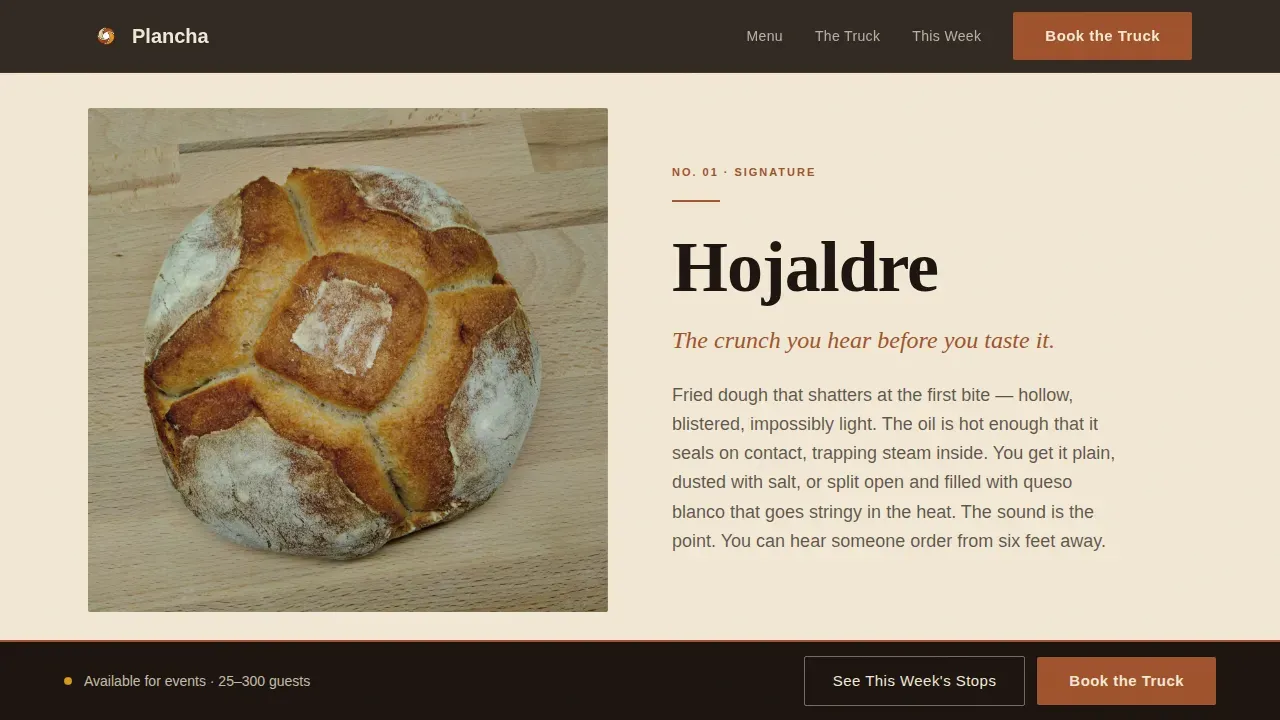
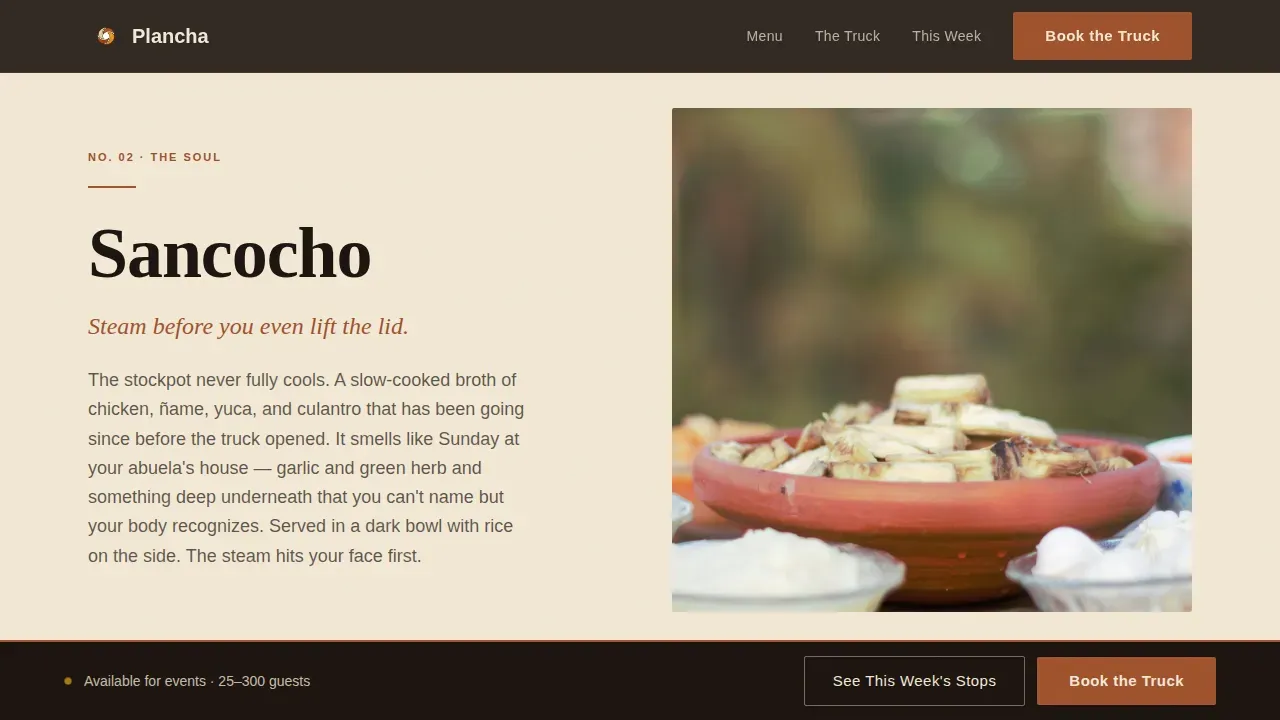
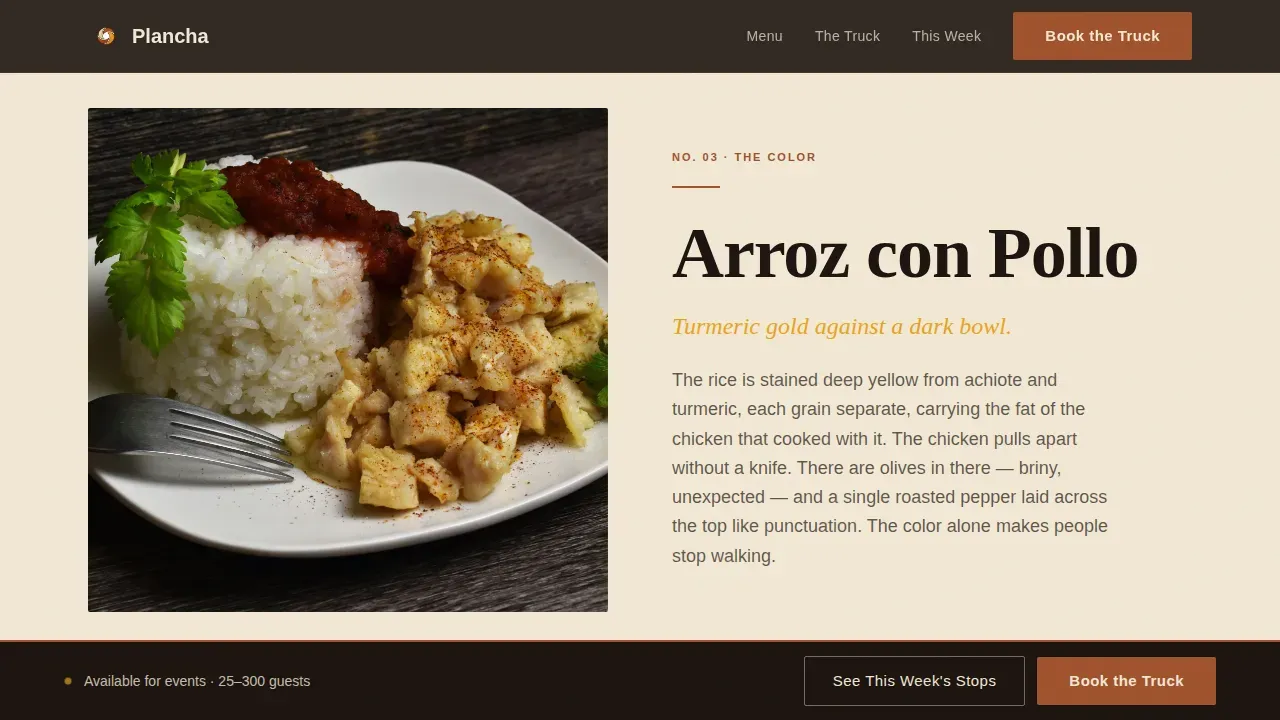
- Three full-height dish portrait sections, one per viewport, each pairing a single arresting image with short sensory copy covering hojaldre, sancocho, and arroz con pollo
- A craft identity section showing the truck itself, the cook's hands at work, and the hand-painted lettering, followed by a structured booking form collecting event date, zip code, headcount, and event type
Feature list
This template is built around six core capabilities drawn directly from the project brief. Each one serves the food truck's conversion goal without adding clutter.
Macro Close-Up Hero with Slide-Up Headline
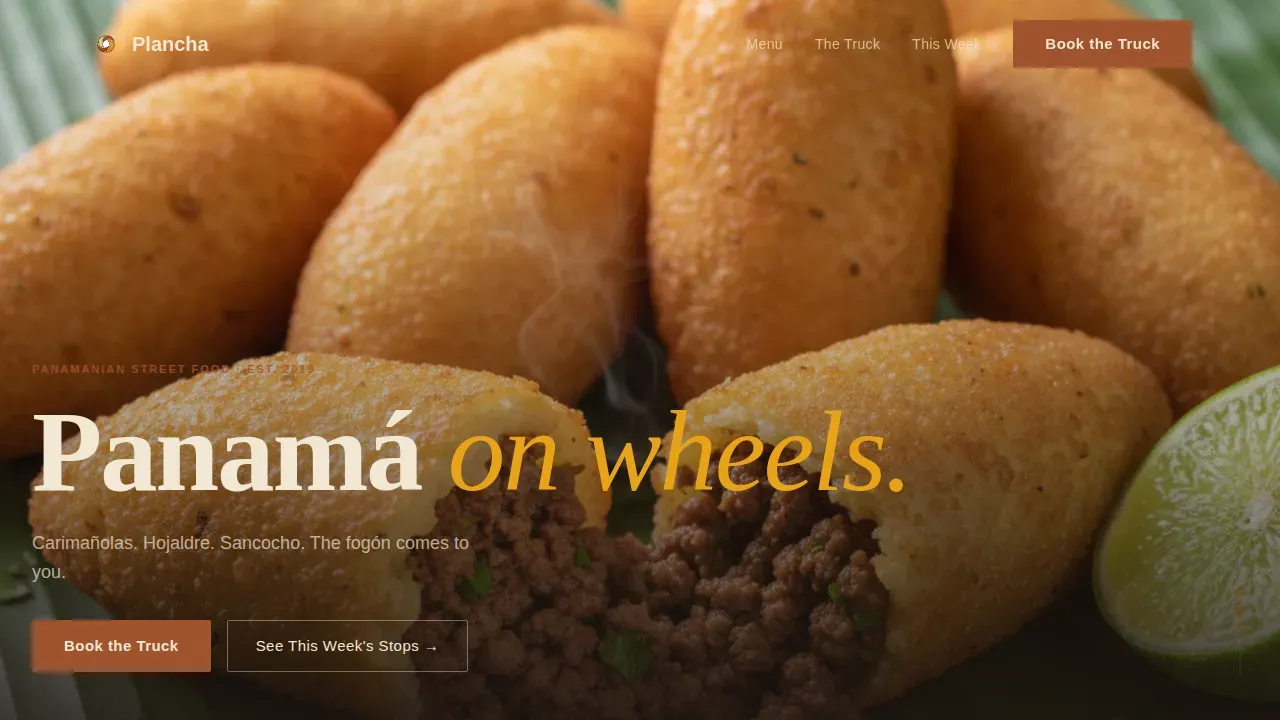
The hero section fills the entire viewport with a single macro food photograph. A carimañola cracked in half, steam rising from the seasoned interior, takes the full frame. No text interrupts the image on the first beat. Then a hand-lettered headline slides up from the bottom of the frame: "Panamá on wheels." The shallow depth of field blurs the truck's service window into warm amber behind it. This approach lets the food do the talking before any copy asks for attention, which is exactly the right order for a cooking-forward brand.
Sensory Dish Portrait Sections
Three sequential full-height sections each introduce a single dish through one high-quality image and a short paragraph of sensory copy. Hojaldre gets the crunch. Sancocho gets the steam. Arroz con pollo gets the color, turmeric gold against a dark bowl. This one-dish-per-viewport rhythm is intentional: it slows the scroll and makes the visitor engage with each plate before moving forward. This approach reflects the research-backed principle that professional, close-up photos of signature dishes are essential for making food feel real and delicious on screen.
Craft Identity Narrative Section
Midway through the page, the tone shifts from food to the people making it. This section introduces the truck itself: the weathered steel counter, the cook's hands pressing masa, the hand-painted lettering on the side panel. It is the proof section. It tells visitors that this is a family craft operation, not a franchise replicating a recipe from a manual. For event coordinators who need to trust a vendor before booking, this section does more conversion work than any promotional copy.
Sticky Booking Bar with Event Form
After the first scroll, a sticky bar anchors to the bottom of the screen and stays visible throughout the entire page. The booking form inside it collects event date first, then zip code, then headcount via a slider ranging from 25 to 300, then event type selected from private party, corporate, festival, or wedding. The sequence is deliberate: by the time visitors reach this form, they have already decided. The form just needs to not get in the way, and this one does not.
Live Schedule Secondary Path
A secondary call to action labeled "See This Week's Stops" links to a live schedule map for walk-up customers. This gives the page two clear conversion paths: one for event bookers and one for the everyday crowd who wants to find the truck this week. Over 80% of users check food trucks on their phones, so having a fast-loading, easy-to-find schedule link is a practical priority, not a nice-to-have.
Parchment and Rust Visual Identity System
The full color system is built into the template. Aged parchment (#F2E8D5) covers the dominant background. Deep plantain-skin rust (#A0522D) drives all headlines and primary buttons. Charred wood black (#1C1410) handles body text. Bright ají amarillo (#E8A317) appears on hover states and price callouts. The result is a palette that feels like a hand-stamped brown paper menu sitting next to a cast-iron cooking surface: warm, oil-touched, and deliberately imperfect.
Page sections overview
| Section | Purpose |
|---|---|
| Hero with headline | Opens with a macro food photograph and a slide-up headline to create an immediate sensory impression |
| Hojaldre dish portrait | Introduces the first signature dish through a full-height image and short sensory copy |
| Sancocho dish portrait | Walks visitors through the second dish with steam-focused visual and paragraph copy |
| Arroz con pollo portrait | Presents the third dish, highlighting color and warmth before moving to the craft section |
| Craft identity section | Builds trust through images of the truck, the cook's hands, and the hand-painted lettering |
| Book the Truck form | Collects event date, zip code, headcount, and event type to convert coordinators into bookings |
| Sticky booking bar | Stays anchored at the bottom of the screen after the first scroll to keep the call to action visible |
| Footer | Horizontal minimal layout providing contact and navigation at the close of the page |
Design & branding system
The Haute Craft visual theme runs through every pixel of this template. The design language is warm, deliberately imperfect, and built to feel handmade rather than mass-produced. Typography pairs Fraunces, a display serif with ink-press character, with DM Sans for clean, readable body copy. The combination gives the page both personality and legibility at every scroll depth.
- The Parchment and Rust color system uses four defined values: parchment (#F2E8D5) for backgrounds, rust (#A0522D) for headlines and buttons, charred black (#1C1410) for body text, and ají yellow (#E8A317) for hover and price accents
- Scroll-linked reveal animations, a parallax effect on dish images, and the slide-up hero headline are all built into the layout, giving the page high visual energy without requiring custom development
- The overall visual direction is Sensory Appeal: every design choice, from the macro photography concept to the warm palette, is intended to make food feel present and real before a visitor reads a single word of copy
Mobile & speed optimization
Food truck discovery happens on the phone. Someone walking past a parking lot, checking where to eat for dinner, or forwarding a catering idea to a colleague is almost certainly on a mobile screen. This template is built mobile-first, meaning every section stacks cleanly on small screens before expanding to desktop polish.
- Images in the dish portrait sections are set to lazy-load, so they appear as the visitor scrolls rather than all at once on page entry
- The sticky booking bar is designed to remain usable on small screens without blocking content, keeping the booking path open throughout the scroll on every device
- CSS scroll animations and Intersection Observer logic drive all motion effects, keeping the animation layer light and compatible with the wide range of devices that food truck audiences use
How this template helps you convert
The page is built around a single conversion principle: make the visitor hungry first, organized second. By the time the booking form appears, the visitor has already experienced the food, trusted the craft narrative, and decided they want this truck at their event. The form just closes the loop.
- The hero macro photograph and slide-up headline create an immediate emotional reaction that holds attention and makes visitors want to keep scrolling, which is how the page earns the right to ask for a booking
- The sensory dish portrait sequence builds appetite and desire through one full-height image and one focused paragraph per dish, so visitors arrive at the booking section already sold on the quality of the food
- The sticky booking bar keeps the primary call to action visible from the first scroll to the last, so a visitor who decides to book at any point in the page can act immediately without scrolling back to the top
Other information about this template
This template sits inside the Food and Beverage category with a Panamanian Cuisine subcategory focus. It is a strong fit for any food truck operator who wants a landing page that works as hard as the truck does. Below are additional context points that matter for operators making a purchase decision.
- Panamanian cuisine carries a rich culinary history rooted in indigenous, African, and Spanish influences, and the template's craft narrative section is specifically designed to share that story with visitors who are encountering the food for the first time
- Street food culture has global credibility: cities from Tijuana, where vibrant food scenes and celebrated food parks like the Telefónica Gastro Park have gained international attention, to markets across south Asia and beyond, all point to the same truth, which is that street food earns its reputation through quality and authenticity, not square footage
- The city of Tijuana, often abbreviated TJ, is particularly well known in the food world for its street food heritage, and the original Caesar Salad was created there at Caesar's restaurant in 1924, a reminder that great food ideas sometimes come from unexpected places and that a truck does not need a brick-and-mortar address to build a lasting reputation
- The template's color system deliberately avoids the vibrant blues and lush greens that might suit a coastal or tropical brand, favoring instead the warm earthy tones of parchment and rust that feel closer to a hand-stamped market stall in Panama City, though operators may adapt the palette to match their own brand identity
- Branding is crucial for food trucks to build a memorable identity, and a vibrant visual system with clear typography does more to attract a crowd than a discount or promotion ever could
- Featuring testimonials or review highlights that praise authenticity and flavor is one of the most effective ways to create social proof, and the template's craft section creates the natural space to introduce that kind of community voice alongside the brand story
- Clearly displaying catering contact information and event options is essential for generating leads from private event coordinators, and the booking form's event-type selector covers private party, corporate, festival, and wedding to make sure no inquiry falls through the gap
- Food trucks that participate in local events and festivals build their reputation faster than those that rely on walk-up foot traffic alone, and this template's live schedule path gives walk-up visitors a reason to follow the truck week after week
- For operators who are new to building an online presence or who have been struggling with a low-quality page, no-code platforms lower the cost and reduce the time required to launch, making this kind of quality layout accessible without a development budget
- No-code tools allow users to customize templates to fit their specific business needs, and AI-powered no-code platforms can automate backend processes so that operators can focus on cooking rather than code
- la plancha, in Spanish, refers to a flat iron cooking surface, and the name connects the template's identity to a genuine culinary tradition that spans Spain, Latin America, and beyond, from the markets of Madrid to the fogones of Panama
- Operators in food categories adjacent to this template, such as a coffee shop, a casual restaurant, or a dinner concept with a strong craft identity, may also find the Sensory Appeal creative direction and Haute Craft theme useful as a starting point for their own single-column layout
Theme
Haute Craft
Creative direction
Sensory Appeal
Color system
Parchment & Rust
Style
Single Column Flow
Direction
Booking/Scheduling
Page Sections
Macro Close-up Hero with Slide-up Headline
Sensory Dish Portrait Sequence
Craft Identity and Trust Section
Sticky Booking Bar with Event Form
Live Schedule Secondary Path
Parchment and Rust Color System
Related questions
Can I use this template for a food truck concept that is not Panamanian?
Does the template include the booking form functionality?
Is there a separate path for walk-up customers who just want to find the truck today?
How does the sticky booking bar behave on mobile devices?
Can the Parchment and Rust color palette be changed to match a different brand?