Grove - Origin Story Mango Plantation Landing Page Template
Grove - Origin Story Mango Plantation Landing Page Template
Grove is a cinematic, card-grid mango plantation landing page template built for single-origin farms that need to earn buyer trust before the click. It tells a three-generation origin story through scrolling archival and harvest photography, displays Alphonso, Kesar, and Langra variety cards with Brix readings and GI certification badges, and closes with a bold amber call-to-action directing buyers to a seasonal catalog.
by Rocket studio
Loading preview…
Quick summary
Grove is a single-page, card-grid landing page template designed for mango plantation businesses that sell to specialty grocers, export buyers, and direct-to-consumer families. The layout uses an editorial, nature-inspired visual language to post a compelling origin story, display variety details, and guide every visitor toward one clear action: exploring the current season's harvest catalog.
Who this template is for
This template is built for mango farm operators who need a credible, story-driven web presence that works across buyer types. It suits both business-to-business and direct-to-consumer audiences equally well.
Specialty grocers and export buyers searching for single-origin mango sourcing with verified certifications and traceable Brix readings
Direct-to-consumer families who pre-order a season's worth of fruits and want to feel connected to the land and the people who farm it
Plantation owners and farm managers ready to share their origin story, post variety details, and live up to the quality their fruits deserve
What problem this template solves
Most mango farm websites look like stock-photo catalogs. They display price and produce without context, and buyers who do not know the farm move on without placing an order. Grove solves the trust gap.
No storytelling structure: The template gives your farm a written narrative arc, from the beginning of the plantation's history to today's harvest, so buyers understand what they are purchasing before they reach the catalog
No visible traceability: Variety cards post Brix lab readings and GI certification badges directly on the page, so specialty grocers and export companies can verify quality at a glance
No clear call-to-action path: A persistent mobile bottom bar and a bold amber button after the origin grid keep the next step visible on every device, removing friction for buyers ready to act
What you get with this template
Grove delivers a fully structured, design-ready landing page with every section pre-built. You do not need to create the layout from scratch or wait for a custom build.
Theme
Nature-Inspired
Creative direction
Origin Story
Color system
Forest Trust
Direction
Click-Through
Page Sections
Panoramic Drone Video Hero
Scroll-linked Origin Story Grid
Variety Cards with Brix and GI Badges
Trust and Traceability Block
Persistent Mobile Call-to-action Bar
Full-width Season Availability Card
Related questions
Who is this landing page template designed for?
Does this page include a contact form or sign-up?
Can I adapt this template without coding experience?
What mango varieties does the template display?
What makes this template different from a standard agricultural website?
Five pre-built page sections covering the hero panoramic video header, origin story grid, variety display cards, trust and traceability block, and final full-width call-to-action card
A Forest Trust color system using deep canopy green, sun-warmed bark, ripe mango amber, and chalky plantation-wall white applied consistently across backgrounds, typography, and interactive states
Fraunces serif headlines and DM Sans body text giving the page a food-magazine editorial class that signals quality to buyers from the first scroll
Feature list
Grove packs meaningful, prompt-backed features into every section. Each one serves a specific purpose in the buyer journey from first visit to catalog click.
Cinematic Panoramic Hero with Fade-In Headline
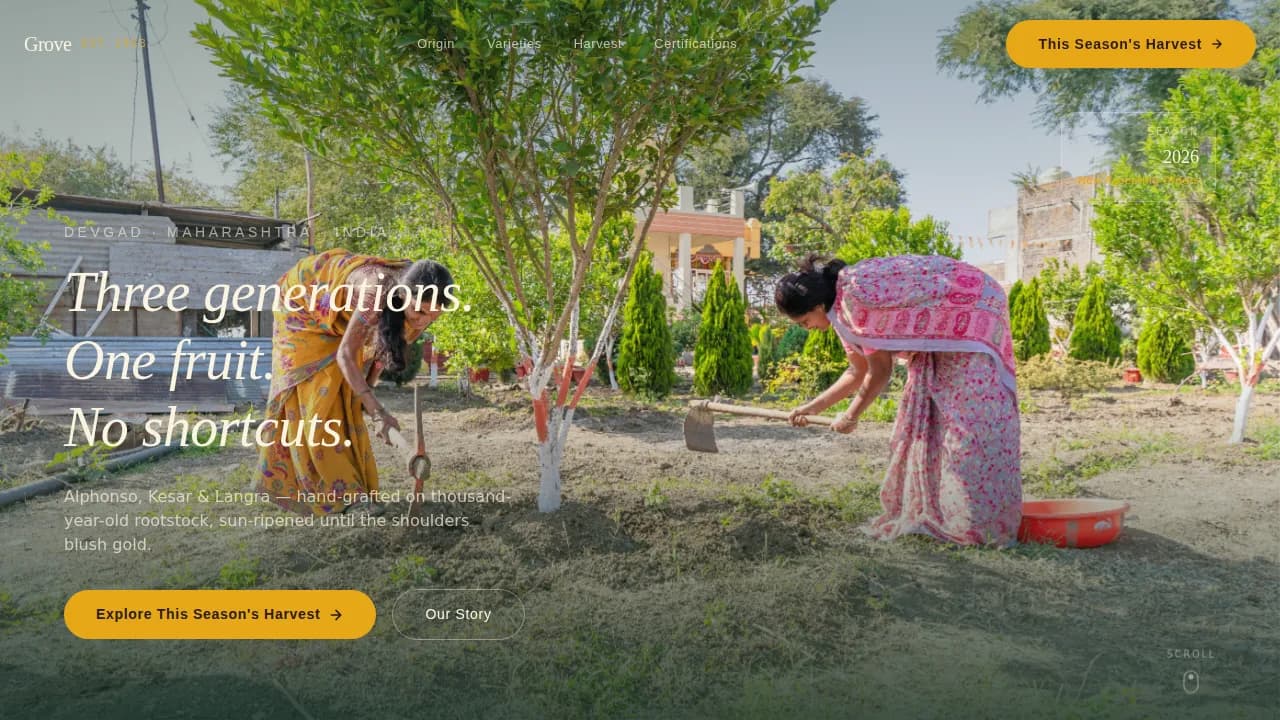
The header uses a panoramic aerial drone video drifting low over endless rows of mango trees at golden hour. A thin serif headline fades in at the bottom third of the frame, reading "Three generations. One fruit. No shortcuts." A scroll indicator invites visitors to continue downward through the story.
Scroll-Linked Origin Story Card Grid
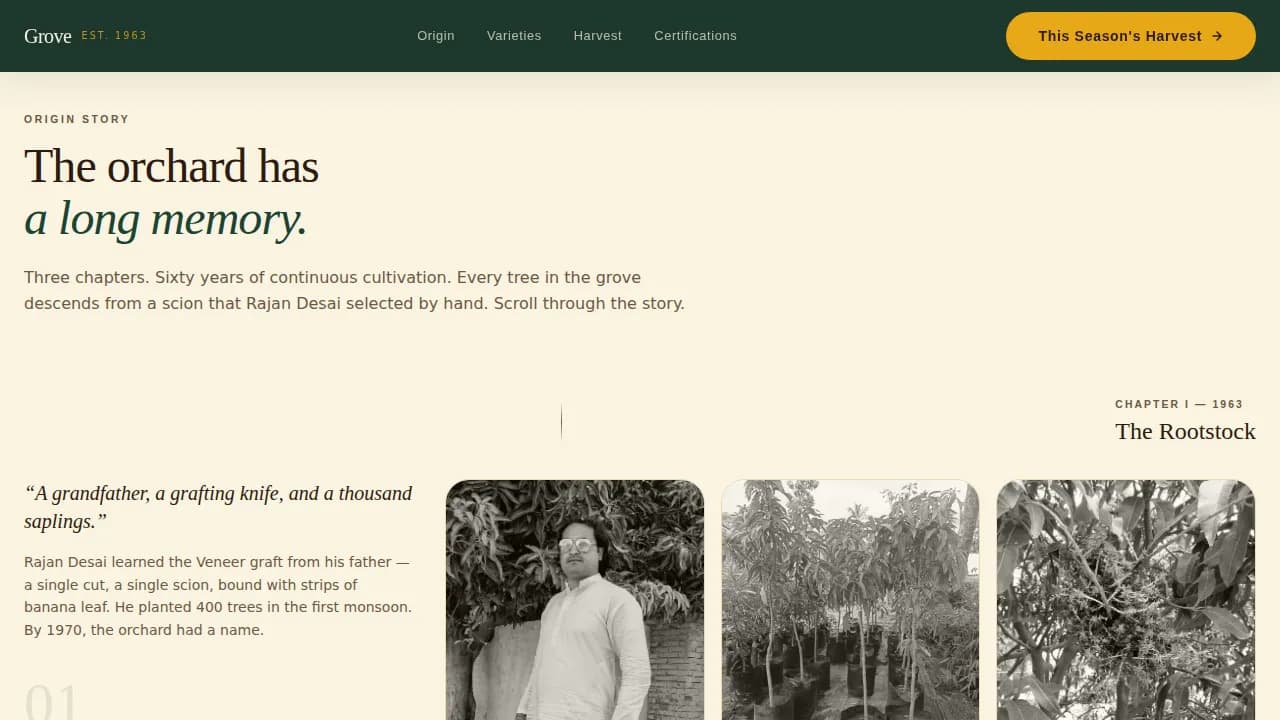
The origin story unfolds as visitors scroll. The first card row posts black-and-white archival photos showing the grandfather grafting saplings in the 1960s. Subsequent rows bloom into full color, covering orchard maturity, the soil program, water management, and harvest close-ups. Staggered card reveals and scroll-linked parallax animate the transition between chapters.
Variety Cards with Brix and GI Badge Display
Alphonso, Kesar, and Langra each get a dedicated variety card. Every card displays a lab-tested Brix reading, a Geographical Indication (GI) certification badge, and an expected ship date for the current season. This Brix-to-box traceability number matters to export buyers who need documented quality before placing large orders.
Trust and Traceability Section
A dedicated block covers cold-chain verification, third-party certifications, and traceability documentation. This section helps the farm live up to the expectations of international buyers by making proof of quality visible on the page before any form or sign-up is required.
Persistent Mobile Call-to-Action Bar
On mobile devices, an amber "Explore This Season's Harvest" button persists as a fixed bottom bar throughout the scroll. On desktop, the same call-to-action appears as a bold amber button after the origin grid and again inside the final full-width season availability card.
Final Full-Width Season Card
The closing section displays current-season mango varieties with expected ship dates in a full-width card format. This is where the origin story hands off to commerce, directing buyers through a click to the catalog page with per-case pricing and minimum order quantity (MOQ) details.
Page sections overview
Section
Purpose
Panoramic Hero Header
Sets cinematic scale, brand tone, and scroll intent
Origin Story Grid
Posts archival-to-harvest narrative in modular cards
Varieties Display Grid
Shows Alphonso, Kesar, Langra with Brix and ship dates
Trust and Traceability
Displays cold-chain proof and GI certification badges
Season Availability Card
Closes story loop and drives click to harvest catalog
Linear Single-Row Footer
Delivers contact and legal links in minimal space
Design & branding system
Grove's visual identity follows a Nature-Inspired editorial direction that feels like a luxury food magazine printed on heavy paper. Every design decision references the farm's physical environment.
Color system: Deep canopy green (#1B4332) anchors backgrounds and navigation; sun-warmed bark (#5C4033) grounds body text and dividers; ripe mango amber (#E6A817) lights up call-to-action buttons and hover states; chalky plantation-wall white (#FAF3E0) gives cards breathing space between sections
Typography: Fraunces serif handles all headlines and pull quotes, adding editorial weight; DM Sans handles body copy and labels, keeping body text simple and readable at any size
Animation and interactivity: Scroll-linked parallax, staggered card reveal sequences, and fade-in transitions carry visitors forward through time; hover states on variety cards surface Brix badge details on desktop
Mobile & speed optimization
Grove is built desktop-first, matching the workflow of export buyers who search and evaluate suppliers on a computer during business hours. Mobile visitors are not left behind.
Persistent mobile call-to-action bar: The amber "Explore This Season's Harvest" button stays fixed at the bottom of the screen on every mobile device, so the next step is always one tap away regardless of where a visitor is in the scroll
Server Components for static content: Pre-built sections and image optimization keep page load lean, so the video header and high-resolution mango photography display quickly without making visitors wait
Responsive card grid layout: The modular card grid reflows cleanly across screen sizes, preserving the origin story's visual pacing on tablet and mobile without losing the chapter structure
How this template helps you convert
Grove earns trust before asking for a click. The layout is designed to move skeptical buyers from curiosity to confidence across a single scroll session.
Origin credibility first: Archival photography and a generational narrative post the farm's history visibly, so buyers from specialty grocer communities and international export companies understand the farm's track record before they see a price
Proof embedded in the product display: Brix readings and GI certification badges sit directly on variety cards, giving buyers the documented quality signals they need to justify a purchase decision without leaving the page to search for credentials elsewhere
One frictionless click-through: No form, no sign-up, no account required on this page. Every call-to-action leads directly to the catalog, keeping the buyer's momentum intact and reducing the number of steps between interest and a placed order
Other information about this template
Grove stands in a specific category of agricultural landing page templates: those built to serve premium, single-origin food brands that live and die by provenance. The inspiration behind templates like this one draws from real mango grove history. The name "Grove Mango Plantation" is associated with the historic Haden mango origin site in Coconut Grove, south Florida. In 1889, Dr. David Fairchild introduced the Mulgoba mango from India to south Florida, and in 1902, Captain John Haden and his wife Florence planted four seeds from the Mulgoba tree in their Coconut Grove backyard. By 1910, one of those seedlings produced a fruit vastly superior, larger, and less fibrous than anything grown before. The Haden mango became the first variety grown commercially in Florida, and approximately 80% of the world's commercial mangoes are its descendants. The original Haden mother tree, over 110 years old, still stands in a private backyard in Coconut Grove. The Mitchell family later founded a 350-acre plantation stretching from Miami to Homestead, shipping up to 100,000 pounds of mangoes a day by the 1970s.
This historical depth is exactly the kind of story that the Grove template is designed to tell. Mangoes have a rich history dating back over 4,000 years, originating in South Asia. They are considered the national fruit of India and are celebrated in festivals and traditional food culture across the subcontinent. Mango trees require a warm climate, well-drained soil, and careful grafting to produce high-quality fruits. Farmers face real challenges: pests, disease pressure, irrigation management, and years of waiting before a grafted tree reaches peak production.
The template gives that full arc a home on the web. You do not need traditional programming skills to adapt it. No-code platforms allow users to create websites and launch production-ready pages without writing a single line of code. Many subscription-based tools offer free trials and pricing plans that suit small farms, growing companies, and product managers alike. Whether your customers are based in New York, navigating export documentation from india, or pre-ordering from a local community, Grove gives your mango farm a digital presence that lives up to what you grow.
This template is designed specifically for the Agriculture and Environment category, within the Fruit and Vegetable Farming subcategory, and posts best in a mango plantation niche context
The grove origin story mango plantation landing page template uses a Click-Through landing page direction, meaning no form collects data on this page; buyers land on the catalog after clicking
The Forest Trust color system and Origin Story creative direction are both defined intersection-level design choices, not ad hoc styling decisions; they were matched to this niche for a reason
The template's library of pre-built sections, written content structure, and video header concept can be adapted to suit other single-origin fruit farms or premium agricultural brands with similar storytelling needs
Mango logo branding for the farm can be developed separately; a well-designed mango logo should communicate the essence of the business and use three or fewer colors alongside clear fonts for maximum legibility
Buyers excited about sourcing single-origin fruits can access the catalog directly from the landing page; no account creation or sign-up is needed before that first click