Comprehensive Heritage Hotel Safety Landing Page Template
The Safeguard historic hotel fire protection landing page template is a hero-dominant, single-page design built for fire protection contractors serving boutique and historic hotels. It pairs a draggable before/after hero with a seven-question property assessment quiz, a Problem→Solution narrative arc, and an Agrarian Root visual identity in charcoal and amber, helping contractors convert cautious hotel owners into booked walkthroughs.
by Rocket studio
Quick summary
Safeguard is a single-page contractor landing page template built for the hotel fire protection niche. It opens with a full-viewport before/after case study slider, moves through a Problem→Solution arc that mirrors the visitor's exact concerns, and closes with a seven-question quiz that delivers a personalized fire safety risk tier. The charcoal and amber visual identity keeps the tone serious, credible, and craft-driven.
Who this template is for
This template is intended for fire protection contractors whose work sits at the intersection of compliance and preservation. The page speaks directly to three distinct buyer types who carry real urgency around fire safety and building code risk.
- Independent hotel owners with 50 to 200 rooms who face rising insurance premiums and Authority Having Jurisdiction (AHJ) citation letters
- Hospitality management companies managing fire protection compliance across multiple properties at once
- Historic inn operators who fear that a retrofit will damage the period architecture they have spent decades protecting
What problem this template solves
Most fire protection contractor websites treat every building the same. Historic hotel owners and hotel managers know their property is not like every other building, and generic service pages do not address their specific fears around preservation, guest displacement, or regulatory requirements. This template solves that trust gap head-on.
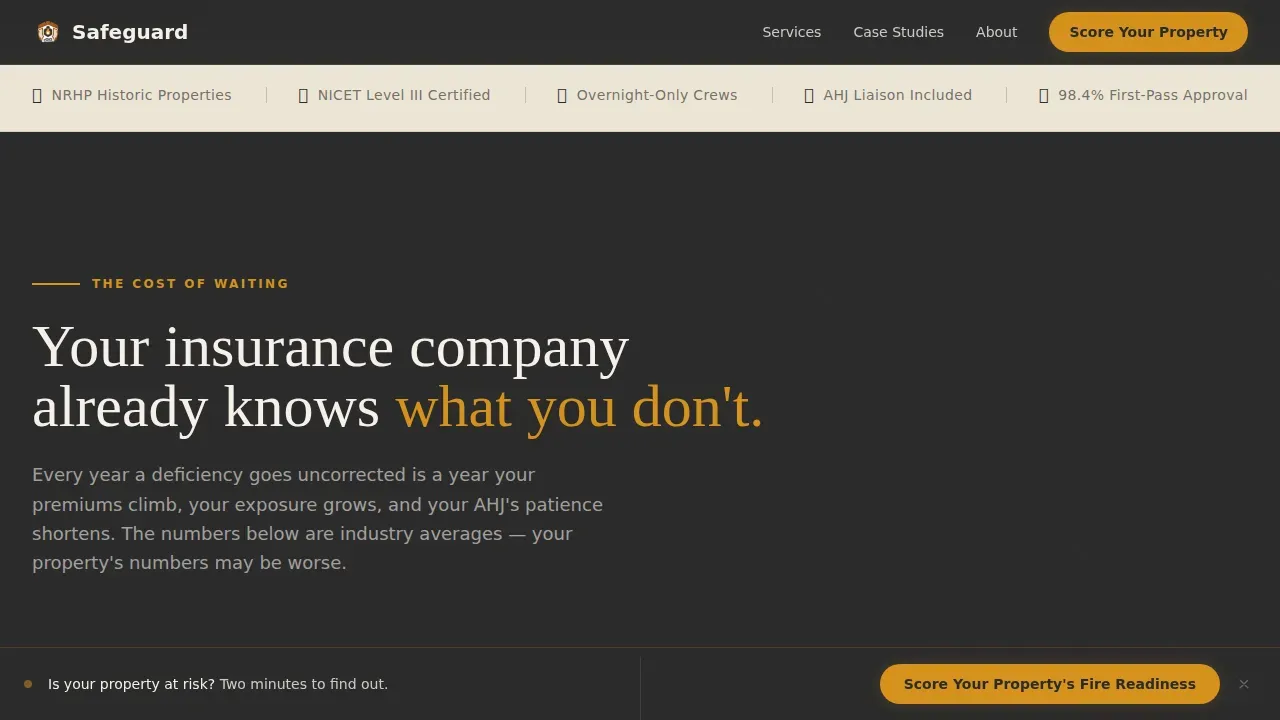
- It names the visitor's real nightmare in oversized amber type: rising premiums, AHJ citations, and the risk of closing guest rooms during construction
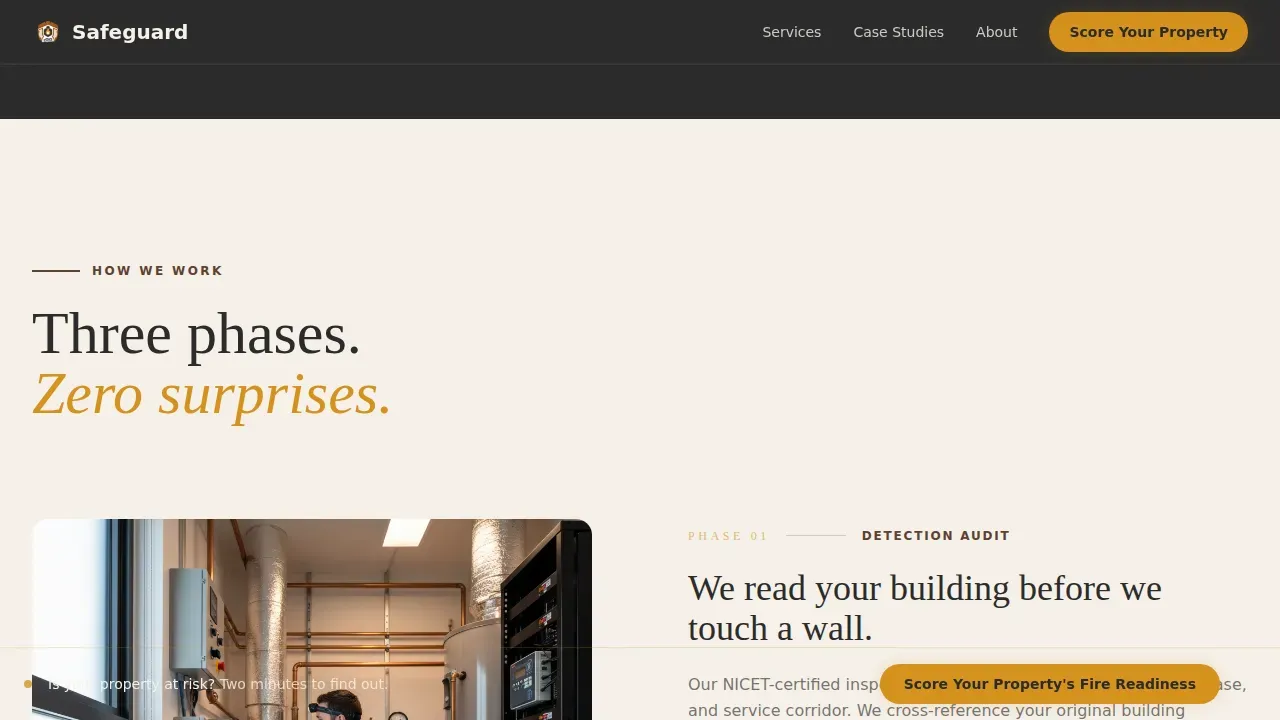
- It walks the visitor through a clear Detection→Suppression→Overnight Installation sequence, showing exactly how the contractor works without disrupting a single occupied room
- It converts hesitation into action through a low-friction quiz that delivers a personalized fire safety risk score, removing the need for a cold phone call as the first step
What you get with this template
You get a fully structured, hero-dominant landing page with every section pre-planned and purpose-built for the hotel fire protection market. The template is designed desktop-first, with full mobile support, so decision-makers can evaluate it at their desk and hotel staff or managers can access it on any device.
- A 90-viewport-height hero with a draggable before/after slider, a compliance-focused headline, and a tagline in linen white on charcoal
- A seven-question quiz funnel with a progress bar in amber, a personalized risk tier output in green, amber, or red, and a summary PDF gated behind a minimal lead form
- Five pre-built content sections covering the real cost of non-compliance, how the crew works, case study metrics, and a full-width quiz call-to-action, plus a linear single-row footer
Feature list
This template is designed to implement a precise set of interactive and structural capabilities that match the demands of a high-stakes B2B fire protection services page.
Draggable Before/After Hero Slider
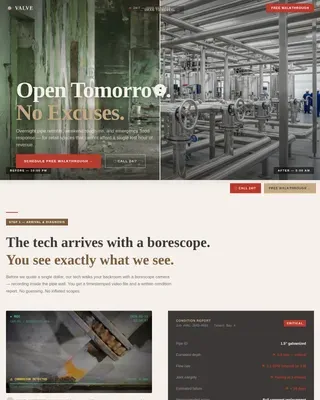
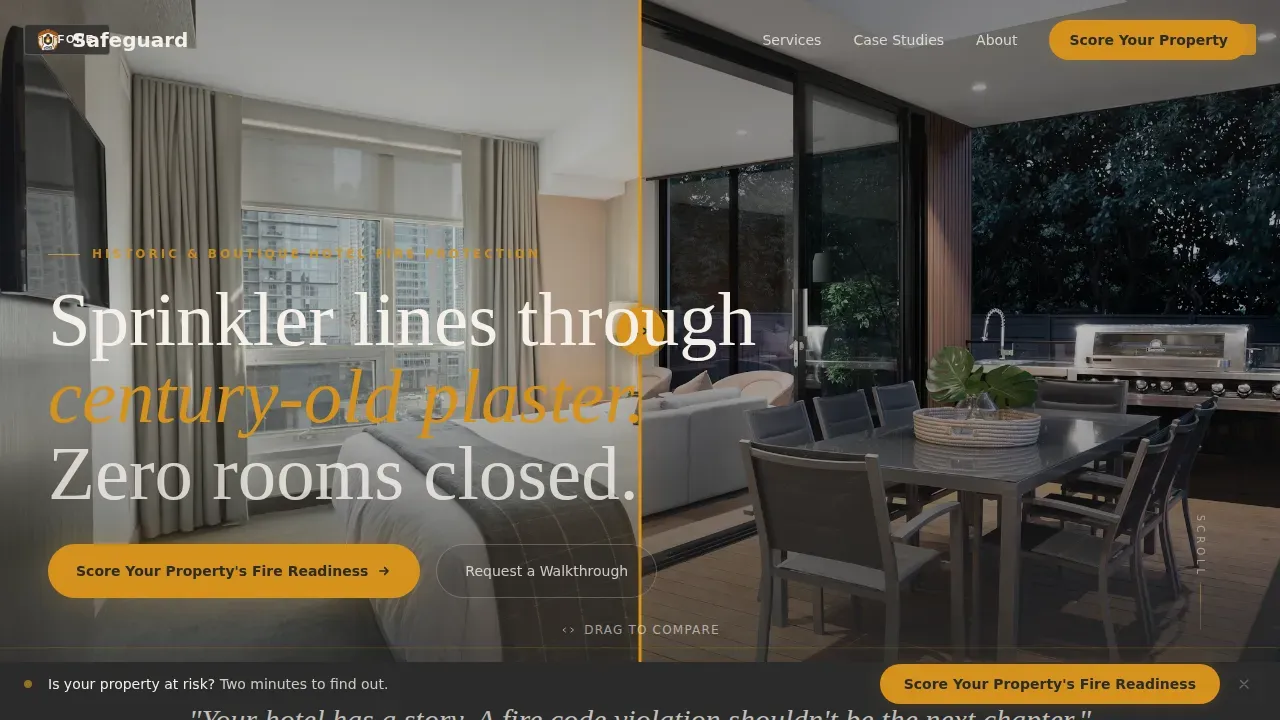
The hero fills ninety percent of the viewport with two photographs of the same hotel hallway. On the left is the pre-retrofit state: exposed conduit, mismatched alarm heads, and a violation notice taped to a fire panel. On the right is the finished result: period sconces undisturbed, sight lines clean, and only a barely visible recessed sprinkler head in the ceiling. A thin amber slider line divides the two images and is fully draggable, letting visitors feel the transformation rather than just read about it.
Seven-Question Property Assessment Quiz
The quiz is the primary conversion engine. It opens with a single, low-friction question about guest room count, then progressively asks about building age, current suppression type, last inspection date, and historic designation status. One question per screen. A progress bar in amber tracks advancement. Results deliver a color-coded fire safety risk tier with a summary PDF offer gated behind three fields: name, property name, and email.
Fixed Call-to-Action Bar
After the visitor scrolls past the second section, a fixed bottom bar appears with the primary call to action: "Score Your Property's Fire Readiness." It stays visible across all subsequent sections so the invitation to evaluate the property is always one tap away. A secondary "Request a Walkthrough" button serves visitors who already know they need help and want to skip the quiz entirely.
Problem→Solution Narrative Arc
Each scroll section is structured to answer one specific problem with one specific solution. The arc moves from the real cost of non-compliance, through detection audits, suppression design, and overnight installation crews, to a bento grid of case study cards with timeline and occupancy metrics. Photography shifts from disorder to calm as the visitor scrolls, reinforcing the contractor's ability to manage the process from start to finish.
Agrarian Root Visual System with GSAP Animation
The template uses GSAP ScrollTrigger and Intersection Observer stagger animations throughout. Data cards animate in as the visitor scrolls. Section transitions are timed to the Problem→Solution arc. The visual language, deep charcoal headers, amber data points and interactive elements, timber card borders, and linen backgrounds, is applied consistently across every section to create a cohesive, craft-focused aesthetic.
Page sections overview
| Section | Purpose |
|---|---|
| Hero Before/After | Draggable slider showing pre- and post-retrofit hotel hallway with tagline |
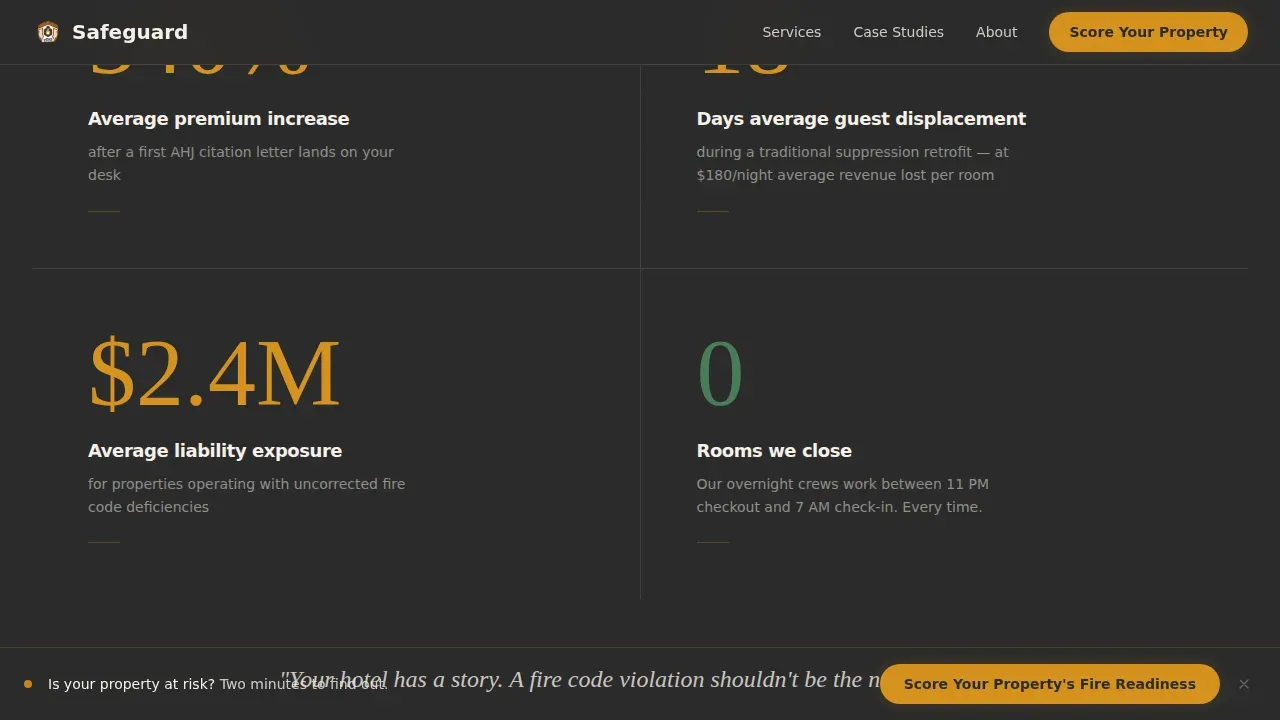
| Real Cost Numbers | Oversized amber problem statistics on charcoal to surface the visitor's exact fears |
| How We Work | Alternating split layout covering detection audits, suppression design, and overnight install |
| Properties Protected | Asymmetric bento grid with case study cards, timeline metrics, and occupancy data |
| Score Your Property | Full-width quiz call-to-action section with assessment entry point |
| Linear Footer | Single-row footer following Pattern 1 layout |
Design & branding system
The design follows an Agrarian Root theme. The overall feeling is a farmhouse kitchen table where serious plans are drawn up by lamplight: soot-darkened beams, honey-colored light, worn wood surfaces. Every color choice reinforces credibility and calm authority.
- Color palette: deep hearth charcoal (#2B2B2B) dominates headers and type; warm amber lantern (#D4911E) marks every interactive element, data point, and progress indicator; weathered barn timber (#5C4033) grounds card borders and section dividers; aged linen white (#F5F0E8) breathes across backgrounds to prevent dense technical content from feeling oppressive
- Typography: Fraunces serif headings carry the heritage weight of the brand; DM Sans body text keeps instructional and data-heavy content highly readable at every size
- Visual tone: photography moves from chaos to calm as the visitor scrolls, and data cards use amber numerals against charcoal to make compliance timelines and occupancy figures feel concrete and trustworthy
Mobile & speed optimization
The template is designed desktop-first, which reflects how hotel managers and ownership groups typically research contractors during business hours. Full mobile support is built in so the page remains usable and persuasive on any screen.
- The quiz flow, fixed call-to-action bar, and before/after slider all adapt to smaller screens, ensuring the primary conversion path is never blocked on mobile devices
- Server Components handle all static sections for faster initial load, while Client Components are scoped specifically to the interactive quiz and the draggable slider, keeping the heavier JavaScript payloads contained
How this template helps you convert
The conversion strategy combines high trust signals with a low-friction entry point. It is designed to move a cautious, high-stakes buyer from recognition to action without requiring a cold call.
- The before/after hero and case study metrics establish credibility immediately. Visitors see proof of preservation-first fire protection work before they read a single word of body copy, which is essential for building trust with historic property owners who are alert to the risk of damage during repairs.
- The seven-question quiz lowers the barrier to engagement by offering a personalized fire safety assessment rather than a generic contact form. Visitors get something of value, a color-coded risk tier and summary PDF, in exchange for only three fields of information, which is exactly the kind of lead form friction reduction that helps a hotel manager say yes instead of closing the tab.
Other information about this template
The Safeguard historic hotel fire protection landing page template is built around the realities that historic hotel owners face every day. Nearly a quarter of properties listed in the National Register of Historic Places fall within counties with high wildfire risk. Historic buildings are often constructed with flammable materials, including centuries-old wood elements, making them costly to insure and vulnerable to both fire emergency events and wildfire embers. Windblown embers are the leading cause of structure loss during wildfires, and improving defensible space alone may not be sufficient to protect them.
This template accounts for those risks in its messaging and structure. The page is designed so a hotel manager or ownership group can use it to communicate the full scope of fire protection services, from discrete smoke detection retrofits within plaster ceilings to suppression system design and compliance documentation. The following bullet points cover additional context relevant to buyers and contractors who want to understand the template's scope:
- The quiz assessment involves assessing seven property-specific variables, producing a risk tier that is regularly reviewed and updated as the visitor provides answers, and the output is a document the lead can act on immediately
- The page plan supports communication around emergency preparedness, evacuation routes, fire drills, and training sessions for hotel staff and personnel, which are certain aspects of fire safety that a contractor's website page must address to signal comprehensive expertise
- Fire extinguishers, fire alarm call points, security cameras, and exit sign locations are the types of equipment details that the How We Work sections can be customized to cover, helping guests and employees understand the full protection plan for the building
- The evacuation process, emergency procedures, and lessons learned from past projects can be woven into the case study cards in the Properties Protected section, giving visitors informed, specific evidence of the contractor's ability to manage every phase
- The template is intended to facilitate feedback collection through the quiz result email, support ongoing communication between the contractor company and new leads, and help the hotel manager evaluate which services to prioritize
- Using ignition-resistant materials for repairs, establishing noncombustible zones, and updating preservation policies to include wildfire risk reduction are topics the page can address in body copy to enhance safety messaging for historic property audiences
- Local authorities and regulatory requirements related to historic site compliance are referenced in the problem section, giving visitors the context they need to understand why acting now protects both the building and its long-term insurance standing
Theme
Agrarian Root
Creative direction
Problem→Solution Arc
Color system
Charcoal & Amber
Style
Hero-Dominant (90/10)
Direction
Quiz/Assessment
Page Sections
Draggable Before/after Hero Slider
Seven-question Property Assessment Quiz
Fixed Conversion Call-to-action Bar
Problem to Solution Narrative Arc
Agrarian Root Visual Identity
GSAP Scrolltrigger Animation System
Related questions
Does this template work for contractors who serve non-historic hotels?
Can the seven-question quiz be customized for different property types?
How does the before/after slider support the sales process?
What social proof elements does the template include?
Is the template designed for desktop or mobile users?