Religious & Cultural Architecture Booking Website Template
Darbar is a storybook landing page template built for a gurdwara architecture practice opening its books to new commissions. A scroll-driven ink drawing reveals the full gurdwara elevation as visitors scroll, then walks them through the design journey chapter by chapter. The page earns trust before it ever asks for contact details, converting diaspora building committees into qualified leads.
by Rocket studio
Quick summary
Darbar is a single-page landing page template for a gurdwara architecture practice. It uses a scroll-jacked SVG ink drawing to reveal a full gurdwara elevation in real time. Chapter-by-chapter sections guide visitors from napkin sketch to completed building. Two lead capture paths collect waitlist signups and site submissions from diaspora gurdwara building committees.
Who this template is for
This template is designed for architecture practices that specialize in sacred or cultural buildings, particularly gurdwaras. It is especially relevant for studios opening a new commission waitlist and needing to demonstrate deep liturgical and design knowledge before asking for contact details.
- Gurdwara architecture studios serving diaspora communities in cities like Brampton, Fresno, and Southall
- Practices pitching to building committees handling projects from fundraising stage through new construction or historic renovation
- Design professionals who want their portfolio to feel like a hand-drawn architectural journal rather than a generic agency site
What problem this template solves
Gurdwara building committees are not casual clients. They are trustees managing significant community funds and deeply held spiritual expectations. A generic architecture portfolio page does not earn their trust. This template solves that gap by showing liturgical knowledge, cultural fluency, and design process before asking for anything in return.
- Committees cannot tell whether a practice understands the difference between a community hall with a flagpole and a true gurdwara
- Practices struggle to communicate sacred geometry, Sikh cosmological orientation, and code-compliant structural thinking on the same page
- Standard lead capture forms feel transactional for clients making once-in-a-generation building decisions
What you get with this template
You get a fully structured, one-page layout that moves a visitor through seven carefully sequenced sections. Every section is designed to deepen credibility before the call to action appears. The layout is desktop-first, reflecting how building committees typically review proposals together on laptops during meetings.
- Scroll-jacked hero with SVG ink line drawing, headline reveal, and inline email capture
- Four chapter sections with page-turn transitions, margin annotation reveals, and alternating full-bleed layouts
- Dual lead capture: a waitlist email field and a "Send Your Site" form collecting city, congregation size, and project stage
Feature list
This template includes the following built-in features, each drawn directly from the design and interaction brief.
Scroll-Jacked SVG Ink Drawing Hero
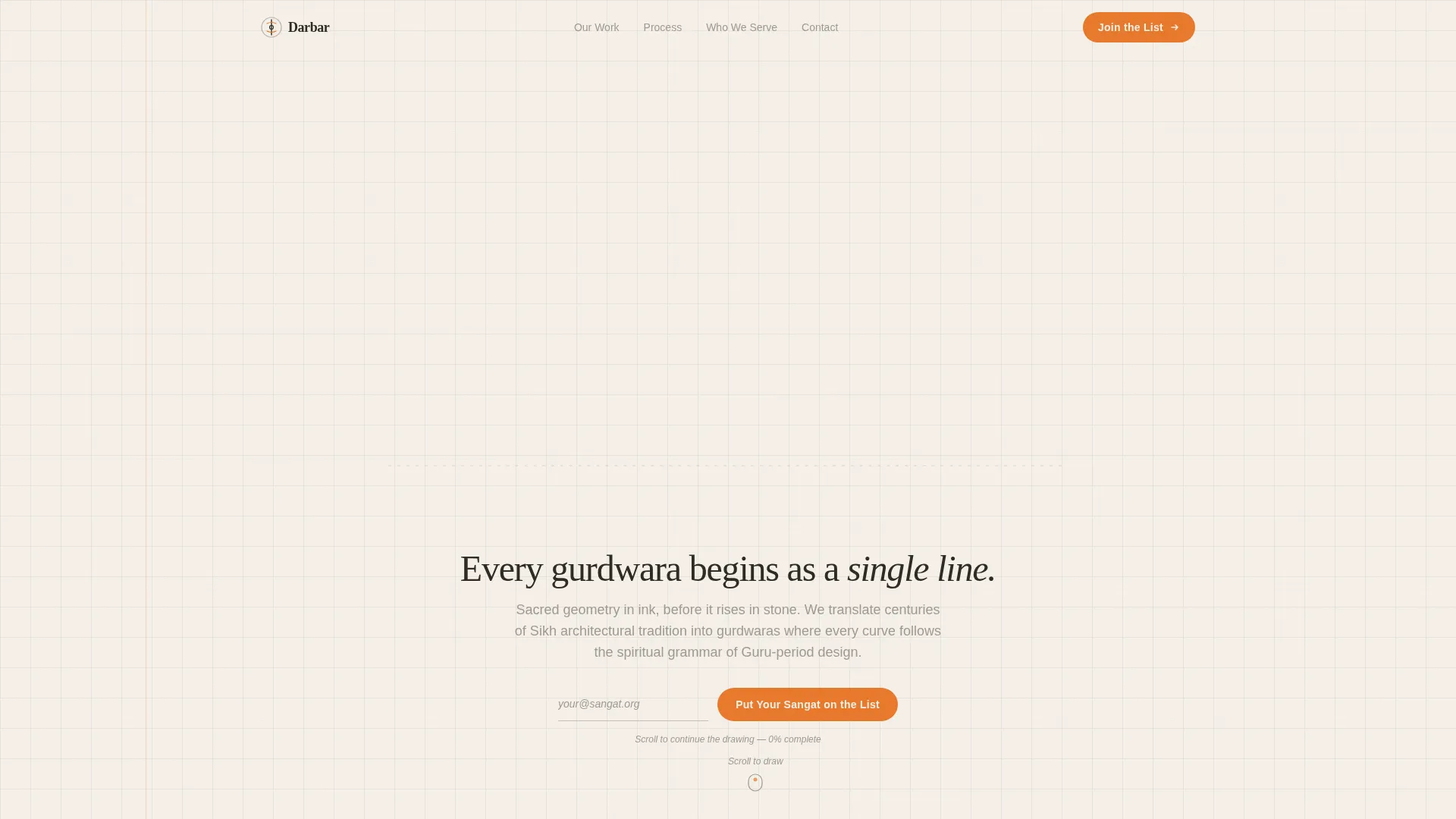
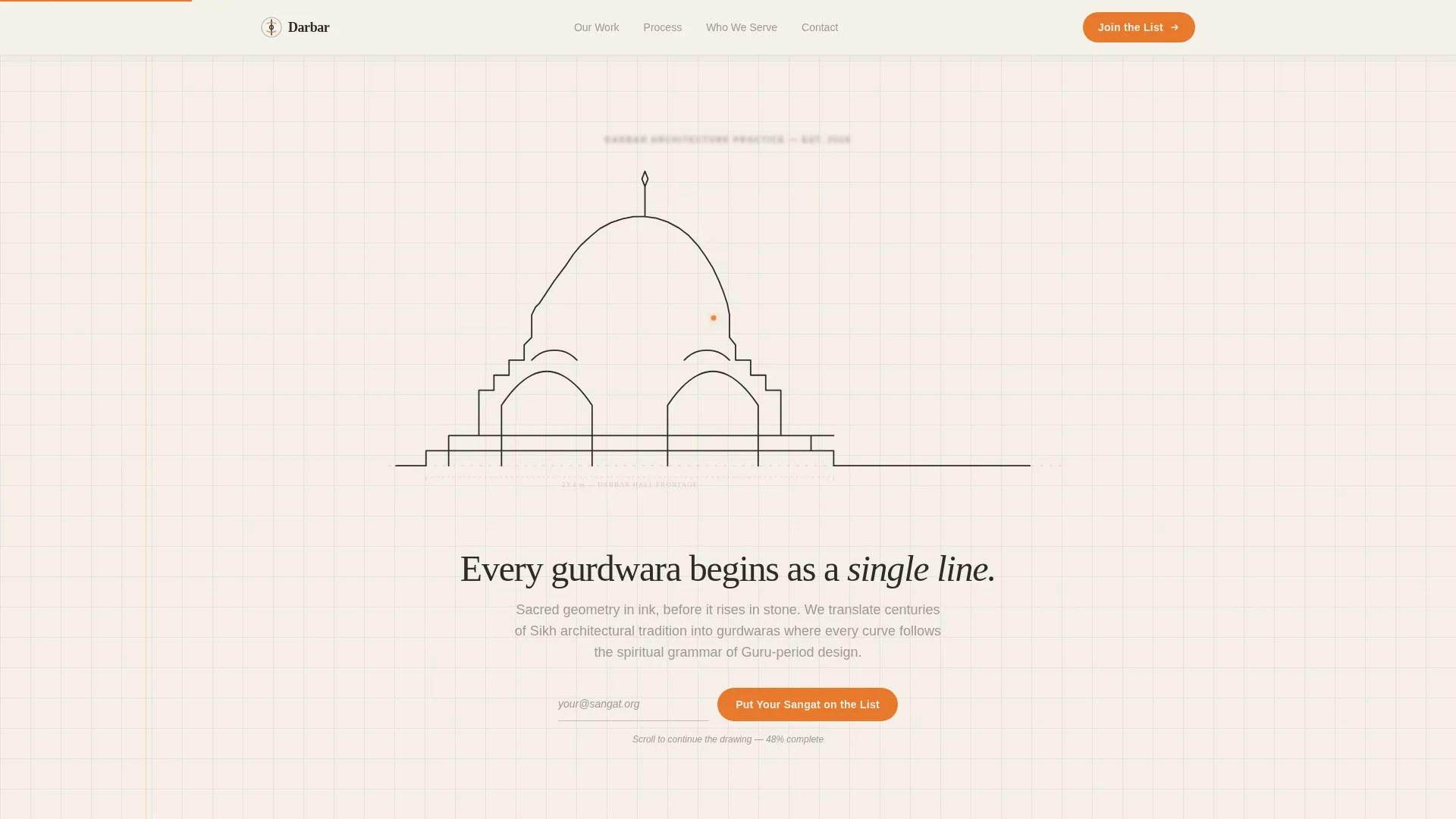
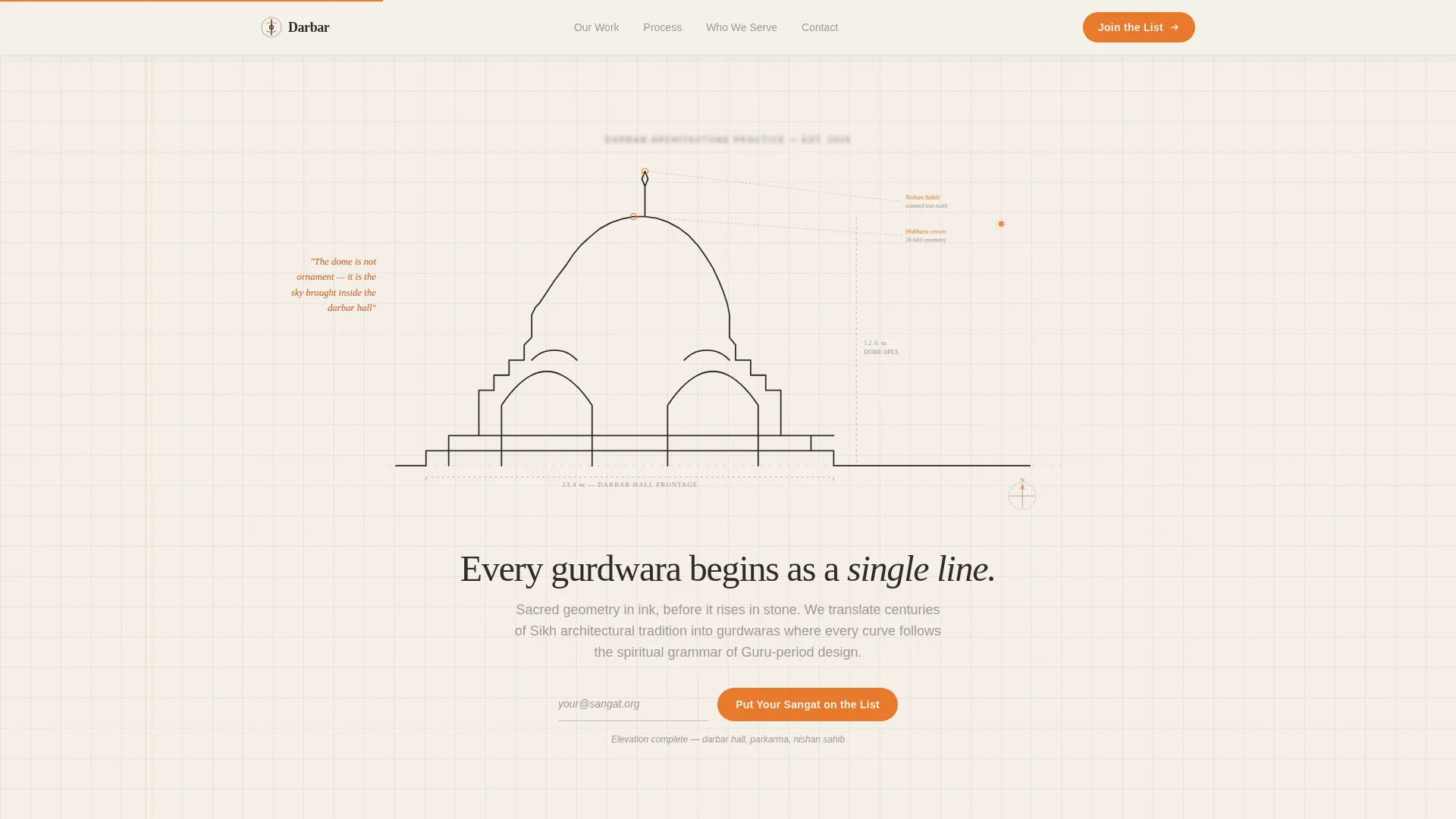
The viewport opens on a single ink stroke. As the visitor scrolls, the SVG path continues in real time, tracing the full gurdwara elevation from dome to flagpole to entrance archway to parkarma colonnade. The headline appears only when the drawing completes. This interaction sets the entire tone of the page before a word of body copy is read.
Chapter Journey with Page-Turn Transitions
Four full-bleed alternating sections tell the story of a gurdwara project from first sketch to completed construction. Each chapter transition uses a page-turn animation. Margin annotations appear on scroll, explaining specific design decisions in handwritten-style notes that build visible expertise.
Dual Lead Capture System
A single-field email capture appears at hero completion and returns as a sticky element after the third chapter. A secondary form collects city, congregation size, and project stage so the practice can qualify leads before responding. Both paths live on the same page without interrupting the reading experience.
Three Commitments Bento Grid
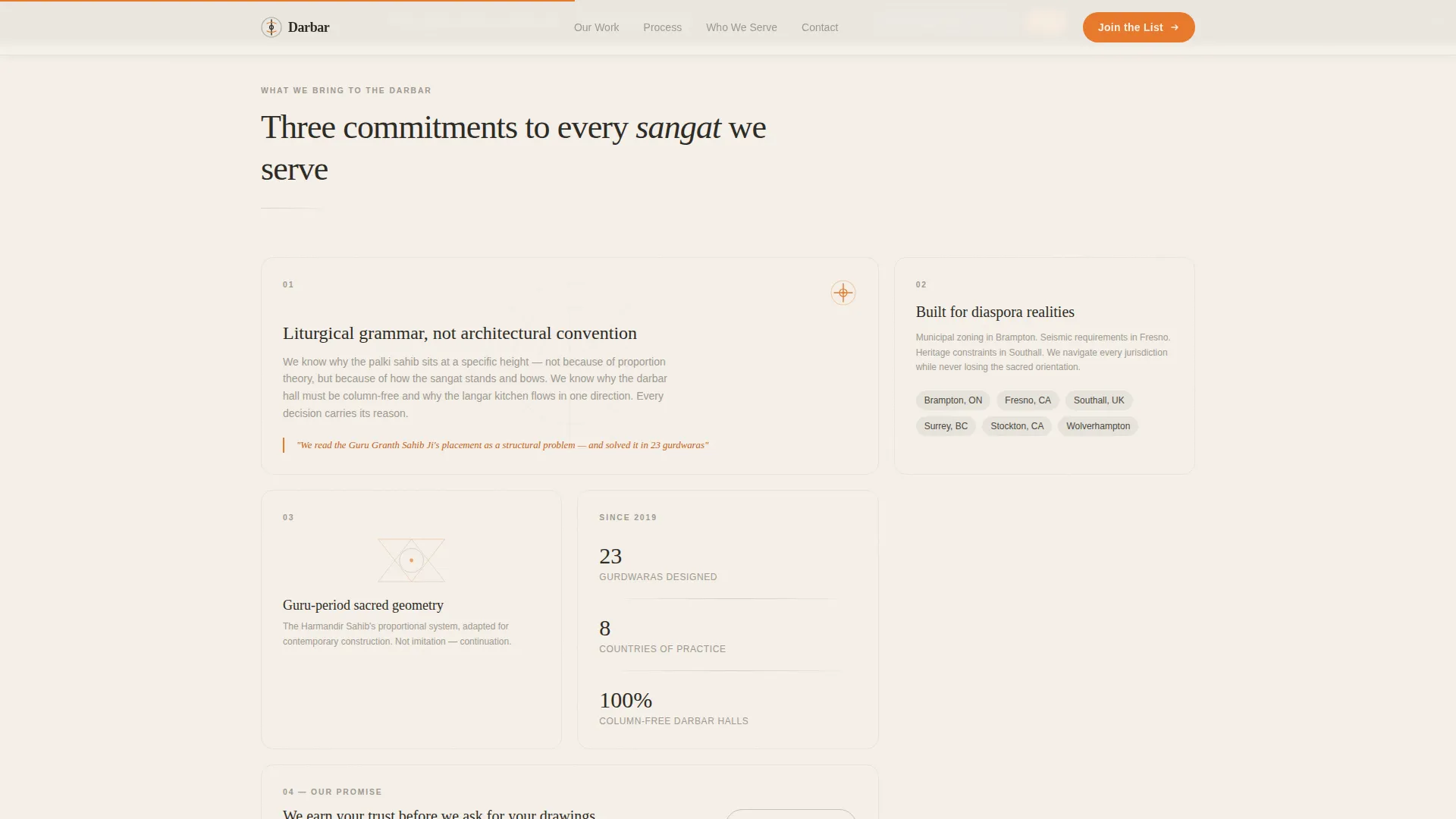
A bento-style grid section presents three core practice commitments: liturgical knowledge, diaspora community expertise, and sacred geometry fluency. Each cell is visually distinct and skimmable, giving committees a fast reference point for what makes this practice different.
Who We Serve Profiles
Three diaspora committee profiles describe the practice's primary client types: a new build committee, a historic renovation committee, and a sangat in early fundraising. These profiles function as social proof and self-selection tools, helping visitors recognize their own situation on the page.
Ink and Paper Visual System
The entire layout uses an unbleached cotton background, iron gall ink body text, graphite trace dividers, and kesri saffron reserved for interactive elements and sacred annotations. Typography uses Fraunces for headings and DM Sans for body text. The result feels like a freshly pressed sheet of handmade paper with still-drying ink lines.
Page sections overview
| Section | Purpose |
|---|---|
| Hero ink drawing | Reveals gurdwara elevation on scroll and captures waitlist email |
| Three Commitments grid | Communicates liturgical, diaspora, and geometry expertise |
| Chapter One: Napkin Sketch | Opens the project story with early community ideation |
| Chapter Two: Site Analysis | Shows cosmological orientation meeting municipal zoning |
| Chapter Three: Structural Drawings | Demonstrates column-free darbar hall problem-solving |
| Chapter Four: Construction | Connects ink drawings to completed building photographs |
| Who We Serve | Presents three diaspora committee profiles |
| Waitlist call to action | Collects email and site submission form entries |
| Minimal footer | Closes the page with clean, distraction-free navigation |
Design & branding system
The visual identity is built on an Ink and Paper theme using the Cloud Canvas color system. Every color decision reinforces the feeling of a hand-drawn architectural journal on handmade Sanganer paper.
- Colors: unbleached cotton (#F5F0E8) for backgrounds, iron gall ink (#2C2A25) for body text, graphite trace (#9E9A91) for structural lines and dividers, and kesri saffron (#E8792B) reserved for interactive elements and sacred annotations
- Typography: Fraunces serif for all headings, DM Sans for body text and user interface elements
- Texture and motion: Sanganer paper texture, scroll-driven SVG path animation, IntersectionObserver-triggered margin annotation reveals, and CSS scroll-linked transitions throughout
Mobile & speed optimization
The template is built desktop-first, reflecting how gurdwara building committees typically review materials together on laptops during trustee meetings. The layout still adapts for smaller screens so committee members can share the link on mobile before a formal review session.
- SVG path animations use CSS scroll-linked properties for smooth performance without JavaScript-heavy libraries
- IntersectionObserver handles margin annotation and chapter reveal triggers efficiently
- Optimized SVG paths keep the ink drawing hero lightweight without sacrificing visual detail
How this template helps you convert
The page is structured to earn trust before it asks for anything. By the time a committee member reaches the lead capture form, they have already seen that the practice understands the difference between a community hall and a true gurdwara.
- The scroll-jacked hero creates immediate visual credibility and reveals the email capture only after the drawing completes, so the request feels earned rather than premature
- Chapter sections with margin annotations demonstrate specific liturgical and structural knowledge, making the practice feel like a trusted expert rather than a vendor pitching for work
- The dual lead capture paths let committees self-select by readiness: those ready to commit join the waitlist, while those still in early stages submit site details for a softer first contact
Other information about this template
This template is part of a curated set of storybook and full-page landing page templates designed for architecture and cultural design practices. A few additional notes for committees and studios evaluating it.
- The template style is classified as Storybook and Full-Page, making it suitable for practices that want a narrative-driven experience rather than a standard portfolio grid
- The creative direction follows an Origin Story structure, where the visitor's journey mirrors the client's own project journey from idea to completed building
- The header concept is a Scroll-Jacked Experience, a design pattern where scroll depth drives animation progress rather than time-based autoplay
- The waitlist and coming soon landing page direction means the page is optimized for lead collection before the practice publicly opens its full project pipeline
- The footer follows a minimal pattern inspired by the Superhuman style: clean, uncluttered, and focused on a single next action
Theme
Ink & Paper
Creative direction
Origin Story
Color system
Cloud Canvas
Style
Storybook/Full-Page
Direction
Waitlist/Coming Soon
Page Sections
Scroll-jacked Ink Drawing Hero
Chapter Journey with Page-turn Transitions
Dual Lead Capture Paths
Three Commitments Bento Grid
Who We Serve Committee Profiles
Ink and Paper Visual Identity System
Related questions
Who is this template built for?
Can a committee member submit project details before the practice formally opens?
Does the template work for renovation projects, not just new builds?
What makes this template different from a standard architecture portfolio page?
Is this template specific to Sikh gurdwara projects?