Proven Farrier Booking Landing Page Template
Forge is a sidebar companion landing page built for mobile farriers targeting yard managers, event trainers, and stud farm owners. It leads with an embossed credential strip, fills the main column with a testimonial mosaic, and keeps a persistent yard contract form pinned in the sidebar. The Monochrome Steel palette and Service Utility theme communicate serious, competition-proven professionalism from the first scroll.
by Rocket studio
Quick summary
Forge is a competition-proven farrier landing page built to win yard contracts, not casual bookings. The page opens with an award badge header that posts credentials before a single word of copy appears. A scrolling testimonial mosaic fills the main column while the sidebar holds navigation, service area details, and a pinned contract form. Everything is created to move a yard manager from first impression to signed contract.
Who this template is for
This template is drawn toward farriers who work at scale. If you manage trimming cycles across multi-horse operations, this page positions your business at the level those clients expect to find.
- Yard managers running 20 to 40 box livery operations who need a reliable, contracted farrier on a fixed cycle
- Event trainers prepping horses for spring competition season who require consistent hoof performance management
- Stud farm owners needing scheduled foal trimming and ongoing remedial work across a full crop
What problem this template solves
Most farrier websites are cluttered, slow to load, and built around a general audience. They bury credentials and rely on word-of-mouth rather than a structured digital presence. Yard managers searching for a contracted farrier need to see professionalism instantly. This landing page solves that by leading with trust signals and guiding visitors toward one clear action.
- Credentials and competition results are buried on typical farrier websites, causing serious buyers to leave before they find the information they need
- Generic websites encourage browsing rather than converting, and a yard manager on a busy schedule will not continue searching for a contact form
- Without social proof at scale, a farrier cannot protect their position against lower-cost uncertified competitors who appear first in local search results
What you get with this template
You receive a fully structured single-page website with a sidebar companion layout, created specifically for the farrier B2B market. Every section has a defined role in moving the visitor toward a yard contract. The design, copy structure, and interactive elements all serve that one goal.
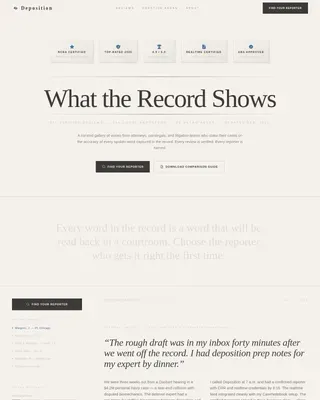
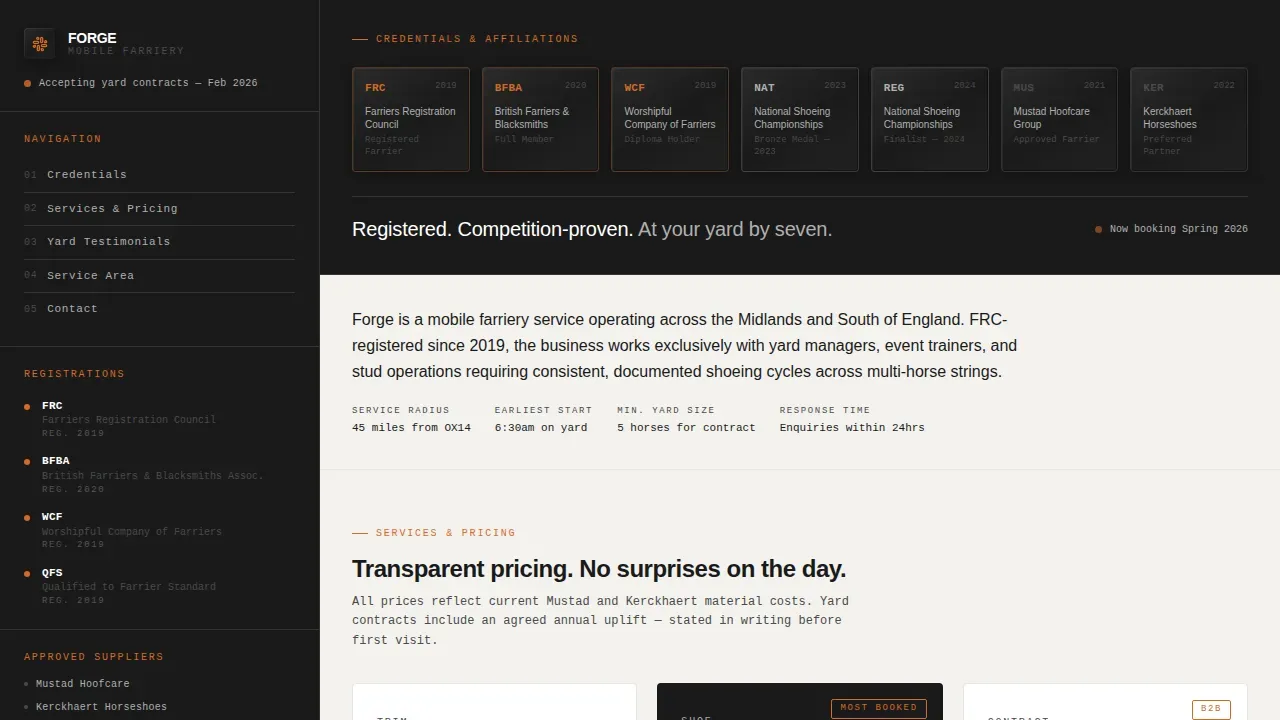
- Award badge header strip with embossed credential icons, a tagline line, and hover shimmer on each certification mark
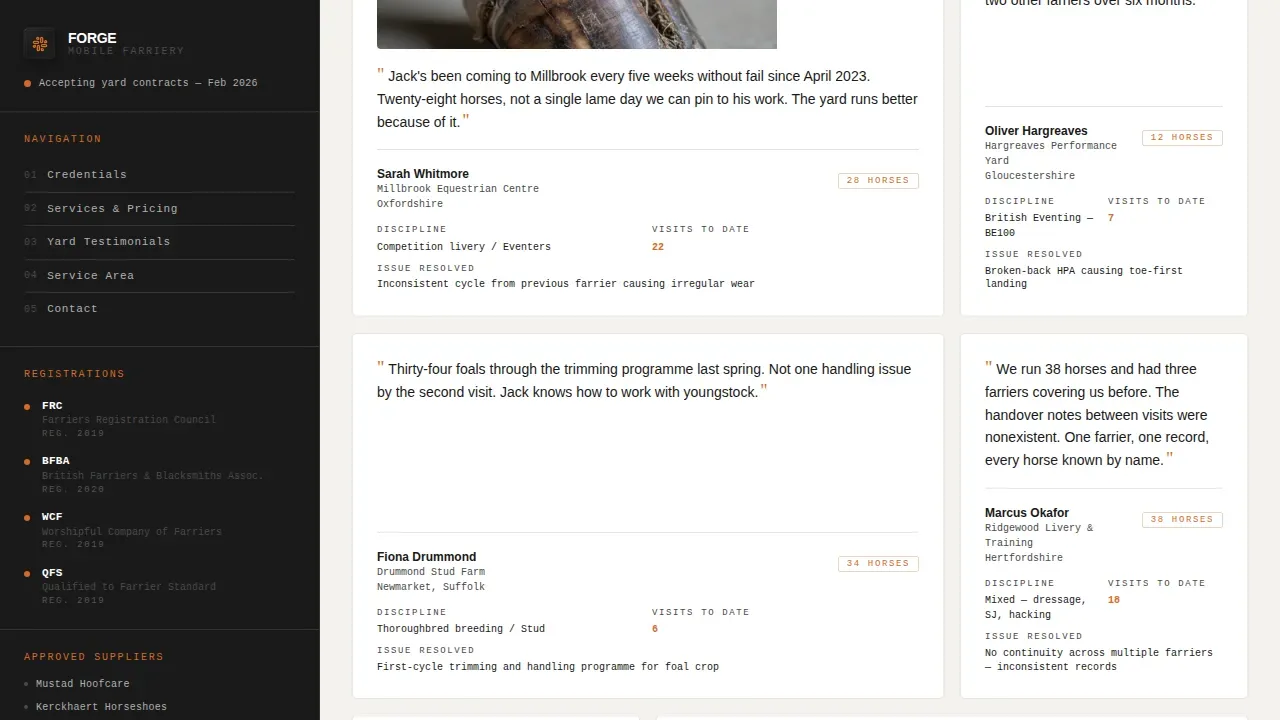
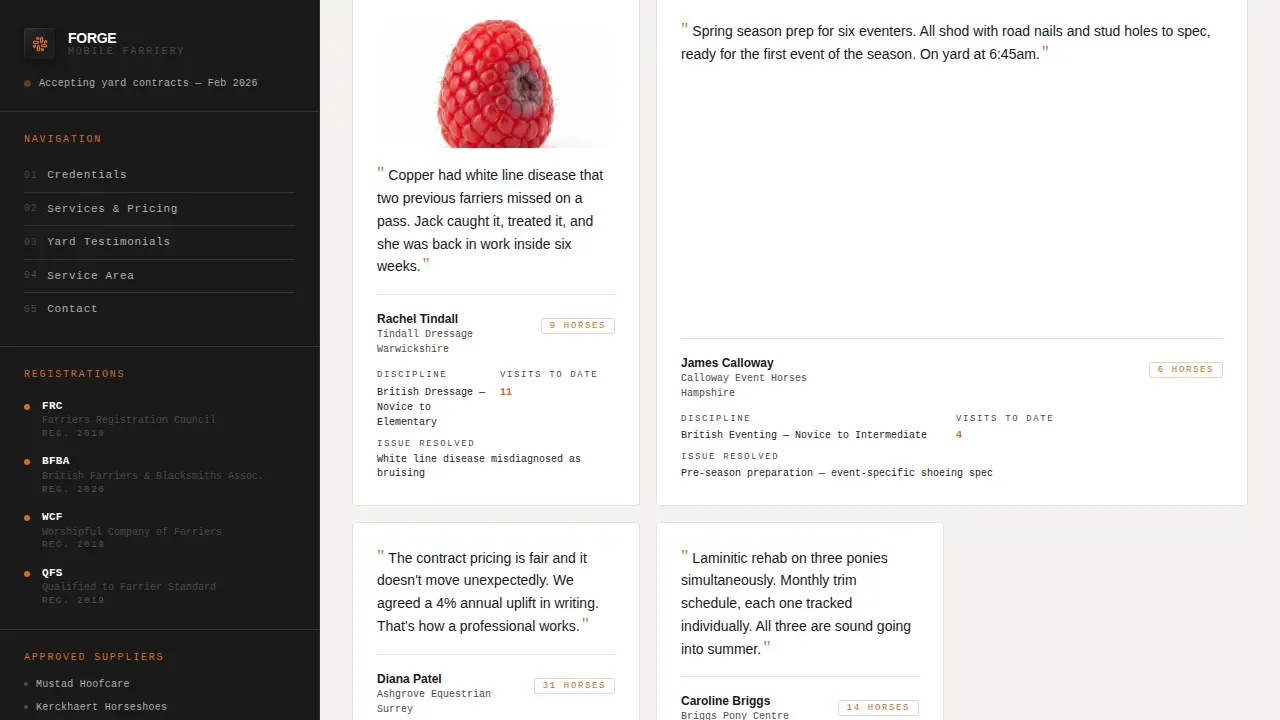
- Testimonial mosaic in the main column with staggered cards carrying horse name, discipline, issue resolved, and visit count per yard
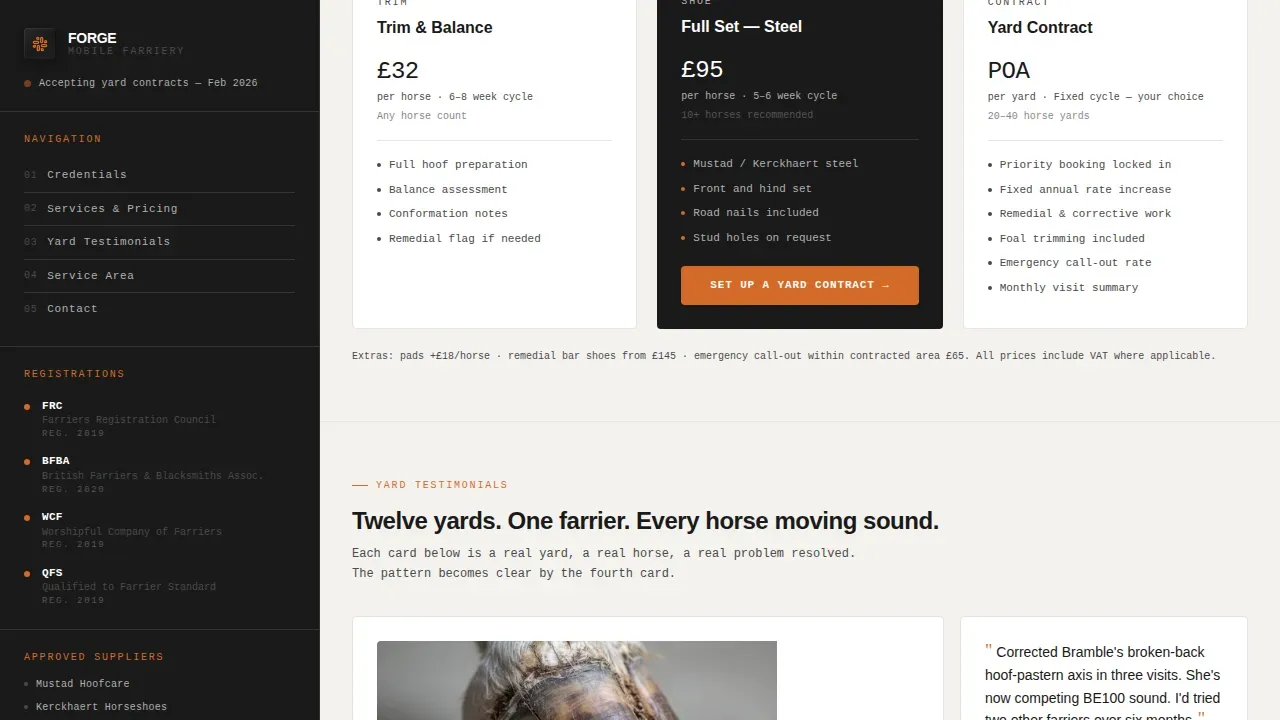
- Persistent sidebar with navigation, service area map placement, cycle pricing tiers, availability windows, and a pinned yard contract form
Feature list
This page is built around a small group of high-impact features. Each one serves a specific conversion role and is grounded in the farrier B2B context.
Award Badge Credential Header
The header is a horizontal band of embossed steel icons representing registrations, competition medals, and certification seals. It catches a metallic sheen on hover. No portrait, no landscape image. The credentials speak first, and a single tagline line reads beneath them. This structure protects the visitor's attention and keeps it on the qualifications that matter to yard managers.
Testimonial Mosaic with Yard Specifics
The main column fills with staggered testimonial cards of varying widths as the visitor scrolls. Each card carries a named quote, the horse's discipline, the issue resolved, and the number of visits completed. The mosaic builds density deliberately. By the time a visitor reaches the contract form, they have reviewed accounts from operations similar to their own, and the pattern of consistent performance is clear.
Persistent Sidebar Contract Form
The sidebar is forge-black and stays pinned as the visitor scrolls. It holds the primary call to action: a yard contract enquiry form with fields for yard name, horse count, current shoeing cycle in weeks, and preferred first-visit date. A secondary text link below the form offers a single-visit booking path. The sidebar also updates contextually to show service area coverage, pricing tiers, and availability windows as the visitor moves down the page.
Scroll-Triggered Mosaic Animation
Testimonial cards reveal with a scroll-triggered stagger animation. Each card enters the view at a slightly offset time, building visual rhythm and encouraging the visitor to continue reading. This controlled reveal creates the sense of pattern recognition rather than a static list of reviews, which makes the social proof feel earned rather than posted.
Monochrome Steel Visual System
The page uses a four-colour system: forge-black for the sidebar and header, anvil iron for mid-tone elements, hoof-wall ash for the main column background, and hot-turn orange exclusively for calls to action and certification marks. Typography is set in Manrope for headings and JetBrains Mono for credentials, pricing data, and cycle information. The system communicates functional authority without decorative distraction.
No-Navigation Focused Layout
There is no top menu navigation. This is deliberate. Removing navigation keeps the visitor on the page and protects the conversion path. The sidebar holds the structural anchors the visitor needs to find the relevant section quickly, without offering an exit route before they reach the form.
Page sections overview
| Section | Purpose |
|---|---|
| Award Badge Header | Posts credentials, competition results, and a benefit-driven tagline before any service copy appears |
| Services and Pricing | Displays yard contract tiers with cycle pricing in a clear, scannable format |
| Testimonial Mosaic | Fills the main column with staggered yard-specific social proof cards that build density on scroll |
| Service Area and Availability | Shows coverage map placement and booking windows alongside availability information |
| Contract Form and call to action | Pinned sidebar form for yard contract enquiries, with a secondary single-visit text link beneath |
| Footer | Minimal developer-pattern footer holding essential links and contact information |
Design & branding system
The visual identity follows a Service Utility theme. Every colour, typeface, and layout decision is functional. The palette feels like a well-kept tool roll laid out on a tailgate. Nothing is decorative; everything is purposeful.
- Colours: forge-black (#1A1A1A) for sidebar and header, anvil iron (#4A4A4A) for structural mid-tones, hoof-wall ash (#B0B0B0) for the main column ground, and hot-turn orange (#D46A27) used exclusively for calls to action and certification marks
- Typography: Manrope in bold weights for headings and utility labels, with JetBrains Mono for credentials, pricing tiers, cycle data, and any data-forward information
- Texture and motion: badge hover shimmer gives metallic sheen to the credential strip, while the ash-white main column breathes against the dark sidebar without visual competition
Mobile & speed optimization
The template is designed desktop-first with the sidebar companion layout as the primary view. On smaller screens, the layout stacks responsively so yard managers and trainers can view the page clearly from a phone at the yard.
- The sidebar stacks below the main content column on mobile, with the contract form remaining accessible without excessive scrolling
- Scroll-triggered stagger animations are handled through client-side components, keeping static sections server-rendered for faster initial load performance
- The no-navigation structure reduces page weight and removes distraction, which supports faster perceived load time and a lower rate of visitors leaving before they reach the form
How this template helps you convert
Forge is built around a single conversion goal: getting a yard manager to submit a contract enquiry. Every structural decision on the page serves that outcome.
- The credential header establishes authority in the first seconds. A visitor does not need to search for qualifications. They are posted at the top of every view, building trust before any service claim is made. Professional credentials protect the farrier's market position against uncertified competition.
- The testimonial mosaic builds social proof at the scale the target audience recognises. Yard managers want to see operations similar to their own already on the books. The staggered cards carry specific information: horse name, discipline, issue resolved, visit count. That specificity earns the account enquiry click far more effectively than a generic review or star rating.
- The pinned sidebar form removes friction at the moment of decision. When a visitor is ready to enquire, the form is already visible. They do not need to scroll back to the top or navigate to a contact page. The yard contract fields are designed to capture qualified leads from operations ready to commit to a regular cycle.
Other information about this template
Forge was created for farriers who want to protect and grow their contracted yard business through a credible digital presence. This section covers additional aspects of how the template fits into a broader farrier promotion and business strategy.
- The page is built as a no-code-ready template, so farriers or their agents can manage and update the website without extensive coding knowledge. No-code platforms enable service-based businesses to build production-ready applications quickly and efficiently, which means money and time saved on development.
- Accreditation is a central subject of this template. The art of displaying certifications and continuing education achievements on a farrier website is well established as a trust signal. Farrier accreditation from bodies such as the British Farriers and Blacksmiths Association (BFBA), the Farriers Registration Council (FRC), and the Worshipful Company of Farriers (WCF) promotes professionalism and illustrates dedication. Certifications received from other farrier associations and boards can also be posted alongside these, helping the farrier's position stand out in a competitive world.
- The template supports promotion across the UK equestrian industry. The design and copy structure encourage farriers to continue building their digital presence through a site that already has the balance of credential authority and social proof built in. Yard managers drawn to a well-structured page are more likely to account for the farrier's services in their annual planning cycle rather than searching for alternatives in february or december when their current arrangement breaks down.
- The art of the testimonial mosaic lies in pattern recognition. As visitors view staggered cards, they find a group of operations similar to their own already on record. That interest converts. The template can support ongoing promotion of new testimonials and case studies of success stories in resolving complex lameness and performance issues, which continue to enhance the farrier's credibility over time.
- The page does not include menu navigation, which is original to a dedicated B2B landing page structure. This keeps visitors focused on the single call to action and prevents them from leaving the page before they complete a contract enquiry. The level of focus this creates is a key aspect of what makes the template competition-proven in its conversion approach.
- Search visibility improves when the page clearly states the service area, uses relevant keywords, and provides structured information about services offered. Local search promotion helps yard managers in the coverage area find the farrier's website when they need a reliable contracted service. The template is built to support those search goals without cluttering the page with unnecessary copy.
- The world of equine health depends on skilled farriers. A farrier has knowledge in managing, trimming, and shoeing horses' hooves, and their work includes fabrication or alteration of horseshoes and application of support materials. Continuing education credits can be obtained from venues across the world, and showcasing that learning on this page builds trust with knowledgeable yard managers and trainers who understand the subject.
Theme
Service Utility
Creative direction
Testimonial Mosaic
Color system
Monochrome Steel
Direction
Partnership/B2B
Page Sections
Award Badge Credential Header
Testimonial Mosaic with Yard Specifics
Persistent Sidebar Contract Form
Scroll-triggered Mosaic Animation
Monochrome Steel Visual System
No-navigation Focused Layout
Related questions
Is this template suitable for a sole-trader farrier?
Can I update the testimonial cards without coding knowledge?
Does the page include a single-visit booking option alongside the yard contract form?
How does the credential header communicate authority to yard managers?
Can I add my own certification marks and competition results to the header?