Recruitment & Hiring Pricing Website Template
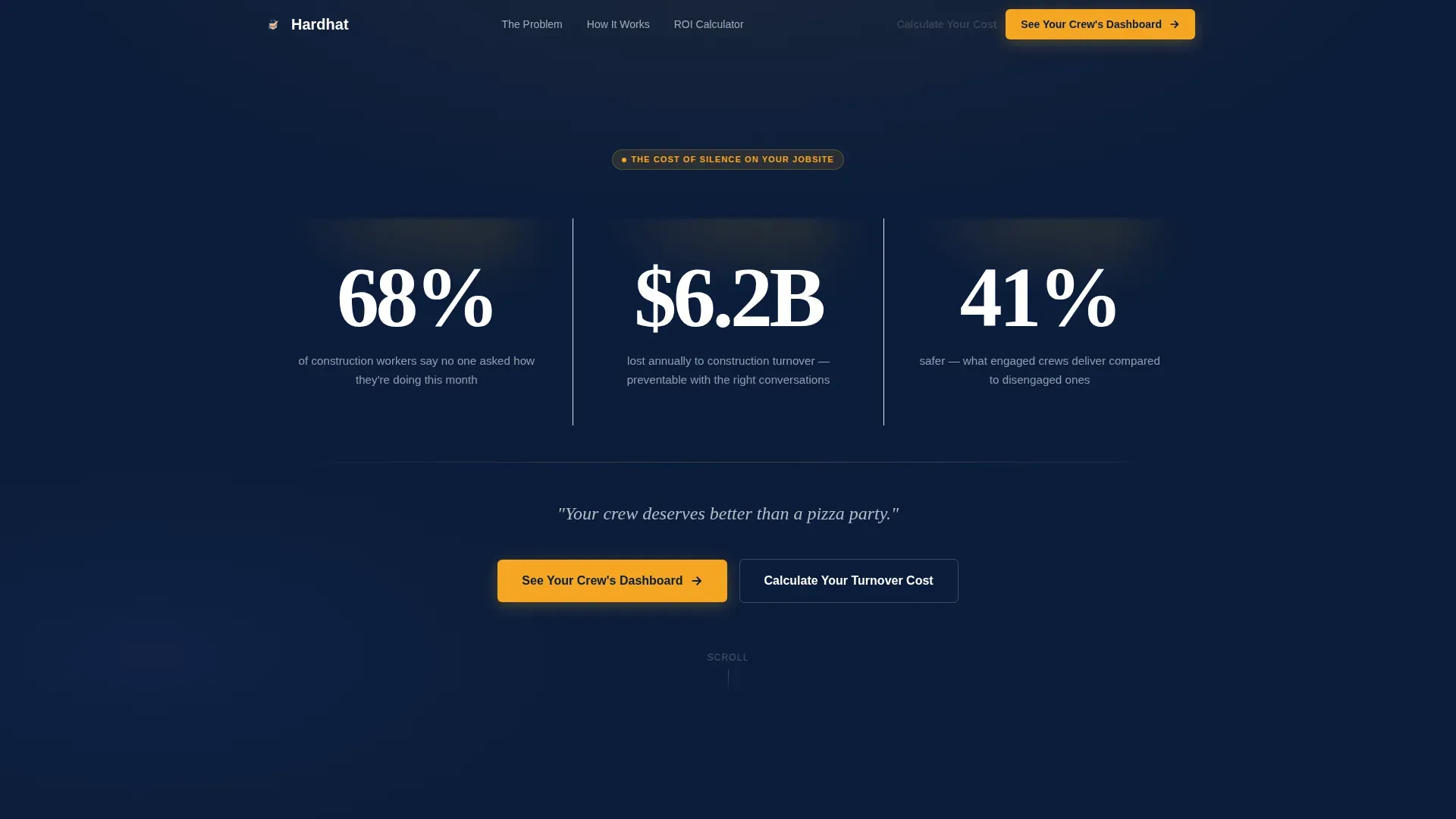
The Hardhat crew retention engagement platform landing page template is built for construction companies losing skilled workers to disengagement. It pairs an animated stats wall, a zigzag problem-to-solution layout, and an inline turnover cost calculator to make the price of inaction impossible to ignore. The result is a click-through landing page that turns cold data into demo requests.
by Rocket studio
Quick summary
This template gives construction companies a single-page experience designed around one goal: showing the human and financial cost of crew disengagement before asking for a click. It opens with three animated counters, walks visitors through a problem-to-solution arc across five alternating sections, and closes with a sticky mobile call to action. Every layout decision serves the moment a foreman needs to act.
Who this template is for
Construction companies, safety directors, and human resources teams deal with workforce turnover daily. This template speaks directly to the people who feel that cost most acutely. It is built for organizations that are done running exit interviews and ready to lead with data.
- Mid-size general contractors losing tens of thousands of dollars each time a skilled worker leaves a project
- Safety directors who understand that disengaged employees are a safety risk before they become a statistic
- Human resources managers at large construction firms focused on building crew culture, not just filling positions
What problem this template solves
Construction workforce turnover is expensive and largely invisible until it is too late. Companies collect almost no structured data on worker sentiment, so managers have no early warning when a reliable carpenter or electrician starts mentally checking out. The template is designed to surface that silence and reframe it as a solvable business problem.
- No central system to track morale trends or flag at-risk employees before they resign
- Foremen lack the tools and language to have retention conversations before a worker walks off to the next contractor
- Human resources departments spend their resources on reactive hiring rather than proactive employee engagement
What you get with this template
This template delivers a fully structured, five-section zigzag landing page with a clear click-through direction toward a guided product demo. Every section is ready to receive your brand, data, and copy without rebuilding the layout from scratch. You get a high-detail starting point that blends industrial visual warmth with conversion-focused structure.
- Animated hero stats wall with three count-up counters, a tagline reveal, and amber accent pulses on a deep navy background
- Zigzag alternating sections covering the disengagement problem, three solution layers, and a video testimonial position
- Inline turnover cost calculator with crew size, hourly rate, and annual quits inputs, plus a follow-up call to action
Feature list
This template includes several purpose-built components. Each one supports a specific moment in the visitor's decision journey, from first scroll to demo click.
Animated Stats Wall Hero
Three oversized counters animate upward on page load, each displaying a construction workforce statistic set in slab-serif display type. The amber accent pulses behind each figure, and a single tagline fades in after a two-second pause. This opening forces the visitor to feel the scope of the problem before reading a word of body copy.
Zigzag Problem-to-Solution Arc
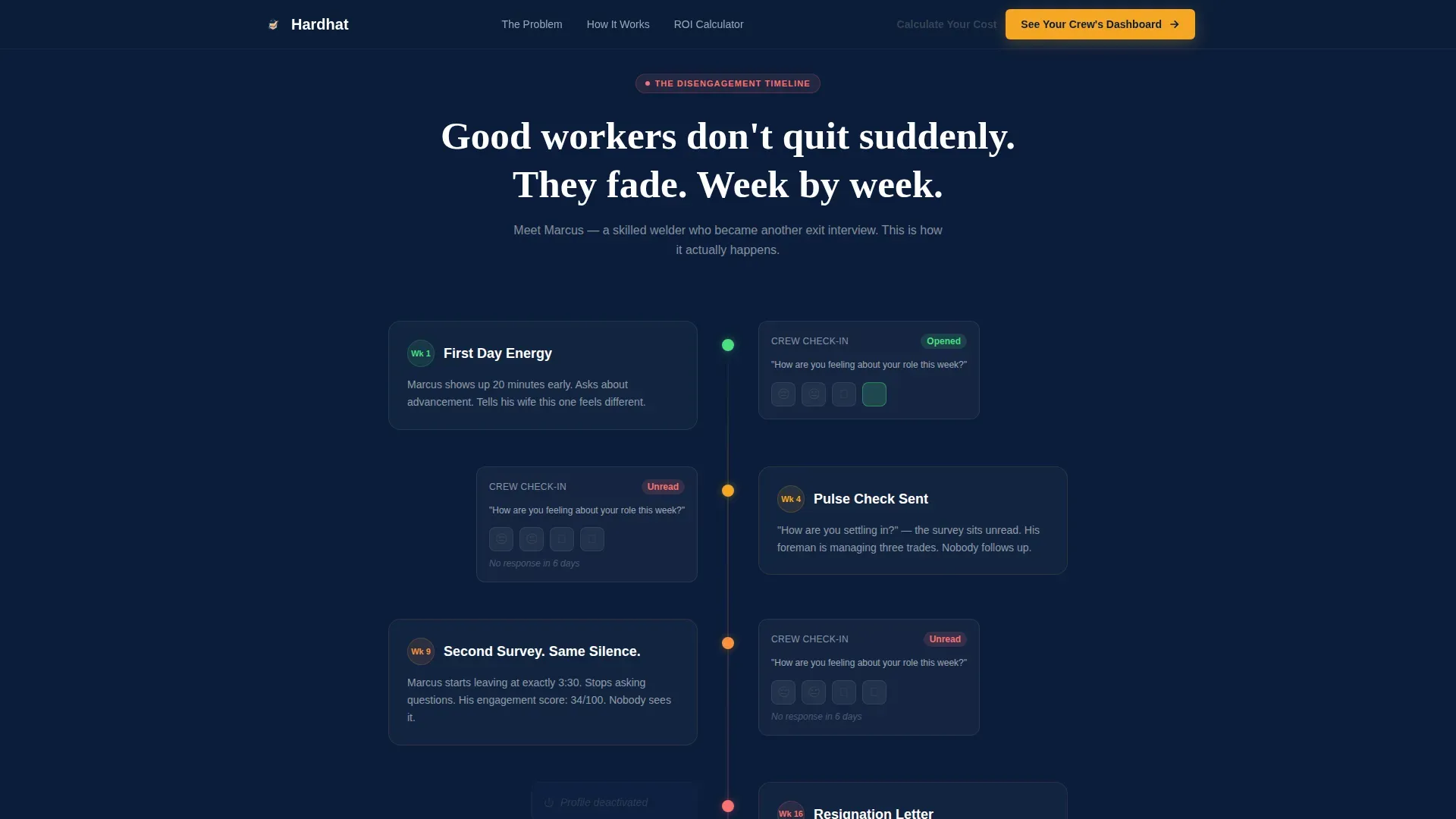
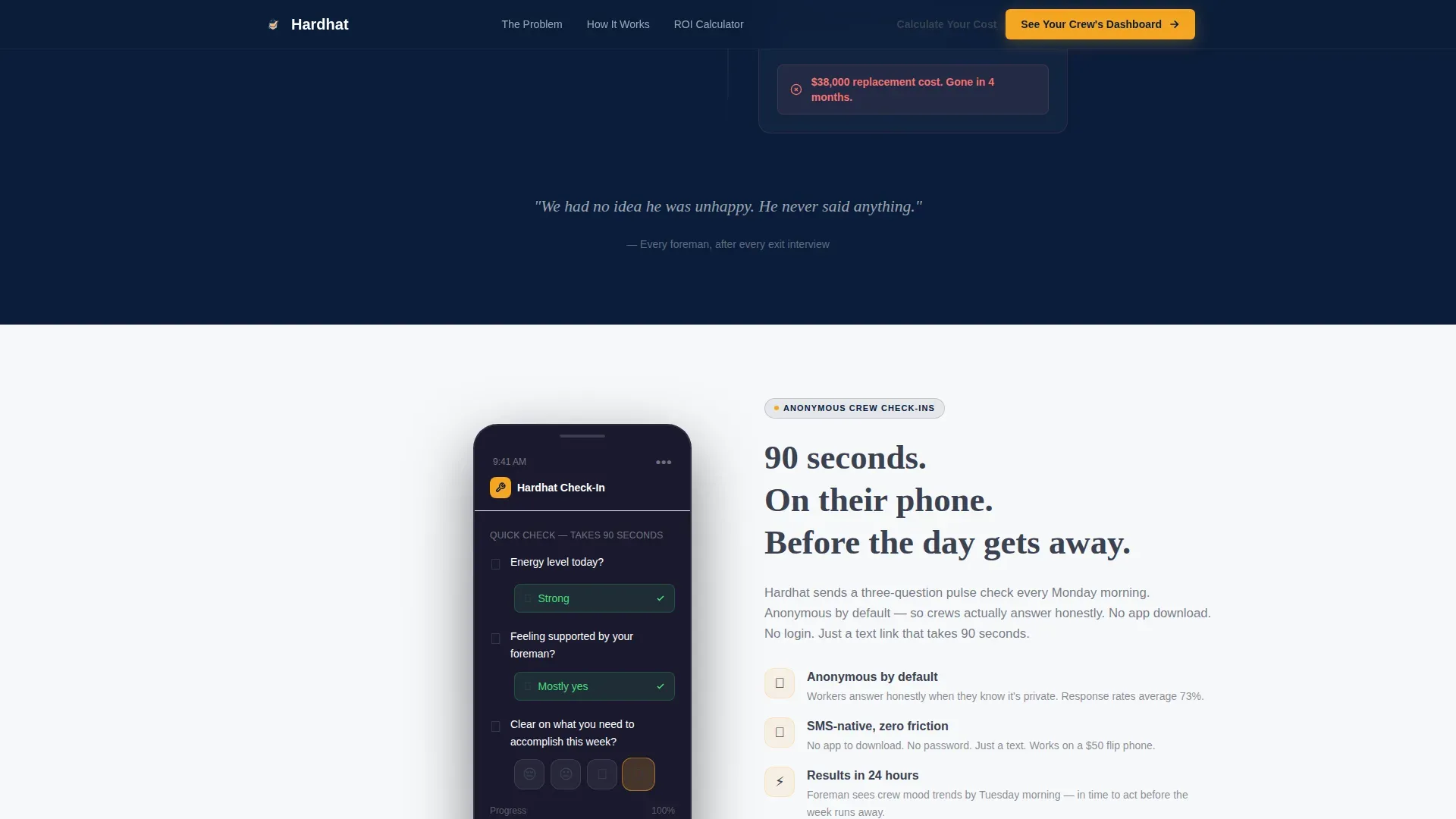
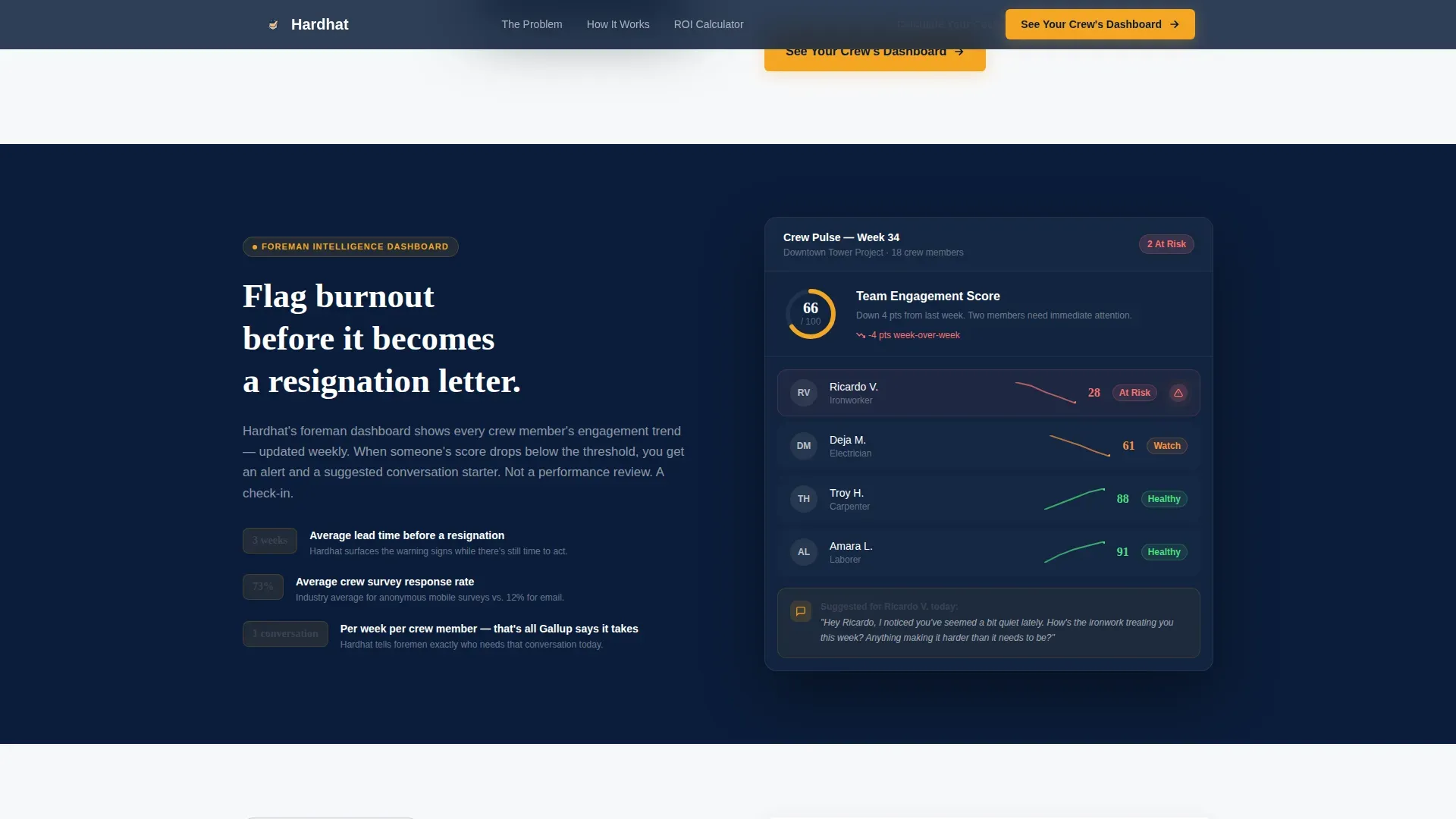
Five alternating sections guide the visitor from a raw disengagement timeline to a warm video testimonial. Each section switches between deep navy and clean white backgrounds, creating visual rhythm while moving the emotional temperature from cold data to human stories. Foreman dashboards, anonymous crew check-ins, and milestone recognition each get their own dedicated panel.
Inline Turnover Cost Calculator
An embedded calculator lets visitors input their crew size, average hourly rate, and number of annual employee departures. It outputs a specific dollar figure, making the cost of inaction personal and precise. A follow-up call to action reading "Let's Fix That Number" appears immediately after the result, connecting the pain directly to the solution.
Pulse Survey Screenshot Blocks
The disengagement timeline section includes visual representations of unanswered pulse surveys. These blocks show what ignored worker sentiment looks like in practice, helping safety directors and project managers recognize patterns they may already be living with on their own projects.
Mobile-Sticky Call to Action Bar
A persistent amber-on-navy call to action bar pins to the bottom of the screen on mobile devices. Foremen and superintendents reviewing the page on a jobsite phone will always have one tap to reach the demo. This detail supports the mobile-first design priority without disrupting the desktop layout.
Milestone Recognition Panel
One zigzag section is dedicated to company-wide milestone recognition, covering personal moments like a worker's anniversary or a family milestone alongside career achievements. This section positions the platform as a tool that helps the whole organization see and celebrate its people, not just track their output.
Page sections overview
| Section | Purpose |
|---|---|
| Hero Stats Wall | Open with workforce cost data to establish urgency |
| Problem Timeline | Show a skilled worker's disengagement arc week by week |
| Solution A: Check-Ins | Introduce 90-second anonymous crew pulse surveys |
| Solution B: Dashboard | Present the foreman at-risk flagging view |
| Solution C: Recognition | Highlight milestone moments and a project manager testimonial |
| Footer Row | Provide navigation links and compliance contact details |
Design & branding system
The visual identity follows a Family First theme built on a Navy Authority color system. The palette is designed to feel like a well-run jobsite at golden hour: serious infrastructure underneath, with warmth visible at every surface. Typography pairs a humanist body font with a slab-serif display face that sets data in concrete.
- Deep command navy (#0B1D3A) for primary section backgrounds, steel-beam charcoal (#3B4252) for body text, and safety-vest amber (#F5A623) for every call to action and key metric accent
- Clean drywall white (#F7F8FA) for alternating section backgrounds, creating natural visual rhythm through the zigzag layout
- Display counters set in Fraunces slab-serif for authority; body copy set in Plus Jakarta Sans for clarity and readability at small sizes
Mobile & speed optimization
The template is built mobile-first, because foremen and superintendents are most likely to encounter this page on a phone between pours, not at a desk. Every section is designed to reflow cleanly at small screen sizes without losing the emotional impact of the full layout.
- Mobile-first design ensures the platform is accessible and easy to use on smartphones, with the sticky call to action bar always visible at the bottom of the screen
- Scroll-reveal animations, count-up counters, and the zigzag stagger are implemented as client-side components, keeping static sections lean and fast to load
- The turnover cost calculator is fully functional on mobile, allowing a foreman to run their own numbers on a jobsite before committing to a demo
How this template helps you convert
This landing page is structured so that every scroll reduces the visitor's hesitation and increases the cost of doing nothing. The conversion path is deliberate: feel the problem, calculate the cost, see the solution, request the demo.
- The animated stats wall establishes credibility and urgency in the first two seconds, using industry data that construction managers already know to be true but rarely see quantified in one place
- The inline calculator turns a general industry problem into the visitor's specific dollar number, making the follow-up call to action feel like the next logical step rather than a sales pitch
- The primary call to action "See Your Crew's Dashboard" appears at the hero, after the second zigzag section, and as a mobile-pinned bar, giving visitors three natural moments to convert without feeling pressured
Other information about this template
This template is designed with the practical knowledge that B2B decision-makers need peer validation before committing to a platform. The video testimonial position and inline social proof details support that need directly. The layout also reflects current best practices in construction employment engagement, where companies are moving away from spreadsheet-driven management toward automated solutions that provide real-time data and actionable insights.
- The footer follows web design essentials by including a minimalist single-row layout with positions for Privacy Policy, Terms of Service, and Company Contact information, supporting transparency with visitors
- Compliance certifications, industry award badges, and security indicators can be placed near the primary call to action to reduce anxiety about data safety and build confidence with skeptical construction managers
- The template supports coverage of volunteer opportunities, local community programs, and national recognition moments through the milestone recognition section, helping companies show employees their hard work is seen beyond the jobsite
- Training resources, education links, and onboarding processes for new crew members can be referenced in the solution sections, helping human resources teams communicate the full scope of support the platform provides
- The hardhat crew retention engagement platform landing page template is positioned specifically at the intersection of construction HR and employee engagement, making it one of the few templates in this category built for field-first audiences rather than office-first buyers
- Project managers, consultants, and finance stakeholders who review the page will find the turnover cost calculator especially useful for building internal business cases, since it produces a specific dollar figure tied to their own workforce data
- The template can support coverage of quality metrics, risk management messaging, and employee experience storytelling when client-specific data and copy are added during customization
- Companies focused on creating diverse and inclusive communities within their workforce will find the milestone recognition section and check-in tools well-suited to those company goals and broader organization-level business goals
Theme
Family First
Creative direction
Problem→Solution Arc
Color system
Navy Authority
Style
Zigzag/Alternating
Direction
Click-Through
Page Sections
Animated Stats Wall Hero
Zigzag Problem-to-solution Arc
Inline Turnover Cost Calculator
Mobile-sticky Call to Action Bar
Milestone Recognition Panel
Pulse Survey Screenshot Blocks
Related questions
Who is this landing page template designed for?
Can I customize the turnover cost calculator with my own numbers?
Does the template work well on mobile devices?
What call-to-action structure does the template use?
How does the template handle trust signals and data transparency?