Master Piano Technician Landing Page Template
The Temperament Executive Suite Piano Tuner Service Area Landing Page Template is a sidebar companion landing page designed for solo piano technicians. It leads with authority metrics, organizes client testimonials by context, and guides visitors through a frictionless three-step booking form. The result is a page that feels as precise and considered as the service it represents.
by Rocket studio
Quick summary
This template gives a solo piano tuning business a landing page that commands immediate trust. A navy stats header opens with three authority figures. A staggered testimonial mosaic fills the main column while a persistent sidebar carries the booking form. Every section is designed to serve a specific client type and move them toward a scheduled appointment.
Who this template is for
This template is built for the working piano technician whose reputation has grown past word of mouth. It suits professionals who serve multiple client types across a defined service area and need one page that speaks to all of them with equal clarity.
- Piano teachers whose students are preparing for graded music exams and need reliable, consistent piano tuning before lesson days
- Worship directors who schedule quarterly service for large instruments in sanctuaries and need a technician they can plan around each semester
- Estate executors and university faculty who require a detailed technical assessment before a piano is sold, rented, or moved to a new room
What problem this template solves
A skilled technician can struggle to communicate decades of expertise through a generic service page. Visitors land, scan a few lines, and leave without booking. This template solves that by organizing proof, context, and action into one scroll-driven layout.
- Visitors from different backgrounds, home studio owners, school music coordinators, chapel directors, each find their own situation reflected before they finish reading
- The page removes decision friction for first-time clients who don't yet know whether they need a standard tuning, regulation, voicing, or a full technical assessment
- The three-step inline booking form captures only essential details, so the process stays fast and the client doesn't abandon mid-form
What you get with this template
You get a fully structured sidebar companion landing page built around four primary content blocks. Each block is thought through to serve both the visitor's confidence and the technician's business goals.
- A navy authority metrics bar, a staggered testimonial mosaic with photo breaks, and a contextual diagnostic questionnaire path
- A persistent sidebar with a mini-map of the service area and a pinned scheduling form that travels with the visitor on scroll
- A three-step booking form that collects piano type and make, a preferred date from an available-slots calendar, and client contact details with an optional notes field
Feature list
This template is equipped with a focused set of components that build credibility and support conversions across every client type.
Authority Metrics Header
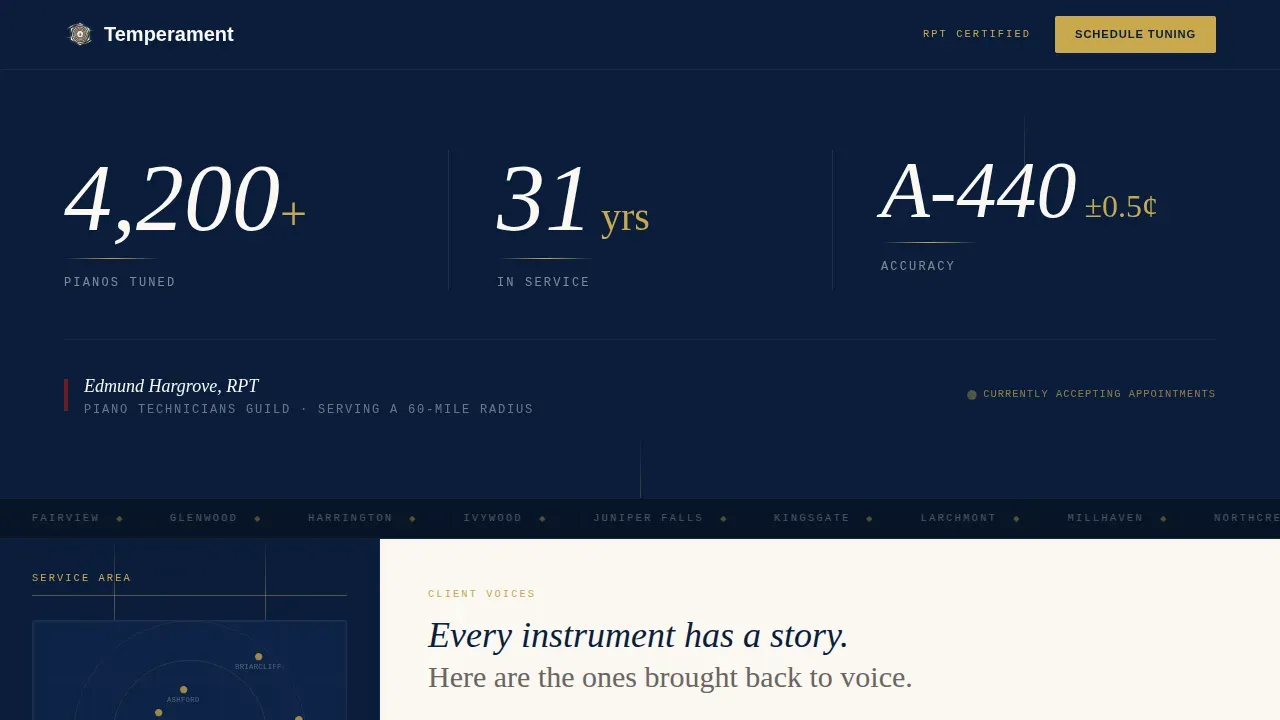
The page opens with three oversized figures set against a deep navy field: pianos tuned, years in service, and pitch accuracy. Each figure is typeset in a refined display serif with a thin brass rule beneath it. A single-line descriptor below the metrics records the technician's name, Registered Piano Technician (RPT) credential, and the region served. No photograph competes with these numbers.
Testimonial Mosaic with Photo Breaks
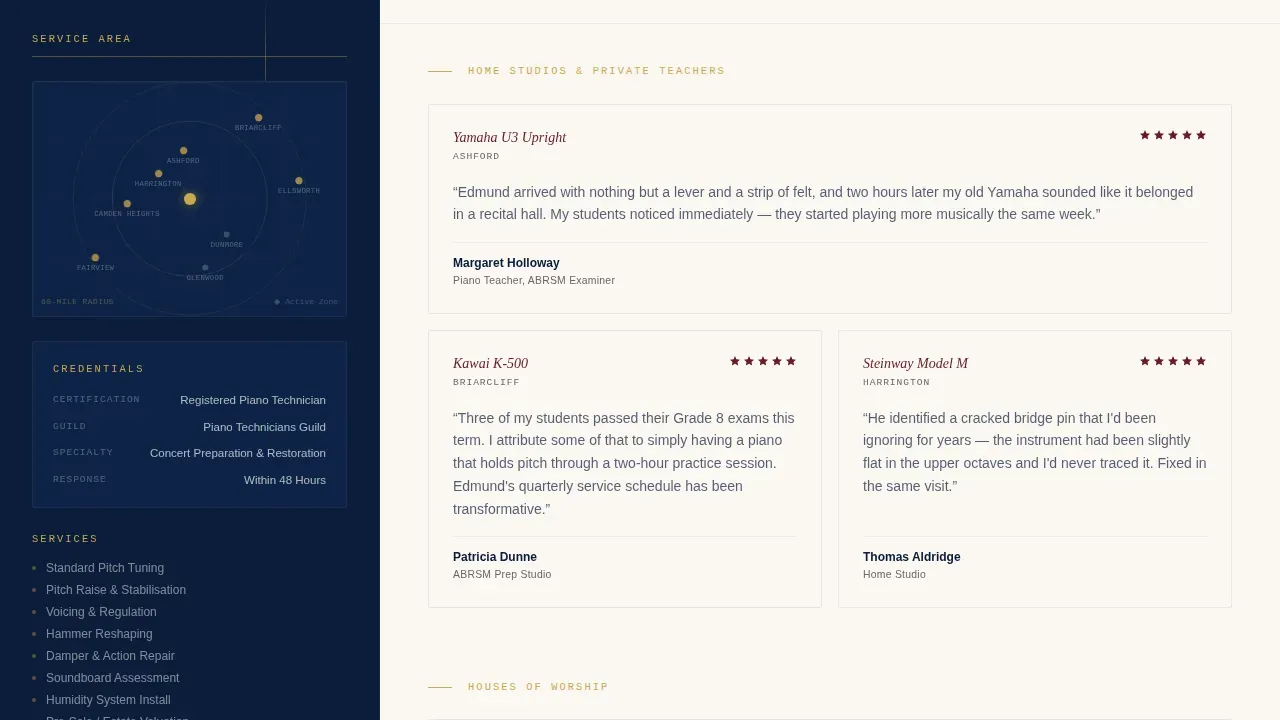
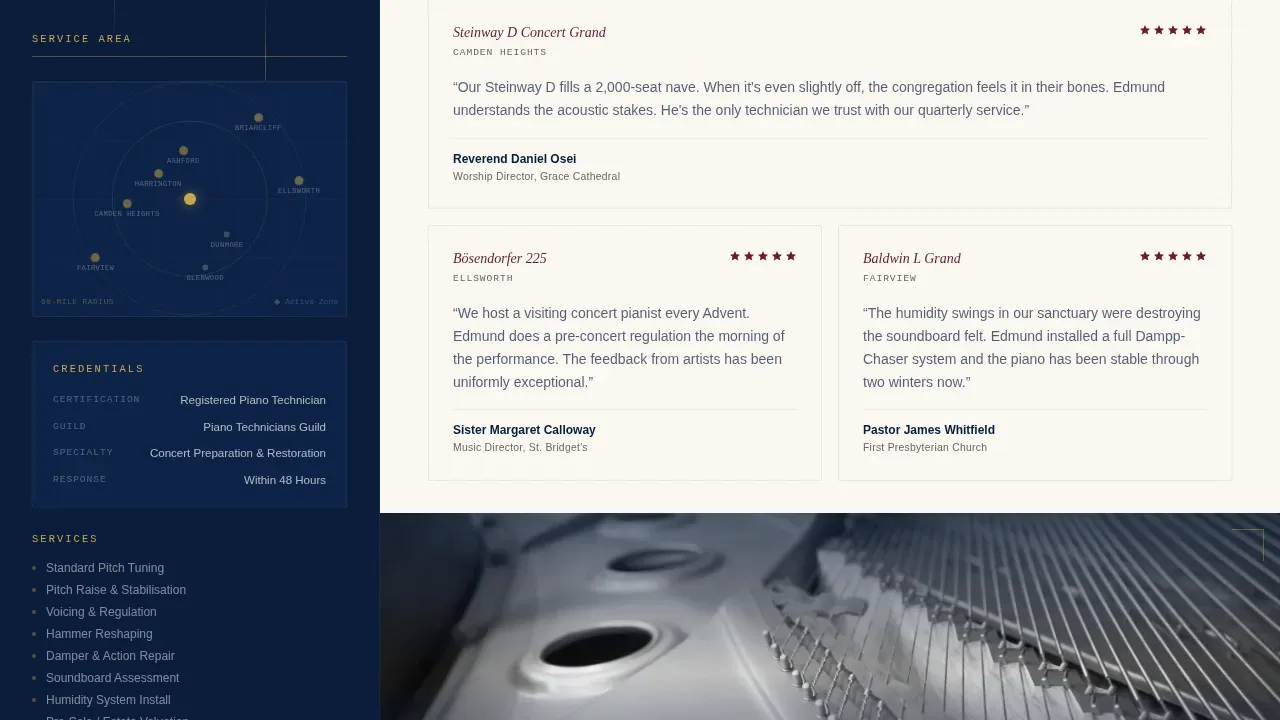
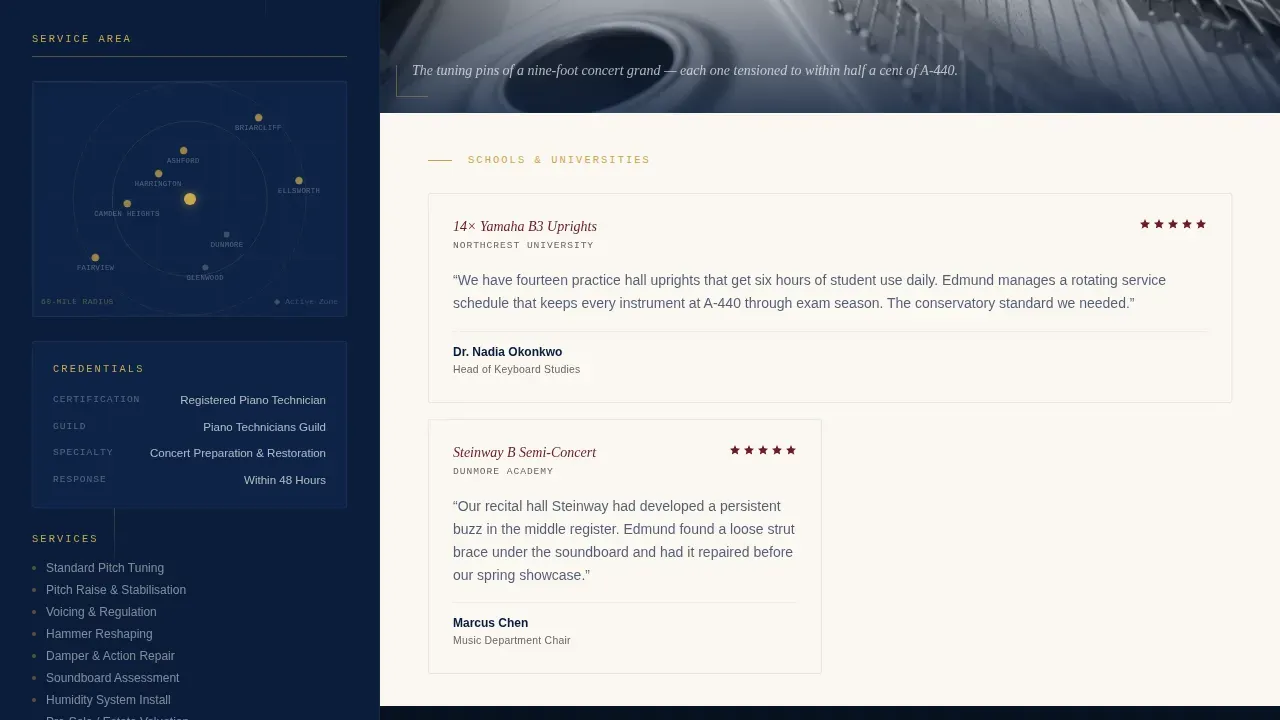
The main column fills with a staggered grid of client testimonials organized by context: home studios, houses of worship, schools, then estates. Each card shows the client's piano make and model, their quote on an ivory panel, and a small location tag. Between clusters, a full-width photo break shows close-up visuals of tuning equipment and piano interiors, building a quiet sense of stakes as the scroll progresses.
Persistent Sidebar with Mini-Map
The sidebar locks in place as the visitor scrolls. It carries a mini-map of the service area with town names highlighted in brass. Below the map sits the primary call-to-action button, pinned so it is always within reach. This layout keeps the path to booking visible at every point on the page.
Three-Step Inline Booking Form
Step one lets the client select piano type, upright pianos, grand pianos, or digital hybrid, and enter the make if known. Step two shows an available-slots calendar so the client can pick a preferred day. Step three captures name, address, and an optional notes field for issues like sticking keys or humidity damage. The minimum information required keeps the process respectful of the client's time.
Diagnostic Questionnaire Path
A secondary route labeled "Not Sure What You Need?" links to a short questionnaire. Answers route the client to either a standard piano tuning appointment or a full technical assessment. This matters for first-time clients who don't yet speak the language of regulation and voicing. It also signals to the technician what scope of work to plan for before arrival.
Context-Organized Social Proof
Testimonials are not placed at random. They are grouped so that a piano teacher reads school-context reviews early, a worship director watches sanctuary stories appear in sequence, and an estate executor finds relevant records before the page ends. Each review card attributes the quote to a specific instrument make and location, giving the social proof real detail and weight.
Page sections overview
| Section | Purpose |
|---|---|
| Navy Stats Header | Establishes authority with metrics |
| Testimonial Mosaic | Organizes proof by client context |
| Photo Break Rows | Adds visual depth between clusters |
| Persistent Sidebar | Keeps booking form always visible |
| Service Area Mini-Map | Shows covered locations at a glance |
| Three-Step Booking Form | Guides visitor to schedule a visit |
| Diagnostic Questionnaire Path | Routes undecided clients to right service |
| Linear Footer Row | Closes page with contact line |
Design & branding system
The visual identity follows an Executive Suite theme that feels like the inside lid of a grand piano. Dark lacquer, a single warm lamp, and the gold of tuning pins catching light where felt dampens everything else. The palette is restrained and intentional.
- Navy (#0B1D3A) dominates headers and the sidebar background; ivory (#FAF7F2) spreads across content panels; mahogany (#6B1C23) anchors pull-quotes and star ratings; brass (#C9A84C) is reserved for buttons, dividers, and hover states only
- Typography uses Fraunces as the display serif for metrics and headings, and DM Sans as the body face for clarity across all reading contexts
- Animation is set to medium intensity: spotlight card reveals, scroll-triggered stagger effects, and beam transitions that add life without distracting from the content
Mobile & speed optimization
The template is designed desktop-first to support its two-column sidebar layout. On smaller screens, the sidebar stacks below the main content column, and the booking form remains fully accessible. The layout adapts without losing its structured hierarchy.
- Server Components handle all static content blocks, including the header, testimonial grid, and photo breaks, to keep initial load light
- Client Components are scoped to the booking form and diagnostic questionnaire, where interactivity is genuinely needed
- The persistent sidebar's pinned call-to-action button collapses into a fixed bottom bar on mobile, keeping the path to schedule a tuning always in view
How this template helps you convert
Every design and copy decision in this template is built around one outcome: turning a curious visitor into a booked appointment. The page earns trust before it asks for anything.
- The stats header acts like a concert program's liner notes, it establishes expertise the moment the visitor arrives, before any claim is made in body copy. Authority metrics and the RPT credential give institutional clients the criteria they need to feel confident moving forward.
- The testimonial mosaic mirrors the visitor's own context back to them. A worship director reads sanctuary reviews. A university faculty contact watches school-context records appear. Relevant proof builds faster than generic five-star averages ever could.
- The three-step booking form and the diagnostic questionnaire path together cover two types of buyers: those who know what they need and want to schedule quickly, and those who need a little guidance before they commit. Both paths end at the same place, a confirmed appointment on the calendar.
Other information about this template
This template is intended for technicians who serve a defined geographic area and need a page that communicates quality across multiple client types without losing its sense of identity. Additional information worth noting for buyers who plan to use this template in a professional context:
- The page is designed to support transparent pricing details; for example, a standard piano tuning fee is commonly set around $180.00, and presenting this figure on the page helps manage client expectations before the first contact
- Scheduling guidance is built into the page structure: the booking form can note that tuning requests should ideally be submitted at least two weeks in advance, and piano rental arrangements for events benefit from four weeks of lead time
- The template supports tiered service presentation, standard tuning versus concert pitch adjustment, so clients understand the difference before they book
- The maintenance plan section of the testimonial mosaic naturally covers preventative services like regulation, voicing, and humidity control, giving the page depth beyond basic piano tuning
- Pianos in humidity-controlled environments require less maintenance than those in uncontrolled rooms; the diagnostic questionnaire can surface this detail and help the technician plan accordingly
- The page is designed to work across the fall semester and winter term schedule that many schools and universities follow, making it easy for faculty and music directors to plan service windows in advance
- The combination of a computerized inventory approach and structured client records means the technician can use booking data to track each piano's service history and generate maintenance reports over time
- Flex scheduling, where the technician works outside regular hours to access practice rooms during off-peak windows, is a natural fit for the available-slots calendar built into the booking form
- Tuning stability is a critical quality standard reflected throughout this page; the A-440 accuracy metric in the header signals this commitment before the visitor reads a single testimonial
- Each room in an institution can be assigned a use-category, and the diagnostic questionnaire path supports this by helping clients identify whether their piano falls under performance, teaching, or general-use criteria
- For estate contexts, the template's assessment routing helps protect the value of important instruments by directing executors toward a full technical review rather than a standard tuning visit
- The page project is well-suited to Piano Technicians Guild members who want a professional web presence that reflects the standards of their credential and serves both families and institutional clients across their region
Theme
Executive Suite
Creative direction
Testimonial Mosaic
Color system
Navy Authority
Style
Sidebar Companion
Direction
Booking/Scheduling
Page Sections
Authority Metrics Header
Context-organized Testimonial Mosaic
Persistent Sidebar with Mini-map
Three-step Inline Booking Form
Diagnostic Questionnaire Path
Executive Suite Visual System
Related questions
What client types is this template designed for?
How does the three-step booking form work?
Can this template support tiered service options?
Is the sidebar booking form visible throughout the scroll?
How does the testimonial mosaic build trust for institutional clients?