Supportive Young Musician Landing Page Template
Strings is a scroll-reveal landing page template built for first-year violin parents. It guides moms, dads, and grandparents through choosing the right instrument, finding lessons, and building practice habits, one stage at a time. The page earns trust before asking for anything, delivering two full stages of genuinely helpful music guidance before the email form ever appears.
by Rocket studio
Quick summary
Strings is a warm, illustrated landing page template designed for kids violin parent resource guides. It walks parents through the first year of string instrument learning in easy steps, from sizing a tiny violin to building daily practice routines. The progressive scroll-reveal layout reveals each stage only when parents are ready, so they never feel overwhelmed.
Who this template is for
This template is built for music educators, studio owners, and independent violin teachers who want to nurture first-year students and their families. It serves anyone creating a parent-facing resource for early childhood string education.
- Parents of young beginners, from age three to age seven, who need clear, trustworthy guidance on violin, viola, or cello
- Suzuki program directors who want to showcase parent involvement as a core part of their teaching method
- Independent string teachers building an online presence and growing their email list
What problem this template solves
Starting violin lessons is exciting, but it is also genuinely confusing. Parents worry about the right instrument size, whether to rent or buy, and how to survive the first screechy week at home. This template cuts through that noise.
- Parents feel lost choosing between violin, viola, cello, or bass for a young child, and need a guided starting point
- Students and families drop out early because no one explained what the beginning actually looks like or sounds like
- Teachers spend lesson time answering the same questions repeatedly instead of focusing on skills and music
What you get with this template
This template delivers a fully structured, stage-gated content destination. Every scroll reveals the next piece of the journey, so parents learn at their own pace. The design and copy framework are ready to fill with your program details.
- A four-stage progressive guide covering instrument sizing, finding lessons, a first-month survival kit, and practice routines
- A quiz starter header that asks three simple questions and delivers a personalized starting-point card
- A primary email capture form tied to a downloadable First-Year Roadmap, plus mini-resource downloads that unlock after a single sign-up
Feature list
This template is built around five core capabilities. Each one is grounded in the source brief and designed to serve both parents and the teachers who want to reach them.
Illustrated Quiz Starter Header
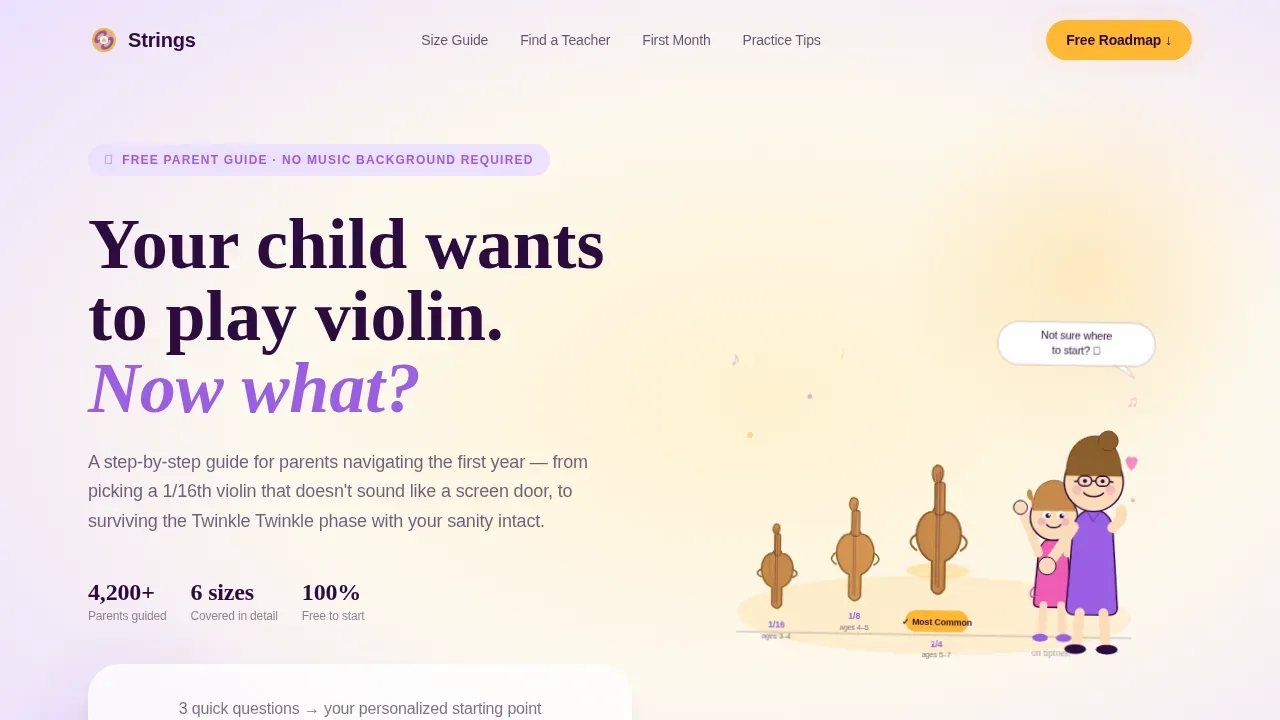
The hero section opens with a hand-drawn parent-and-child scene. A warm saffron button invites parents to take a two-minute quiz covering the child's age, any prior music experience, and their biggest worry. The result is a personalized starting-point card that feels like a small, helpful gift.
Four-Stage Scroll-Reveal Guide
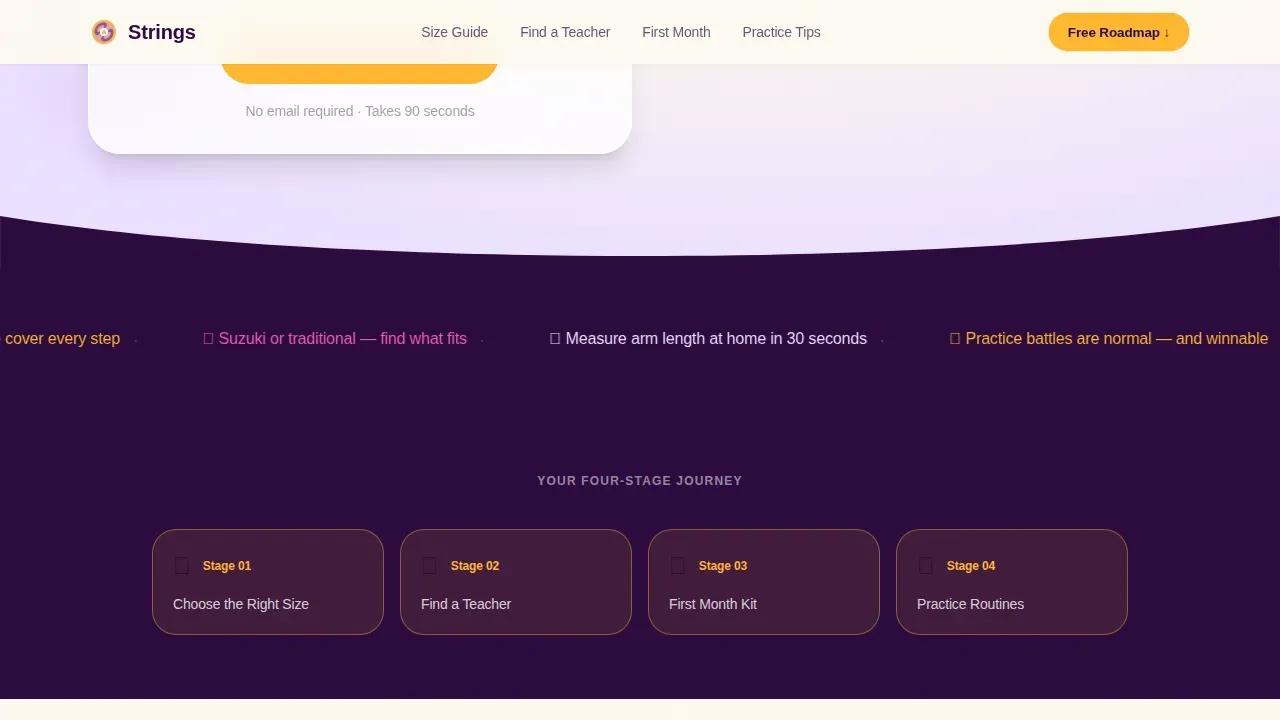
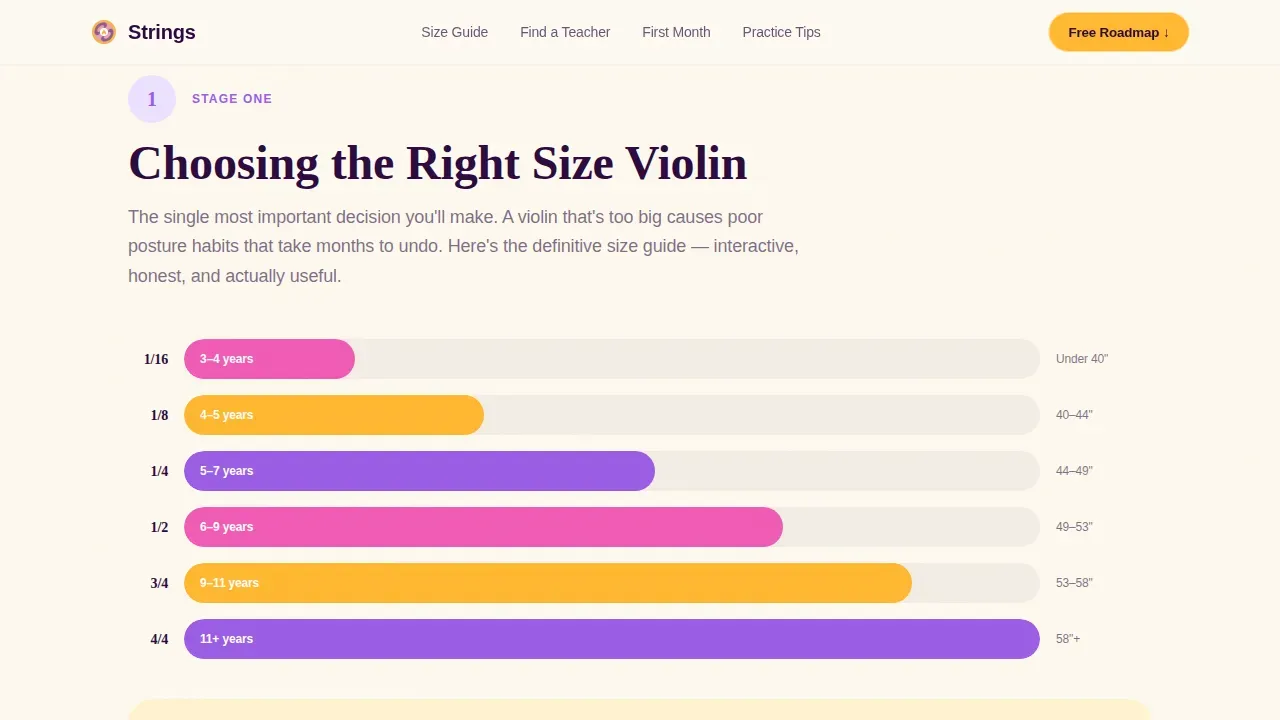
Each stage materializes as the visitor scrolls, like turning pages in a picture book. Stage one covers choosing the right violin size using an illustrated size chart. Stage two walks through the teacher-versus-home decision. Stage three is a first-month survival kit with checklists. Stage four covers practice routines that help kids actually develop lasting skills.
Progressive Email Capture Gate
The email form appears after stage two, once parents have already received real value. It asks only for a first name and email. Once a visitor fills out the form, all downloadable mini-resources unlock instantly, including a printable practice chart, a size guide, and a teacher interview worksheet.
Downloadable Resource Bundle
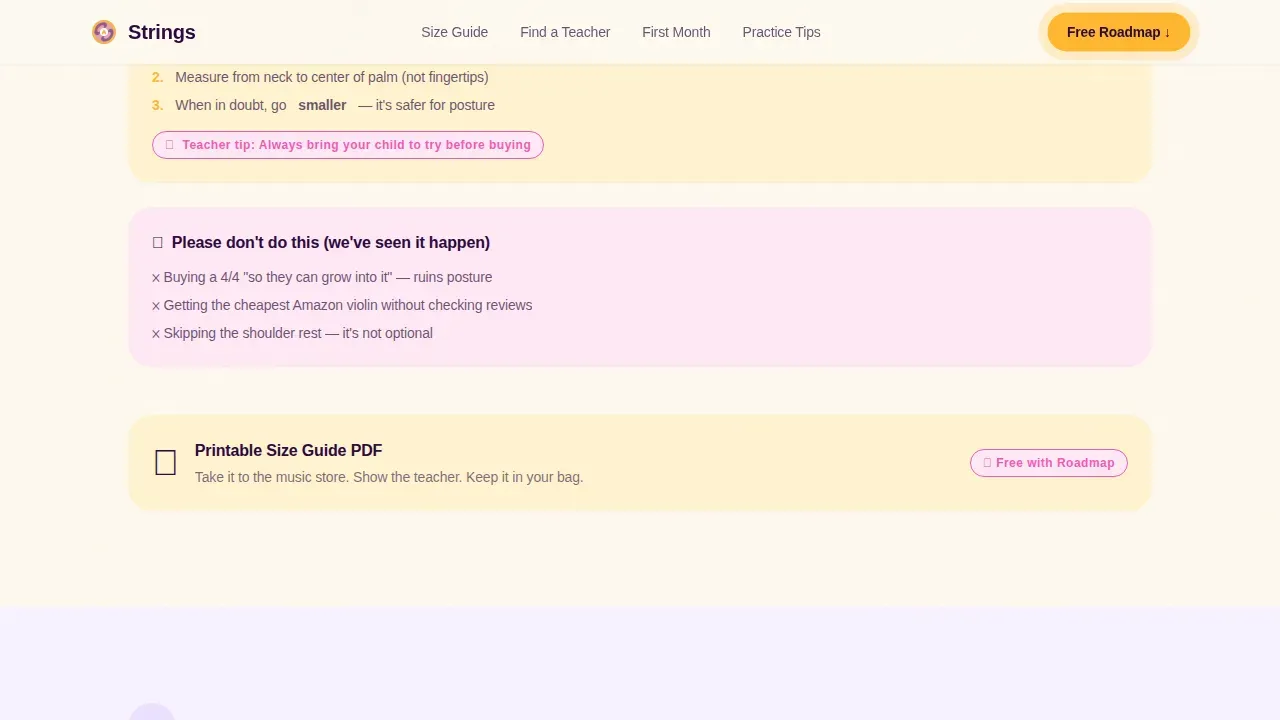
The template is structured to deliver multiple gated downloads through a single email capture. Resources include a printable practice chart, a violin size guide, and a teacher interview questions sheet. These materials help parents stay involved and celebrate progress at every stage of the program.
Scroll-Reveal Animation System
Illustrations slide in, checklists unfold, and each stage stagers onto the screen as the parent scrolls. This progressive reveal keeps the page feeling like a story, not a wall of text. SVG illustrations keep the visual load light while maintaining the children's-book warmth of the design.
Page sections overview
| Section | Purpose |
|---|---|
| Hero Quiz Starter | Opens with illustrated scene and saffron quiz button |
| Stage One: Size Guide | Illustrated violin size chart, scroll-reveal |
| Stage Two: Teacher versus. Home | Decision guide with email capture form |
| Stage Three: First Month | Survival checklist and audio progress context |
| Stage Four: Practice Routines | Printable chart and final Roadmap call to action |
| Footer | Horizontal flow with links and contact info |
Design & branding system
The visual identity follows a Nurture and Care theme powered by a Dopamine Pop color palette. The result feels like a box of joyful crayons spilled across a practice room floor, warm and energetic but never chaotic.
- Saffron yellow (#FFB830) leads on buttons and progress indicators; viola purple (#9B5DE5) anchors section headers; blush pink (#F15BB5) highlights callouts; chalk white (#FEF9EF) forms the background with deep eggplant (#2B0A3D) for body text
- Typography pairs Fraunces serif headlines with DM Sans body text, giving the page a storybook warmth that still reads cleanly at small sizes
- All illustrations are hand-drawn in style, loose and children's-book inspired, with no stock photography required
Mobile & speed optimization
This template is built mobile-first. Most parents searching for violin guidance are on their phones, often late at night. Every layout decision prioritizes fast loading and easy reading on small screens.
- All illustrations are delivered as SVG files, keeping the visual experience rich without heavy image payloads
- Scroll-reveal animations use stagger effects that perform smoothly on mobile without requiring large JavaScript bundles
- The quiz flow, email form, and download unlock interactions are all designed for one-handed, thumb-friendly use on phones
How this template helps you convert
This template is structured to build trust before it ever asks for anything. Parents receive genuine value across two full stages before a form appears. That sequence makes the email capture feel like a fair trade, not an interruption.
- The quiz starter personalizes the experience immediately, so parents feel seen and understood from the very first scroll
- Two full stages of free, useful guidance on violin sizing and lessons establish credibility before the email gate appears
- After sign-up, instant access to the full resource bundle, including worksheets, printable charts, and the First-Year Roadmap PDF, rewards the decision to stay engaged
Other information about this template
The strings nurturing first year violin parent resource landing page template is shaped around principles that experienced string educators already know and teach. The following points cover additional context helpful for anyone setting up or adapting this template.
- The Suzuki method forms a natural philosophical backbone for this template. It teaches music the way children learn language: by ear, through listening, and with daily repetition. The Suzuki Association of the Americas and similar bodies in each country provide resources, events, and community support that parents can be directed toward from within the page.
- Violin open strings are G, D, A, and E. A worksheet covering those string names, plus basic finger patterns like the high-2 technique, can be included as one of the gated mini-resources. Warm-up sequences across each open string help young students build the ear for pitch and tempo from the beginning.
- Group classes are a key motivational tool for young string students. When kids play together in group settings, they hear what progress sounds like and feel part of a community. Orchestra involvement, school ensemble concerts, and ensemble programs all reinforce the joy of making music with others.
- Parent involvement is central to how this template is structured. Parents do not need to know how to play violin to be helpful. Noticing small improvements, celebrating each new song or piece, and being present at individual lessons and group classes makes a real difference. The Suzuki method taught us that the learning triangle of student, teacher, and parent is what helps young beginners truly develop.
- Individual lessons and individual student progress are highlighted across the four stages. The template can cover how teachers structure note reading, technique, and early repertoire for beginners. It can also address ideas like curated listening lists, reminder cards for home practice, and tips for creating a distraction-free practice space.
- Parents who hope to rent rather than buy a first instrument will find the size-guide stage especially helpful. Knowing what violin part or cello size is right for a child's age and height gives families confidence before they ever contact a music shop or sign up for a program.
Theme
Nurture & Care
Creative direction
Step-by-Step Guide
Color system
Dopamine Pop
Style
Scroll Reveal (Progressive)
Direction
Content/Resource
Page Sections
Illustrated Quiz Starter Header
Four-stage Scroll-reveal Guide
Progressive Email Capture Gate
Downloadable Resource Bundle
Scroll-reveal Animation System
Social Proof and Progress Markers
Related questions
Do I need to know how to play violin to use this template?
Can I adapt this template for cello or viola programs?
How does the email gate work in this template?
What is the Suzuki method and why does it matter for this template?
Is this template suitable for parents who are complete beginners?