Food Security Research Institute Landing Page Template
Harvest is a modular card grid landing page built for food security research and policy institutes. It opens with a serif manifesto that stops readers cold, then guides them through flagship research areas, policy impact metrics, and speaker profiles before converting them through an event registration form and a gated briefing download. The Forest Trust color system and farmhouse-research aesthetic ground every section in purpose.
by Rocket studio
Quick summary
Harvest is a single-page, card grid landing page template designed for hunger and food security research institutes. It leads with a slow-reveal manifesto, moves through three rows of modular content cards, and closes with a dual-path conversion: event seat registration and a gated pre-summit briefing download. The visual identity draws from a Forest Trust palette that feels grounded, serious, and organic without ever feeling sterile.
Who this template is for
Harvest is built for organizations where food security research meets real policy decisions. It speaks directly to people who deal in evidence, data, and legislation rather than general advocacy.
- Policy advisors and municipal planners who need a credible, data-forward page that earns trust in the first scroll.
- Foundation program officers and funders who are evaluating whether an institute's research warrants grant allocation or summit attendance.
- Graduate researchers, journalists, and food system advocates who are studying food deserts, food insecurity, and the gaps in local food access and who need a clear entry point into the institute's published work and events.
What problem this template solves
Most research institute pages fail the same way. They bury their most compelling data in long paragraphs. They give equal visual weight to everything, so nothing stops the eye. They ask for commitment before they have earned belief. The result is that policy advisors bounce, funders click away, and registration numbers stay low.
Harvest fixes this by structuring the scroll like a research briefing that earns trust before it asks for action.
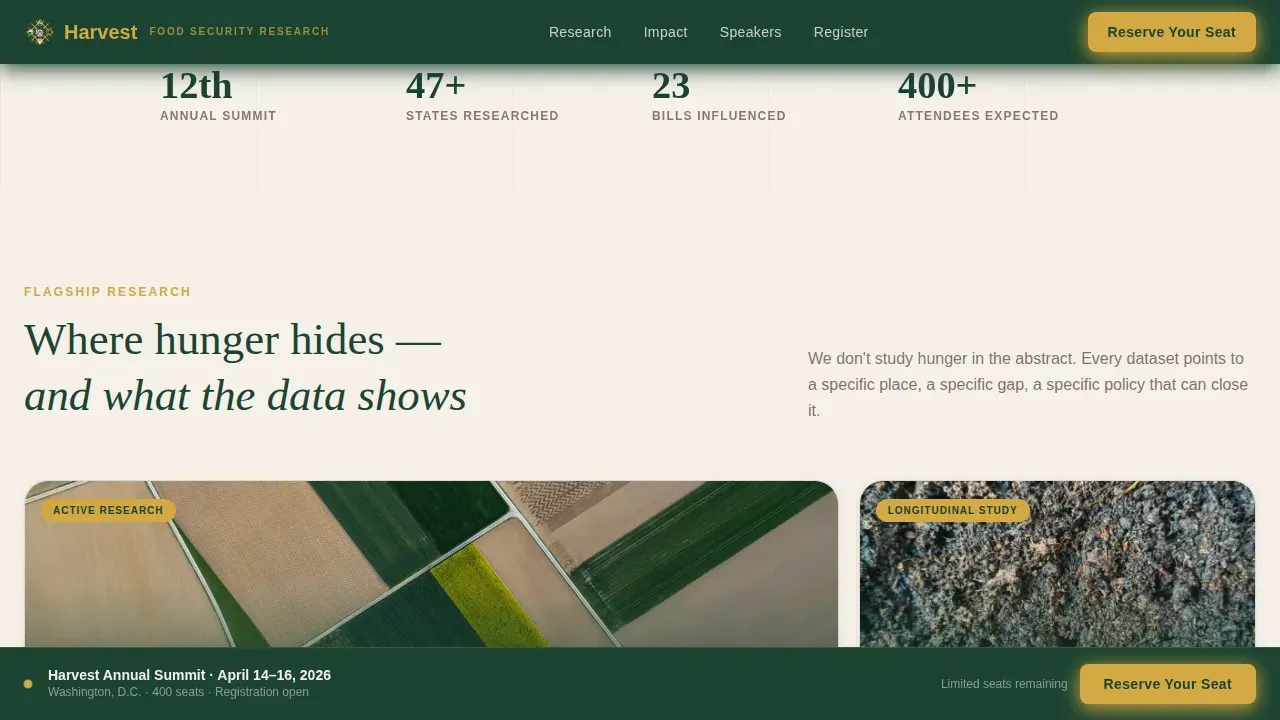
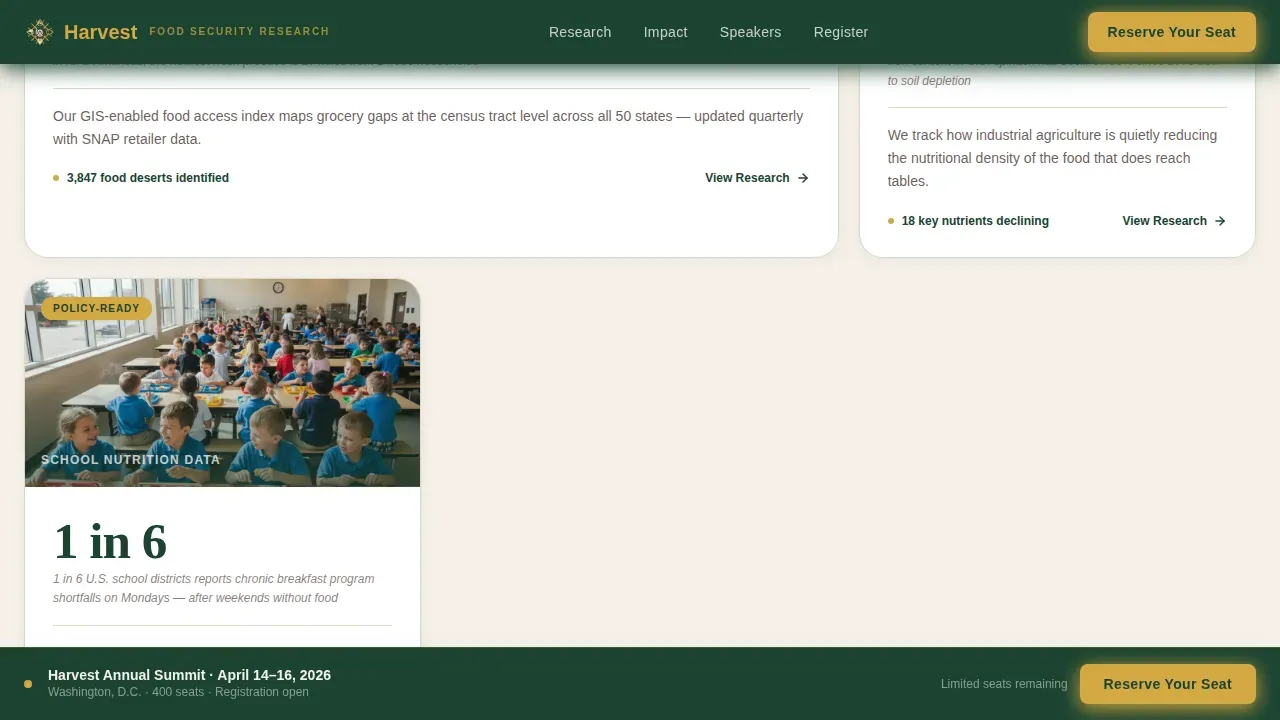
- Data buried in prose becomes a hyperlocal callout card that stops the reader mid-scroll with a single, specific number.
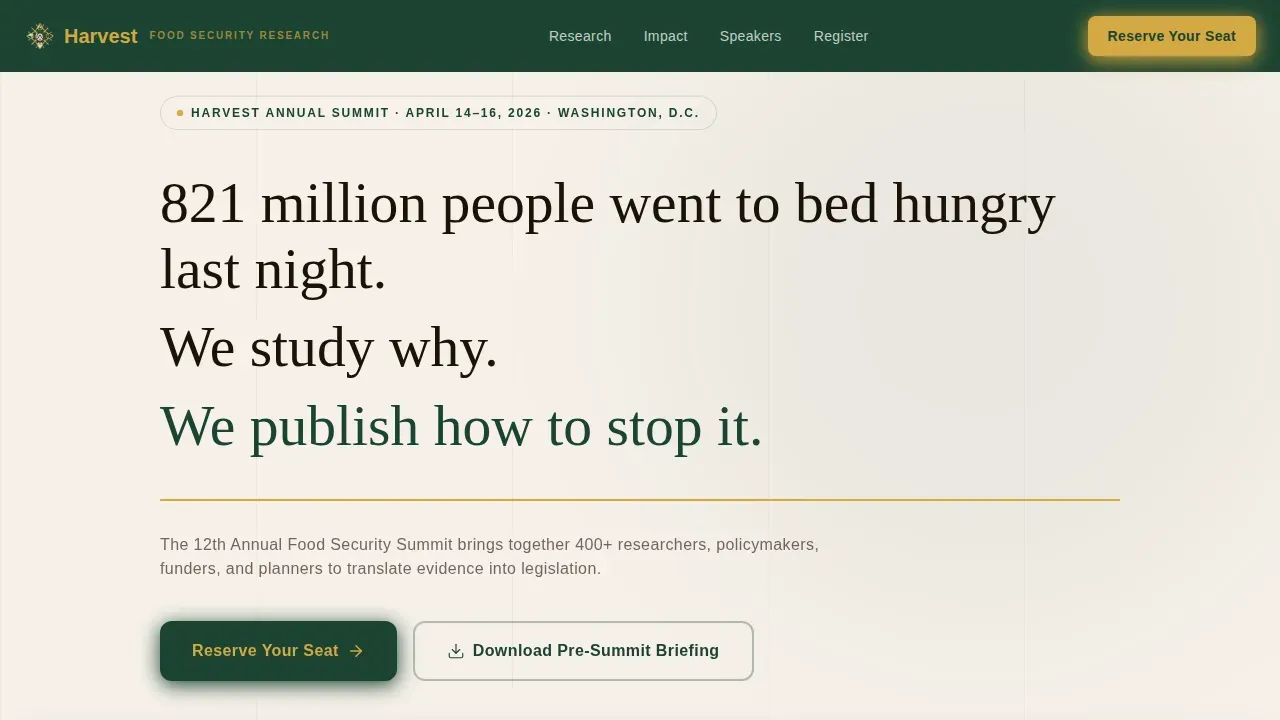
- Vague mission statements are replaced with a serif manifesto that states the problem, the method, and the purpose in three unhurried lines.
- Weak conversion paths are replaced with a dual call to action system: a primary "Reserve Your Seat" button and a secondary gated PDF download for visitors who need more time before committing.
What you get with this template
Harvest delivers a fully structured, event-oriented landing page where every section has a clear role in moving the visitor from awareness to registration. The layout is modular, which means each card row can be updated independently as research areas evolve or speaker lineups change.
- A five-section page architecture covering the manifesto hero, research area cards, policy impact cards, speaker cards, and a registration form with a persistent bottom call to action bar.
- A dual conversion system that captures both ready registrants through the event form and early-stage visitors through a gated pre-summit briefing PDF download.
- A complete visual identity using the Forest Trust color system with Fraunces serif headlines and DM Sans body text, delivering a farmhouse-research aesthetic that communicates academic seriousness without feeling institutional or cold.
Feature list
Harvest is primarily focused on converting high-value visitors in research, policy, and funding roles. Every feature below is drawn directly from the template's built structure and creative direction.
Sequential Manifesto Hero with Dual call to action
The page opens with black serif text on a soft parchment background. The headline appears line by line with a slow fade, as if someone is reading aloud. A thin grain gold line separates the manifesto from the event name and date. Two calls to action appear immediately below: the primary "Reserve Your Seat" button in grain gold on canopy green, and a secondary "Download the Pre-Summit Briefing" link for visitors who are not yet ready to commit. This dual-path structure is one of the most important features for pages where the audience includes both decision-ready funders and researchers who need to review evidence first.
Research Area Card Grid with Hyperlocal Data Callouts
Three flagship research cards sit in the first content row. Each card carries a single, hyper-specific data point designed to arrest attention. Rather than summarizing a study, each card surfaces one number so precise it becomes undeniable evidence. The cards use the parchment background with generous whitespace, letting each data point breathe. This approach reflects a core truth about food security communication: broad statistics about global food insecurity are processed quickly and forgotten. Specific, localized numbers stay with readers and build the kind of trust that moves them toward registration.
Policy Impact Row with Document Icon Cards
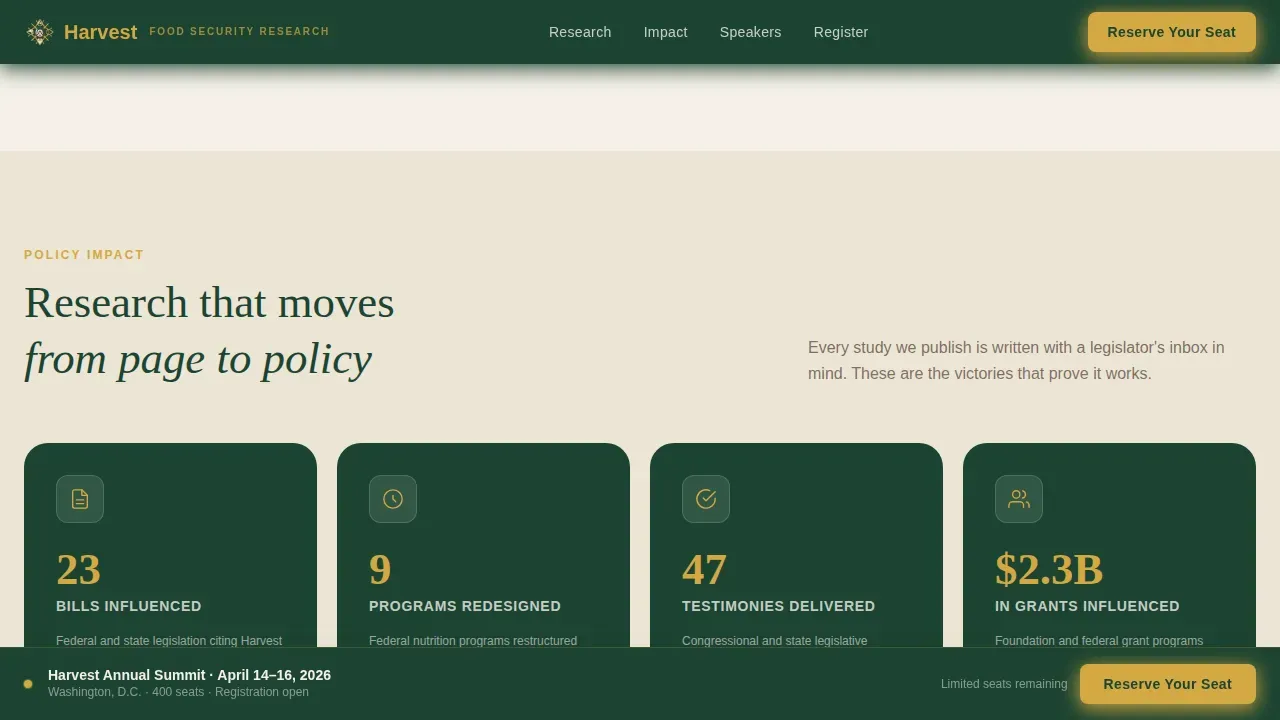
Four cards follow in a second row, each representing a concrete policy outcome. Bills influenced, programs redesigned, testimony delivered, and initiatives supported each get their own card rendered in canopy green with a document icon. This row does the credibility work that a speaker bio alone cannot. It shows that the institute's research translates into legislative and programmatic change, which is exactly what policy advisors, program officers, and municipal planners need to see before they commit time to an event.
Speaker Profile Cards with Talk Questions
Speaker cards include a portrait, institutional affiliation, and the single question the speaker's session will answer. This format does more than list credentials. It gives the visitor a reason to attend by framing each session as a focused inquiry rather than a general presentation. For a page serving researchers studying food deserts, policymakers drafting food access legislation, and funders deciding where to direct nutrition grants, the question-led card format makes the agenda feel immediately relevant.
Multi-Field Registration Form with Open Text Question
The registration form collects full name, organizational affiliation, and role via a dropdown that includes researcher, policymaker, funder, journalist, student, and other. The final field is an open-text prompt: "What food security question matters most to you right now?" This field simultaneously qualifies registrants for breakout session placement and makes visitors feel heard before they arrive. A persistent bottom call to action bar repeats the "Reserve Your Seat" prompt after the speaker cards, ensuring the conversion opportunity is never more than one scroll away.
Gated Pre-Summit Briefing Download
Visitors who are not ready to register can access a pre-summit briefing document by submitting their email address and organizational affiliation. This secondary path captures high-value contacts who are in early research or evaluation mode. It recognizes that funders and policymakers often need to review materials before approving attendance, and it gives the institute a warm follow-up list beyond confirmed registrants.
Page sections overview
| Section | Purpose |
|---|---|
| Manifesto Hero | Establishes mission and anchors the visitor with event date and dual call to action |
| Research Area Cards | Surfaces three hyperlocal data callouts that demonstrate investigative depth |
| Policy Impact Row | Shows concrete legislative and programmatic outcomes from institute research |
| Speaker Profile Cards | Frames each session as a focused question to drive attendance intent |
| Registration Form | Collects name, affiliation, role, and open-text question for breakout placement |
| Persistent Bottom Bar | Repeats the primary call to action after speaker cards to close the conversion loop |
| Gated PDF Download | Captures email and affiliation from visitors who need more time before registering |
| Footer Pattern | Splits logo and tagline left, navigation links right for clean exit navigation |
Design & branding system
The visual identity behind Harvest follows a Nature-Inspired theme anchored in the Forest Trust color system. Every color choice has a functional role, and together they create a palette that communicates the weight of the subject without making the page feel clinical or bureaucratic.
- Color roles by element: Deep canopy green (#1B4332) anchors headers and navigation. Rich loam brown (#3E2723) carries body text with weight and readability. Warm grain gold (#D4A843) illuminates calls to action, data callouts, and hover states. Soft parchment (#F5F0E8) forms the primary background and card surfaces, giving each module organic breathing room.
- Typography system: Fraunces, a premium variable serif, handles all headlines and the manifesto reveal. DM Sans handles body text across cards, form fields, and navigation. The pairing delivers academic seriousness with the readability that policy and research audiences expect when scanning complex information.
- Animation approach: The manifesto uses a sequential fade-in at a slow pace, so each line lands before the next appears. Cards enter on scroll with a staggered reveal. The grid entries animate in sequence to guide the eye down the page without forcing a single reading path.
Mobile & speed optimization
Harvest is designed desktop-first, reflecting the reality that the primary audience of policy advisors, foundation officers, and municipal planners typically conducts research and evaluates events on desktop devices. Full mobile support is included so the page remains accessible for secondary audiences and sharing contexts.
- Desktop-first layout with full mobile support: The card grid reflows cleanly for smaller screens. The manifesto hero, registration form, and persistent bottom bar all adapt to mobile viewports without losing hierarchy or functionality.
- Performance-aware component structure: Static sections such as the manifesto, research cards, policy impact row, and speaker cards are built as server components. The registration form and animations are handled as client components. This separation keeps the initial page load lean while preserving interactive behavior where it matters.
How this template helps you convert
Harvest is structured to move high-intent visitors toward registration without friction, while keeping a secondary path open for visitors who need more evidence first.
- The manifesto builds belief before asking for action. The sequential text reveal earns emotional buy-in in the first fifteen seconds. By the time the visitor reaches the call to action below the manifesto, they already understand the mission, the urgency, and the stakes. This is especially important for food security research pages where the audience includes skeptical policymakers and budget-conscious funders who need to trust the source before they commit.
- The modular card grid escalates from problem to evidence to action. Research area cards establish the problem with hyperlocal specificity. Policy impact cards demonstrate that the institute's work produces real legislative and programmatic outcomes. Speaker cards connect that credibility to the specific event at hand. By the time the visitor reaches the registration form, the narrative has already done the persuasive work. The form simply collects the decision that the page has already built.
- The persistent bottom bar and gated PDF path eliminate dead ends. Visitors who scroll past the first call to action without registering encounter the "Reserve Your Seat" bar again after the speaker section. Visitors who are not ready to register at all can download the pre-summit briefing, giving the institute a warm lead rather than a lost visit.
Other information about this template
Harvest reflects a broader set of principles about how food security communication works online, and how research institutions can use structured design to serve their audiences more effectively.
Food security research pages face a specific challenge that general nonprofit templates do not address. The audience arrives with expertise. Policy advisors understand food system dynamics. Foundation program officers know the difference between rigorous agricultural production data and advocacy talking points. Graduate researchers studying food deserts and food availability gaps can immediately identify whether an institute's data is credible or curated for optics.
This means the page has to work harder than most. It cannot rely on emotional imagery alone. It has to surface real data, demonstrate real policy impact, and present real speakers asking real questions. Harvest is structured to do exactly that.
The Forest Trust color system is not decorative. Canopy green and loam brown communicate rootedness and authority. Grain gold draws the eye to data and action without feeling salesy. Parchment gives the page the texture of a working document rather than a marketing brochure. Together they support a farmhouse-research aesthetic that feels like sitting at a wooden table with maps and briefing papers spread out in front of you.
The template is categorized under Community and Nonprofit, within the Hunger and Food Security Nonprofit subcategory, and is specifically designed for the Hunger and Food Security Research and Policy Institute niche. It is one of the more specialized templates in this category, built for contexts where the visitor has domain expertise and will notice if the page feels generic.
Here are additional considerations that inform how this template sits within the broader landscape of food security research and communication:
- The food system spans agricultural production, distribution infrastructure, markets, household consumption patterns, and food intake behavior. Effective food security research pages must signal competency across this full system rather than one slice of it.
- Food insecurity is not uniform. It presents differently in rural households facing geographic isolation from fresh food sources, in urban communities where food prices outpace incomes, in immigrant and refugee populations where pregnant women face compounded risk, and in regions like south asia, central asia, and latin america where smallholder farmers and small scale farmers operate under pressure from climate change, market volatility, and limited access to services.
- Climate change is expected to exacerbate food insecurity by affecting agricultural productivity and food access. Extreme weather events have increased agricultural losses significantly over the past thirty years, impacting food production and food security across other regions and other countries.
- Satellite data can provide critical insights into crop conditions and help inform strategies to mitigate the impacts of climate change on food security. Artificial intelligence and machine learning tools are increasingly used to provide targeted interventions for smallholder farmers and to improve market transparency in regions where food availability data has historically received limited attention.
- The balance between food demand and agricultural output is critical for global food security. This balance is threatened by climate change, biodiversity loss, and the structural inequities that persist across the global food system.
- Wild food harvesting plays a key role in food security for rural households across developing countries. Wild species and intraspecies biodiversity constitute a significant portion of the food basket for poor rural households in south asia, central asia, latin america, and other regions. Many neglected and underutilized plants provide nutrient dense foods that support nutritional security among populations with limited economic access to formal food markets. The use of wild food is related to food shortages, food heritage, and knowledge of nutritional and medicinal value that often receives limited attention in mainstream agricultural development discussions.
- Farmers who harvest wild food often do so because they are moderately or severely food insecure. Food forests, kitchen gardens, and cover crops are resilient agricultural systems that provide agroecosystem services alongside cultural and social benefits. Strengthening local food production systems, including support for smallholder farmers and small scale farmers, can provide multiple economic and public health co-benefits.
- Food insecurity is associated with higher intake of unhealthy foods among low-income populations. Access to nutritious food, including fruits and other fresh produce, is often limited by socio-economic factors. This leads community members to rely on cheaper, less nutritious options that affect food quality and long-term health outcomes. Non communicable diseases are increasingly linked to poor food intake patterns rooted in food insecurity.
- Per capita consumption of nutritious food varies widely across communities, countries, and regions. Household consumption data, per capita consumption trends, and food availability metrics are among the data types that food security researchers use to map where growing populations face the greatest risk.
- Ecosystem services provided by healthy agricultural landscapes play a key role in sustaining food production. Cover crops, diversified crops, and agroecosystem services support soil health and reduce the climate adaptation costs that farmers face when extreme weather events damage growing seasons. Rice and other staple crops in south asia and central asia are particularly exposed to climate-related production disruptions.
- Food prices affect economic access to nutritious food for low-income households. When food prices rise due to production shortfalls, supply chain disruptions, or market concentration, the communities who were already food insecure feel it first and most severely.
- An effective landing page for a food security research institute must bridge complex research and the urgent nature of hunger. The page should include a clear, mission-driven statement, organize research expertise around the four pillars of food security (availability, access, utilization, and stability), and display key metrics using visual formats that communicate impact simply. Trust signals such as partner organization logos boost authority. Featured publications and direct links to datasets support visitors who need to go deeper before deciding to attend or register.
- Rocket.new provides templates for building production-ready apps and websites. The Harvest template is available on this platform and can be customized to suit the specific needs of food security research institutes. Design elements, card content, color values, typography, and form fields can all be adapted to reflect an institute's specific research focus, geographic coverage, and brand identity.
Theme
Nature-Inspired
Creative direction
Vision & Mission
Color system
Forest Trust
Style
Card Grid (Modular)
Direction
Event Registration
Page Sections
Sequential Manifesto Hero with Dual Call to Action
Research Area Cards with Hyperlocal Data
Policy Impact Row with Document Icons
Speaker Cards with Talk Questions
Multi-field Registration Form with Open Text
Gated Pre-summit Briefing PDF Path
Related questions
Who is this template designed for?
Can the card grid rows be updated as research areas or speakers change?
Does the template include a secondary conversion path for visitors not ready to register?
What typography and color system does Harvest use?
Is the registration form customizable?