Aquaculture Consulting Services Website Template
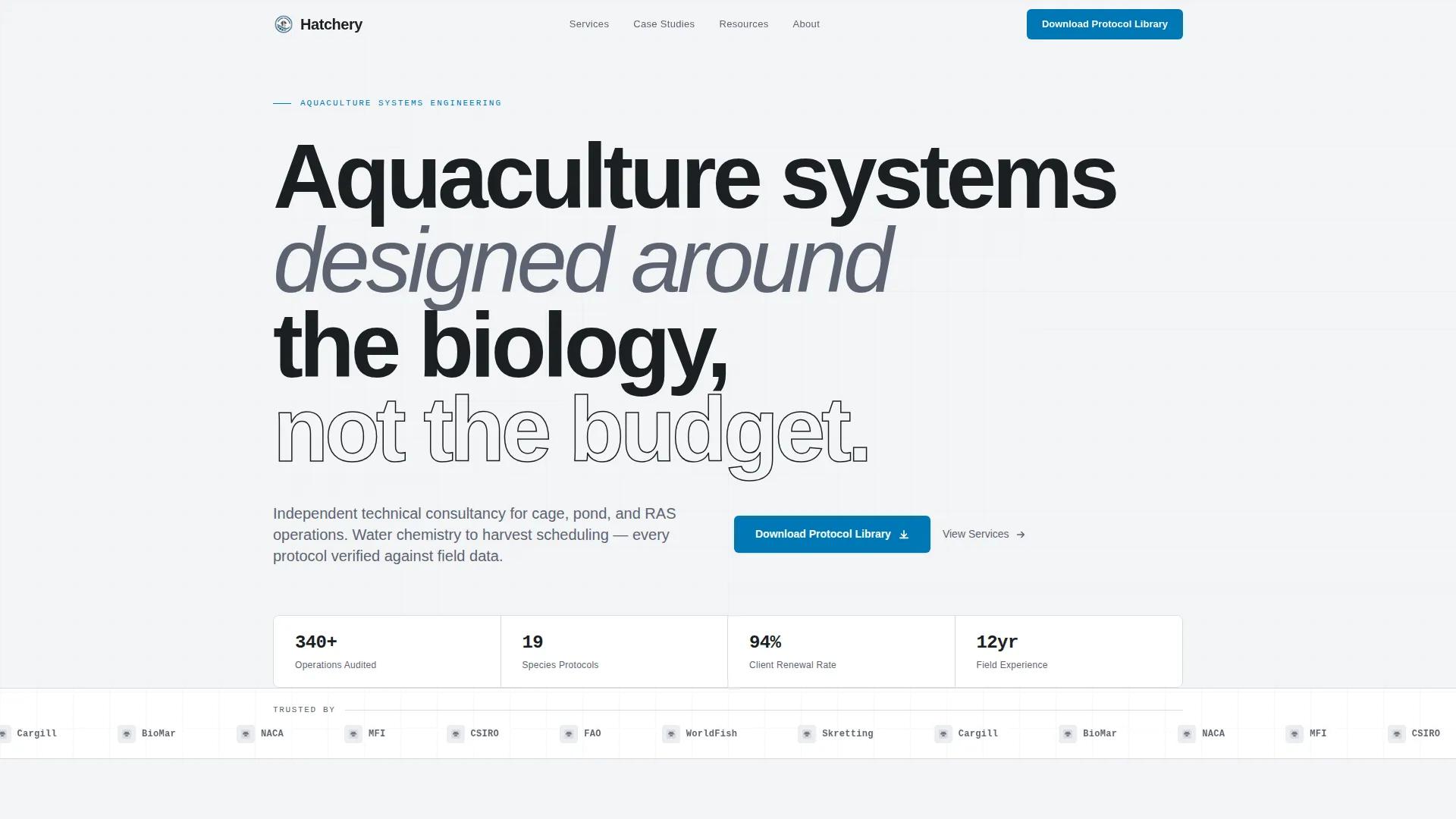
Hatchery is a precision aquaculture landing page template built for consultancies that work at the operational edge of fish and shrimp production. It combines a modular card grid layout, a restrained Carbon Fiber color system, and a content-first resource hub structure to present technical services with institutional authority and earn qualified leads through gated and ungated deliverables.
by Rocket studio
Quick summary
Hatchery is a single-page landing page template designed for aquaculture consulting firms. It uses a modular card grid to display specialized services, deliverables, and case study results. The layout is anchored by a Logo Bar header, a Carbon Fiber color system, and a layered conversion strategy that earns trust before it asks for an email.
Who this template is for
This template is built for technically credible aquaculture consultancies that serve serious operators, not general audiences. It works best when the firm has real deliverables, measurable results, and a client base that reads data before it reads brochures.
- Aquaculture consulting firms offering services across cage, pond, and recirculating aquaculture system (RAS) operations
- Hatchery design and biosecurity specialists who need to demonstrate methodology, not just credentials
- Independent consultants supplying growth-trial data or regulatory compliance guidance to feed companies and government fisheries agencies
What problem this template solves
Most consulting landing pages fail because they describe capability in vague terms. A firm that audits feed conversion ratios (FCR), designs water chemistry protocols, and writes national aquaculture strategy documents cannot afford a page that looks like a general services brochure. Buyers in this space are farm managers, researchers, and government officers who will leave if the content does not match their level of technical fluency.
- Vague service descriptions that do not show methodology, timeline, or deliverables
- No clear path from public expertise to gated lead capture, which leaves conversion to chance
- Visual designs that undercut technical authority with stock photography or marketing-speak
What you get with this template
The template delivers a fully structured, single-page layout with every section purpose-built for an aquaculture consultancy. No placeholder sections, no generic hero image. The structure moves from institutional proof to specific service cards to ungated resources and then to a gated conversion moment.
- A Logo Bar header featuring partner and client organization logos beneath a single authority headline
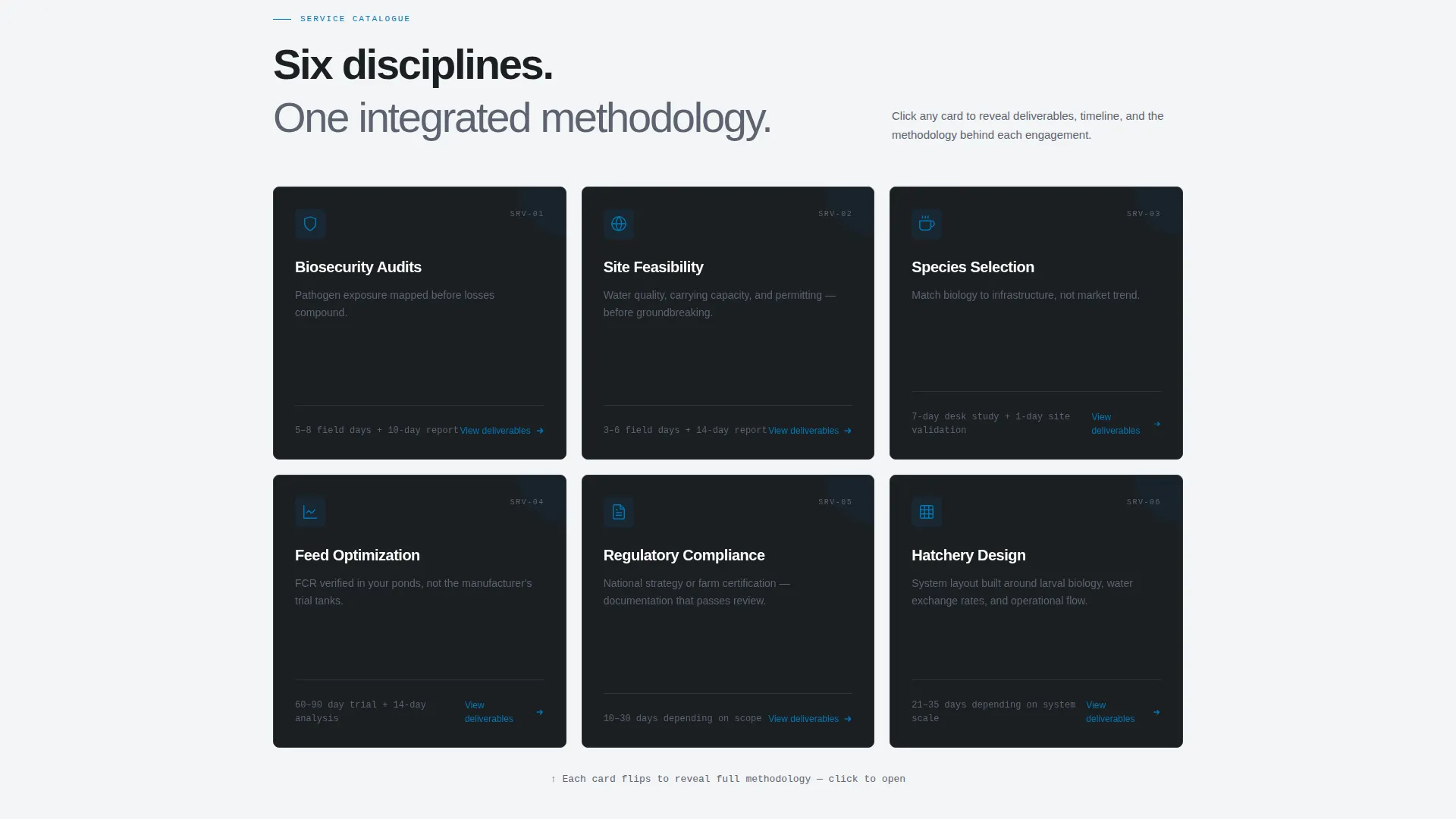
- Modular service cards that flip or expand to reveal exact deliverables, timelines, and methodology for each consulting area
- A layered content hub with ungated tools (checklist, calculator, audit template) and a gated Protocol Library download behind a segmented email form
Feature list
This template is built around six tightly scoped capabilities drawn directly from the brief. Each one serves a specific functional role in the page.
Modular Service Card Grid
Each card represents one consulting service: biosecurity audits, site feasibility, species selection, feed optimization, regulatory compliance, and hatchery design. Cards flip or expand to surface exact deliverables, timelines, and methodology. The cumulative scroll feels like opening successive project folders.
Logo Bar Header
A clean horizontal band displays client and partner logos alongside a single authority headline. There is no hero image and no video. Institutional proof is the visual statement, and the restraint communicates confidence to an audience that distrusts ornamentation.
Layered Conversion Structure
The page separates ungated resources from gated content deliberately. Ungated tools build expertise-trust first. The gated ask, a Protocol Library download, sits behind a form that collects email, professional role, and species-of-interest. This earns the lead rather than demanding it.
Case Study Result Cards
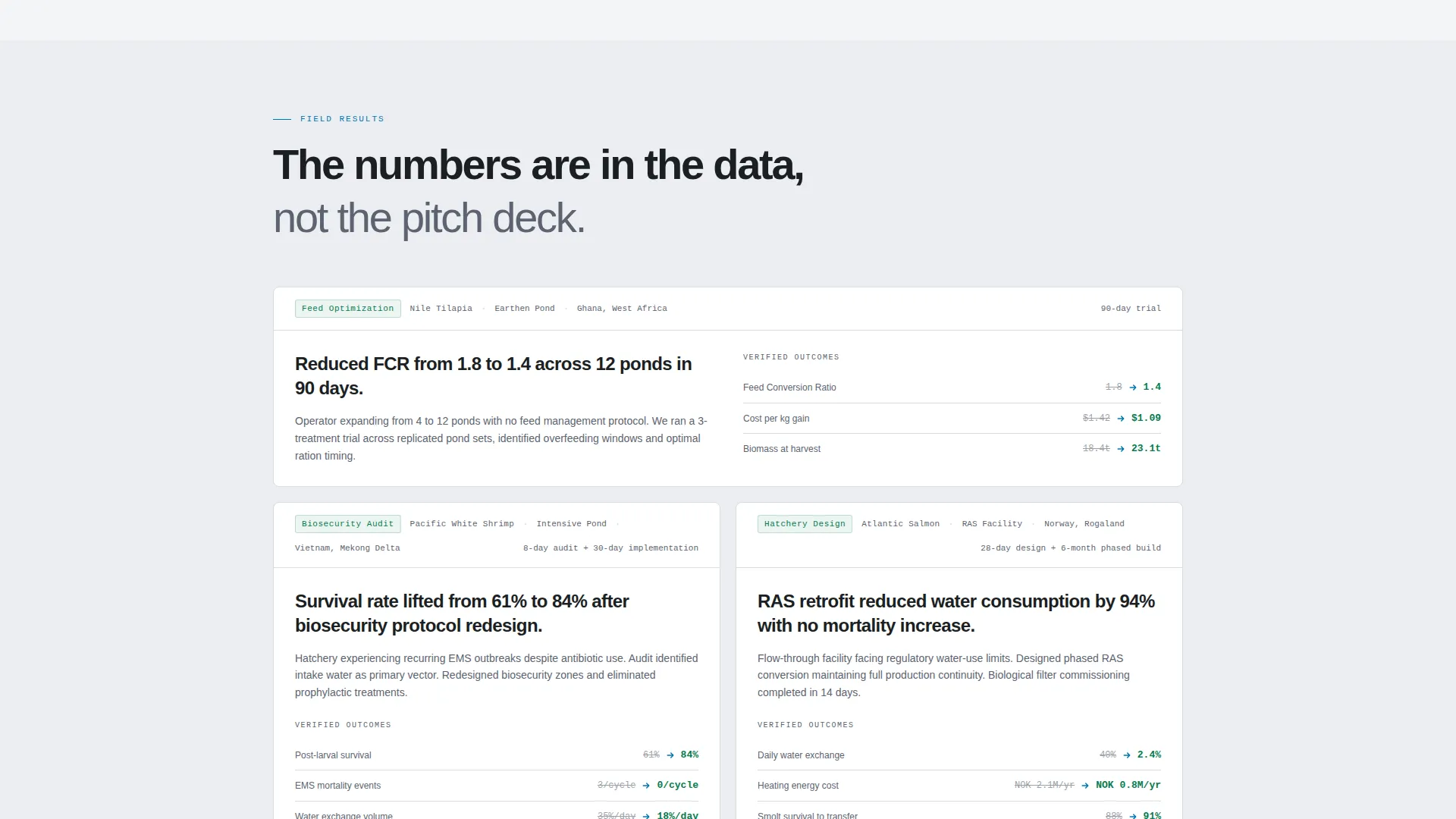
Hard-number case study cards are interspersed throughout the grid. Results like reduced FCR from 1.8 to 1.4 across 12 ponds in 90 days anchor credibility at every scroll point. No vague testimonials, only verified outcomes with context.
Carbon Fiber Color System
The palette uses structural charcoal for card backgrounds, titanium mid-gray for body text and dividers, clinical white for the page canvas, and a single biosecurity-blue accent reserved for links, icons, and interactive states. The result is a matte, technical visual identity with zero decorative noise.
Ungated Resource Cards
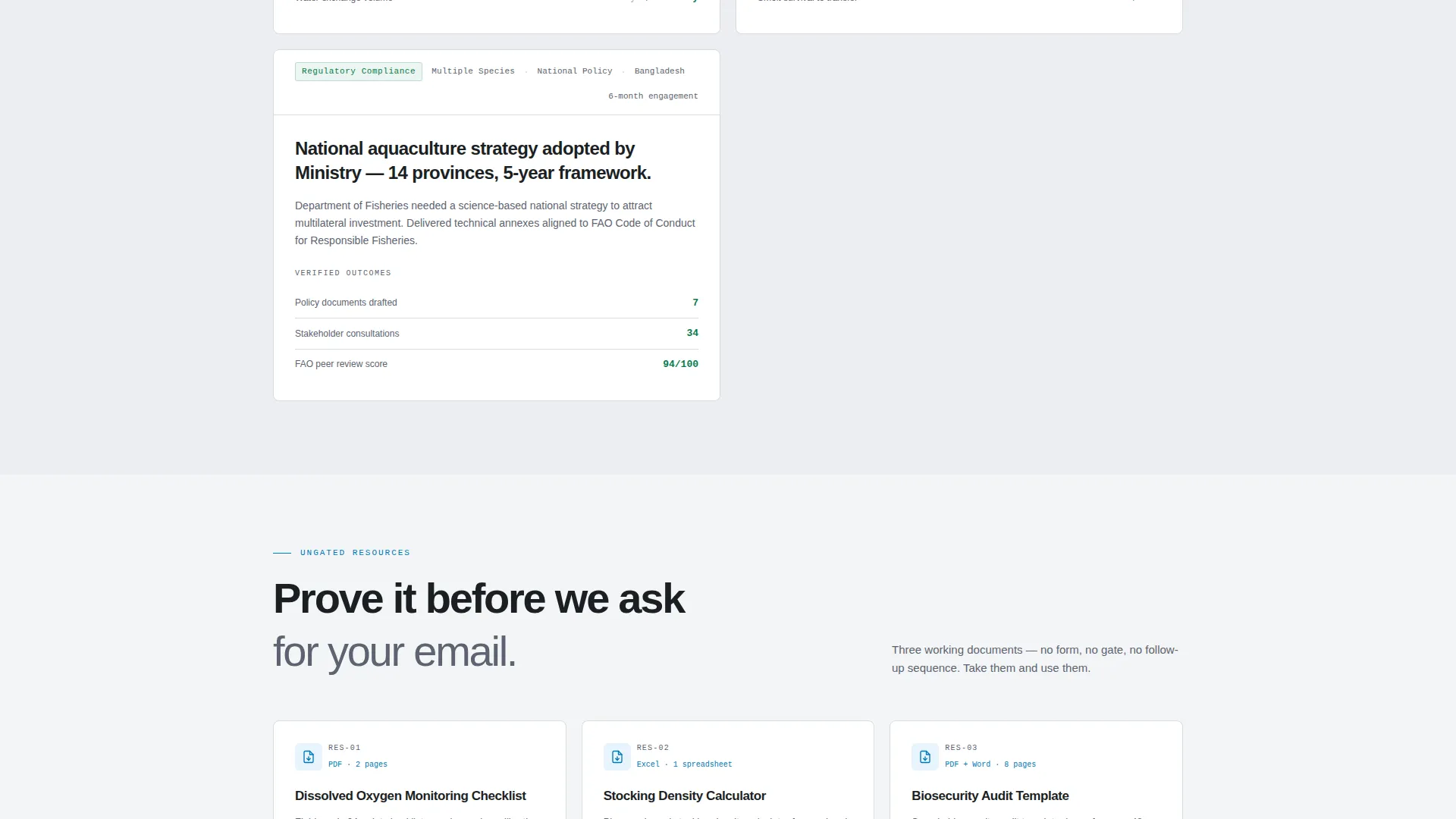
Three secondary conversion cards offer immediate value without a form: a dissolved-oxygen monitoring checklist, a stocking-density calculator, and a sample biosecurity audit template. Each resource builds trust and signals the depth of the gated Protocol Library waiting behind the form.
Page sections overview
| Section | Purpose |
|---|---|
| Logo Bar Header | Establishes institutional authority with partner logos and a single positioning headline |
| Service Card Grid | Presents each consulting service with expandable deliverables, timeline, and methodology |
| Case Study Cards | Delivers hard-number results to validate expertise at each scroll point |
| Ungated Resource Cards | Offers free tools to build trust before the gated conversion ask |
| Protocol Library call to action | Captures leads via a segmented form gating the firm's full resource library |
Design & branding system
The Carbon Fiber color system is designed to communicate precision and technical seriousness. Every color choice has a functional role and the palette avoids decorative use of color at every level.
- Structural charcoal (#1B1F23) for card backgrounds, titanium mid-gray (#5C6370) for body text and dividers, and clinical white (#F4F5F7) for the page canvas
- Biosecurity-blue (#0077B6) reserved exclusively for links, icons, and interactive states, keeping the only active color purposeful
- A Corporate Precision theme with zero ornamentation: no gradients, no photography, no decorative elements competing with technical content
Mobile & speed optimization
The modular card grid is inherently responsive. Cards reflow cleanly across screen sizes, and the absence of hero images or video assets removes the heaviest typical page-load contributors. Consultants presenting to clients on tablets or phones will find the layout holds its structure at every viewport.
- Card grid reflows from multi-column desktop layout to single-column mobile without content loss
- No hero images or video embeds, keeping the page lean and fast to load on any connection
- Form elements in the Protocol Library gating section remain usable and clearly labeled at smaller screen sizes
How this template helps you convert
The conversion architecture is deliberate and layered. It does not ask for a lead at the top of the page. It earns one by the time the visitor reaches the gated form.
- The Logo Bar header establishes credibility immediately with recognized institutional partners and a precise positioning headline, reducing bounce before the visitor reads a single service description.
- Ungated resource cards give visitors something useful without any form friction, building the kind of trust that makes a segmented gated form feel like a reasonable next step rather than an interruption.
- The gated Protocol Library form captures email, professional role, and species-of-interest in a single ask, giving the firm a qualified, segmented lead rather than a generic email address.
Other information about this template
This template is part of a specialized Marine and Maritime category within the Maritime Services subcategory, positioned specifically for the Aquaculture Consulting niche. It is built on a Card Grid (Modular) template style with a Transparent Process creative direction, meaning every card is designed to show working method, not just outcomes. The template suits consultancies working across tilapia expansion projects, shrimp hatchery survival-rate programs, and government-facing strategy engagements. Its Content and Resource hub landing-page direction means the primary goal is demonstrating expertise publicly before converting visitors into qualified leads. Teams using this template for RAS operations consulting, pond management advisory, or species diversification programs will find the service card structure maps naturally to multi-service consulting portfolios.
- Built for the Marine and Maritime category, Maritime Services subcategory, and Aquaculture Consulting niche
- Uses a Transparent Process creative direction to show deliverables and methodology inside each service card
- Well suited to consultancies advising on tilapia, shrimp, and multi-species production across cage, pond, and RAS systems
Theme
Corporate Precision
Creative direction
Transparent Process
Color system
Carbon Fiber
Style
Card Grid (Modular)
Direction
Content/Resource
Page Sections
Modular Service Card Grid
Logo Bar Header
Layered Conversion Architecture
Hard-number Case Study Cards
Carbon Fiber Color System
Ungated Resource Cards
Related questions
Can I add or remove service cards from the grid?
Does the gated form include role and species-of-interest fields?
Is this template suitable for a solo aquaculture consultant?
How many case study cards does the template support?
Can the ungated resource cards link to external files or tools?