Shrimp Farm Direct-Sales Landing Page Template
Hatchery is a single-column landing page template built for coastal shrimp and prawn farms selling direct to buyers. It combines an engineering-blueprint visual identity with warm organic tones to present your farm's production system, cold-chain delivery, and order options with quiet confidence. From the harvest hero image to the inline order bar, every section earns the sale before the buyer clicks.
by Rocket studio
Quick summary
Hatchery is a direct-sales landing page template designed for vannamei and tiger prawn operations. It translates the precision of a working shrimp farm, ponds, aeration systems, ninety-day rearing cycles, and cold-chain logistics, into a single-column scroll that converts sushi chefs, home cooks, and seafood distributors into paying buyers with minimal friction.
Who this template is for
This template is built for coastal aquaculture businesses that produce prawns at farm scale and want to sell directly. It works equally well for small family-run operations and larger commercial hatcheries preparing to open a direct-to-consumer channel.
- Shrimp and prawn farm owners who want to sell harvested product online without a marketplace middleman
- Seafood hatcheries and grow-out operations targeting both retail buyers and foodservice accounts
- Aquaculture producers seeking a professional layout that communicates production credibility to investors and wholesale buyers
What problem this template solves
Most shrimp farm websites look like company brochures. They do not help a sushi chef understand the species, the rearing cycle, or when the next harvest window opens. They do not give a home cook a clear path from curiosity to placing a one-kilo order. The result is lost trust and lost sales.
- Buyers leave without purchasing because the farm's production process is never explained in terms they can verify
- Foodservice buyers cannot find the practical information they need, species, size grades, harvest dates, and delivery lead times, so they go elsewhere
- Farm operators spend time answering the same questions by phone or email because the page does not display that information upfront
What you get with this template
This template gives you a fully designed, single-column landing page focused on direct sales for a prawn or shrimp farm. Every section is intentional. The visual and structural layout guides the visitor from first impression through to completed order.
- A cinematic hero section with a fade-in headline, a blueprint-style pond cross-section diagram, an interactive pond grid map, a scroll-animated cold-chain timeline, and a marquee testimonial strip
- A persistent bottom order bar with species toggle, size-grade selector, quantity stepper, and delivery-date picker, all without requiring account creation
- A monthly subscription text link offering a clear saving for recurring buyers, keeping the purchase flow clean and conversion-focused
Feature list
The feature list below covers the essential components built into this template. Each one is developed directly from the source brief and serves a specific role in the buyer journey.
Blueprint Pond Cross-Section Diagram
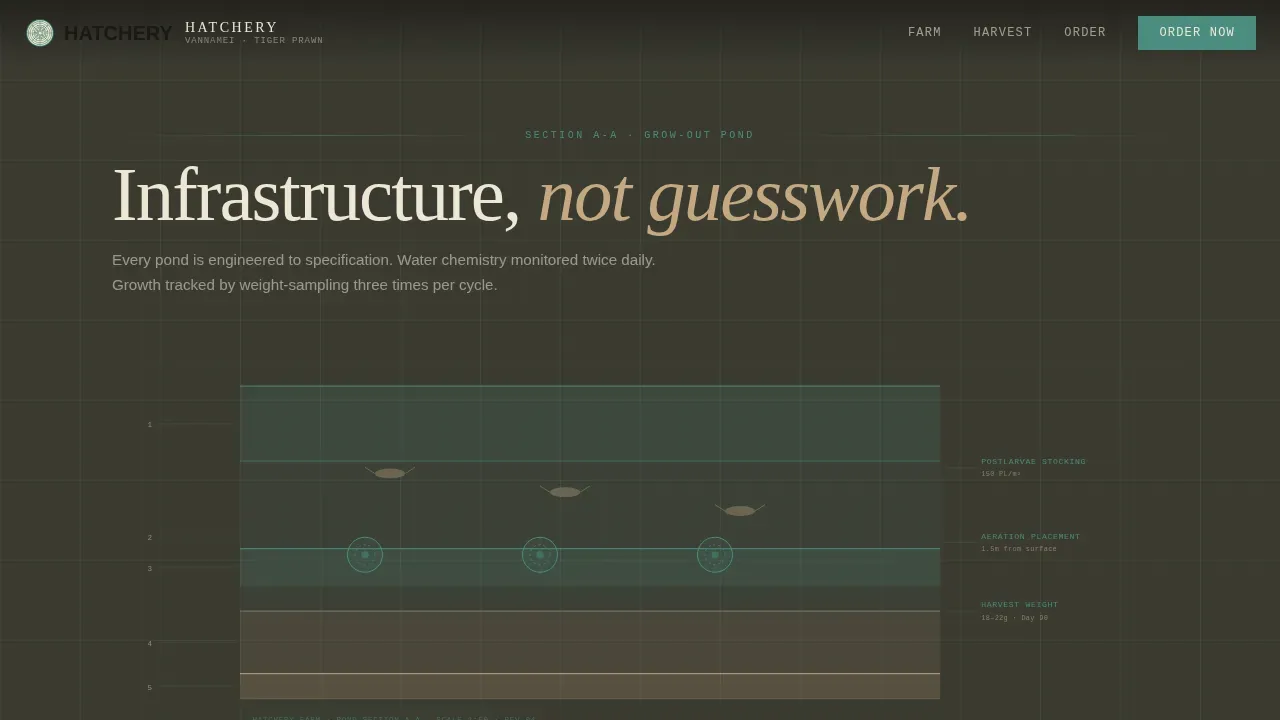
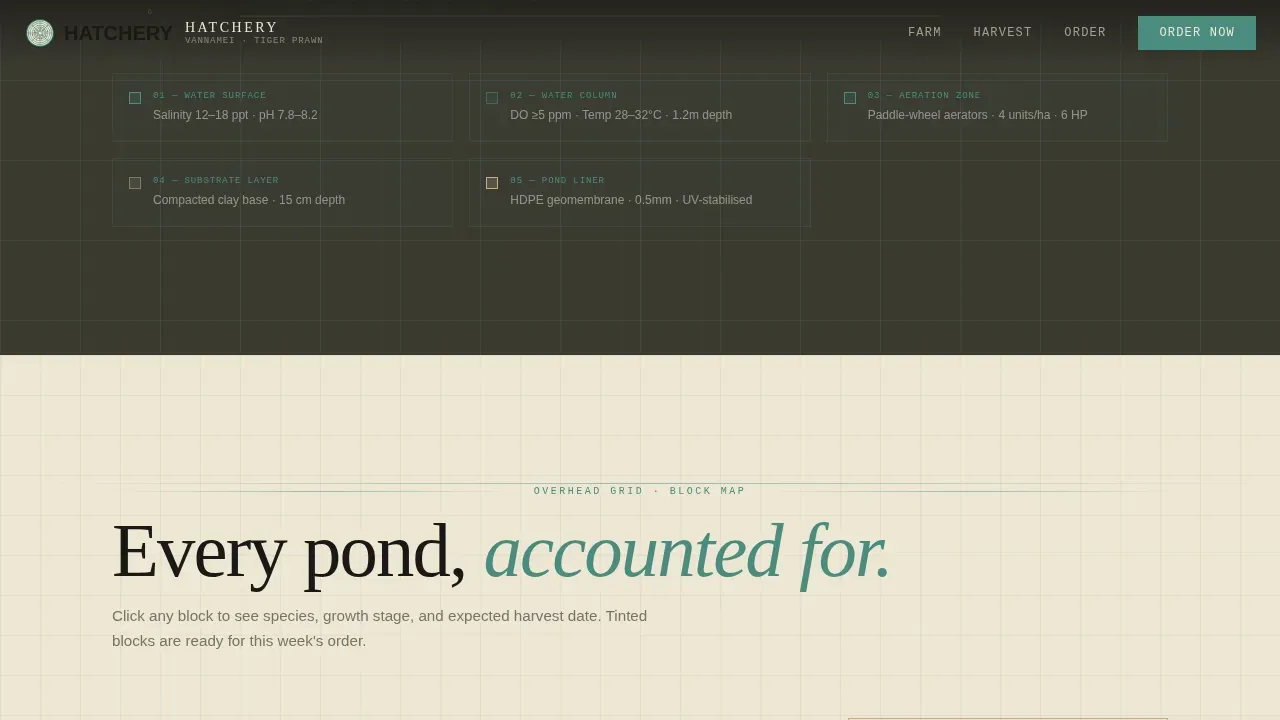
This section renders a detailed SVG cross-section of a single grow-out pond on a sediment-dark background. It labels each layer, liner, substrate, water column, and aeration placement, like a construction drawing. The diagram communicates that this is an engineered operation with controlled water volume, precise aeration, and measurable rearing depth, giving technical buyers a clear picture of how prawns are raised.
Interactive Pond Grid Map
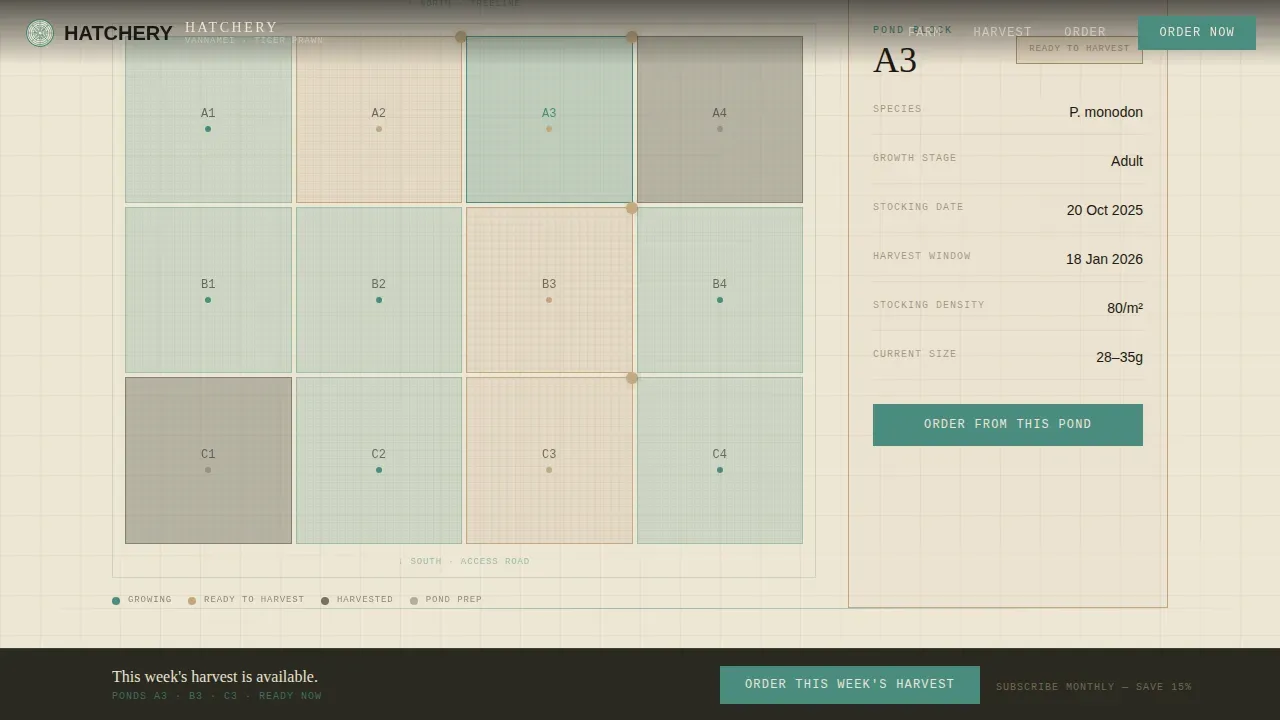
An overhead satellite-style map displays the numbered pond blocks across the farm. Each block is clickable and reveals the current species, growth stage, and expected harvest date. This transparency is a clear advantage for foodservice buyers who need to plan supply weeks in advance. The map turns static farm data into live, useful content for every visitor type.
Scroll-Animated Cold-Chain Timeline
A horizontal node timeline draws itself as the visitor scrolls. Each node represents a step: harvest basket, ice slurry, vacuum pack, insulated box, doorstep delivery. Thin teal connector lines animate between nodes. This section directly addresses buyer concerns about freshness and logistics, making the pond-to-plate promise feel concrete and verifiable.
Persistent Inline Order Bar
After the pond cross-section, a bottom bar slides into view and stays visible throughout the scroll. The order bar includes a species toggle for white prawn or tiger prawn, a size-grade selector covering 16/20, 21/25, and 26/30 count per kilogram, a quantity stepper starting at one kilogram, and a delivery-date picker showing only available harvest windows. No account creation is required, just name, address, and payment.
Marquee Testimonial Strip
Social proof is displayed as a continuously scrolling marquee featuring named buyers: a sushi chef, a seafood distributor, and a home cook. Testimonials tied to real buyer categories, high survival rates, freshness on arrival, consistent size grades, build the kind of trust that turns a first-time visitor into a subscriber.
Hero Section with Fade-In Headline
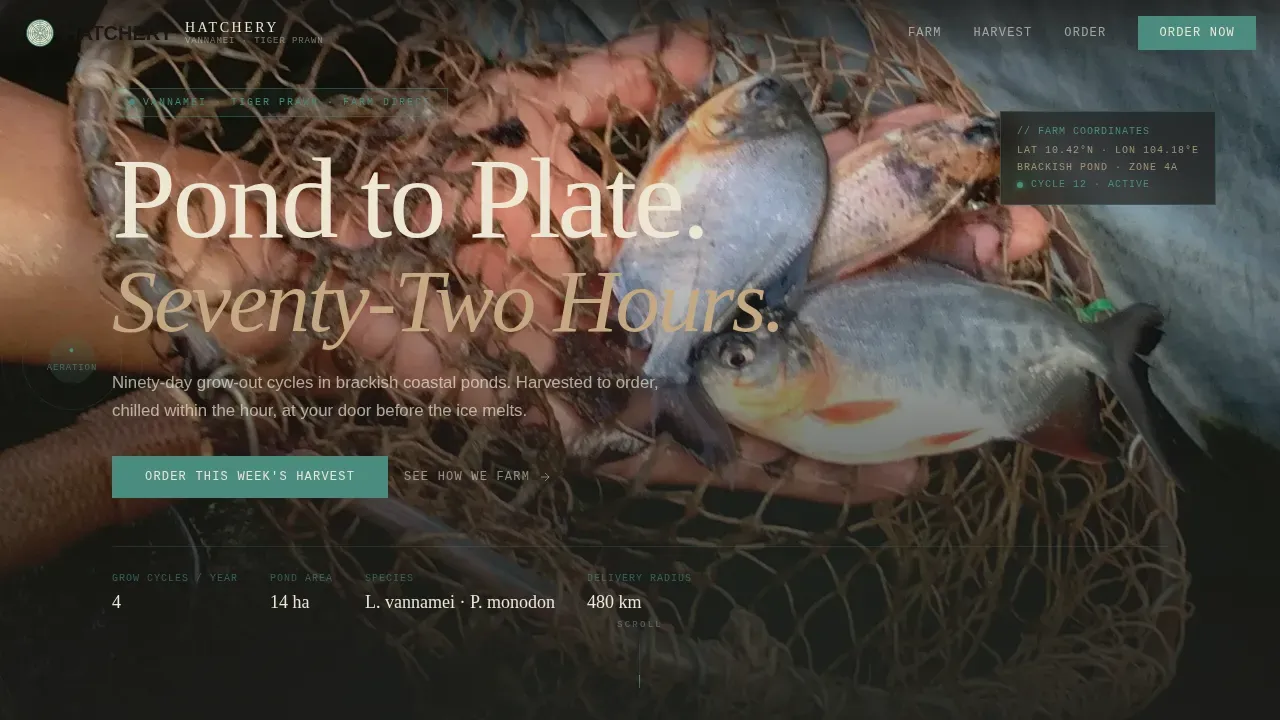
The hero is framed as an architectural photograph, weathered hands lifting a harvest net from the water, prawns catching early light. A single headline fades in over the image: "Pond to Plate. Seventy-Two Hours." This combination of imagery and copy immediately states the value and sets the tone for the entire scroll.
Page sections overview
| Section | Purpose |
|---|---|
| Hero with Headline | Opens with harvest imagery and the core value statement |
| Pond Cross-Section | Explains the grow-out system in blueprint diagram form |
| Pond Grid Map | Shows live farm data, species, stage, harvest date, per block |
| Cold-Chain Timeline | Animates the full delivery journey from net to doorstep |
| Testimonial Marquee | Scrolling social proof from named buyers across categories |
| Persistent Order Bar | Enables direct purchase with species, grade, and date selection |
| Footer | Single-row linear footer with farm contact and navigation |
Design & branding system
The visual identity follows an Engineering Blueprint theme expressed through a Warm Stone color system. The palette feels like a topographic survey map printed on kraft paper, technical in structure but alive in texture. Backgrounds alternate between bleached levee sand and deep pond sediment, creating clear contrast between light and dark sections.
- Colors: sun-dried clay (#C4A882) for accents, bleached levee sand (#EDE6D5) for light backgrounds, deep pond sediment (#3B3A30) for dark sections, and aeration-foam teal (#4A8C7F) reserved for buttons, quantity selectors, and hover states
- Typography: Fraunces serif display for headlines and Directional Mono Sans (DM Sans) for body text and interface labels, creating a pairing that feels both editorial and functional
- Thin teal rules separate sections like water channels dividing grow-out ponds, reinforcing the engineered-landscape feel throughout the scroll
Mobile & speed optimization
The template is built desktop-first with full mobile responsiveness across all sections. The interactive components, pond grid map and order bar, are developed as client-side elements, while static sections such as the hero, cross-section, and timeline are built as server components to keep the initial load lightweight.
- The single-column flow stacks cleanly on smaller screens, preserving the scroll narrative from hero to order bar without layout breaks
- The pond grid map and inline order selector are optimized for touch interaction, making the species toggle and quantity stepper easy to use on mobile devices
- Mobile-first design matters because many users, particularly business-to-business buyers, check product and supply information on their phones before committing to an order
How this template helps you convert
The template is structured so that by the time a visitor reaches the order bar, they have already seen how the animals are raised, how they are chilled, and how fast they arrive. That sequence of transparency is what makes the purchase feel like a natural next step rather than a leap of faith.
- The blueprint pond cross-section, interactive grid map, and animated cold-chain timeline build layered credibility, each section adds a specific, verifiable piece of information that reduces buyer hesitation before the order bar appears
- The persistent bottom bar stays visible after the cross-section reveal, so the primary call to action is always one scroll-stop away, the inline selector removes all friction by letting the buyer choose species, size grade, quantity, and delivery date in a single panel without creating an account
- The monthly subscription text link beneath the order button captures recurring buyers at the moment of highest intent, converting a one-time purchase into a reliable revenue stream for the farm operation
Other information about this template
This section covers additional context that helps farm operators, investors, and aquaculture producers understand the broader scope of this template and the operational knowledge it reflects.
This template is well-matched to the realities of how successful hatcheries operate. Shrimp farming mainly takes place along the coast where briny water is pumped to fill grow-out ponds. Proximity to rivers is highly desirable because fresh water is needed to flush and replace pond volume regularly. Sites located on flat ground near road networks are preferred, as steep slopes are not suitable and access to processing plants and markets is essential.
Hatchery design must account for the target species, production targets, and financial inputs. A complete facility includes maturation tanks, spawning tanks, larval rearing tanks, nursery tanks, and live food culture tanks. Broodstock tanks are essential for maintaining a constant supply of gravid females. The capacity of broodstock tanks and rearing tanks depends on the number of spawners needed and the intended production volume per cycle. Aeration is essential throughout the larval rearing process to maintain dissolved oxygen concentration in the water column.
The template's content structure maps naturally to best practices in hatchery inventory management. Visual timelines from eggs and larvae through to harvest help buyers understand the production process. Setting specific production goals and identifying variability in production performance are the first steps toward consistent operation. Hatcheries that create a detailed annual production plan aligned with market demand are better positioned to mitigate risk and optimize capacity across cycles.
Operational challenges that affect hatcheries include power outages, storms, and disease outbreaks. Strategies to mitigate these include diversifying broodstock populations and scheduling maintenance during low-risk periods. A structured landing page that displays production data, harvest windows, and species information clearly also serves a practical risk-communication role for buyers and investors.
The template's sustainability framing supports eco-efficiency storytelling. Highlighting low-impact technologies such as recirculating aquaculture systems (RAS) and clean energy water pumps underscores the farm's environmental credentials. Sustainability credentials that emphasize practices like water recycling and low-discharge systems add value for buyers who want to source responsibly.
For hatcheries preparing a business proposal, this template can serve as the public-facing layer of a broader pitch. A well-structured business proposal for hatcheries typically includes sections for market analysis, operational plans, and cost estimates. The template's transparent layout, showing construction-level detail about tanks, water systems, and harvest schedules, builds the same confidence with retail buyers that a formal proposal builds with investors.
Engineered performance data adds credibility. Metrics such as growth rates reaching 22g in 90 days and high survival rates across rearing cycles give buyers and investors clear benchmarks. Cost estimates, production capacity figures, and harvest ranges displayed on the page help buyers plan their supply commitments with confidence.
- The Hatchery engineered harvest shrimp farm landing page template is built for single-column, direct-to-consumer aquaculture sales
- It is ideal for farms located in coastal Southeast Asia or similar subtropical zones, and it can support operations in equivalent climates across the USA and other regions
- The pond grid map is an example of how interactive content can replace static farm-overview pages, making data more accessible and more useful
- The template can be utilized by a farm owner acting alone or by a small marketing team preparing a seasonal launch
- It supports the introduction of a direct-sales channel without requiring a full e-commerce build
- The template's layout ranges from hero to footer in a single scroll, keeping the buyer focused and reducing the number of decisions required before purchase
- Farm stats such as hectares in production, cycles per year, and delivery radius can be displayed in the hero or footer to reinforce scale and reliability
Theme
Engineering Blueprint
Creative direction
Spatial & Architectural
Color system
Warm Stone
Style
Single Column Flow
Direction
Direct Sales
Page Sections
Blueprint Pond Cross-section Diagram
Interactive Numbered Pond Grid Map
Scroll-animated Cold-chain Timeline
Persistent Inline Order Bar
Marquee Testimonial Strip
Hero Section with Fade-in Headline
Related questions
Who is this template designed for?
What sections are included in this template?
Can this template handle both retail and wholesale buyers?
Does the order bar require buyers to create an account?
How does this template communicate farm credibility?