Federal Community Tourism Funding Landing Page Template
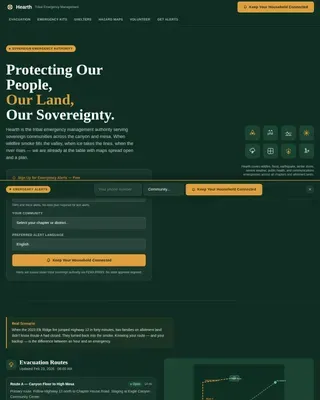
The Hearth federal community tourism funding landing page template is a modular card-grid layout built for federal tourism agencies connecting rural communities to grant programs. It opens with an animated stats wall, guides visitors through a five-phase funding journey, and drives conversions through a dual call-to-action path: an eligibility check and a downloadable program guide. Deep navy, warm parchment, and amber make the page feel authoritative yet welcoming.
by Rocket studio
Quick summary
The Hearth template is a single-page, card-grid layout designed for a federal tourism agency. It opens with three large animated counters that establish credibility instantly, then walks every visitor through the complete funding journey in five digestible steps. The design balances institutional authority with genuine community warmth, so regional tourism boards, small-town mayors, and rural hospitality owners feel guided rather than overwhelmed.
Who this template is for
This template serves public-sector communicators and community advocates who need to present complex federal funding programs in a clear, process-oriented format. It is built for organizations and officials working at the intersection of tourism and rural economic development.
- Regional tourism board directors filing for grant allocations and managing annual funding cycles
- Small-town mayors and county officials seeking to place their historic district or byway on national programs
- Rural hospitality owners, non-profit organizations, and tribal community coordinators who want to identify and access available federal grants
What problem this template solves
Federal tourism funding programs carry real promise, but their complexity often stops eligible applicants before they even begin. Visitors arrive at government pages not knowing which program fits their proposed project, what documents to gather, or where to submit their request. The result is missed funding and stalled community development efforts.
This template solves that problem by making the process feel completable from the moment the page loads.
- Eligibility criteria and program scopes are presented in an easy-to-read card format, so any person can quickly determine whether their community qualifies
- The step-by-step card grid removes ambiguity from the funding journey, addressing the most common challenges applicants face before they have to ask
- A dual conversion path captures both ready applicants and those who need time to plan, so no visitor leaves empty-handed
What you get with this template
You get a fully structured, single-page layout ready to represent a federal tourism funding agency. Every section is built from the ground up to serve the specific needs of grant seekers and public-sector communicators. The template prioritizes clarity, trust, and action.
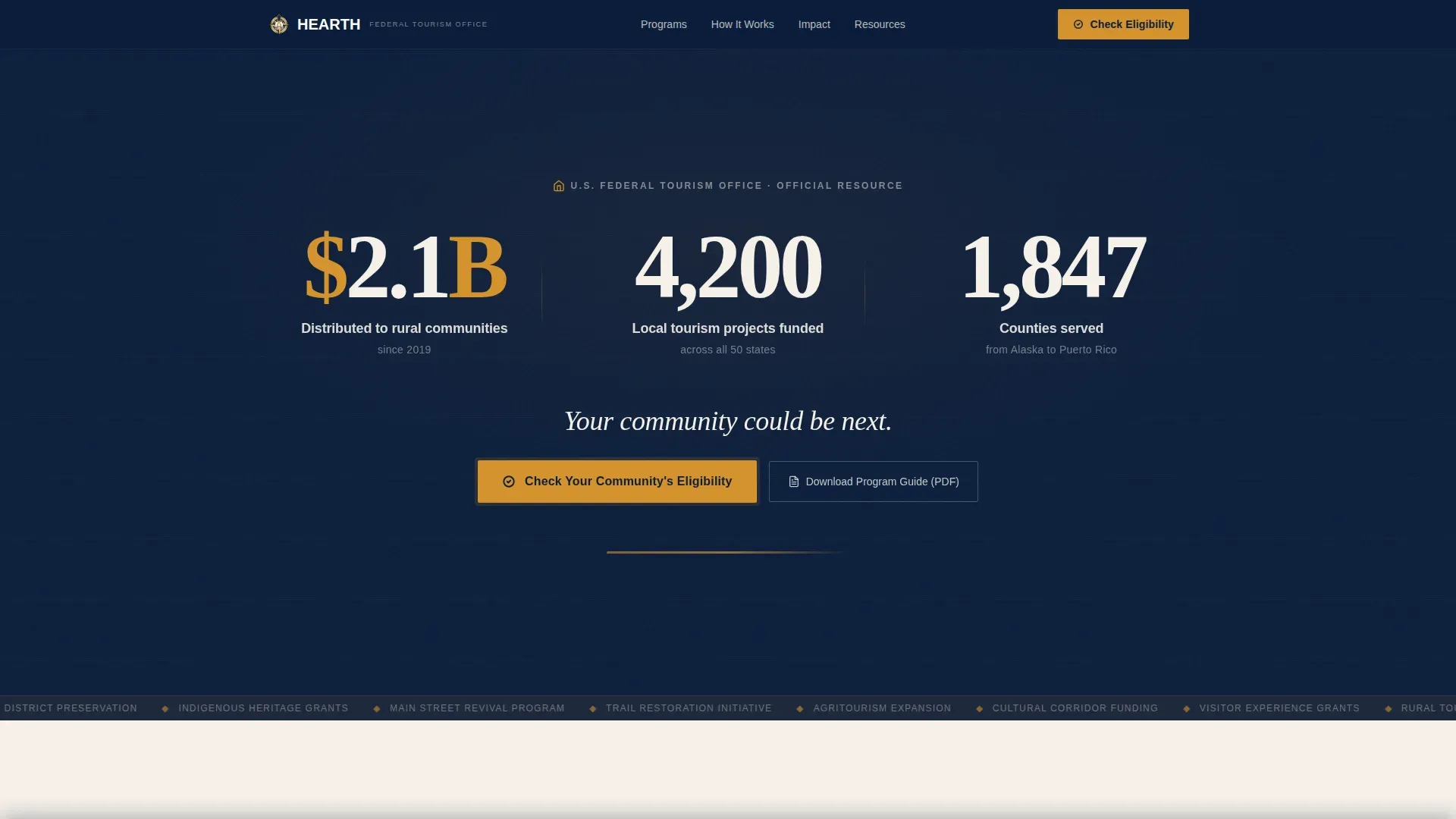
- An animated stats-wall header that uses live counters to establish funding authority and scale the moment the page loads
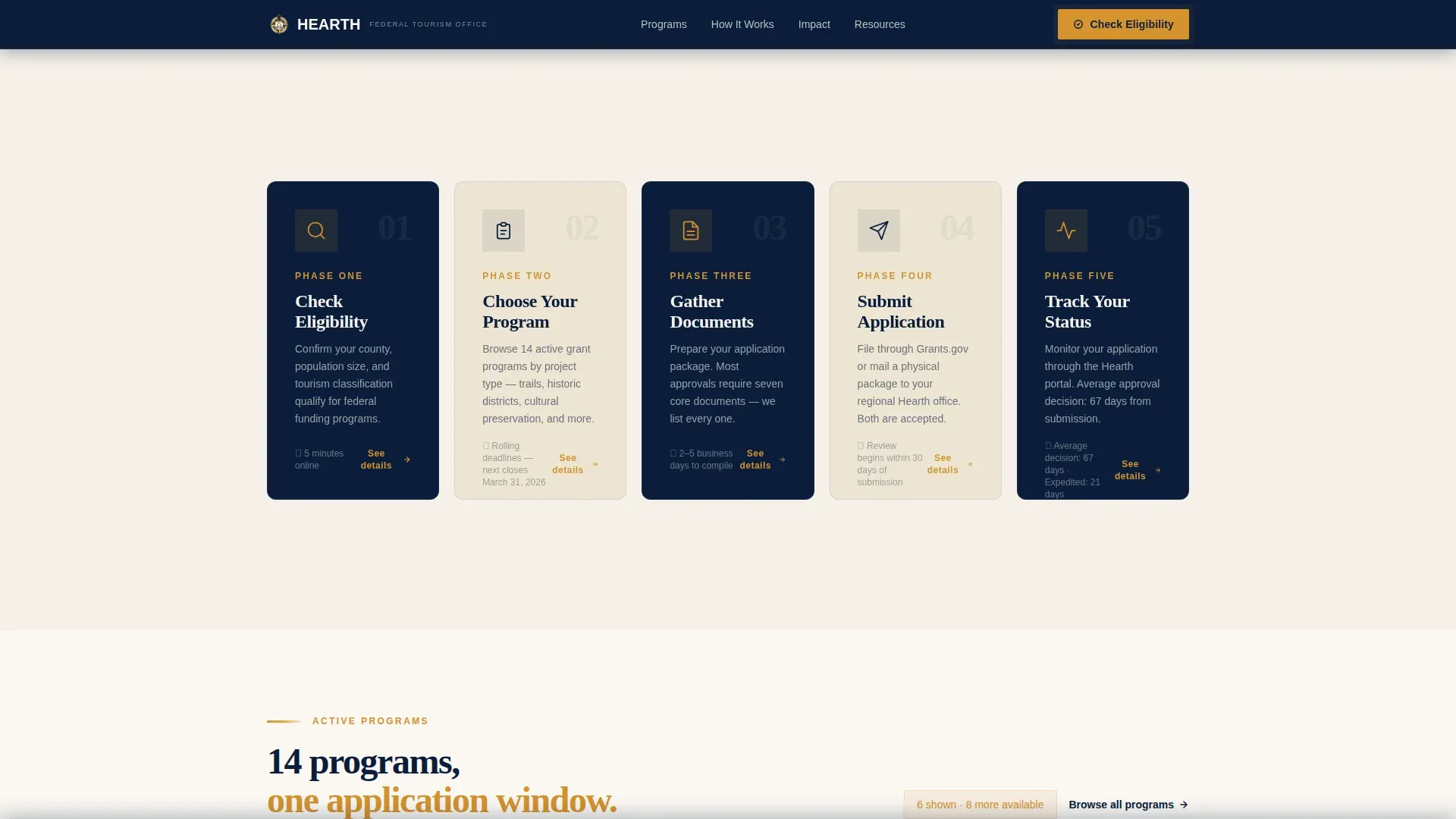
- A five-phase modular card grid covering Check Eligibility, Choose Your Program, Gather Documents, Submit Application, and Track Your Status, each card expanding on click to reveal program-specific details
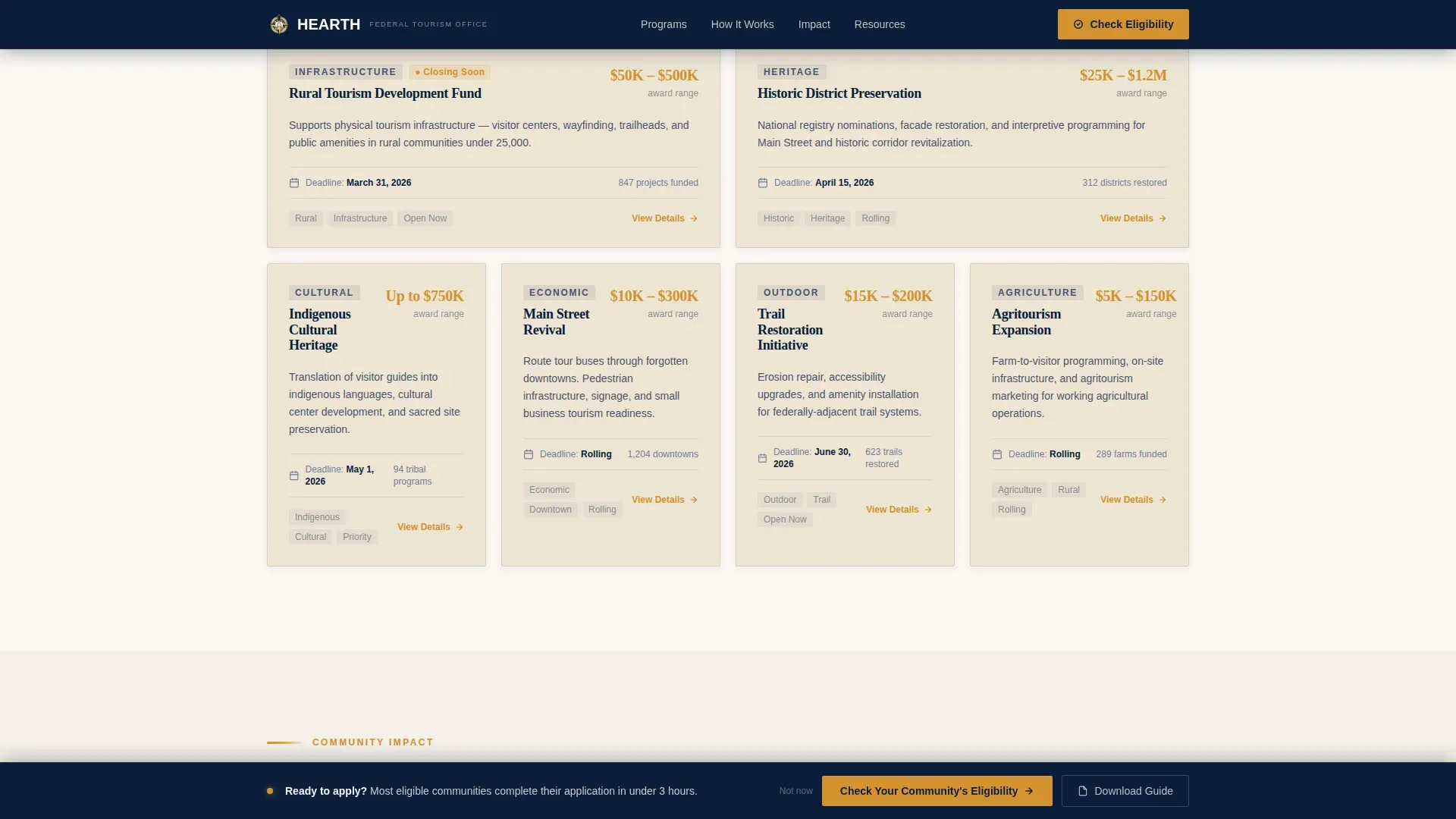
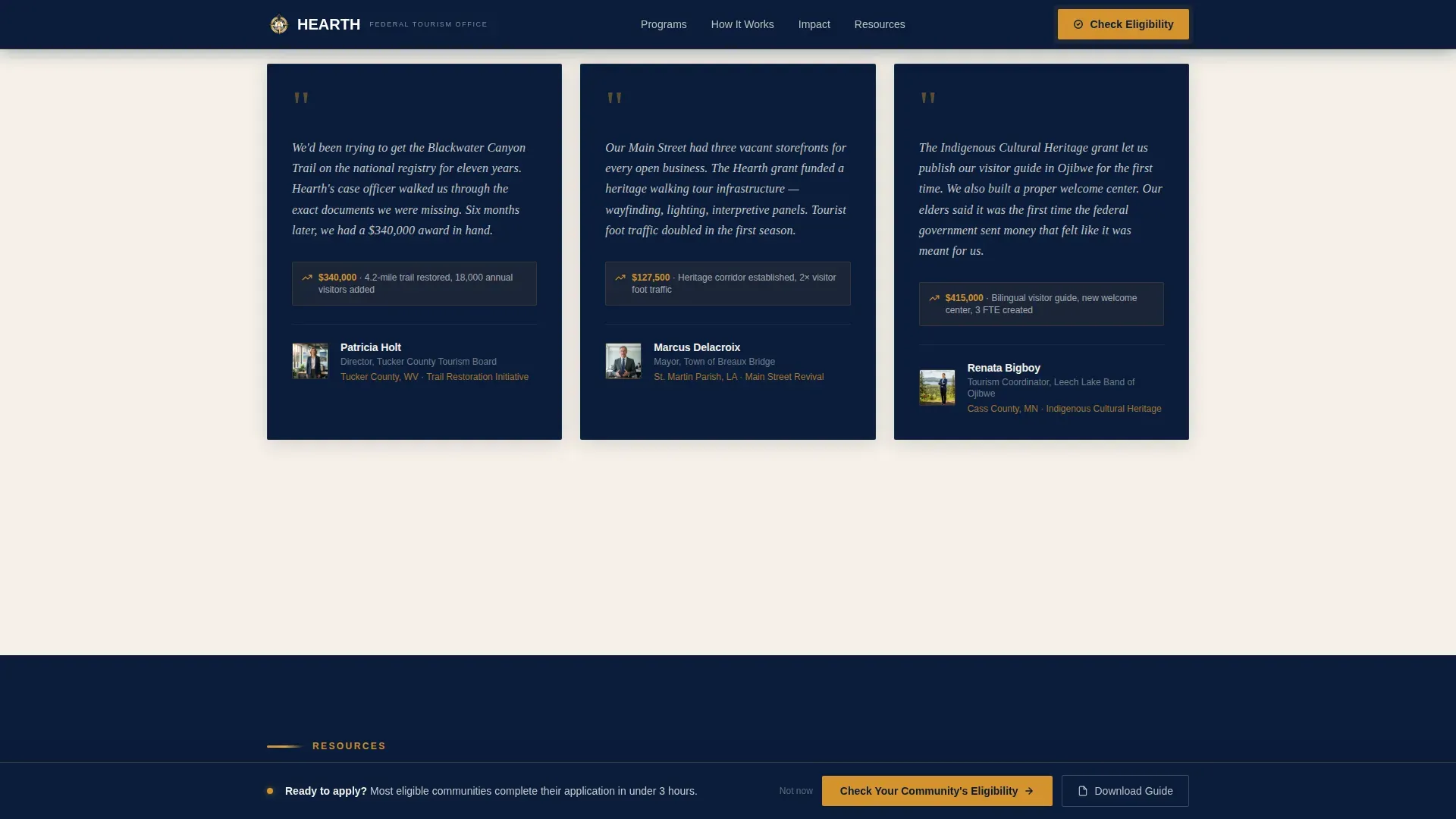
- A program directory bento grid, a social proof section with named community testimonials, and a sticky dual call-to-action bar with a primary eligibility check button and a secondary PDF download path
Feature list
This template is developed around high-interactivity components and a clear visual hierarchy. Each feature below is grounded in the prompt brief and serves a specific role in the funding communication flow.
Animated Stats-Wall Header
Three large counters animate upward on page load using smooth transitions. The figures cover total funds distributed, total projects funded, and counties served across all fifty states. No photography or hero image is needed. The data itself creates immediate evidence of program scale and builds trust before a single paragraph is read. A single line of warm parchment text below the counters reads: "Your community could be next," connecting the agency's record directly to the visitor's hope.
Five-Phase Funding Journey Cards
The modular card grid breaks the federal application process into five sequential phases. Each card represents one step: Check Eligibility, Choose Your Program, Gather Documents, Submit Application, and Track Your Status. On click, each card flips or expands to reveal specifics such as required population thresholds, document checklists, and average approval timelines. This design removes the sense that federal funding is impenetrable and gives visitors a clear plan to follow from first visit to application submitted.
Program Directory with Grant Details
A bento-style grid displays active funding programs with amounts, deadlines, and brief descriptions. Visitors can scan available grants at a glance and identify which programs fit their proposed project and community profile. The grid is built to support multiple program types, including cultural tourism grants, route-based tourism development funds, and tribal initiative support programs aligned with legislation such as the Native American Tourism and Improving Visitor Experience Act (NATIVE Act).
Social Proof and Community Impact Section
Named testimonials from funded communities, each referencing a real county and state, address one of the hardest trust challenges in government services: proving the money actually reaches people. Each testimonial notes the funded project type and outcome, building credibility through evidence rather than assertion. When visitors see that a specific county received funds for trail restoration or that a city used grants to translate visitor guides, the program feels real and the results feel achievable.
Sticky Dual Call-to-Action Bar
A warm amber sticky bar appears after the third card row and persists as the visitor scrolls. The primary button reads "Check Your Community's Eligibility" and links to the full application portal on a dot-gov domain. A secondary link, "Download the Program Guide (PDF)," captures visitors who want to bring something tangible to their next town council meeting before they commit to a full application. Both paths serve different visitor readiness levels and together increase overall conversion across the page.
Navy Authority Color and Typography System
The design system uses deep navy (#0B1D3A) for headers and the persistent navigation bar, warm parchment (#F5F0E8) for the page background, slate (#4A5568) for all body text, and warm amber (#D4922E) exclusively for calls to action and progress indicators. Cabinet Grotesk and Fraunces handle display type, while DM Sans covers body copy. The combination reads like a brass plaque on limestone: authoritative without being cold, permanent without being intimidating.
Page sections overview
| Section | Purpose |
|---|---|
| Stats Wall Header | Animated counters establish funding scale and credibility on load |
| Eligibility Checker Cards | Five-phase card grid guides visitors through the funding journey step by step |
| Program Directory Grid | Bento layout displays active grants with amounts, scopes, and deadlines |
| Social Proof Impact | Named community testimonials with county, state, and funded project outcomes |
| Sticky call to action Bar | Dual conversion path with eligibility check button and PDF guide download |
| Footer Row | Single linear footer row with navigation links, key contacts, and agency address |
Design & branding system
The visual identity follows a Community Hearth theme built on a Navy Authority color system. The palette is designed to feel like a permanent government document, not a corporate marketing page. It earns authority without sacrificing warmth.
- Deep navy (#0B1D3A) anchors the header and persistent navigation bar; warm parchment (#F5F0E8) softens the background so the page breathes rather than interrogates; slate (#4A5568) carries body text in a tone that reads like a trusted document
- Warm amber (#D4922E) is used exclusively for calls to action and progress indicators, acting as the single visual flame that draws the eye across every section of the page
- Cabinet Grotesk and Fraunces handle all display and heading type in a heavy condensed style, while DM Sans keeps body paragraphs clean, legible, and professional across desktop and mobile
Mobile & speed optimization
The template is built desktop-first to serve government directors and officials who typically complete form-heavy tasks on larger screens. At the same time, it includes a solid mobile fallback so that rural residents and community members accessing the page from a phone can still navigate the full funding journey without friction.
- Counter animations use requestAnimationFrame for smooth, performant load behavior, keeping the stats wall visually impactful without slowing the initial paint
- Card flip and expand interactions are designed to work cleanly on touch screens, so visitors on mobile devices can still access each phase's checklist and timeline details
- The sticky call-to-action bar reflows for smaller viewports, ensuring the eligibility check button and PDF download link remain accessible and clearly tappable at every scroll position
How this template helps you convert
Every design decision on this page is oriented toward one outcome: moving a hesitant visitor from "I heard there's federal money" to "I just submitted my request." The layout earns that click before it asks for it.
- The stats wall leads with impact data rather than introductory copy, so visitors understand the program's reach within the first three seconds and trust the agency enough to keep reading and explore available grants
- The five-phase card grid creates a sense of progress and completion before any form is filled out, so by the time a visitor reaches the sticky call-to-action bar, they have already mentally walked through the process and feel ready to participate
- The secondary PDF download path ensures that visitors who are not yet ready to submit still leave with a resource they can use to plan their proposed project and return when their community is ready to apply
Other information about this template
This template is designed for any federal or federally affiliated tourism agency that needs to promote economic development through structured, community-centered grant communication. It is well suited to programs that address cultural tourism, route-based tourism, and tribal tourism development at the national level.
- The template supports communication for programs aligned with the Tribal Tourism Grant Program (TTGP), which provides funding to help a tribe or tribal members plan, develop, and manage tourism infrastructure; tribes can also use TTGP grants to obtain technical assistance for feasibility studies or to develop tourism business plans under the NATIVE Act framework
- Funding initiatives covered by this template can address key areas such as promoting tourism-related activities, workforce development, infrastructure improvements, and marketing efforts that promote economic development across underserved regions
- The page structure is suited to programs where eligible applicants include state and local governments as well as non-profit organizations; each proposed project must typically demonstrate how it will enhance tourism and address community needs such as arts and heritage preservation, recreation development, or cultural tourism programming
- Community Project Funding requests are often subject to compliance with state law and must be submitted through a congressional office's designated process; each office can submit up to 20 such requests per fiscal year, so timing the application submitted date within the correct window matters
- The template can address programs that carry a matching requirement, where the applicant must provide a share of the project budget alongside the federal contribution; eligibility criteria, matching requirement details, and selection process steps can all be built into the expandable card modules
- The design pattern is also relevant for locally administered grant programs, such as city-level tourism committees that review applications funded by Hotel/Motel tax revenues; whether the scope covers a single city neighborhood or an entire rural county, the step-by-step card structure keeps the review process transparent
- Route-based tourism content fits naturally into the program directory grid; a well-developed byway can generate between $250,000 and $450,000 per mile per year in visitor spending, making route-based projects a strong candidate for funding requests that need to demonstrate economic return
- When the arts and tourism communities work together, they can highlight the unique character of a place and harness market forces to educate and entertain visitors; this template creates space to communicate those stories through the social proof section
- Cultural tourism programs serve as a catalyst for new audiences and dollars, helping organizations grow stronger and improving quality of life for local residents; the Hearth federal community tourism funding landing page template is built to communicate that mission clearly and drive real action
- Key contacts for agency staff or regional program officers can be surfaced in the footer row, giving every visitor a named person to reach out to if their county or city situation requires direct assistance
- Washington-based agencies and regional offices alike can adapt the template for their specific program scope; the modular structure means sections can be reordered or expanded without breaking the overall design system
- Final report requirements, application timelines, and evidence of community impact can all be addressed within the card grid and program directory, giving applicants a complete picture of what completion of the funding cycle looks like from request to final report
Theme
Community Hearth
Creative direction
Step-by-Step Guide
Color system
Navy Authority
Style
Card Grid (Modular)
Direction
Click-Through
Page Sections
Animated Stats-wall Header
Five-phase Funding Journey Card Grid
Program Directory Bento Grid
Named Community Social Proof Section
Sticky Dual Call-to-action Bar
Navy Authority Design System
Related questions
Who is this template designed for?
Can the card grid cover multiple funding programs at once?
Does the template support both primary and secondary conversion paths?
Is this template suitable for tribal tourism funding programs?
How does the social proof section build trust with applicants?