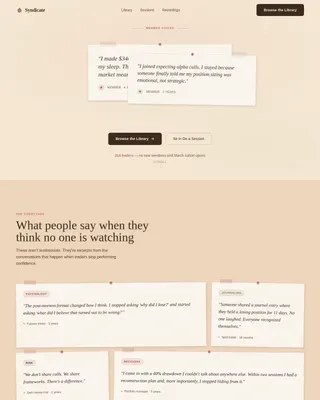
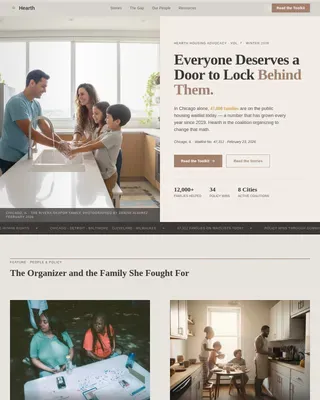
Therapist Peer Accountability Group Landing Page Template
Held is a single-column landing page template built for a therapist peer accountability group. It opens with an emotional community mosaic header, flows through a first-person origin story, and layers in practical frameworks, member testimonials, and burnout research. The design uses a warm teal and linen palette with editorial typography to feel professional, grounded, and genuinely human.
by Rocket studio
Quick summary
Held is a single-column landing page template for a therapist peer accountability group. It guides solo-practice counselors and newly licensed clinicians from emotional recognition to cohort sign-up. The design blends narrative-first storytelling with practical clinical frameworks, creating a scroll that feels less like a sales page and more like a session.
Who this template is for
This template is built for therapists and counselors who want to launch or promote a structured peer accountability community. It speaks directly to the professional isolation that many licensed clinicians experience after graduation or years of solo practice.
- Solo-practice counselors who feel cut off from meaningful collegial conversation
- Newly licensed therapists who lost their supervision cohort after graduation
- Seasoned clinicians ready to build honest professional relationships again
What problem this template solves
Many therapists spend their days holding space for others and have no equivalent support for themselves. The standard therapy community page either feels too clinical or too generic to earn real trust. This template solves that gap.
- It replaces vague community language with a specific, emotionally resonant narrative
- It gives visitors a structured framework for understanding peer accountability before asking for a commitment
- It moves people from passive reading to action by earning trust through genuine clinical insight first
What you get with this template
You get a complete single-column landing page flow with five content sections, a footer, and two clear conversion paths. Every section is designed to deepen emotional resonance before presenting a call to action.
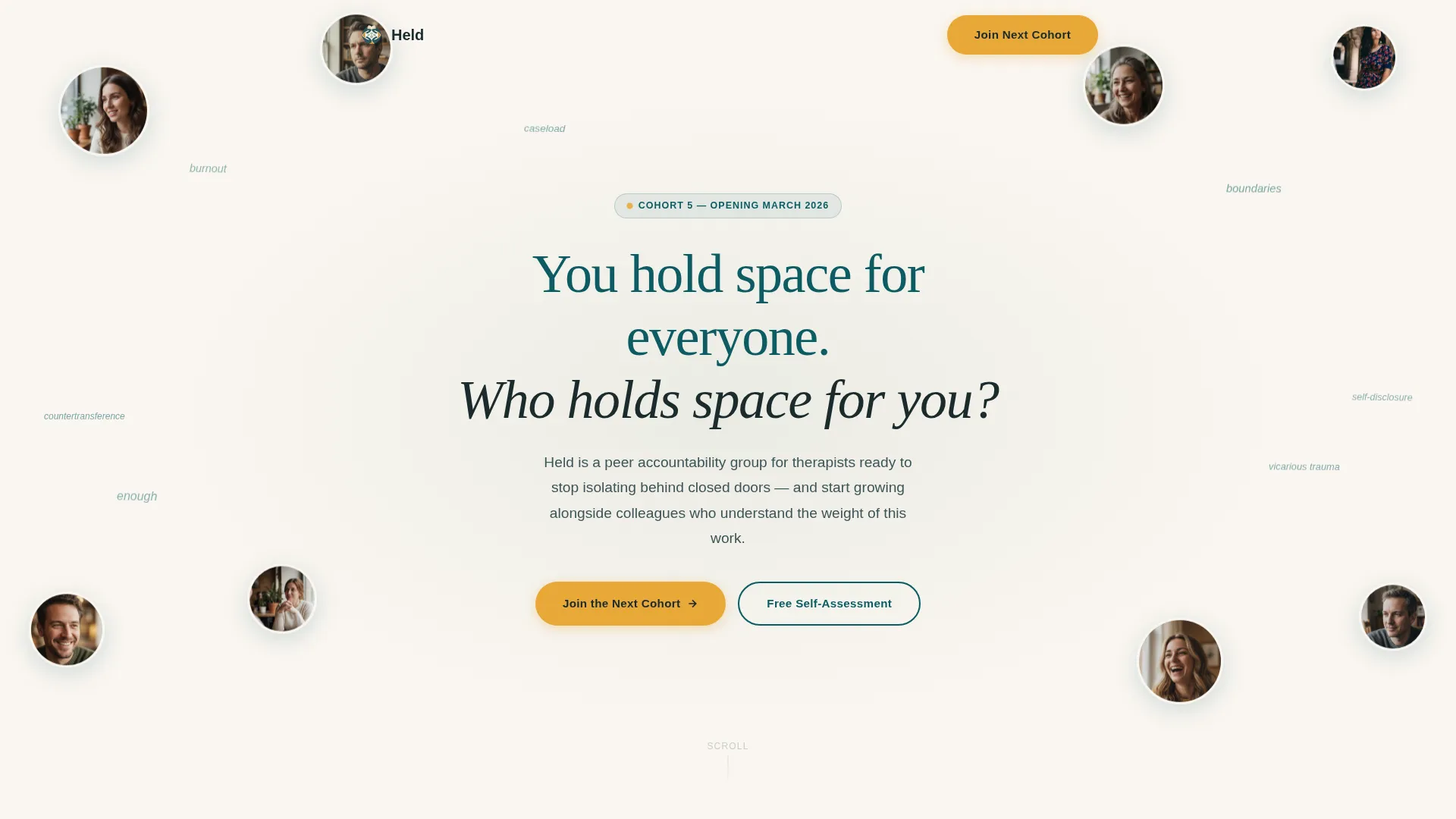
- A community mosaic hero with floating portrait clusters and animated handwritten words
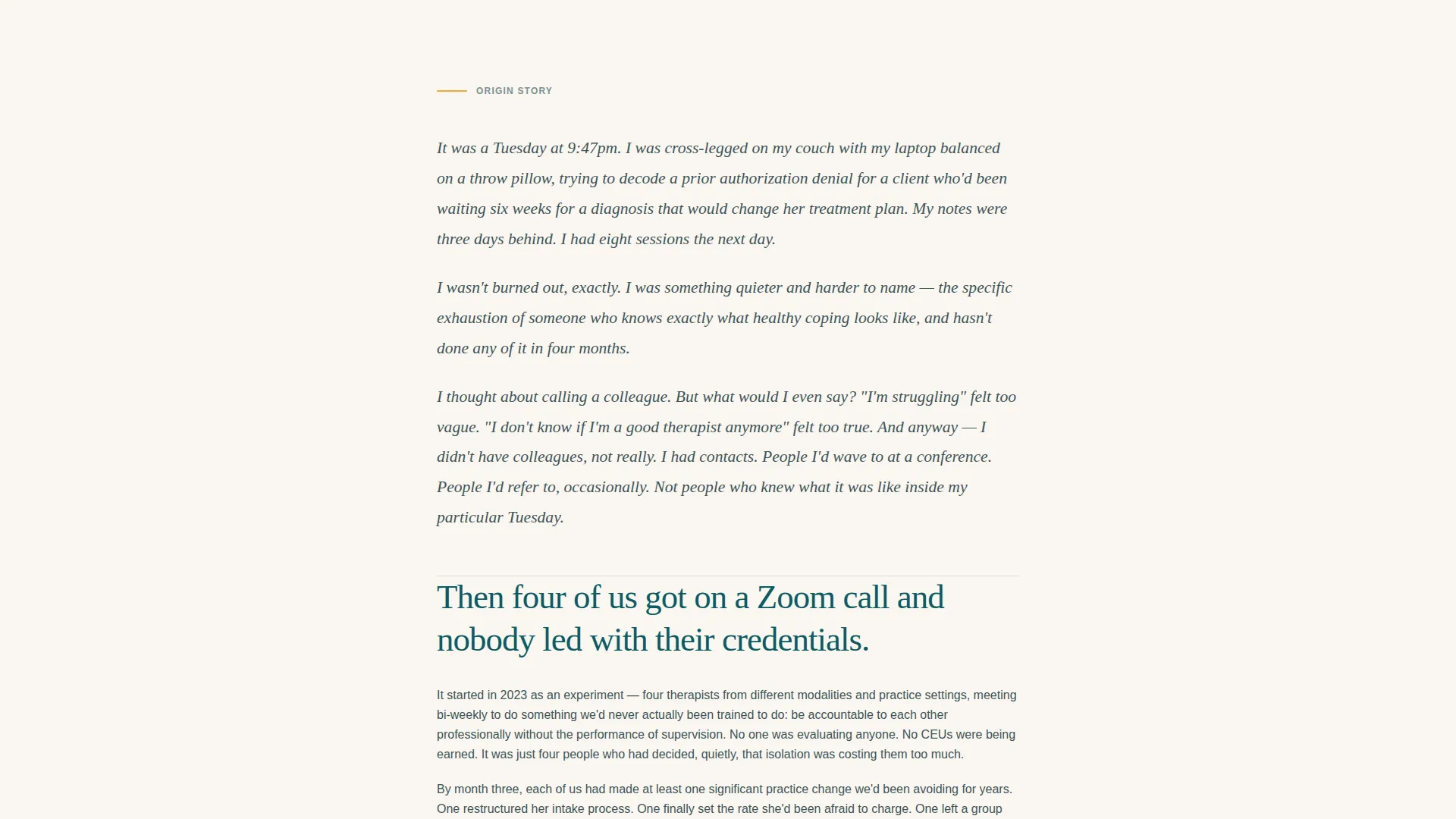
- An origin story section that shifts from first-person journal voice to shared community narrative
- A research and call-to-action section with burnout statistics, a primary cohort sign-up button, and a secondary PDF lead magnet form
Feature list
This template delivers a focused set of built-in components that serve the accountability group's narrative and conversion goals.
Community Mosaic Hero Section
The hero arranges softly overlapping circular portraits in an organic cluster with scroll-linked parallax movement. Small handwritten-style words float between the portraits. The headline materializes from the center of the mosaic, creating an immediate emotional entry point.
First-Person Origin Story Flow
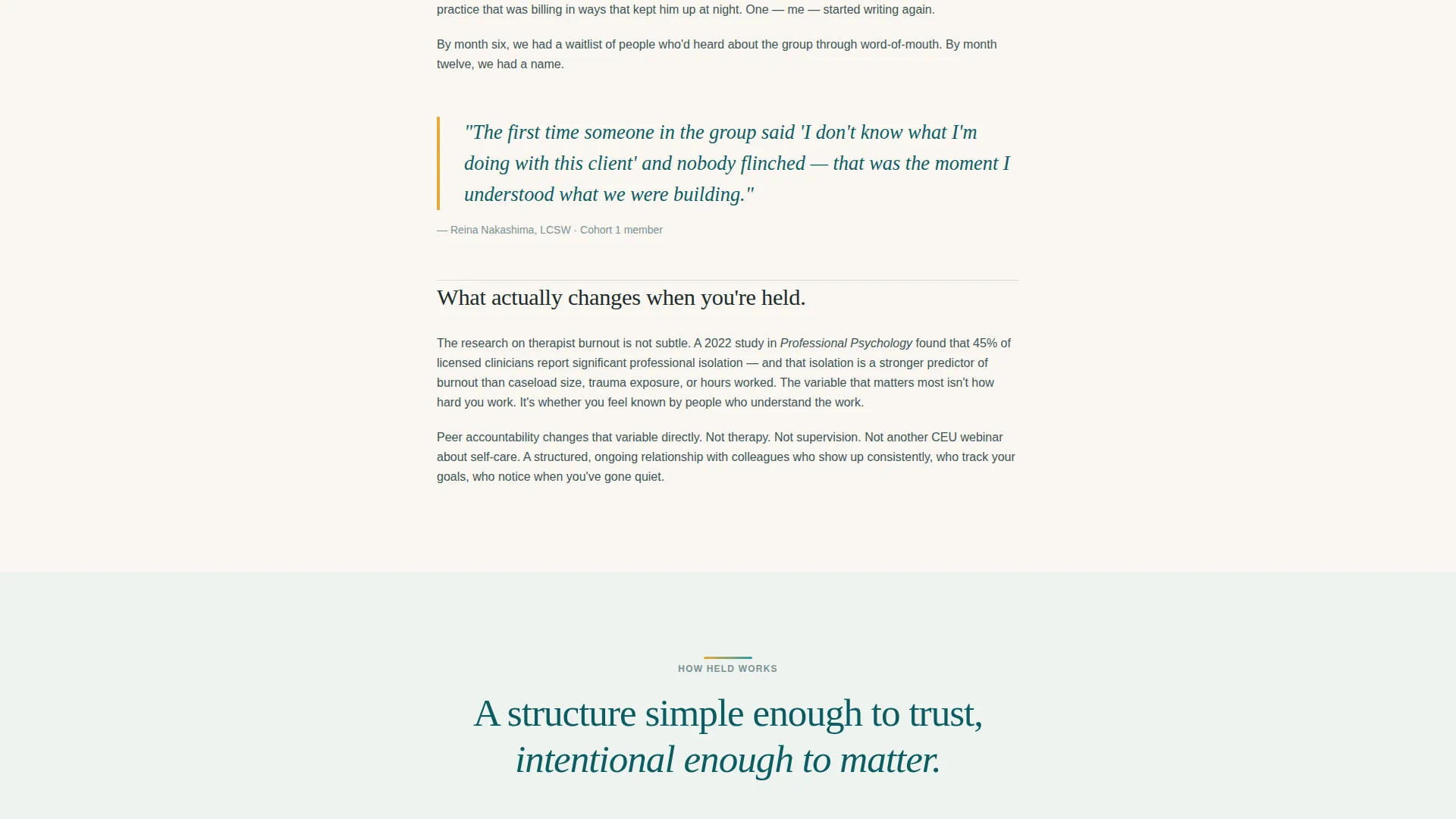
The scroll opens with a single therapist's internal monologue rendered in first-person italic text. The voice gradually shifts from "I" to "we" as the story moves from isolation to community formation, making the reader feel the transition rather than just read it.
Peer Accountability Framework Explainer
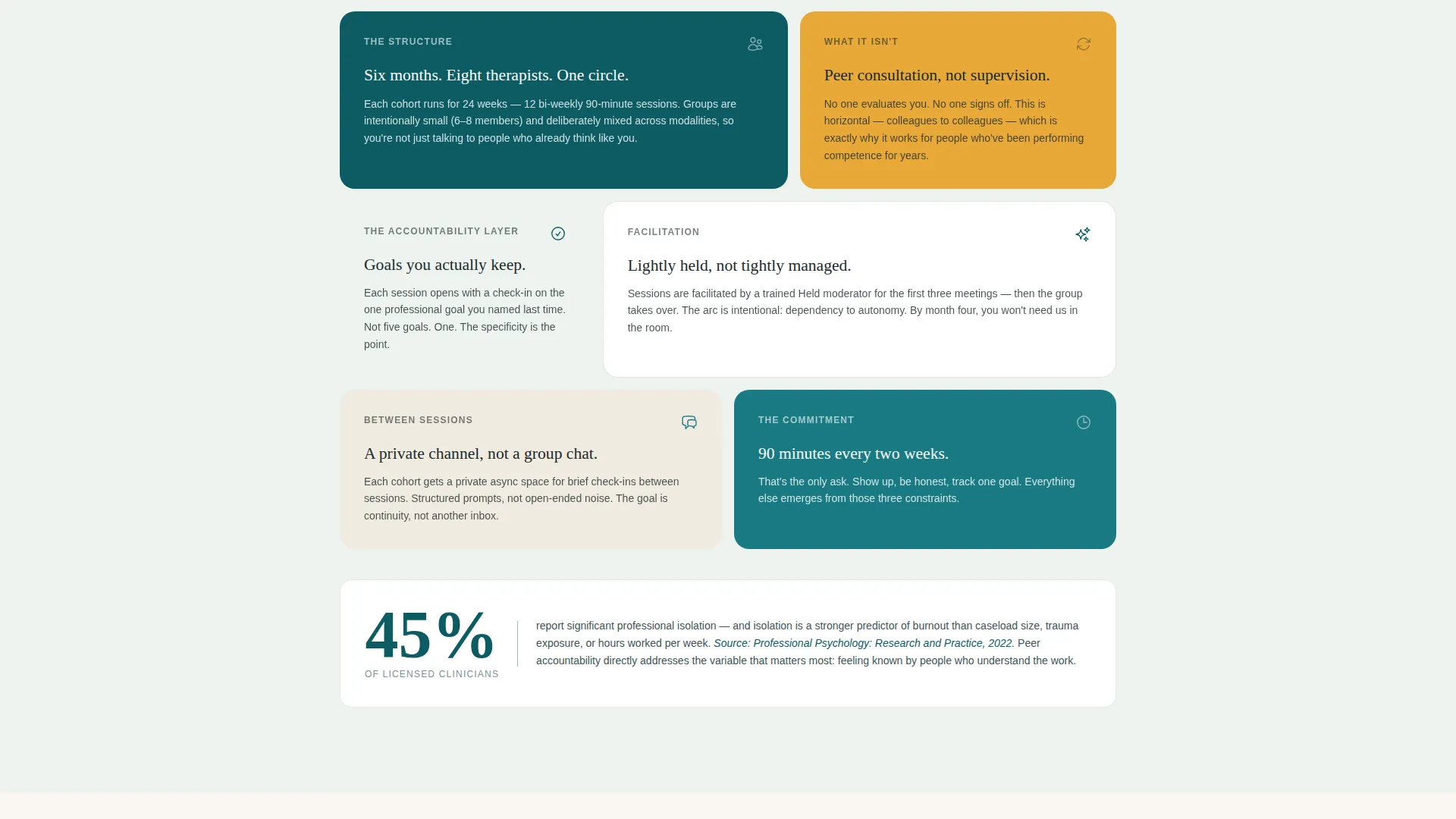
A bento-grid section breaks down what an accountability structure actually looks like in practice. It distinguishes peer consultation from clinical supervision and gives visitors enough context to trust the format before they commit.
Member Testimonials in Clinical Voice
Member voices are presented in a therapy-speak style that feels inward and honest rather than promotional. These testimonials mirror the language therapists use with clients, which builds credibility with a clinically trained audience.
Dual Conversion Path with Lead Magnet
The primary call to action, "Join the Next Cohort," appears after the emotional peak of the origin story and repeats at the bottom of the page. A secondary path offers a free downloadable PDF titled "The Therapist Loneliness Inventory: A Self-Assessment," gated behind a first-name and email field.
Scroll-Linked Animations and Stagger Reveals
Section content reveals on scroll using stagger animations and intersection-based triggers. Portrait hover effects and floating word animations add interactivity without overwhelming the calm, editorial tone of the page.
Page sections overview
| Section | Purpose |
|---|---|
| Community Mosaic Hero | Opens with floating portraits and the central headline to create immediate emotional recognition |
| Origin Story Narrative | Shifts from first-person journal voice to shared "we" story to build trust through lived experience |
| What Held Actually Is | Explains the peer accountability structure using a bento-grid framework layout |
| Member Voices | Delivers intimate testimonials written in clinical, inward language to reinforce credibility |
| Research and Call to Action | Presents burnout statistics, the primary cohort sign-up button, and the PDF lead magnet form |
| Footer | Single-row linear footer with essential links and contact information |
Design & branding system
The visual identity follows an Educational Guide theme built around the Teal Catalyst color system. The palette is designed to feel like a well-loved therapy office: professional but warm, grounded but never sterile.
- Deep teal (#0D5C63) as the primary brand color, warm linen white (#FAF6F1) as the background, and soft sage (#A3B9AA) for alternating section backgrounds
- Catalyst amber (#E8A838) used exclusively for buttons and highlighted pull-quotes, never as a decorative fill
- DM Sans for body text and Fraunces for editorial headlines, pairing functional readability with a warm, literary feel
Mobile & speed optimization
The template is built desktop-first, reflecting the reality that therapists often review professional resources during evening hours on a desktop or laptop. Mobile adaptation is handled carefully so the experience holds across devices.
- Scroll-linked parallax and stagger reveal animations use CSS-preferred approaches with Intersection Observer for controlled performance
- The community mosaic portrait grid and floating word animations adapt gracefully for smaller screens without losing their emotional impact
How this template helps you convert
The page earns trust before it asks for anything. Every scroll step is designed to move a skeptical, analytically trained audience closer to action.
- The origin story creates emotional recognition early, so visitors feel understood before they encounter any offer or call to action.
- The framework explainer and burnout research give clinically trained readers the intellectual credibility they need to trust the community structure.
- The dual conversion path captures both high-intent visitors ready to join a cohort and lower-intent visitors who want to self-assess first, converting both groups at different points in their decision process.
Other information about this template
This template sits within the Community and Nonprofit category, specifically built for the therapists and counselors accountability group niche. It is structured as a Content and Resource destination, meaning the page gives genuine value on every scroll before presenting a conversion moment.
- The PDF lead magnet, "The Therapist Loneliness Inventory," is included as a secondary conversion path and can be connected to an email collection form
- The template style is Single Column Flow, keeping the reading experience linear and focused without sidebar distractions
- The footer uses a Pattern 1 Linear Single-Row layout, keeping the close of the page clean and uncluttered
- Localization is set for a United States English-speaking audience with USD pricing in mind
Theme
Educational Guide
Creative direction
Origin Story
Color system
Teal Catalyst
Style
Single Column Flow
Direction
Content/Resource
Page Sections
Community Mosaic Hero with Floating Portraits
First-person Origin Story Narrative
Peer Accountability Framework Explainer
Clinical-voice Member Testimonials
Dual Conversion Path with PDF Lead Magnet
Scroll-linked Animations and Stagger Reveals
Related questions
Who is this landing page template designed for?
What are the two conversion paths included in this template?
What makes this template different from a generic community page template?
Can I customize the portrait mosaic and testimonials with my own content?
Is this template suitable for a group practice, or only for solo practitioners?