Videography & Film Portfolio Professional Website Template
Helms is a bold brutalist landing page designed for commercial directors who win work through craft, not churn. Built around a cinematic case study narrative, it guides agency producers and brand creative directors through three immersive campaign stories, each framed like a monograph page, before delivering a single, earned call to action.
by Rocket studio
Quick summary
Helms is a storybook landing page designed for premium commercial directors. It presents work through a dark, cinematic case study format: each campaign unfolds across four panels, moving from brief to final frame. The page earns every click before it asks for one, letting the film speak first and converting through range and production credibility.
Who this template is for
This template was created for directors who live at the intersection of film and brand production. It speaks directly to the people on both sides of the treatment table.
- Agency producers who need to attach a director name before a deadline
- Brand creative directors evaluating range, crew command, and visual control
- Post-house executive producers who want a shareable, self-contained reel presence
What problem this template solves
Most director portfolios feel like archive pages. They list commercials without context, show frames without story, and ask for the click before the work has landed. Agencies wanted something that felt like a pitch, not a resume.
- No clear narrative between projects leaves visitors unconvinced
- Generic portfolio layouts strip the visual weight from cinematic work
- Scattered calls to action dilute the moment when the viewer is ready to act
What you get with this template
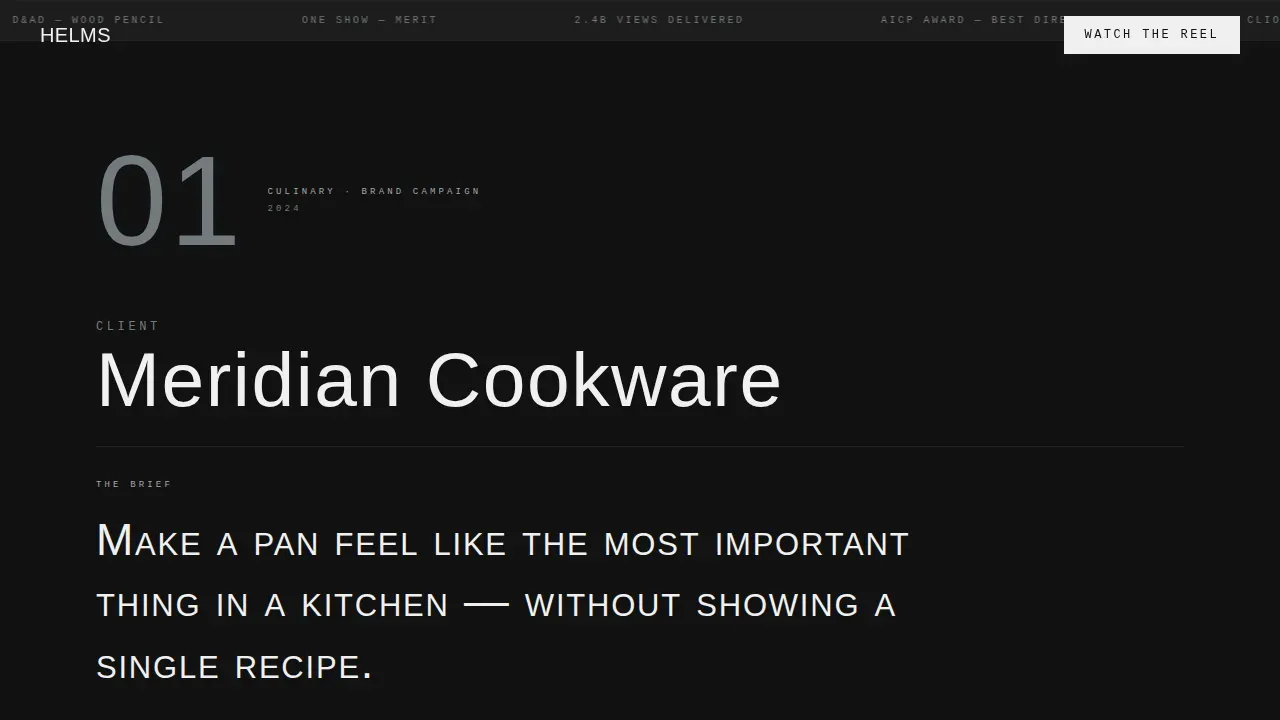
This landing page is designed around three full case studies, each built as a four-panel sequence. Every panel has a job: distill the brief, show the hero frame, share behind-the-scenes stills and the director's treatment excerpt, then autoplay the spot muted. After each case study, a stark metrics line closes the chapter before the next one starts.
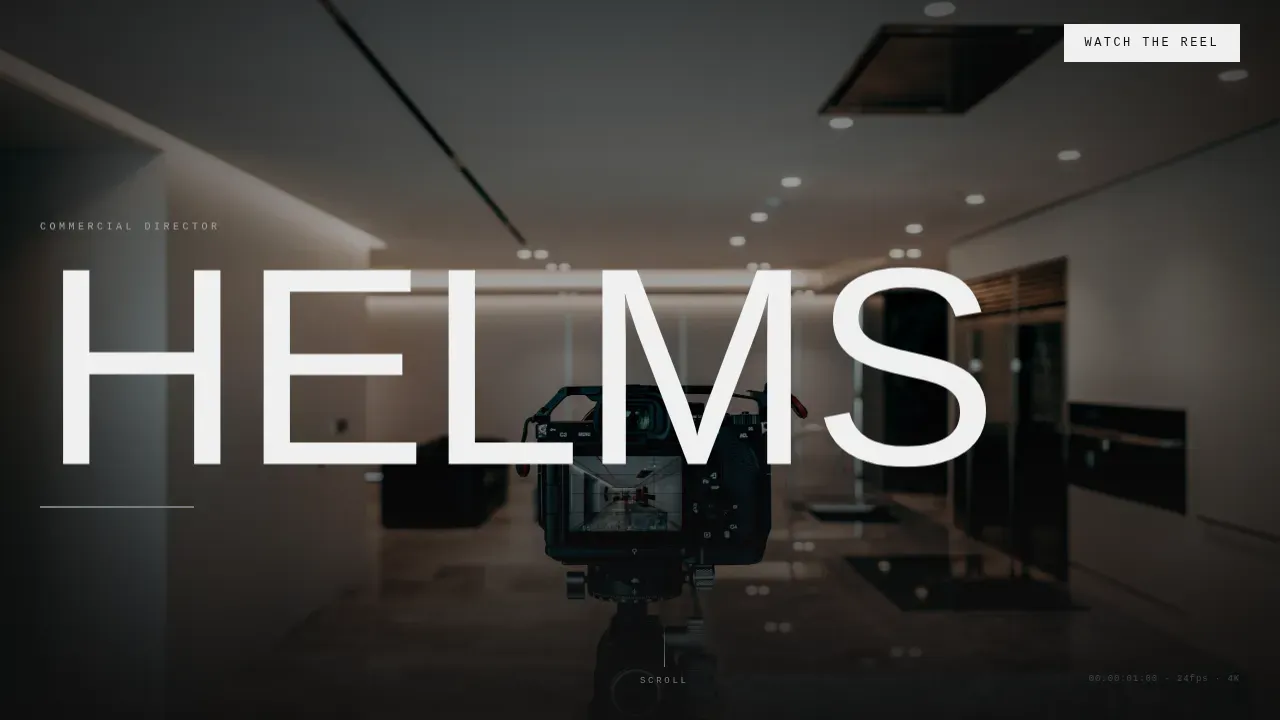
- A full-viewport hero with oversized condensed type welded over a cinematic still
- Three four-panel case studies with autoplay video, treatment excerpts, and metrics lines
- A persistent floating "Watch the Reel" call to action and a secondary "Request Treatment Availability" link
Feature list
This template includes focused, production-specific components built for high-stakes director presentations.
Cinematic Hero Frame
A full-viewport still frame opens the page, desaturated ten percent inside a soot-black shell. The director's name is set in ultra-bold condensed type directly over the image. No tagline, no reel button. Just name, frame, and tension.
Four-Panel Case Study Structure
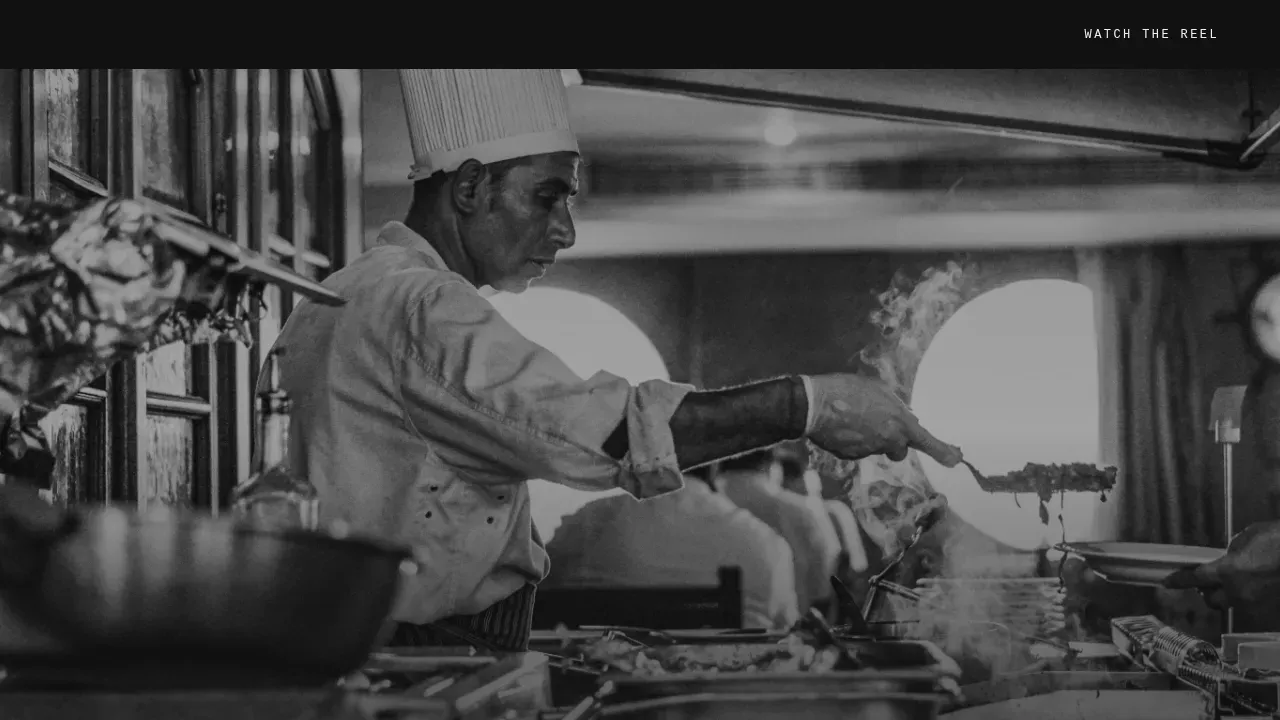
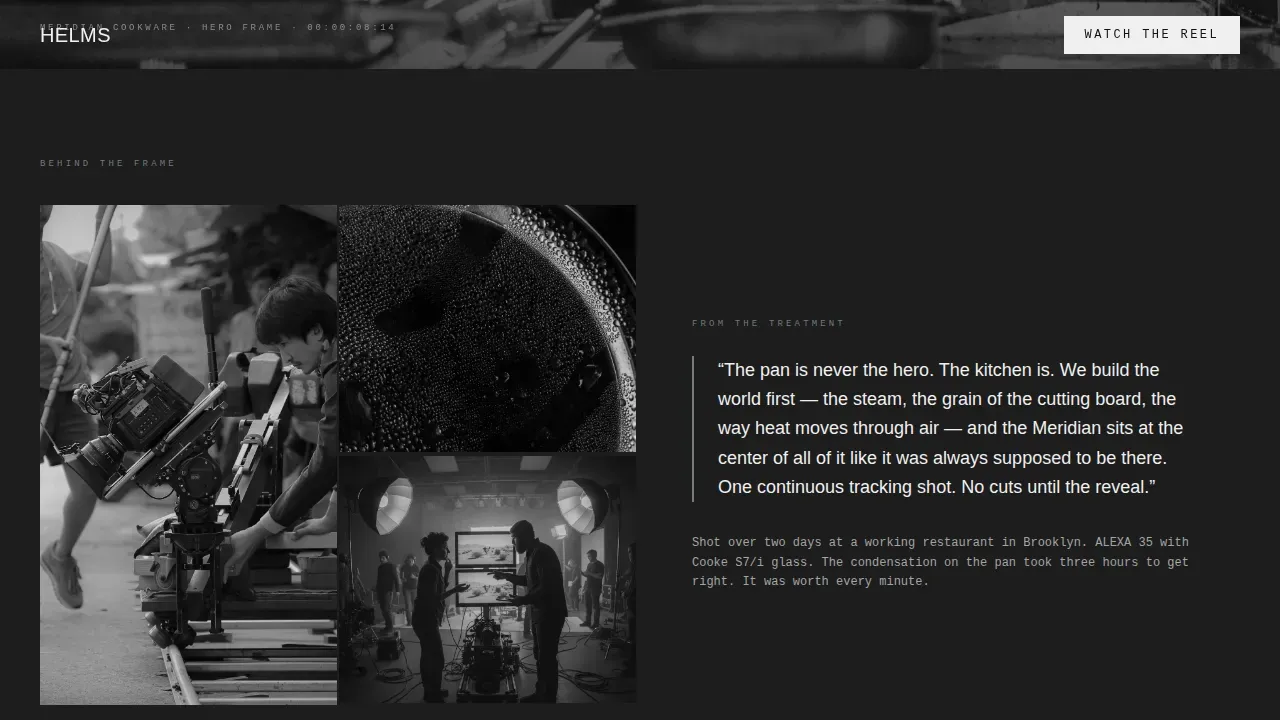
Each campaign occupies four full-page panels. The sequence moves through brief, hero frame, behind-the-scenes stills with the director's treatment excerpt in their own voice, and muted autoplay video. Designed to feel like being presented to, not browsed.
Persistent Floating Call to Action
A minimal "Watch the Reel" button floats in the top right across the entire landing page. It inverts from black-on-white to white-on-black as backgrounds shift, maintaining clarity across dark and light panels.
Scroll-Linked Reveals and Motion
Scroll-triggered animations, a noise overlay, grayscale hover states, and GPU-accelerated transforms create a grading-suite atmosphere. Motion is added purposefully so every visual transition feels like a cut, not a reload.
Stark Metrics and Hard Dividers
Each project closes with a single-line metrics display covering views, awards, or sales lift. A hard black divider resets the eye. Social proof is built through bold production results, not logos.
Minimalist Superhuman Footer
The footer follows a minimal, single-row pattern. It keeps focus on outbound intent: reel or representation meeting, nothing else.
Page sections overview
| Section | Purpose |
|---|---|
| Full-Viewport Hero | Name over cinematic still sets confrontational tone |
| Case Study One | Cookware campaign in four sequential panels |
| Case Study Two | Automotive campaign in four sequential panels |
| Case Study Three | Fragrance campaign in four sequential panels |
| Treatment Availability call to action | Single-line secondary conversion moment |
| Minimal Footer | Closes page with zero distraction |
Design & branding system
The visual identity follows a bold brutalist aesthetic, the feeling of a dark grading suite where color exists only inside the work. Typography pairs Bebas Neue for condensed display headers with DM Sans for clean body reading.
- Monochrome Steel palette: soot black (#111111), mill-finish steel (#71797E), poured concrete mid-gray (#A3A3A3), and searing white (#F0F0F0) for type and hover states
- Bold, intentional headers complement the visual weight of each film frame
- Dramatic typography maintains clarity as backgrounds shift between black panels and full-bleed stills
Mobile & speed optimization
The template is built desktop-first for agency producers on workstations, with responsive layouts that scale to mobile. Lazy-loading is used across image and video assets to keep the page fast despite heavy production visuals.
- GPU-accelerated transforms keep scroll animations smooth across large film frames
- Lazy-loaded images and compressed video assets reduce load time on video-heavy sections
- Mobile-responsive layout ensures the cinematic structure holds at smaller screen sizes
How this template helps you convert
The page earns the click by proving craft before asking for anything. Conversion is structured around progressive trust, not pressure.
- The hero frame and oversized type create immediate visual authority before any copy appears
- Three case studies build cumulative proof of range across commercials, each closing with a concrete metrics line
- The persistent call to action captures producers who are ready early, while "Request Treatment Availability" converts those who reach the end of the work
Other information about this template
This template is perfect for commercial filmmakers who started in film and moved into brand production, as directors transitioning from film to commercials bring a unique perspective agencies actively look for. The case study narrative format aligns with emerging trends in contextual storytelling, similar to the approach seen in work like Brady Corbet's campaign "The Contextualist." Creative collaboration between agencies and directors is essential for impactful content, and this page is built to start that conversation.
Builders wanted a no-code path to a production-ready director page. This template was designed for use on AI-powered no-code platforms where natural language prompts generate structured layouts without requiring code knowledge. No-code platforms help users build visually appealing pages quickly and efficiently, and this template fits that workflow.
When preparing treatments and visual references, tools like Frame Set offer an industry-leading collection of reference frames for commercials, shot lists, and storyboards. Frame Set lets users filter by color, saturation, and number of people, and its similarity search helps find thousands of similar frames for mood boards. Users can also search by director, producer, or set designer, and create folders of frames for pitches and lookbooks. These tools pair well with the director's treatment workflow this landing page is designed to support.
- The Helms cinematic commercial director landing page template is free to customize inside supported no-code platforms
- Jun-released template updates and added components can be applied without rebuilding from scratch
- Sign up on the platform to get started and connect your reel or booking link directly
Theme
Bold Brutalist
Creative direction
Case Study Narrative
Color system
Monochrome Steel
Style
Storybook/Full-Page
Direction
Click-Through
Page Sections
Cinematic Hero Frame with Bold Type
Four-panel Case Study Narrative
Persistent Floating Call to Action Button
Scroll-linked Motion and Noise Overlay
Metrics Lines and Hard Dividers
Related questions
Can I use this template without writing code?
How do I add my own case studies and director's treatment excerpts?
Is this template suitable for commercials across different product categories?
What call-to-action options does the template include?
Can filmmakers in different niches use this template?