Liver Disease Care Professional Website Template
Hepatic is a liver disease support group landing page built for patient communities navigating cirrhosis, fatty liver disease, and hepatitis. It pairs a clean clinical design with structured comparison tables, expert credential cards, and a sequential three-question lead generation form. The result is an organized, medically literate page that earns visitor trust before asking for contact.
by Rocket studio
Quick summary
Hepatic is a single-page template for liver disease support groups. It opens with a first-name member testimonial card, flows through two structured comparison tables with expert commentary, and closes with a qualifying lead generation form. The design feels like a well-organized clinical document: clean white space, teal accents, and purposeful typography that respects a reader who is already carrying a heavy diagnosis.
Who this template is for
This template is built for patient community organizers, nonprofit health advocates, and medical group coordinators who want to connect liver disease patients with the right peer support. It works equally well for groups serving newly diagnosed patients and those supporting advanced-stage care.
- Newly diagnosed patients learning to interpret ALT and AST lab values for the first time
- Long-term caregivers managing complex medication schedules on behalf of a spouse or family member
- Transplant candidates tracking their Model for End-Stage Liver Disease (MELD) score while waiting for evaluation
What problem this template solves
People newly diagnosed with conditions like nonalcoholic fatty liver disease (NAFLD), hepatitis B, hepatitis C, or cirrhosis often search for community support but land on chaotic forums with no structure. This template solves that by presenting a support group with the authority and clarity of a medical resource, not a message board.
- Visitors cannot easily tell the difference between casual chatrooms and organized, medically literate peer groups
- There is no clear path for a visitor to self-identify their diagnosis type and find the right support track
- Generic contact forms collect emails before the visitor feels understood, reducing trust and conversion
What you get with this template
You get a fully structured, single-page lead generation layout built specifically for a liver disease support community. Every section is designed with both medical credibility and emotional clarity in mind.
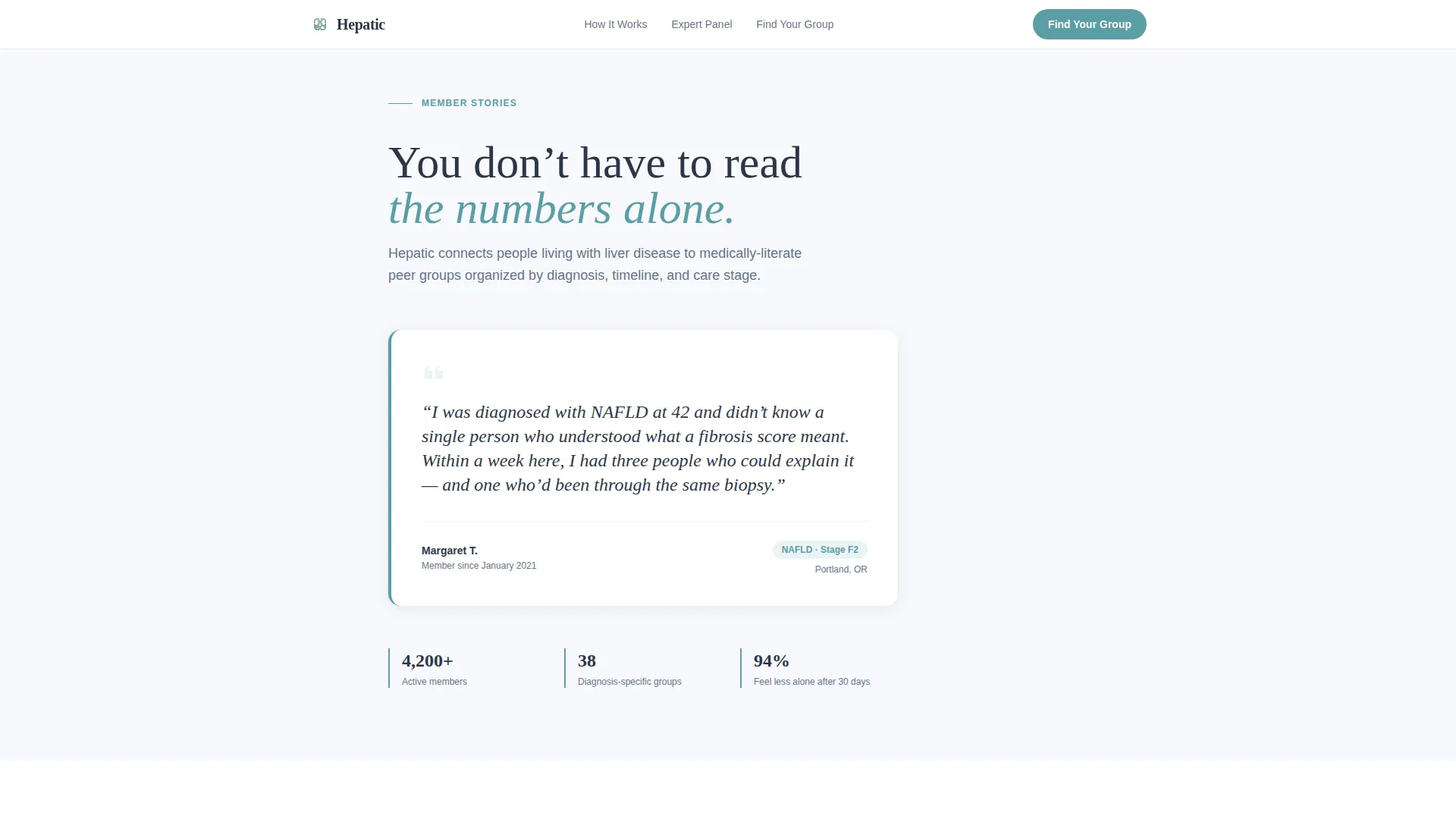
- A hero section featuring an oversized testimonial card with a teal left-border accent and no photography
- Two structured comparison tables with expert credential cards placed between them
- A sequential three-question qualifying form and a secondary PDF download call-to-action (call to action)
Feature list
This template delivers several purpose-built components for health-focused community pages.
Oversized Testimonial Hero Card
The page opens with a single, large testimonial card floating on a cloud white background. A first-name-only member quote anchors the header, supported by small typographic details including member-since date, condition stage, and city. A teal left-border and a subtle drop shadow give it clinical credibility without using any photography.
Structured Comparison Tables
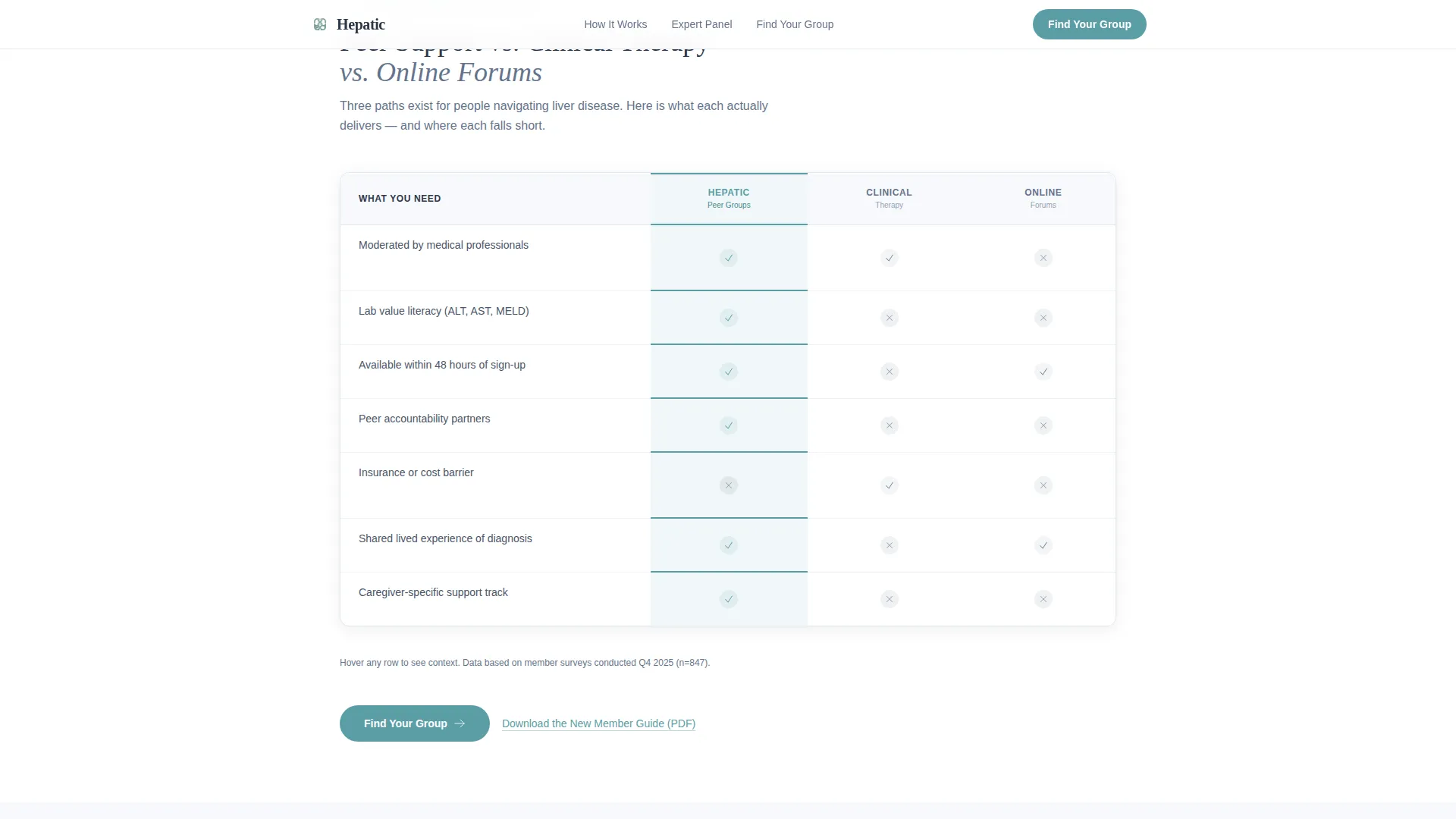
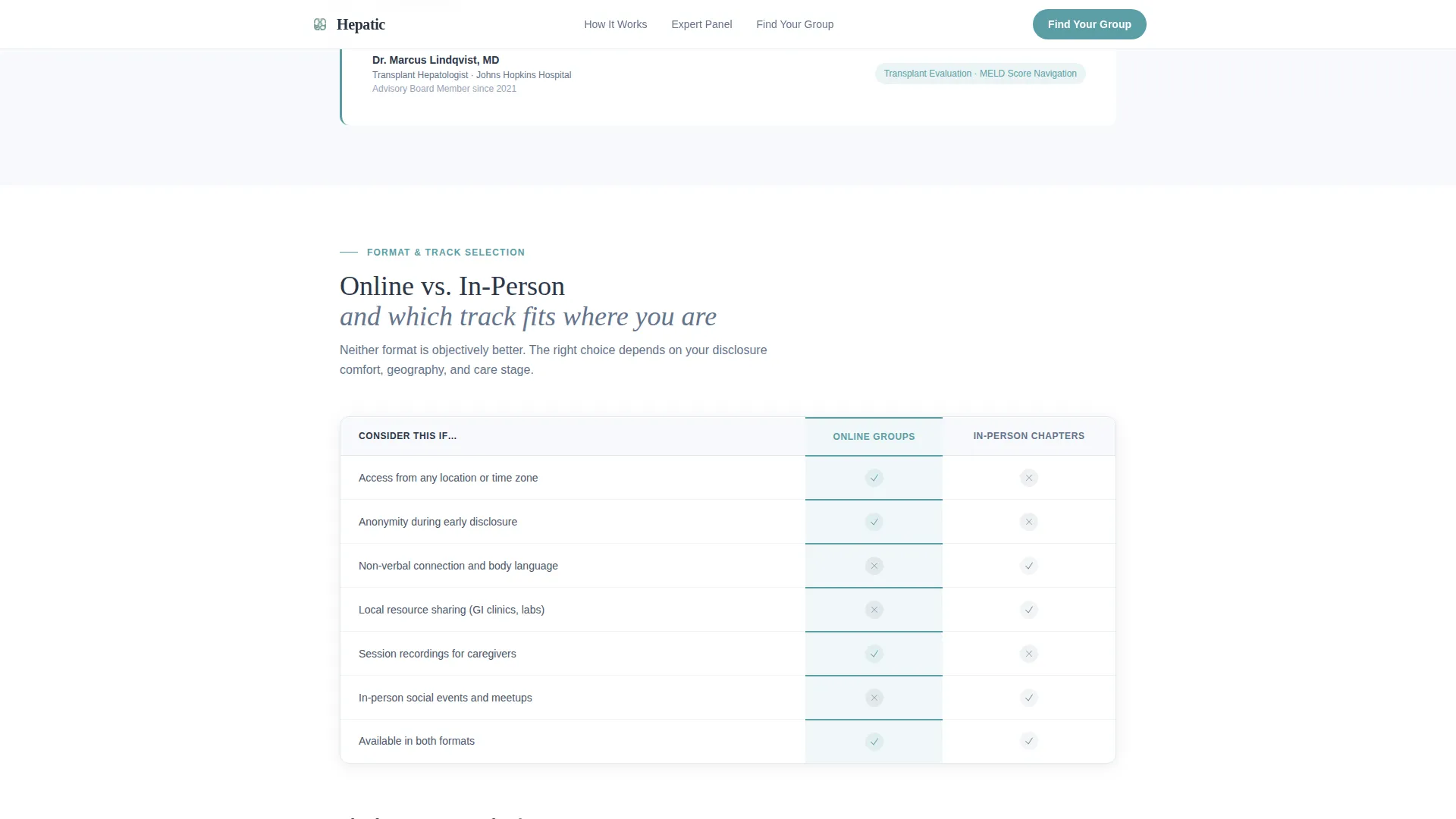
Two dedicated comparison table sections break down key support decisions side by side. The first compares peer group support against clinical therapy. The second compares online forums against in-person chapter membership, and newly diagnosed tracks against advanced management tracks. Hover highlights make the tables interactive and easy to scan.
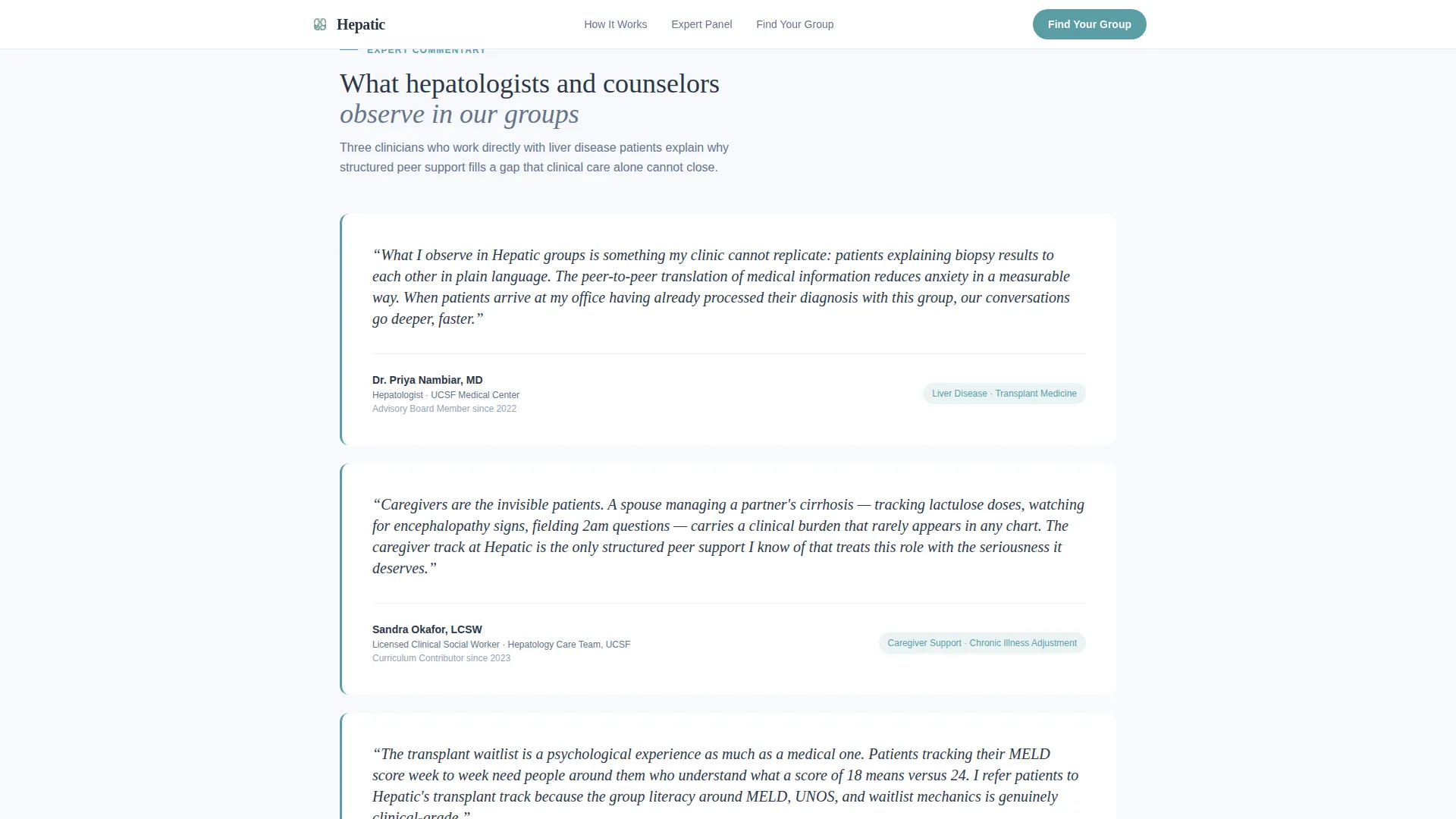
Expert Commentary Credential Cards
Between the two comparison tables, the template places hepatologist and licensed counselor commentary cards. Each panelist credential is displayed in the same clean card format used throughout the page, reinforcing that this community is medically literate and professionally contextualized.
Sequential Lead Generation Form
The qualifying form asks three questions in a deliberate order: diagnosis type via dropdown (NAFLD, hepatitis B, hepatitis C, cirrhosis, autoimmune, or other), time since diagnosis, and preferred format (online, in-person, or both). The email field appears last, after the visitor has already felt understood. Step transitions are included to keep the experience smooth.
Secondary PDF Download Path
Visitors who are not ready to join can access a secondary call to action to download a forty-page New Member Guide. The guide covers liver function basics, nutrition protocols, and question lists for gastroenterology appointments, capturing leads at an earlier stage of readiness.
Scroll-Triggered Fade-In Animation
The template uses subtle fade-in animations on scroll throughout the page. Card hover states and form step transitions add a layer of responsiveness without heavy JavaScript, keeping the experience clean and clinically appropriate.
Page sections overview
| Section | Purpose |
|---|---|
| Hero Testimonial Card | Opens with a member quote card to build immediate emotional trust |
| Comparison Table One | Contrasts peer group support with clinical therapy options |
| Find Your Group call to action | Primary call-to-action placed after the first comparison table |
| Expert Commentary Cards | Hepatologist and counselor credential cards add medical authority |
| Comparison Table Two | Compares online forums, in-person chapters, and patient tracks |
| Lead Generation Form | Sequential three-question form with email capture at the end |
| PDF Download call to action | Secondary path for visitors not yet ready to join the group |
| Footer | Single-row linear footer closing the page |
Design & branding system
The visual identity follows a Corporate Precision theme using the Cloud Canvas color system. The overall feeling is a freshly printed medical summary: no visual noise, no decorative elements, just information presented with authority and care.
- Cloud white (#F7F9FC) dominates all backgrounds with generous spacing; muted teal (#5B9EA6) marks interactive elements, comparison table highlights, and card border accents
- Calm slate (#64748B) carries secondary labels and supporting text; warm graphite (#2D3748) anchors all body paragraphs in quiet visual authority
- Typography pairs DM Sans for body text with Fraunces serif for display headings, creating a contrast that reads as both clinical and human
Mobile & speed optimization
The template is designed desktop-first for a medical and research audience, with full mobile responsiveness built in. The technical approach keeps the page light by relying on server-rendered static content and minimal JavaScript.
- Comparison tables and credential cards reflow cleanly for smaller screens without losing their structured layout
- The sequential form uses step transitions that work smoothly on both desktop and mobile touch interactions
How this template helps you convert
The page is built around a deliberate conversion strategy that earns trust before asking for anything.
- The testimonial hero card creates an immediate emotional connection, showing a real patient story before any form or call to action appears, which lowers the visitor's guard early in the scroll.
- The comparison tables present the group's value in a structured, side-by-side format that helps visitors self-identify their situation and understand why this community differs from a generic online forum.
- The sequential form qualifies the visitor through three natural questions before requesting their email, making the "Find Your Group" call to action feel like a recommendation rather than a data collection step.
Other information about this template
This template is part of a Health and Medical category collection focused on the Liver Disease Care subcategory. It is purpose-built for the liver disease support group niche and carries a high intersection match for that use case. A few additional details worth noting:
- The page style is Comparison Table, meaning the primary content structure relies on side-by-side data presentation rather than long-form copy blocks
- The header concept is a Testimonial Card, and the creative direction is Expert Panel, both of which drive the scroll rhythm from emotional trust to structured authority
- The lead generation direction means every section is sequenced to move the visitor toward the "Find Your Group" form or the PDF download, with no dead-end sections
- Animation level is low to medium, using scroll-triggered fade-ins and hover states that feel appropriate for a clinical audience without feeling distracting
- The footer follows a single-row linear pattern, keeping the page close cleanly without adding visual weight at the bottom
Theme
Corporate Precision
Creative direction
Expert Panel
Color system
Cloud Canvas
Style
Comparison Table
Direction
Lead Generation
Page Sections
Oversized Testimonial Hero Card
Structured Comparison Tables
Expert Commentary Credential Cards
Sequential Three-question Form
Secondary PDF Download Path
Scroll-triggered Fade-in Animations
Related questions
Who is this landing page template designed for?
Can I customize the comparison table content?
What does the sequential lead generation form include?
Is the New Member Guide PDF included with the template?
Does the template use any photography or stock images?