Liver Disease Care Education Website Template
Hepato is a sidebar companion landing page built for liver disease patient education. It translates fibrosis scores, enzyme panels, and MELD values into plain language for frightened patients and caregivers. An animated stats dashboard, scroll-linked sidebar guide, and inline four-step risk assessment work together to move a worried reader toward confident, informed next steps.
by Rocket studio
Quick summary
Hepato is a single-page sidebar companion for a liver disease patient education platform. It opens with an animated statistics dashboard, narrows progressively from population-level facts to personal risk factors, and closes with an inline quiz. The design is clinical but calm, built for patients reading lab results late at night and caregivers deciphering discharge paperwork at a kitchen table.
Who this template is for
This template serves anyone who needs clinical liver health information translated into clear, honest language. It is built for high-anxiety readers with low medical literacy who need to feel heard, not lectured.
- Newly diagnosed hepatitis or cirrhosis patients researching their lab results
- Caregivers and family members working through discharge paperwork
- Patients preparing questions before a specialist appointment
What problem this template solves
Medical reports are written for clinicians, not patients. A MELD score or a fibrosis index number sitting alone on a printout can send someone into a spiral of confusion and fear. This template closes that gap.
- Lab values like ALT, FIB-4, and MELD (Model for End-Stage Liver Disease) have no plain-language context online
- Patients often cannot tell which numbers signal urgency and which reflect normal variation
- Caregivers reading discharge papers need guidance, not jargon
What you get with this template
You get a fully structured, desktop-first landing page with a persistent sidebar companion, an animated hero dashboard, and a progressive inline assessment. Every section is pre-built and editable to match your platform's voice.
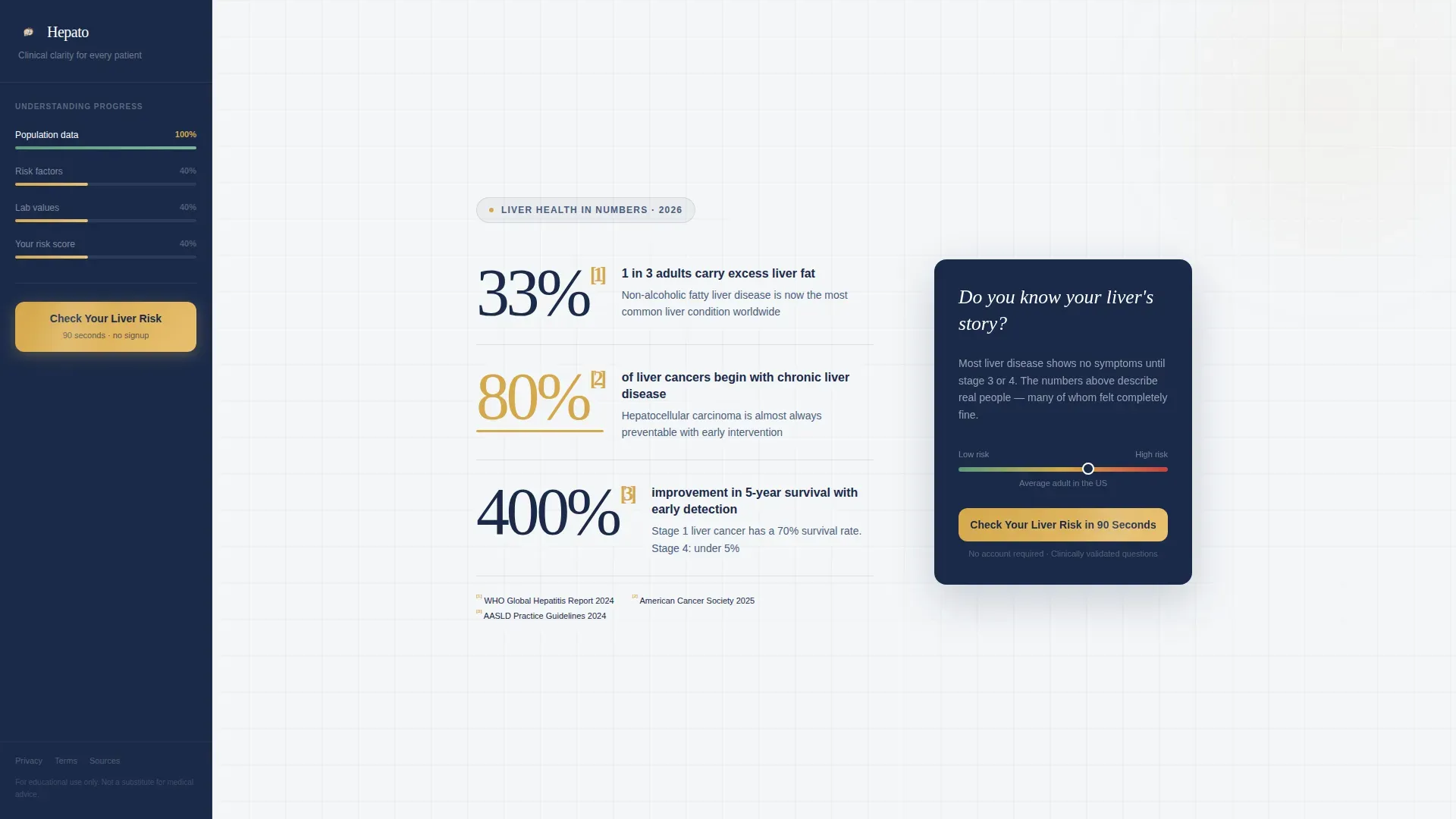
- Animated counter-roll hero section with cited clinical statistics and asymmetric layout
- Scroll-linked sidebar that transitions from a liver health checklist into a progress tracker
- Five pre-built content sections escalating from population stats to personal risk, plus a footer
Feature list
This template includes the following built-in components and interaction patterns.
Animated Statistics Hero Dashboard
The header displays large animated counter-roll statistics, each rolling upward from zero on page load. Numbers are typeset in navy on fog white, with amber underscoring the most urgent figure. A single line of body copy sits asymmetrically to the right. Each statistic includes a small superscript citation link for credibility.
Scroll-Linked Sidebar Companion
A fixed sidebar stays visible as the visitor scrolls through every section. It begins as a liver health checklist, with items graying out or illuminating based on scroll position. Once the visitor passes the third content section, the sidebar transitions into a progress tracker and pins the primary call-to-action button in place.
Progressive Inline Assessment
The four-step risk quiz opens directly inside the page, not as a modal overlay. It moves the visitor through lifestyle factors, family history, symptom recognition, and optional lab value entry. Each step reveals only after the previous one is answered, keeping the experience clinical rather than rushed.
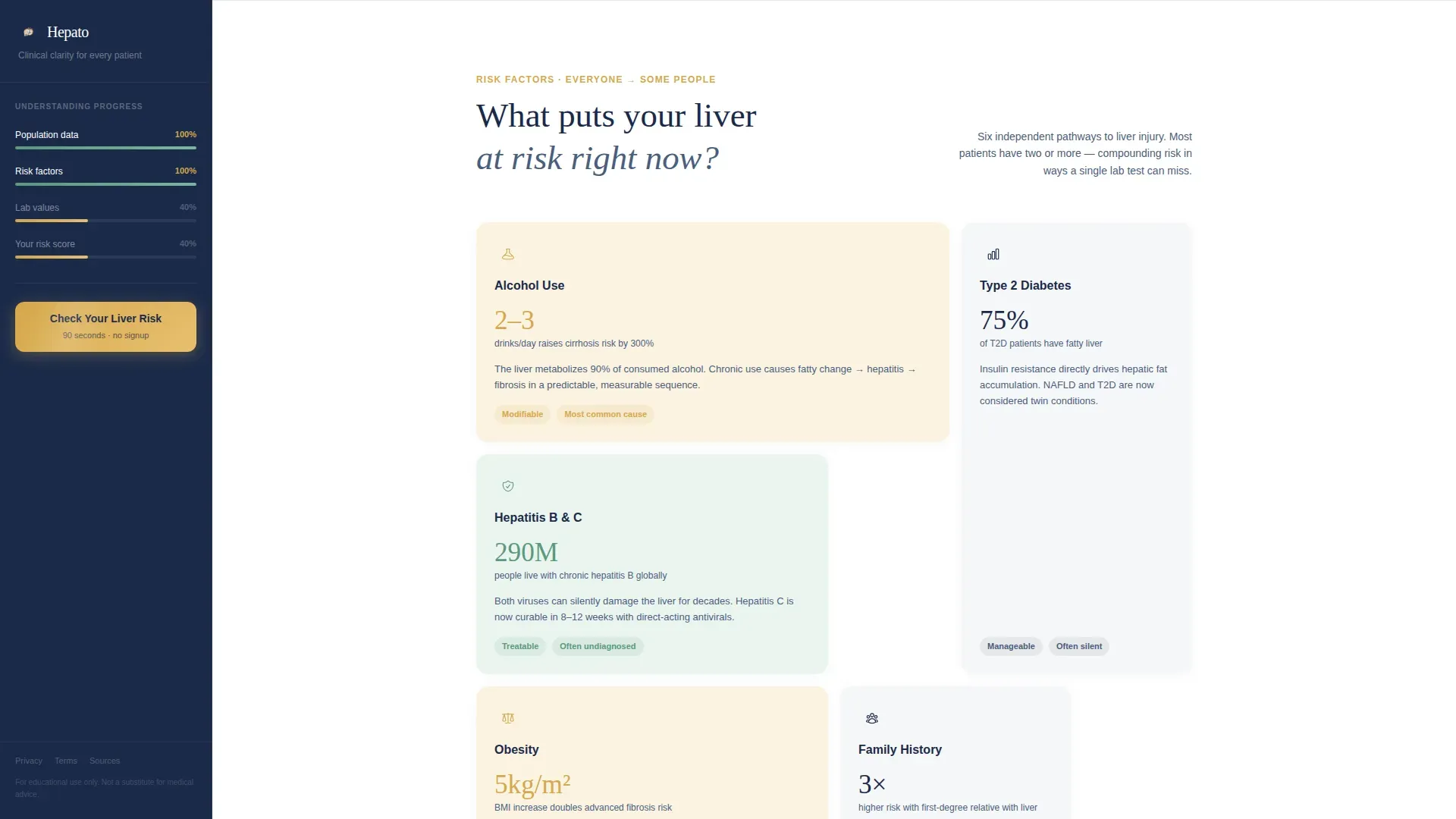
Risk Factor Bento Grid
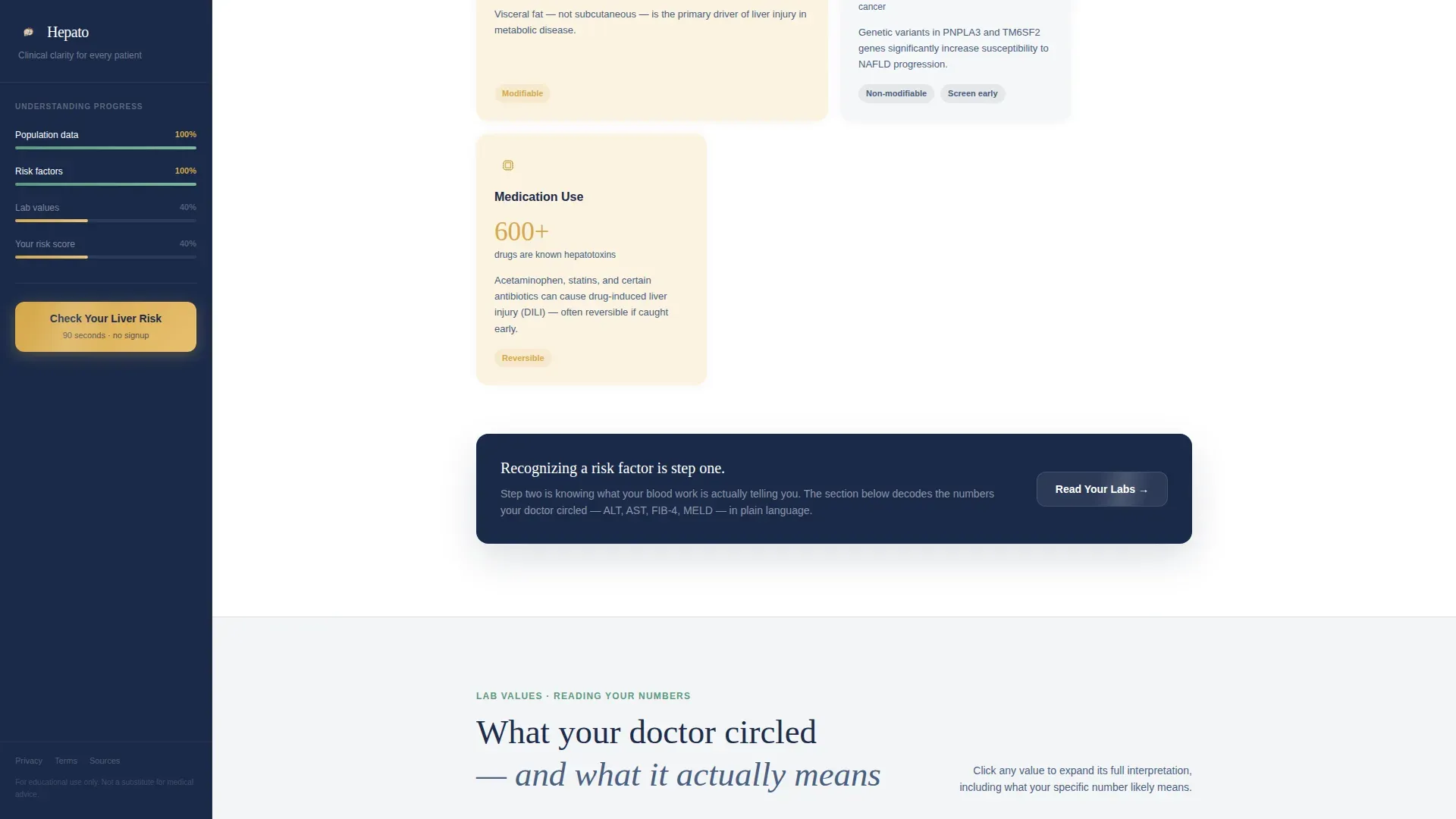
The second content section presents population-level liver disease statistics and narrows them to individual risk-factor breakdowns. The bento grid layout groups related data visually, helping readers understand which factors apply specifically to them without overwhelming them with information all at once.
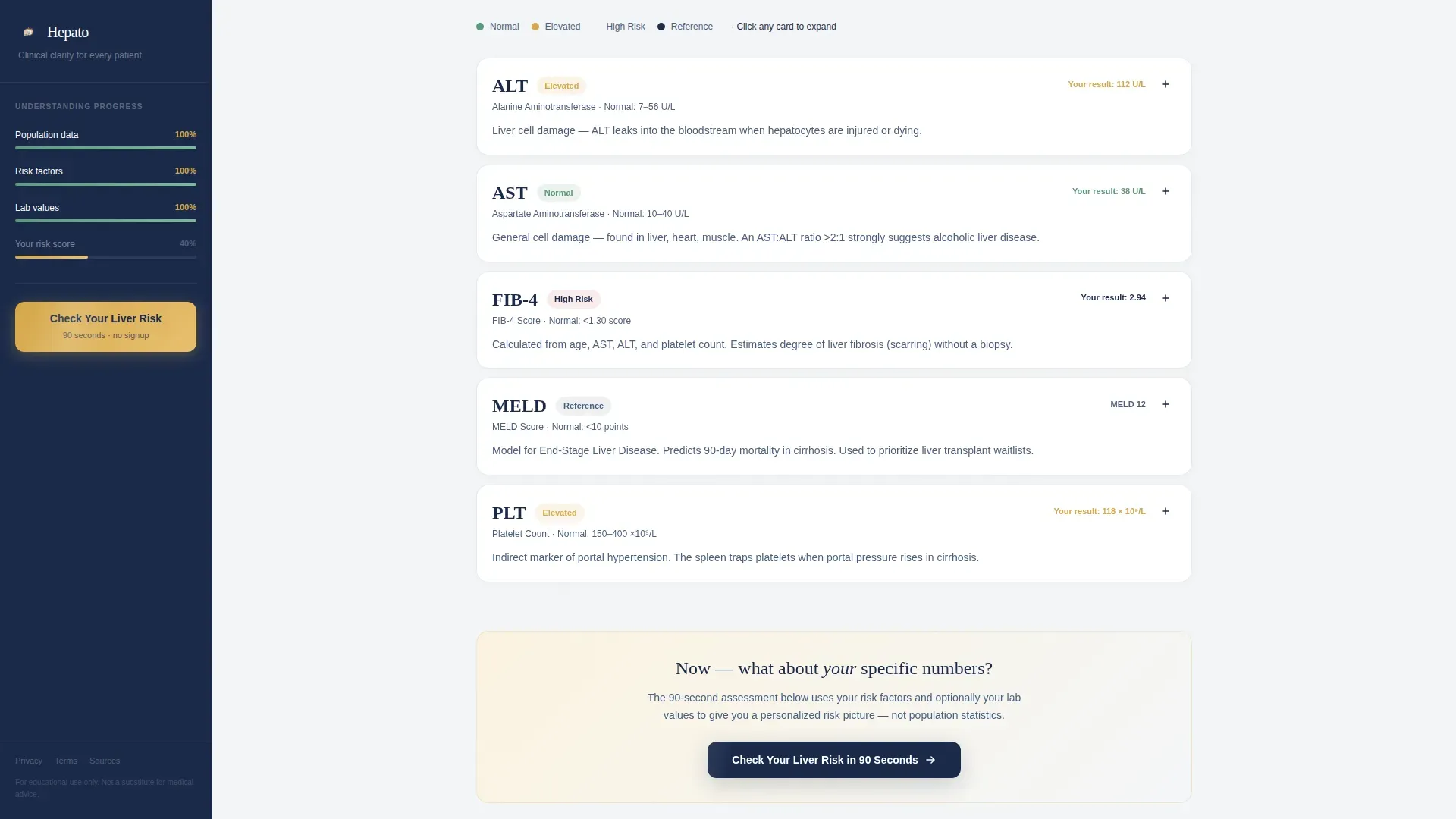
Lab Value Explainer Cards
The third section provides plain-language explainer cards for common hepatology values. Cards cover MELD scoring, the FIB-4 fibrosis index, and alanine aminotransferase (ALT) levels. The sidebar tracker highlights which concept the visitor is currently reading, reinforcing orientation on a data-heavy page.
Secondary Email Capture Section
A dedicated section offers a downloadable Lab Decoder Guide as an alternative conversion path. Visitors who are not ready to complete the assessment can enter their email to receive the guide. This gives the page two distinct conversion moments without competing for attention.
Page sections overview
| Section | Purpose |
|---|---|
| Hero Stats Dashboard | Animate cited liver disease statistics and open with an asymmetric layout that immediately establishes clinical authority |
| Risk Factor Breakdown | Narrow population-level data into individual risk-factor groups using a bento grid layout |
| Lab Value Interpreter | Explain MELD, FIB-4, and ALT values through plain-language cards with sidebar tracking |
| Inline Assessment Quiz | Collect lifestyle, history, symptom, and lab data through a four-step progressive disclosure quiz |
| Lab Decoder Guide | Offer a secondary email-capture path for visitors not ready to complete the assessment |
| Page Footer | Close the page with horizontal flow footer pattern |
Design & branding system
The visual identity follows a Corporate Precision theme expressed through a Soft Mist color system. The palette is described in the brief as sterile but not cold, authoritative but not alarming, like a freshly printed lab report held under fluorescent hospital light.
- Fog white (#F4F6F8) fills main content panels; steady-pulse navy (#1B2A4A) anchors all body text and the persistent sidebar
- Liver-enzyme amber (#D4A84B) appears exclusively on statistics and risk indicators; reassurance green (#5B9A7D) appears only on progress indicators and positive states
- Typography pairs Fraunces serif display for headings with Plus Jakarta Sans for body text, creating a clinical-but-readable contrast
Mobile & speed optimization
The template is designed desktop-first, with the sidebar companion layout as the primary experience. A mobile fallback is included in the design scope.
- The sidebar collapses gracefully on smaller screens so the checklist and progress tracker remain accessible
- Interactive components including the counter-roll animation, inline quiz, and sidebar state transitions are built as client-side elements, while static content sections use server-side rendering for faster initial loads
- Staggered reveal animations on scroll keep the page feeling responsive without loading everything at once
How this template helps you convert
The page earns trust before it asks for anything. By the time the primary call-to-action appears, the visitor has already learned something real about their own risk profile.
- The animated statistics header immediately signals clinical credibility, making the visitor feel they are in capable hands before reading a single paragraph.
- Each section narrows the relevance from "everyone" to "some people" to "maybe you," so the assessment feels like a natural next step rather than an interruption.
- The pinned sidebar call-to-action "Check Your Liver Risk in 90 Seconds" appears only after the visitor has passed three content sections, timing the ask to the moment of highest engagement.
Other information about this template
This template is purpose-built for health tech and patient education platforms operating in the liver disease care space. It supports a business-to-consumer medical literacy model where conversion is defined by assessment completion, not a purchase.
- The no-stock-photography design choice keeps the page free from generic medical imagery that patients often find distressing
- The "everyone to some people to maybe you" rhythm is built directly into the section copy structure and can be adapted for related chronic disease education topics
- The footer uses a horizontal flow layout pattern consistent with modern clinical platform conventions
- The template supports English (United States) localization and contains no currency symbols or date-specific content, making it straightforward to maintain over time
- Color usage rules are strict by design: amber never appears on non-data elements, and green is reserved for safe or improving states, preserving the semantic meaning of each color across the page
Theme
Corporate Precision
Creative direction
Stats-First Impact
Color system
Soft Mist
Style
Sidebar Companion
Direction
Quiz/Assessment
Page Sections
Animated Statistics Hero Dashboard
Scroll-linked Sidebar Companion
Progressive Inline Assessment
Lab Value Explainer Cards
Risk Factor Bento Grid
Secondary Email Capture Section
Related questions
Who is this landing page template designed for?
Does the inline assessment open as a pop-up or modal?
Can a visitor skip the assessment and still get value?
What lab values does the explainer section cover?
Is this template suitable for desktop and mobile use?