Certified Rowhouse Appraisal Landing Page Template
The Brownstone landing page template is built for a one-person certified appraisal practice serving Brooklyn rowhouse owners, estate attorneys, and renovation couples. It pairs a dark, golden-hour visual identity with an interactive Before/After Reveal, a direct booking form priced at $975, and a lead-capture path for visitors who want a sample report before committing.
by Rocket studio
Quick summary
This template gives a boutique Brooklyn appraisal practice a full-width, immersive landing page that converts visitors into paying clients. The dark parlor aesthetic, address-input hero, and draggable Before/After Reveal all work together so that buyers, agents, estate attorneys, and renovation homeowners immediately sense they have found the right service for their historic rowhouse.
Who this template is for
A landing page for appraisal services must lead with trust, expertise, and the specialized nature of the properties being assessed. This template is built precisely for that brief.
- Brooklyn brownstone owners preparing to sell who need a certified number before their listing goes live on the city market
- Estate attorneys settling generational house transfers and renovation couples who need a defensible valuation before they gut the parlor floor
- Investors and brokers representing multi-unit properties who want to inform buyers and agents with documented, comparable historic sales data
What problem this template solves
Most people searching for a brownstone appraiser land on generic real estate service pages that were clearly not built for landmarked properties. The result is lost trust and lost bookings.
- Homeowners and agents cannot find a listing-ready, credentialed specialist who understands how the New York City Landmarks Preservation Commission affects valuations and proposed renovations
- Buyers and brokers have no fast way to review a sample appraisal report, verify the appraiser's credentials, or book a walkthrough on the same site visit
- Estate attorneys dealing with generational building transfers need retrospective evaluations tied to a specific past date, and generic appraisal sites do not address that use case at all
What you get with this template
You get a fully realized, single-page design that walks visitors through the appraisal experience from the street to the cellar. Every section serves a clear purpose: build credibility, demonstrate the depth of the service, and drive a booking.
- A hero section with a full-bleed blue-hour streetscape, a centered address input field, and a floating credential card that signals professional authority from the first moment on the page
- Interactive Before/After Reveal sliders that pair exterior and interior photographs with scroll-linked dollar-figure overlays covering the facade, parlor floor, garden level, and rear extension
- A streamlined booking modal with a pre-filled address field, a property type toggle, a date picker limited to the next three weeks, and a single clear price of $975 for a certified appraisal report delivered in ten business days
Feature list
This template ships with every component a boutique appraisal practice needs to fill its calendar and build a credible web presence.
Address-Input Hero with Cross-Dissolve
The hero centers a serif address field over a slow-panning, full-bleed blue-hour photograph of a landmarked brownstone block. When a visitor submits their address, the background cross-dissolves from the street scene into a brownstone entry hall interior. This transition is the first Before/After Reveal and immediately signals that the service understands the inside of the house, not just the facade.
Draggable Before/After Reveal Sections
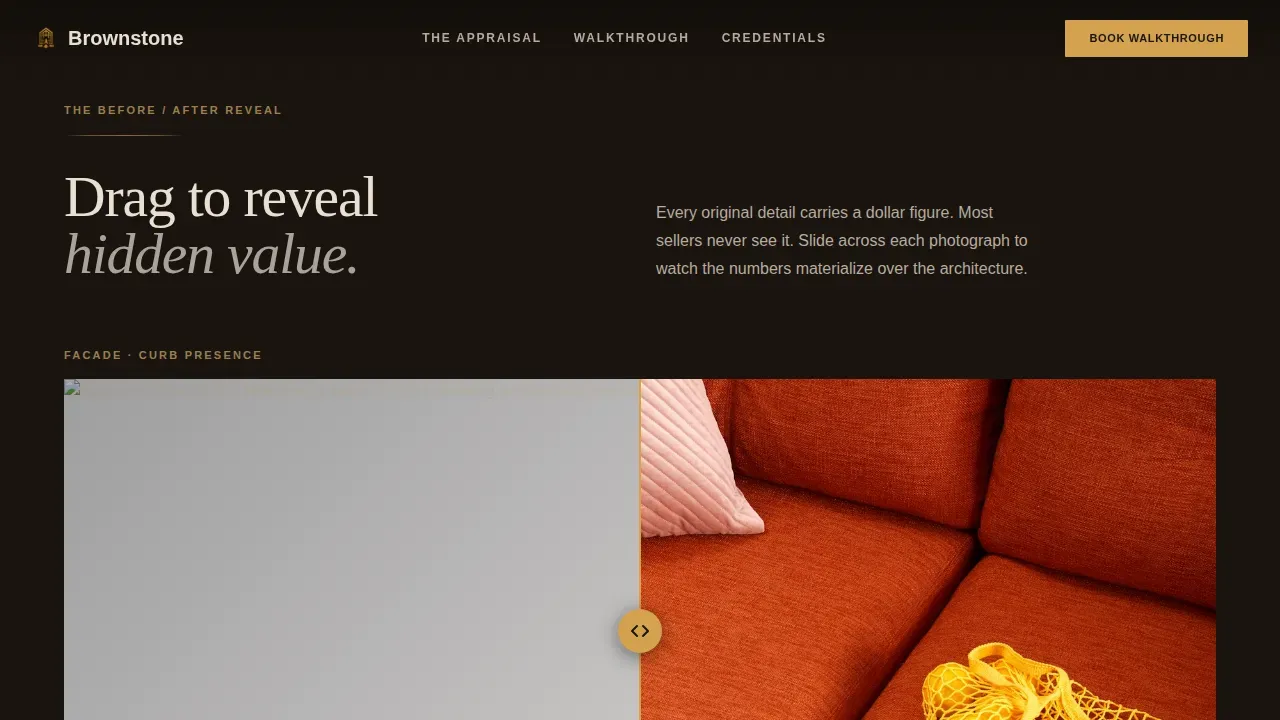
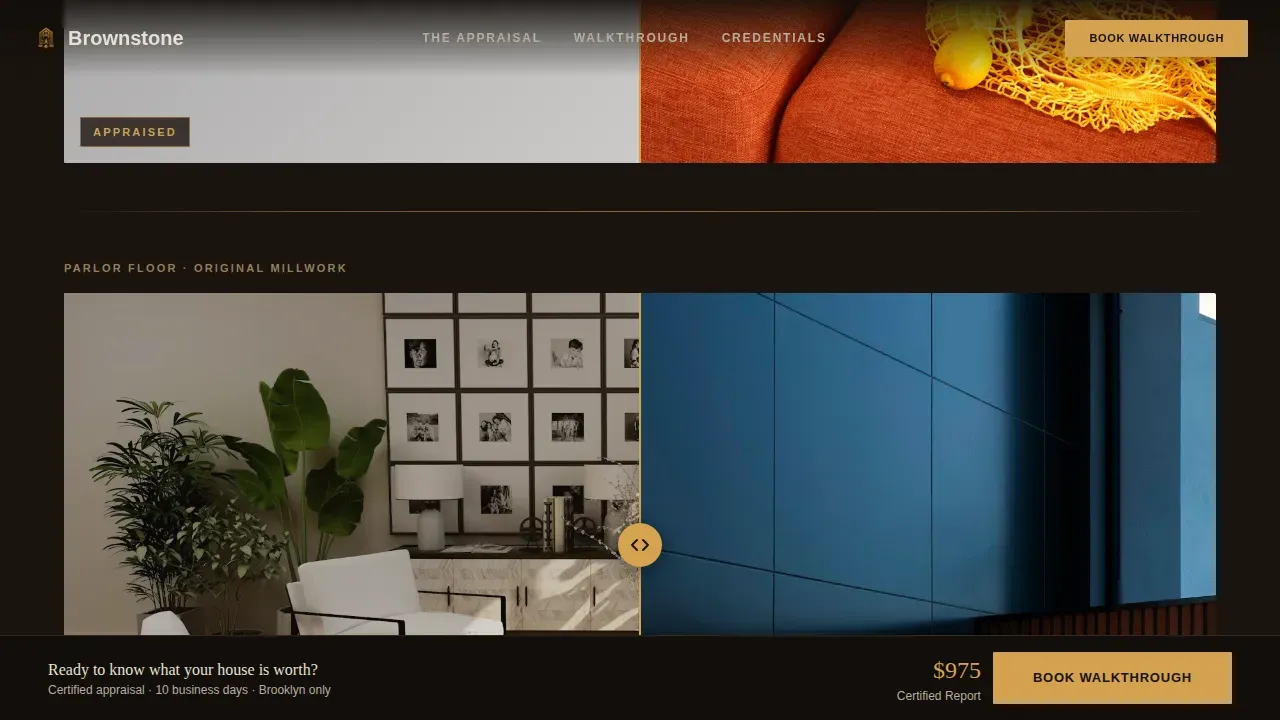
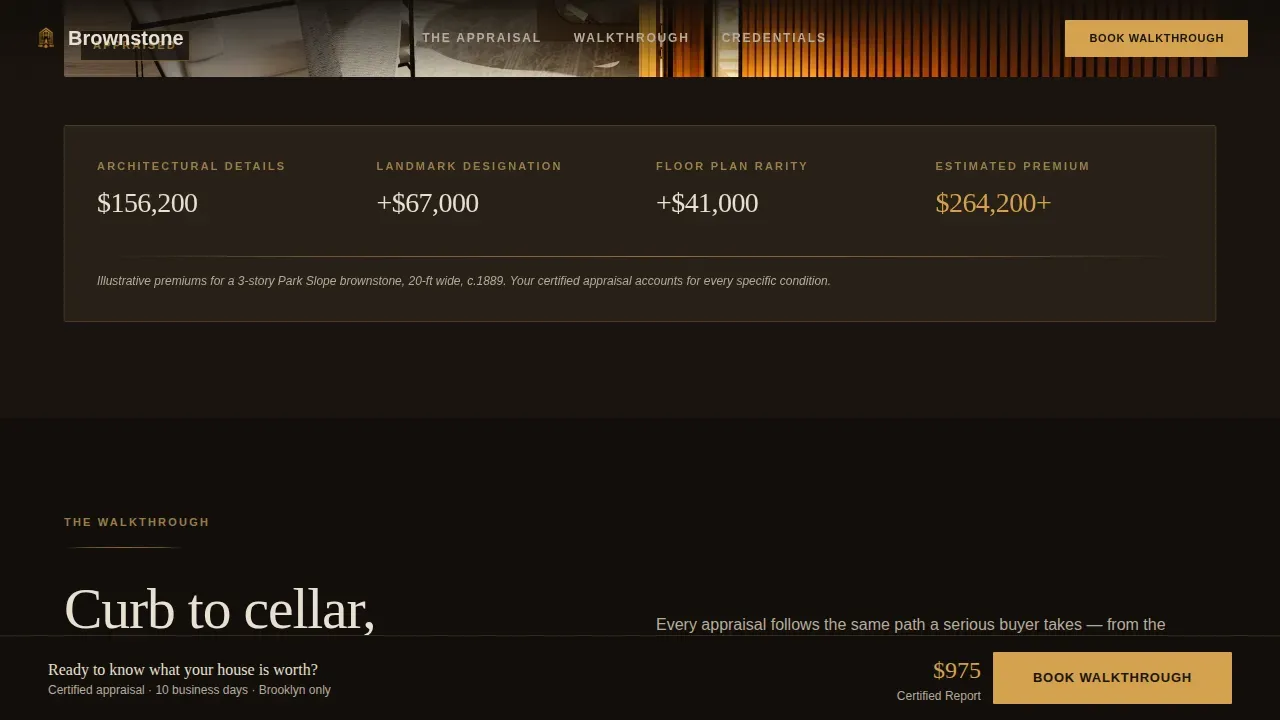
Each reveal section pairs a real exterior or interior "before" photograph with a layered appraisal overlay. Visitors drag a slider and watch dollar figures appear over architectural details: original millwork premiums, historic-district designation multipliers, and floor-plan rarity scores. The sections escalate from facade to cellar, mirroring the actual room-by-room walkthrough an architect-trained appraiser performs on site.
Bento-Style Walkthrough Layout
Below the reveal sections, a bento-style grid breaks the building into discrete zones: garden level, rear extension, and vertical circulation. Each cell in the grid represents one stop on the walkthrough and explains what the appraiser documents there, from windows and backyard space to structural condition and repair history.
Direct Booking Modal
The primary call to action, "Book Your Walkthrough," opens a lightweight checkout form. The property address is pre-filled from the hero input. Visitors choose a property type (brownstone, limestone, or brick rowhouse), select a preferred date, and see the price displayed without any hidden costs. The form is designed to let visitors submit a booking in under two minutes.
Lead-Capture Sample Report Gate
A secondary conversion path offers a downloadable sample appraisal report gated behind a single email field. This path captures prospects who are not ready to purchase but want proof of depth before they commit. High-quality photography inside the sample report showcases before/after images and highlights unique features such as 18-inch walls and high ceilings.
Persistent Bottom Call-to-Action Bar
After the second reveal section, a persistent bottom bar appears and stays visible during the rest of the scroll. It keeps the "Book Your Walkthrough" action within reach at every point on the page, reducing the friction between intent and conversion.
Page sections overview
| Section | Purpose |
|---|---|
| Hero Address Input | Capture visitor address and establish immediate visual authority |
| Before/After Reveal | Show facade and parlor floor value with interactive slider overlays |
| Walkthrough Bento Grid | Break the building into room-by-room appraisal stops |
| Credibility and Process | Display appraiser credentials and gate the sample report |
| Booking Modal | Convert visitors to paid bookings at $975 with a date picker |
| Persistent call to action Bar | Keep the booking action visible throughout the full scroll |
| Footer | Horizontal flow footer on deep brownstone shadow background |
Design & branding system
The visual identity is built on a Dark Immersive theme using a Cloud Canvas color system. Every design choice evokes a parlor-floor sitting room at dusk: walls receding into charcoal, trim glowing faintly gold, and a quiet sense that every detail in this building is worth more than it first appears.
- Core palette: deep brownstone shadow (#1A1410) for backgrounds, warm plaster cream (#E8E0D2) for body text, tarnished brass (#9B7E4F) for accents and section dividers, and gaslight amber (#D4A24E) reserved strictly for buttons, hover states, and interactive highlights
- Typography: Fraunces serif for all headlines and the address input prompt, which feels hand-engraved at display scale; DM Sans for body copy, captions, and form labels, keeping the reading experience clean and clear
- Section dividers are thin brass rules that echo original ironwork, and natural light in the photography is deliberately balanced against the deep background so each image reads as warm and storied rather than dark and flat
Mobile & speed optimization
The template is desktop-first by design because estate attorneys and homeowners typically research appraisal services on a desktop browser. That said, the layout is structured so it adapts across screen sizes without losing the immersive quality of the dark color system.
- Images are loaded lazily so the page does not block on heavy photography assets; CSS scroll-behavior is handled natively to keep the parallax and slider reveals smooth without additional script overhead
- The booking form and lead-capture gate are touch-friendly, with tap targets sized for mobile users who arrive from a broker referral link or a community forum post on their phone
How this template helps you convert
A clear call to action is crucial for converting visitors on real estate landing pages, and this template builds toward that action through every scroll depth.
- The address input in the hero creates immediate personal investment: the visitor has already typed in their Brooklyn house address before they have read a single credential, which makes them more likely to complete the booking form at the bottom of the page
- The Before/After Reveal sliders demonstrate value in real time, replacing abstract claims about appraisal depth with a visual experience of dollar figures materializing over period details like cornices, pocket doors, and cracked marble mantels
- The persistent bottom bar and the sample report gate work as a two-path system: visitors who are ready to book can submit immediately, while those who need more proof can fill in an email and download a report, keeping both buyer types inside the conversion funnel
Other information about this template
This template is the brownstone certified historic rowhouse appraisal landing page template for boutique appraisal practices serving the Brooklyn market and similar city neighborhoods with significant landmarked building stock.
- Many brownstones were constructed between the mid-1800s and the early 1900s; determining the exact construction date of a house can be complicated by historical record-keeping issues, and city property folders held by the Department of Buildings are often the most reliable documents available to homeowners
- Appraisals of these properties focus on the cost of reproducing historic materials, the integrity of period details, and location within a designated historic district; the New York City Landmarks Preservation Commission oversees landmark restrictions that directly affect property valuations and proposed renovations
- Certified appraisals account for unique architectural elements including brown sandstone facades, stoops, cornices, original molding, fireplaces, pocket doors, and windows; condition assessments also identify issues such as sandstone spalling and the structural integrity of the building facade
- Appraisers use the cost approach and income approach to account for specialized craftsmanship; special, high-cost masons are often required to repair and maintain historic properties, which affects the final valuation
- Single-family brownstones are primarily lifestyle purchases, while multi-unit properties are valued for both lifestyle and rental income; rent rolls and documented permits are important supporting documents for multi-unit building appraisals
- Retrospective evaluations can determine property value at a specific past date for estate, tax, or litigation purposes; this is a core use case that agents and estate attorneys rely on when settling generational transfers
- Gathering records of past approvals, permits, and renovation plans, and disclosing recent exterior construction work, is important for compliance in historic districts; the template's credibility section and sample report gate help appraisers present these documents in a format that buyers and agents trust
- High-quality photography is essential for effectively marketing brownstones and for real estate landing pages to capture buyer interest; the template uses high-quality images, including before/after photography, to create the sense of a complete, floor-by-floor walkthrough even before a visitor books
- A/B testing different landing page designs can help identify which elements are most effective for lead generation; this template's two-path conversion system (direct booking and sample report gate) is designed to support that kind of iterative improvement

Theme
Dark Immersive
Creative direction
Before/After Reveal
Color system
Cloud Canvas
Style
Full-Width Immersive
Direction
Direct Sales
Page Sections
Address-input Hero with Cross-dissolve
Draggable Before/after Reveal Sliders
Bento-style Walkthrough Grid
Direct Booking Modal at $975
Email-gated Sample Report Download
Persistent Bottom Call-to-action Bar
Related questions
Who is this template designed for?
What sections are included in the template?
Can this template handle both direct bookings and lead capture?
Does the template address multi-unit brownstone properties?
Is this template relevant for estate and retrospective appraisals?