Noble Scottish Cuisine Landing Page Template
Brose is a masonry-style Scottish restaurant landing page built to drive event registrations. It pairs close-up Highland food photography with sensory copy, a hand-illustrated mascot, and a sunset gradient palette rooted in heather purple and rowan amber. The registration form covers tasting menus, whisky pairing evenings, private dining, and Burns Night suppers, all designed to turn appetite into a confirmed booking.
by Rocket studio
Quick summary
Brose is a single-page event registration landing page for a fine dining Scottish restaurant. It uses a Pinterest-style masonry layout, immersive food photography, and aroma-driven copy to build appetite through every scroll. The page ends at a booking form that feels like the natural next step. The design draws from an Agrarian Root theme with a Sunset Gradient colour system.
Who this template is for
This template suits hospitality and food and beverage professionals who want a landing page that does more than list details. It is built for people who need to communicate atmosphere, seasonality, and exclusivity before asking for a commitment.
- Scottish restaurant owners and operators running ticketed tasting events, whisky pairing evenings, private dining programmes, or seasonal suppers such as Burns Night
- Event managers and hospitality marketers who need a high-impact event registration page without starting from a blank canvas
- Independent venues and hotel dining departments seeking a visually rich site that converts visitors browsing on desktop into confirmed guests
What problem this template solves
Most event registration pages fail because they jump straight to a form. They list a date, a location, a price, and a button. They do not make the visitor feel anything before asking them to purchase. For a fine dining Scottish restaurant, that gap is costly. Guests booking a tasting menu or a private dining event need to feel the warmth of the room, the weight of the food, and the quality of the experience before they commit.
Brose solves this by building appetite first and presenting the registration form second. Every element of the page earns the click.
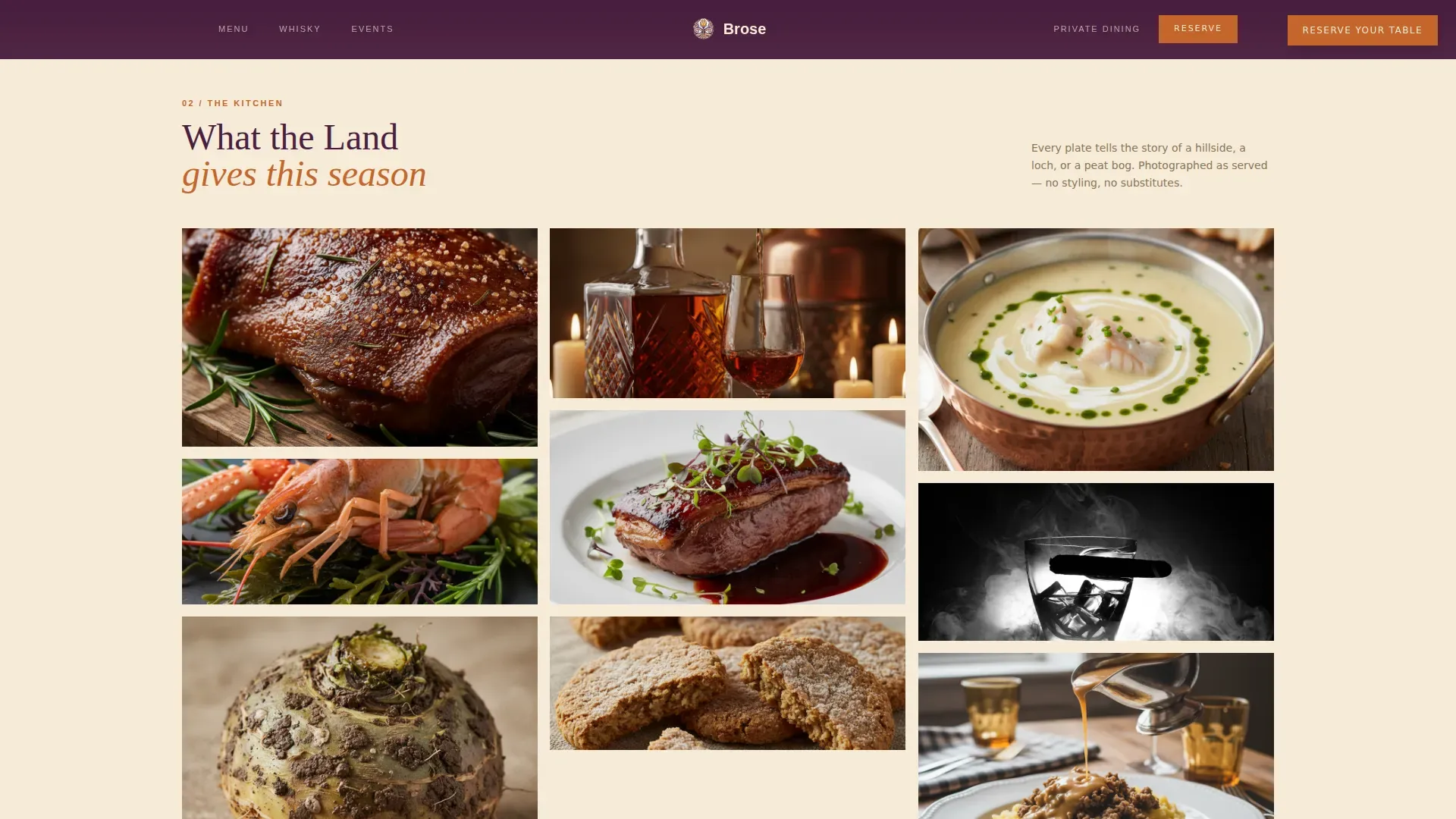
- The masonry food photography and aroma interstitials create sensory pull before any pricing or commitment is visible, addressing the core risk of early drop-off
- The structured registration flow collects event type, party size, preferred date, and dietary notes in a logical sequence, reducing friction and improving the quality of information captured at the point of booking
- The secondary "Gift an Evening" path extends the page's reach beyond the primary booker, opening access for gift purchasers who are not booking for themselves
What you get with this template
This template delivers a fully structured single-page layout built around five major content zones. Each zone has a distinct visual treatment and a specific role in the journey from first impression to confirmed reservation. The layout is designed desktop-first, with full mobile support built in.
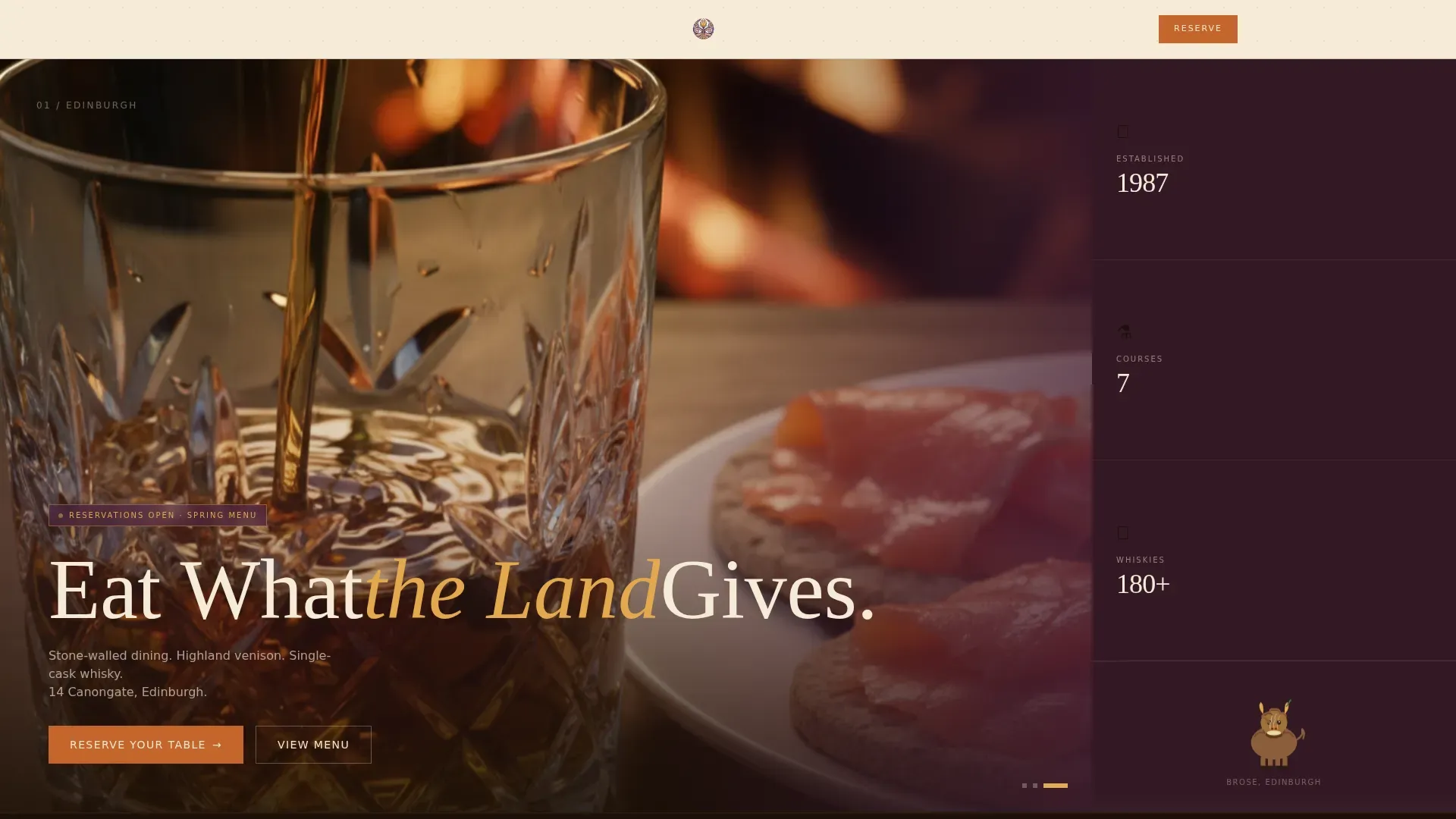
- A cinematic hero section with a hand-illustrated Highland cow mascot, a full-bleed sunset gradient, floating stat cards, and the headline "Eat What the Land Gives"
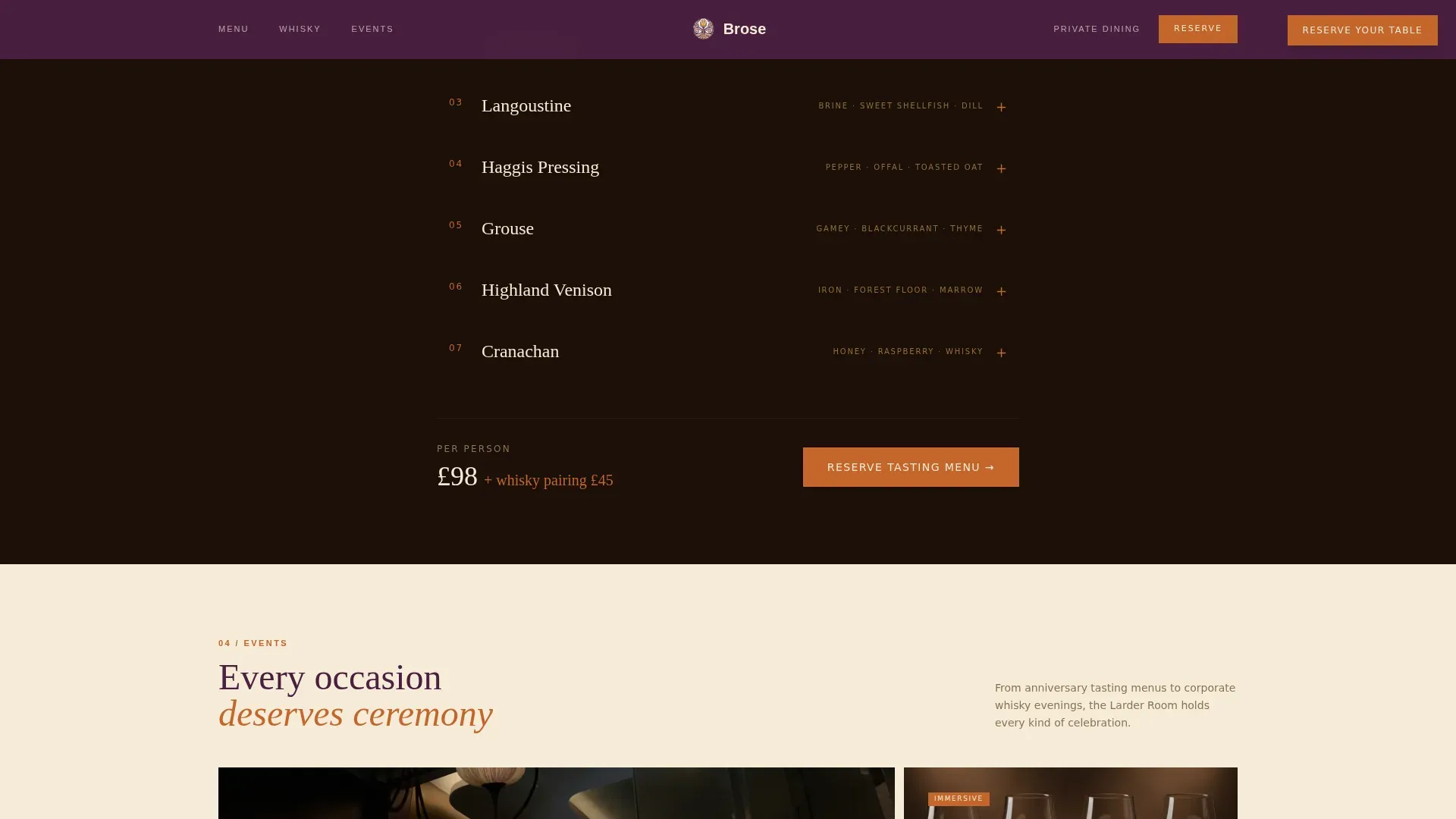
- A Pinterest-style masonry gallery with staggered portrait and landscape food photography cards, full-width aroma interstitial strips, a 7-course tasting menu reveal with sensory descriptions, a private dining bento grid with four event types, and a footer zone combining whisky pairing content, testimonials, and the reservation form
- A sticky "Reserve Your Table" call-to-action button that appears after the hero and recurs within the private dining section and the seasonal tasting-event card, keeping the primary action visible throughout the scroll
Feature list
This section covers the core capabilities built into the Brose template. Each feature reflects a deliberate design or functional decision grounded in the project brief.
Masonry Gallery with Aroma Interstitials
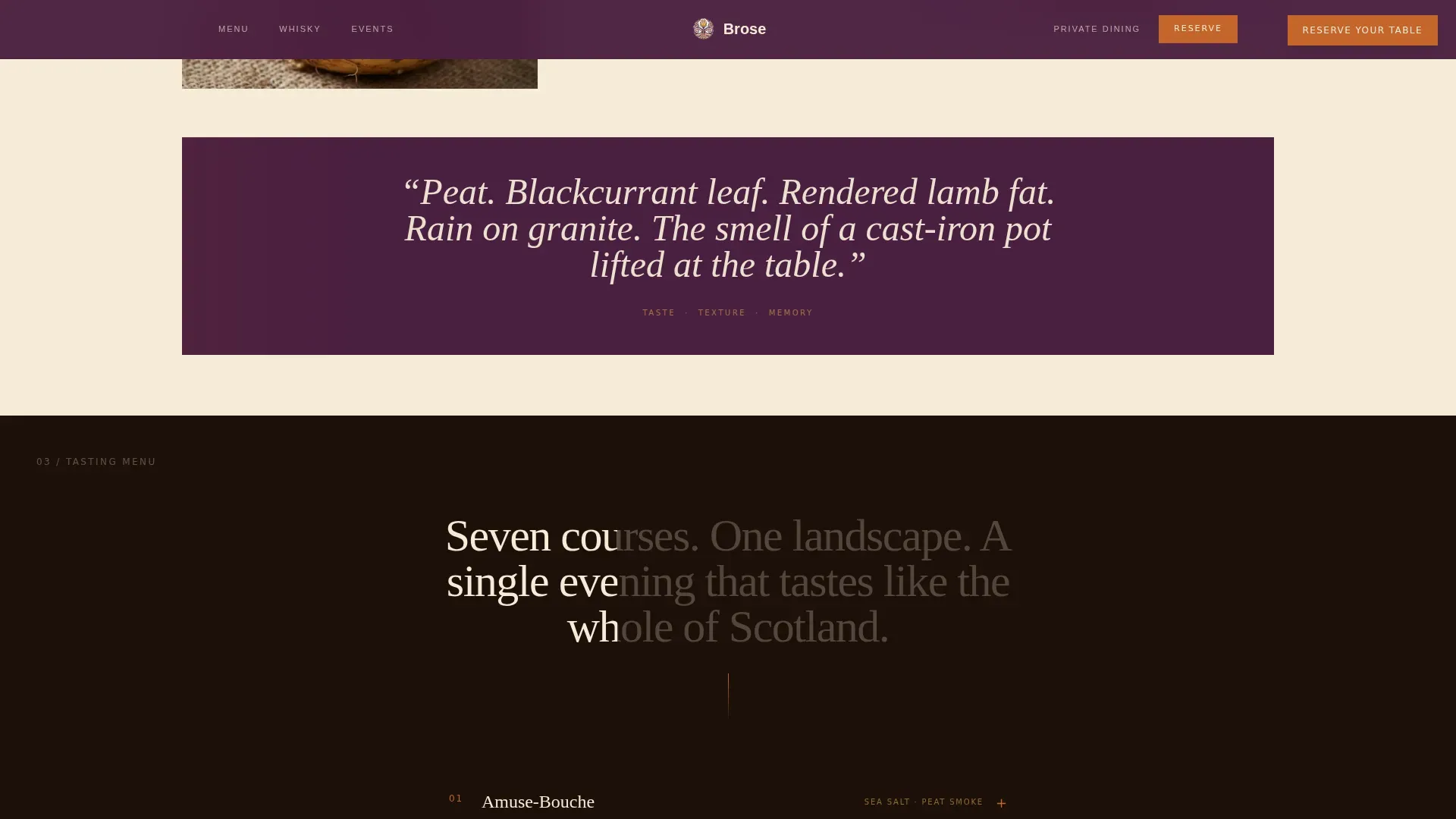
The masonry layout arranges food photography cards at staggered heights. Portrait-cropped cards focus on single ingredients such as a muddy turnip, a whole langoustine, or a crumbled oatcake. Landscape cards frame plated dishes mid-pour of sauce. Between clusters of cards, full-width interstitial strips render aroma descriptions in large typography: "Peat. Blackcurrant leaf. Rendered lamb fat. Rain on granite." These strips pull the visitor deeper into the food experience, building appetite before any registration prompt appears. The system creates a rhythm of image and word that keeps the scroll moving naturally. Each card in the collection is designed to reward close attention, making the food feel present rather than photographed.
Hand-Illustrated Mascot Hero
The hero section opens with a Highland cow mascot rendered in a rough ink-and-watercolour style. The character features a shaggy fringe half-covering one eye, a sprig of rosemary tucked behind a curved horn, and a bowl of cullen skink balanced on its broad back with steam curling upward. The illustration sits against a full-bleed sunset gradient that shifts from heather purple to rowan amber as the visitor scrolls. This visual identity signals warmth, craft, and a sense of place before a single word of body copy is read. The mascot anchors the brand character and gives the page a personality that standard restaurant websites rarely achieve.
Multi-Type Event Registration Form
The registration form follows a logical sequence designed to reduce drop-off. It opens with event type selection, presenting four options: tasting menu, whisky pairing evening, private dining, and Burns Night supper. From there, the visitor selects party size, preferred date, and adds any dietary notes. This ordered approach to data collection means the visitor is oriented around their own needs before they address logistics. A secondary path labelled "Gift an Evening" allows purchasers who are not booking for themselves to proceed through a separate flow, extending the page's conversion reach without complicating the primary registration journey.
Sticky Call-to-Action with Multiple Placements
The primary call-to-action button, labelled "Reserve Your Table," first appears as a sticky element after the hero section. It recurs as an embedded button within the private dining section and inside the seasonal tasting-event card. This multi-placement strategy means the visitor never has to scroll back to act. The amber colour of the button creates a strong contrast against both the oat-cream card backgrounds and the heather purple navigation, making the action visually prominent at every scroll depth.
7-Course Tasting Menu Reveal
The tasting menu section unfolds as a scroll-driven reveal, presenting each course with sensory language that describes aroma, texture, and origin rather than just listing ingredients. This is not a static menu card. It is a structured narrative that builds anticipation course by course. The section uses the same typographic system as the aroma interstitials, creating visual continuity between the gallery and the menu. The sensory descriptions create a mental experience of the meal before the guest has booked, which is one of the most effective strategies for converting a curious visitor into a committed registrant.
Private Dining Bento Grid
The private dining section uses a bento grid layout to present four distinct event programmes: tasting menu evenings, whisky pairing nights, private dining for corporate or personal groups, and Burns Night suppers. Each cell in the grid carries a title, a short description, and an embedded call-to-action. The grid format allows a group leader or an event organiser to quickly identify which programme fits their needs without reading through long paragraphs. The embedded calls-to-action within each cell mean the visitor can move directly to registration from the programme that matches their interest.
Page sections overview
| Section | Purpose |
|---|---|
| Hero with Mascot | Introduce brand character, headline, and gradient atmosphere |
| Stat Cards Float | Display key social proof figures alongside the hero |
| Masonry Food Gallery | Build appetite through staggered food photography |
| Aroma Interstitial Strips | Deepen sensory engagement between gallery clusters |
| Tasting Menu Reveal | Present 7-course scroll with sensory course descriptions |
| Private Dining Grid | Show four event types with embedded booking actions |
| Whisky Pairing Section | Highlight single-cask pairing evenings and programme details |
| Testimonials Block | Feature guest reviews with specific dish references |
| Reservation Form Footer | Capture event type, party size, date, and dietary notes |
Design & branding system
The visual language of Brose draws from an Agrarian Root theme interpreted through a Sunset Gradient colour system. The palette is drawn directly from the Scottish land at dusk: heather purple anchoring the upper register, rowan amber firing through the midpoint, harvest gold catching the highlights, and oat cream breathing across every card background. The typographic pairing of Fraunces for display headlines and DM Sans for body text and user interface elements balances editorial warmth with functional clarity. The rough ink-and-watercolour illustration style runs through the mascot and supporting graphics, giving the page a handmade quality that resists the polished anonymity of standard restaurant design. Every visual decision is made to support one goal: to make the visitor feel the warmth and texture of the dining room before they interact with a single form field.
- Colour system: deep heather purple (#4A2040) for headers and navigation, rowan-berry amber (#C4652B) for hover states and pricing callouts, harvest gold (#E2A94F) for seasonal ingredient highlights, oat cream (#F5EBD8) for card backgrounds
- Typography: Fraunces for display headlines and primary typographic moments, DM Sans for body copy and all user interface text, with a handwritten-style headline treatment for the hero
- Illustration and texture: rough ink-and-watercolour mascot, farmhouse sketchbook aesthetic, editorial food photography treated as the primary visual material throughout the scroll
Mobile & speed optimization
The template is built desktop-first to match the research behaviour of its primary audiences: anniversary couples and corporate bookers both tend to research and commit from a desktop browser. That said, the layout extends fully to mobile screens without losing its visual hierarchy or the sensory impact of the photography. Mobile-friendly registration forms improve accessibility for guests on various devices, and this template is structured to support that standard. The masonry grid adapts its column count to screen width, and the sticky call-to-action remains anchored and prominent on mobile viewports. Images in the layout are set up for lazy loading, which helps manage the visual weight of a photography-heavy page. CSS animations in the template are structured for GPU acceleration, keeping scroll-driven reveals smooth across devices.
- Lazy-loaded images across the masonry gallery and interstitial sections prevent the page from front-loading all visual assets at once, supporting a faster initial render
- GPU-accelerated CSS animations power the scroll scrub text effects, masonry stagger reveals, spotlight cards, and parallax layers without relying on heavy JavaScript execution
- The sticky call-to-action and the reservation form are both optimised for touch input, so mobile visitors can check in to the booking flow without pinching or zooming
How this template helps you convert
The Brose template earns conversions through a structured sequence of sensory build-up and strategic call-to-action placement. Every design and copy decision is made to reduce resistance and increase appetite before the registration form appears.
- The masonry gallery and aroma interstitials create an emotional connection to the food and location before any pricing or commitment is introduced, so by the time the visitor reaches the reservation form, they are already invested in the experience rather than evaluating it
- The sticky "Reserve Your Table" button and its multiple embedded recurrences mean the primary action is always within reach, reducing the effort required to act at the exact moment the visitor decides they want to book
- The secondary "Gift an Evening" path captures purchase intent from visitors who are not booking for themselves, ensuring the page converts a broader population of visitors rather than only direct attendees
Other information about this template
The Brose template sits at the intersection of fine dining brand presentation and practical event management infrastructure. It is worth understanding how it positions itself in both contexts.
From a design and development perspective, the template is built using new technologies that support high levels of interactivity and animation without requiring the restaurant operator to have programming knowledge. No-code tools enable users to build applications and customise this template without needing extensive coding skills. AI-powered event management tools have made it significantly easier for non-technical users to launch and manage event registration pages, and this template is structured to work naturally within those broader technology ecosystems. AI-powered platforms can generate production-ready configurations from natural language prompts, which means the setup process for operators using supported platforms can be streamlined considerably. Using AI and no-code tools together, a restaurant or hotel dining department can go from template to live event page quickly, without depending on a specialist development team.
From a content and community standpoint, the template treats the Edinburgh dining city and its surrounding Scottish country as active ingredients in the experience rather than passive location details. The page references agriculture, the land, and wildlife-adjacent Highland sourcing as part of its sensory narrative, which connects the restaurant to a broader food community and to the seasonal rhythms that define its menu. This approach aligns with growing interest in sustainability, the provenance of natural resources, and the story behind what ends up on the plate. The template makes those stories visible without requiring separate editorial programmes or complex content management systems.
For operators managing multiple event programmes across the year, the four event-type selection in the registration form acts as a lightweight scheduling and analysis tool at the point of capture. Each submission carries event type, party size, preferred date, and dietary notes, giving the venue useful data for planning future programmes, managing availability, and understanding demand distribution across event types. Testimonials and past event photos can be updated within the template's content zones to keep the social proof current and relevant. Policy recommendations around dress code, parking, and transportation access can be addressed in the frequently asked question section of the page, keeping the registration process clean while still answering the logistical questions that guests expect.
The template is designed for use in a city dining context, particularly for venues in Edinburgh or comparable Scottish city locations, but the layout system and design architecture are flexible enough to serve any fine dining venue or hotel dining unit that wants to drive event registrations through sensory storytelling. The Agrarian Root theme and Sunset Gradient colour system are not locked to a single geographic location. They can be adapted to suit any restaurant or hotel that draws its identity from the land, the seasons, and the craft of cooking.
From an industry standpoint, this template demonstrates how the event registration page has evolved from a utility form into a brand experience. The evolution from simple sign-up sheets to immersive landing pages reflects broader development in digital hospitality marketing. This template represents a case study in what is possible when sensory creative direction, editorial food photography, and a structured booking system are treated as a single unified project rather than separate department concerns.
The Brose template supports a range of additional programmes beyond the four core event types. A group leader managing a corporate dinner or a large anniversary celebration can use the private dining bento grid section to quickly identify which programme fits their needs and move directly to registration from that cell. The secondary "Gift an Evening" path means the template can also support gift purchase journeys, which extend the value of the page beyond direct bookings. For hotel venues that incorporate private dining as part of a broader guest experience, the template's architecture can be adapted to support that context.
The template note worth emphasising for prospective buyers: the page is built around the principle that the registration form should feel like relief, not effort. Every scroll, every photograph, every line of aroma copy is doing work to build appetite and reduce resistance. By the time a visitor reaches the form, they have already made the emotional decision to book. The form simply confirms it.
From a broader analysis of event registration best practices, this template addresses each core element with a deliberate design decision. High-quality visuals are present throughout the masonry gallery. The hero communicates the event atmosphere immediately. The registration form captures essential details without overloading the visitor. Urgency is built into the limited seating language. Social proof appears through testimonials with specific dish references and press mentions. The schedule of event types is clear and easy to navigate. Dietary notes are collected at the point of registration to support inclusivity and kitchen planning. An interactive map can be embedded in the footer area to help guests find the venue and plan transportation. Multiple payment options can be connected to the form depending on the platform the operator uses to host the page.
The template's approach to the visitor journey reflects an understanding of how different audience segments use the page. Couples marking an anniversary will linger in the masonry gallery and the tasting menu reveal before booking. Whisky tourists will navigate quickly to the pairing evening option in the bento grid. Corporate bookers will check the private dining section first, assess capacity and programme details, then proceed to the form. Each of these journeys is supported by the page structure without requiring separate landing pages for each audience segment.
The template is also relevant to any operator thinking about the economic development of their dining programme. Events drive revenue beyond the standard cover count. A well-run tasting event or whisky pairing evening can command a premium per head, extend dwell time, and build the kind of community loyalty that sustains a restaurant through quieter periods. The Brose template is built to support those efforts by making event booking as compelling as the event itself.
From a resources perspective, the template reduces the time and budget required to create a professional event registration experience. Rather than commissioning a bespoke build for each new event season, the operator can update content zones, swap photography, refresh the aroma copy, and relaunch for a new date. This efficiency matters for independent restaurants and small hotel dining departments that have limited design resources and need to move quickly when a new event programme is ready to launch.
The template's architecture draws on established systems in hospitality landing page development, including masonry grid systems, sticky navigation patterns, parallax scroll systems, and multi-step form systems. These systems are well-supported across modern browsers and devices, which reduces compatibility risks for operators launching the page on a new project.
For those considering the broader context of where this template fits in the food and beverage market, the demand for experiential dining is strong and growing. Guests are increasingly willing to purchase a ticketed event rather than a standard à la carte service, particularly when the event offers something they cannot replicate at home: a tasting menu paired with single-cask whiskies, a private room that smells of juniper smoke and tastes like the Highlands, a burns night supper with the full ceremonial service. The Brose template is designed to sell that experience at the moment of maximum appetite.
- The template's brose agrarian highland dining event registration landing page template designation reflects its specific positioning as a masonry-style event registration page for fine dining Scottish restaurants and agrarian-themed hospitality venues
- UNESCO World Heritage Site proximity or association can be referenced in the hero or about section to add cultural weight to the location story, particularly for venues near Edinburgh's Old and New Towns
- The template supports both direct city restaurant applications and rural hotel dining units that draw guests from the wider Scottish country and international visitor population
- Park settings, riverside locations, and buildings with historic architecture can all be referenced in the location description and the hero content area, as the template's editorial style is designed to accommodate rich place storytelling
- The design system was built with an understanding of local conditions in Scottish hospitality: short summer seasons, strong event-driven revenue peaks around Burns Night and Hogmanay, and a visitor population that includes a high proportion of whisky and food tourism traffic
- The template's modular content zones mean each seasonal event can receive its own card and call-to-action within the bento grid, allowing the operator to address the full year's event schedule within a single page system
- Policy recommendations, logistics details such as transportation access and parking, and dress code guidance can all be accommodated within the frequently asked question section of the page, which is designed to answer questions efficiently without cluttering the main registration flow
- The template can be evaluated on a case by case basis to determine which content zones and event types are most relevant to a specific venue's programme, and non-relevant sections can be removed or repurposed without disrupting the overall layout system
- For venues near paved surfaces, city transport links, or with specific access requirements, the footer's interactive map embed and frequently asked question area provide the right place to surface that information clearly for guests
- Climate change and seasonal variability are increasingly influencing when and how Scottish produce reaches the kitchen, and the template's harvest gold seasonal ingredient highlight system gives operators a way to signal that responsiveness to guests at the point of booking
Theme
Agrarian Root
Creative direction
Taste & Aroma
Color system
Sunset Gradient
Style
Masonry/Pinterest
Direction
Event Registration
Page Sections
Masonry Gallery with Aroma Interstitials
Hand-illustrated Highland Mascot Hero
Multi-type Event Registration Form
Sticky Multi-placement Call to Action
Course Tasting Menu Scroll Reveal
Private Dining Bento Grid
Related questions
Can this template be customised without coding knowledge?
What event types does the registration form support?
Is this template suitable for hotel dining venues as well as standalone restaurants?
How does the sticky call-to-action work across the page?
Can the page address logistics like parking and transportation for guests?