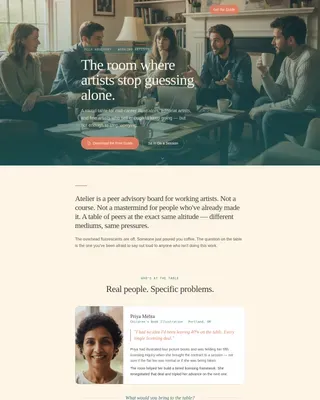
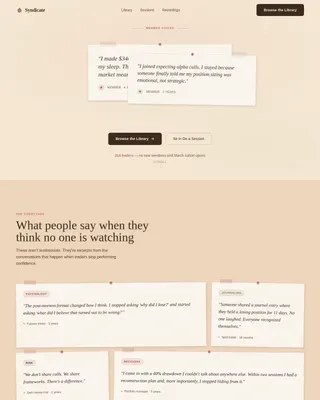
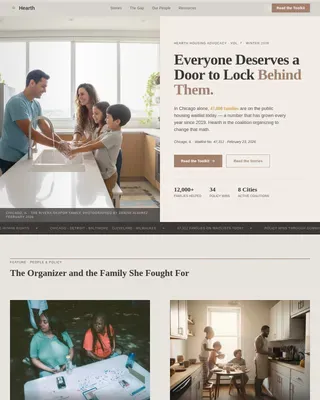
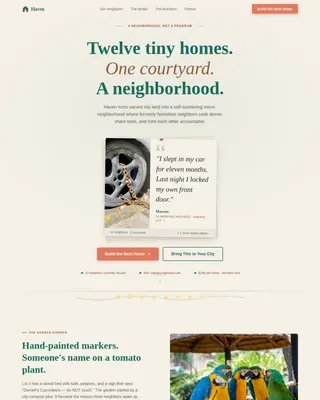
Affordable Housing Nonprofit Reviews Website Template
The Shelter Healing Space Affordable Housing Campaign Landing Page Template is an editorial-magazine layout built for nonprofit advocates, faith leaders, and housing organizers. It walks visitors through a family's housing journey using photojournalism, data visualizations, and handwritten testimonials, then invites them to join a named coalition through a focused, single-purpose sign-up form.
by Rocket studio
Quick summary
This shelter healing space affordable housing campaign landing page template turns a housing crisis into a story visitors walk through, not just read. Each scroll carries them from one family's waitlist experience to the moment a community organizes and wins. The page closes with a coalition form that asks visitors to name exactly what they can offer.
Who this template is for
This template was built for people who already understand the stakes of homelessness and want to bring more people into the fight. It serves those who need a page that earns trust quickly and converts it into collective action.
- City council staffers and nonprofit directors drafting housing resolutions or coalition letters
- Faith leaders and community organizers opening space for residents to gather and heal
- Advocacy teams running affordable housing awareness campaigns who need a lead generation landing page that respects the dignity of the people it serves
What problem this template solves
Most campaign pages observe a crisis from a distance. Visitors scroll, feel vaguely sad, and leave. This template solves the emotional distance problem by creating a narrative the visitor enters as a character, not a spectator. It makes the immediate needs of families visible and positions the reader as the mentor the story has been waiting for.
- Housing waitlists are invisible to people with power; this template makes the numbers undeniable through data visualizations and animated counters
- Coalition-building campaigns often lose sign-ups to complicated forms; the single dropdown and four-field layout keeps friction low
- Campaigns that guilt visitors lose them; this page invites, names, and welcomes, building trust at every section
What you get with this template
You get a fully structured, editorial-magazine landing page built around a Hero's Journey narrative arc. Every section has a defined emotional role, and the design system is consistent from the hero to the footer.
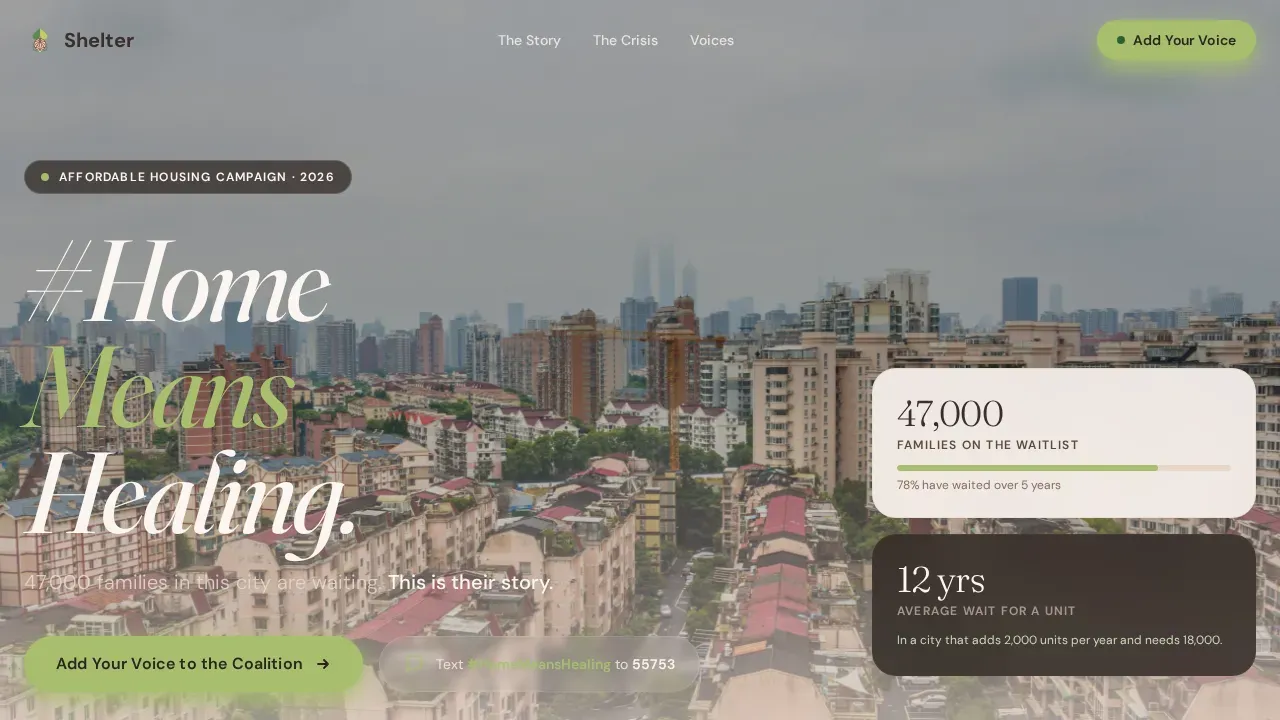
- A full-viewport hero with a botanical hashtag treatment, a floating stat card, and an above-the-fold call-to-action button
- Five content sections including a family story card, a bento-grid data section, horizontal-scroll testimonial cards, and a coalition sign-up form with an "I can offer" dropdown
- A Botanical color system, Fraunces serif headlines, and DM Sans body type that give the page warmth, editorial credibility, and a clear sense of community belonging
Feature list
This section describes the core built-in capabilities you can deploy immediately from the template.
Hero with Movement Hashtag and Stat Cards
The full-bleed hero layers a slow-panning aerial neighborhood photograph beneath the #HomeMeansHealing hashtag rendered in hand-painted botanical letterforms filled with pressed wildflower textures. Floating stat cards inform visitors of the scale of the housing challenge before they scroll one pixel. A high-contrast chartreuse call-to-action button and an SMS shortcode path both appear above the fold, giving visitors two ways to engage from the first moment.
Family Story Card with Animated Waitlist Counter
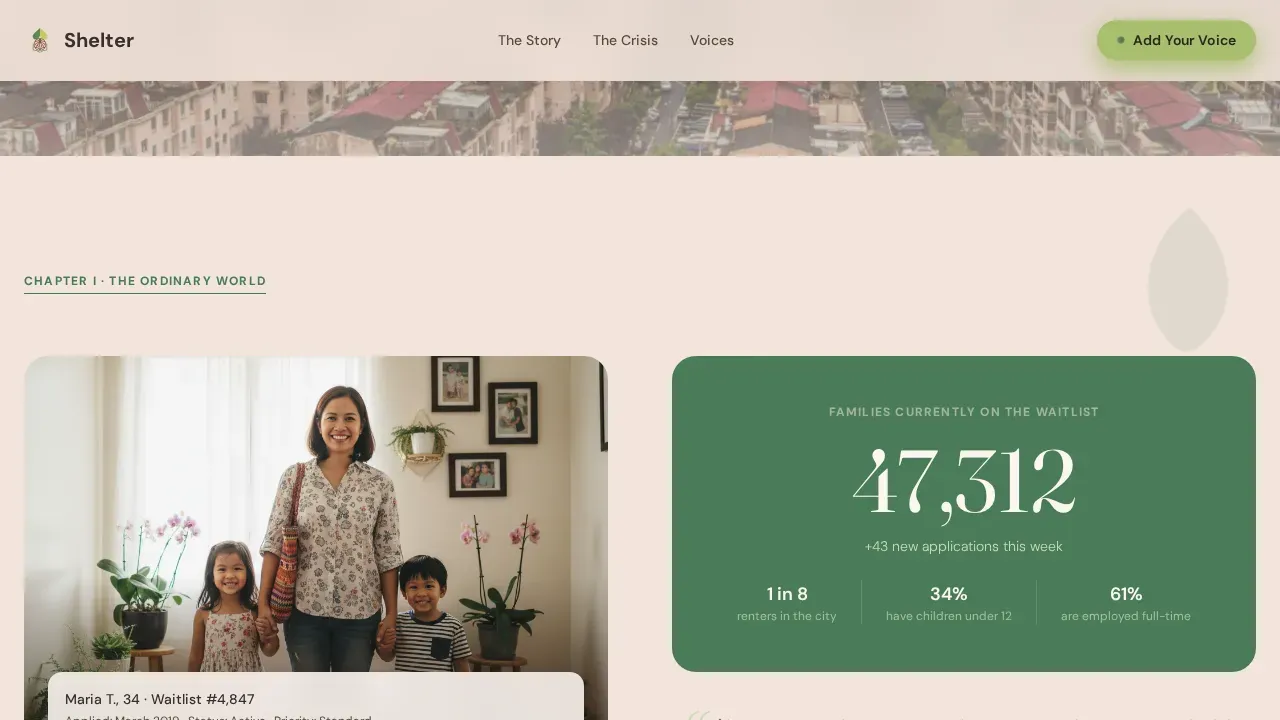
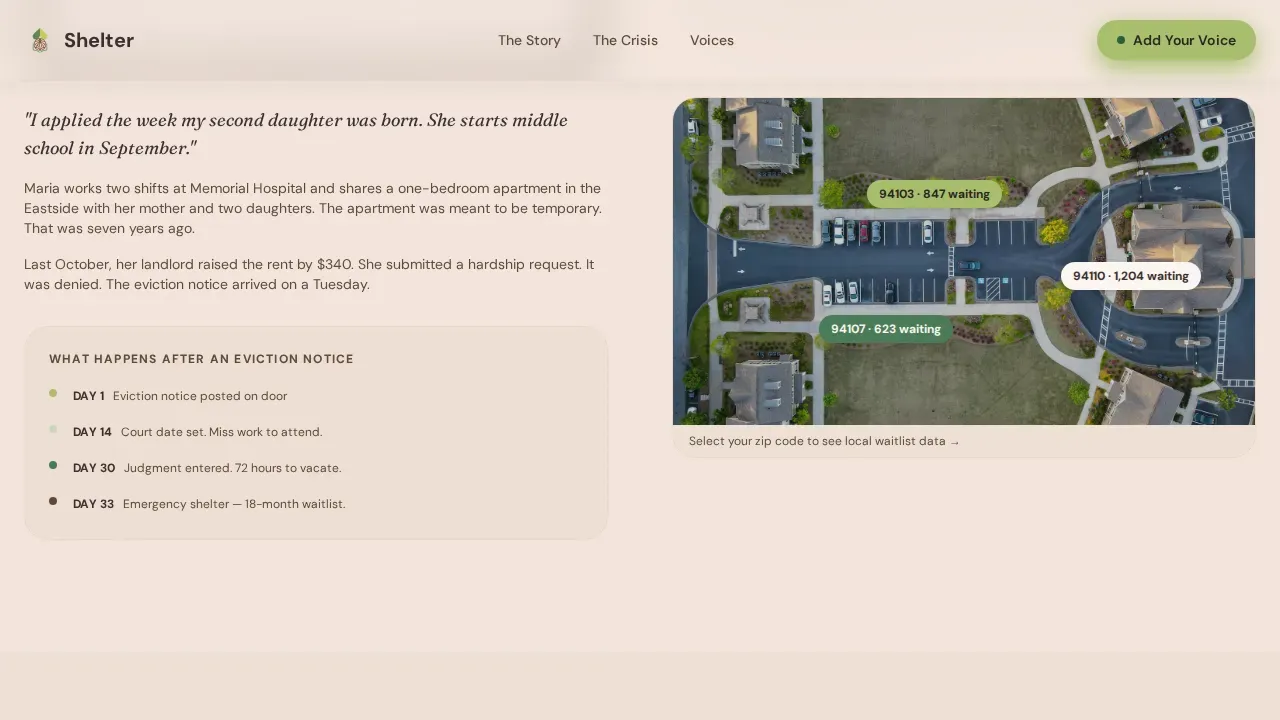
The Ordinary World section centers a specific family narrative rendered in a photojournalism aesthetic. An animated waitlist counter adds live-feeling context to the story, helping visitors develop a sense of how long families wait for stable housing. The expandable story card lets visitors learn more without leaving the section, keeping the focus where it belongs.
Bento-Grid Crisis Data Section
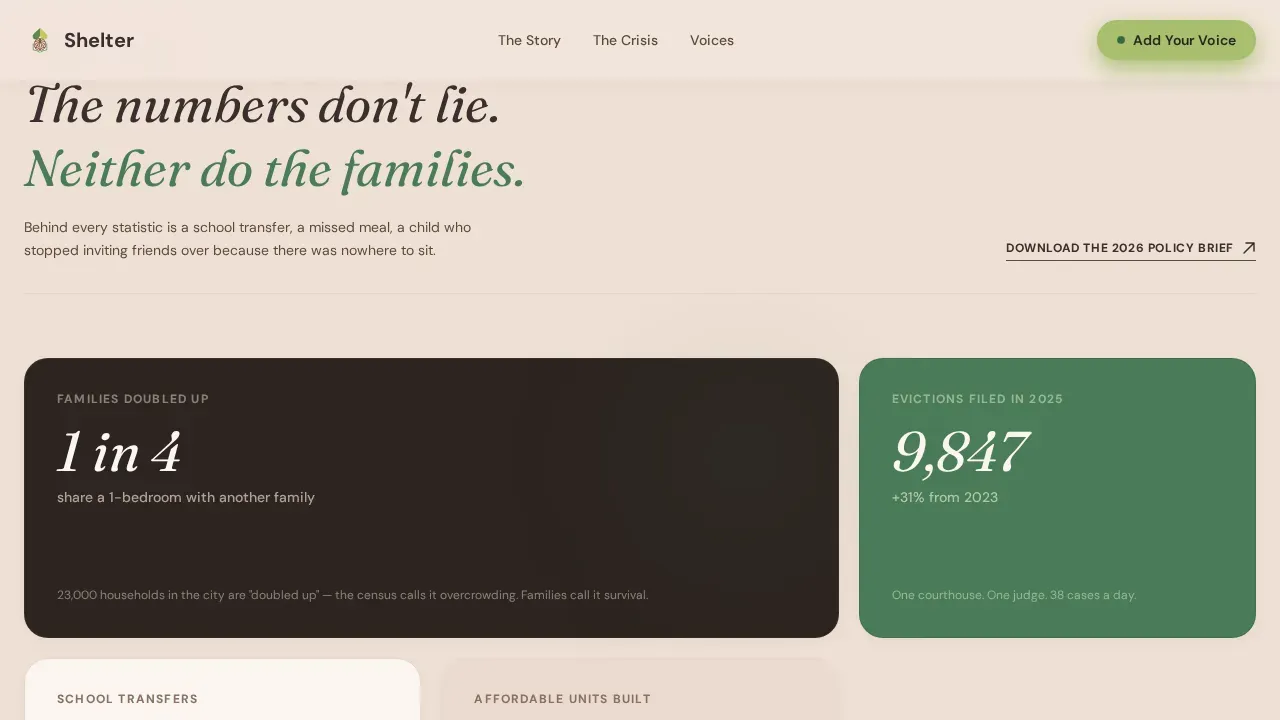
The Crisis in Numbers section uses an asymmetric bento grid to present overcrowding rates, eviction figures, school transfer data, and waitlist statistics as visual, scannable units. Infographics communicate impact metrics clearly, making the case for support without requiring visitors to parse dense text. The layout makes data feel urgent without feeling clinical.
Horizontal-Scroll Testimonial Cards
The Voices From the Waitlist section renders named testimonials in a handwritten-card aesthetic and arranges them in a horizontal scroll. Each card carries a neighborhood attribution, giving residents a specific, dignified presence on the page. This section builds credibility and emotional resonance at the moment visitors are deciding whether to act.
Coalition Sign-Up Form with "I Can Offer" Dropdown
The primary conversion section is a full-width form with four fields: name, organization or affiliation, zip code, and a dropdown asking what the visitor can contribute. Options include signature, congregation, council vote, professional skills, or personal story. The minimal form reduces friction and the framing transforms a sign-up into an act of named commitment, not a generic subscription.
SMS Shortcode Secondary Path
Visitors who prefer mobile engagement can text the campaign hashtag to a shortcode and receive updates directly. This secondary conversion path extends the campaign's reach beyond the page and serves community members who access resources primarily via phone.
Page sections overview
| Section | Purpose |
|---|---|
| Full-Viewport Hero | Introduce the campaign, display scale stats, and offer two immediate conversion paths |
| Ordinary World Story | Humanize the waitlist experience through a specific family narrative and animated counter |
| Crisis in Numbers | Display housing and homelessness data in a scannable bento-grid format |
| Voices From Waitlist | Build credibility and empathy through neighborhood-attributed resident testimonials |
| Coalition Sign-Up Form | Convert engaged visitors into named coalition members via a low-friction form |
| Linear Footer | Anchor the page with partner logos, social links, and secondary navigation |
Design & branding system
The visual identity follows a Healing Space theme through a Botanical color system. Every color choice carries an emotional intention rooted in warmth, growth, and safety.
- Petal blush (#F2E4DC) as the background wash, living fern green (#4A7C59) for section accents and pull quotes, deep loam brown (#3B2F2F) for body text, and new-growth chartreuse (#A8BF6F) for buttons and interactive elements
- Fraunces serif in italic for editorial headlines and pull quotes; DM Sans for body copy, labels, and form fields
- High-quality photojournalism imagery, pressed wildflower textures, and handwritten card aesthetics create a visual environment that feels nurturing, alive, and grounded in real community life
Mobile & speed optimization
The template is built desktop-first as an editorial experience, and every section is fully responsive for mobile users. Many community members and coalition partners will access the page on their phones, so the layout adapts cleanly at every breakpoint.
- Parallax hero, scroll-triggered counters, stagger-reveal animations, and horizontal scroll testimonials are built with GPU-accelerated CSS animations to keep motion smooth
- Images are optimized for fast loading, and the minimal navigation structure keeps visitors focused on the coalition sign-up rather than wandering the site
- The simple four-field form is thumb-friendly and loads without layout shift on mobile devices
How this template helps you convert
The page is engineered to serve the mission at every scroll depth, not just at the bottom. Each section earns the next click by giving the visitor something real before asking for anything in return.
- The above-the-fold call-to-action button and SMS path capture early-decision visitors before they reach the data sections, serving those who are already convinced and ready to contribute their voice immediately.
- The Hero's Journey narrative arc moves skeptical visitors through understanding, empathy, and finally agency, so by the time they reach the coalition form they feel personally invited, not generically solicited.
- Named testimonials, partner organization logos, and policy win milestones inform late-stage visitors that real organizations and real community members already stand behind the campaign, which builds the trust needed for sign-up.
Other information about this template
This template was developed with a holistic approach to campaign design, treating the landing page as both a storytelling platform and a coalition-building tool. It reflects decades of research showing that housing is a determinant of health, and that well-designed shelters and housing projects heal more than physical shelter alone.
- The design integrates principles of trauma informed care by creating an environment where visitors feel safe, welcomed, and given choices about how they engage rather than pressured
- Sections can be adapted to serve a range of housing contexts including transitional shelters, senior housing programs, or community health initiatives that extend beyond a single campaign
- The template supports narratives that center case management services, outdoor spaces, natural light, and physical activity as part of a holistic support model for residents
- Organizations working on real estate development, public spaces, or integration projects for marginalized communities will find the editorial structure flexible enough to serve a wide range of campaign goals
- The color system, typography, and section layout contribute to a sense of belonging and wellness for every visitor who lands on the page, whether they are a decision-maker or someone living the story themselves
- The Selfhelp Active Services for Aging Model (SHASAM) is one example of the kind of program narrative this template can help communicate, where health, social services, and housing intersect to support older adults and other vulnerable populations
Theme
Healing Space
Creative direction
Hero's Journey
Color system
Botanical
Style
Editorial/Magazine
Direction
Lead Generation
Page Sections
Hero Section with Botanical Hashtag Treatment
Animated Family Story and Waitlist Counter
Bento-grid Crisis Data Visualizations
Horizontal-scroll Testimonial Cards
Coalition Sign-up Form with Dropdown Offer
Secondary SMS Shortcode Conversion Path
Related questions
Who is the primary audience for this template?
Can I adapt the coalition form fields for my specific campaign?
Does the template include testimonial content and photography?
Is this template suitable for a senior housing or transitional shelter campaign?
How does the SMS path work alongside the main coalition form?