Veteran & Military Support Professional Website Template
Homestead is a nature-inspired, modular card grid landing page built for a community-driven veteran housing program. It guides three distinct visitors, veterans in housing need, VA caseworkers, and local volunteers, from mission to action. The primary conversion is Build Day event registration, supported by a dynamic veteran-or-volunteer form toggle and a secondary illustrated site map path.
by Rocket studio
Quick summary
Homestead is a single-page, card grid landing page for a nonprofit veteran housing program. It moves visitors from emotional connection to clear action through a scroll that alternates mission storytelling, vision renderings, social proof, and a smart event registration form. The design feels warm, grounded, and human from the first illustrated headline to the final call to action.
Who this template is for
This template is built for organizations running community-led permanent housing programs for veterans. It speaks equally well to the veteran seeking a home, the caseworker researching options, and the neighbor who wants to help build one.
- Post-service veterans in housing instability, including those couch-surfing or aging out of transitional housing
- VA caseworkers and placement coordinators looking for verified housing resources
- Local volunteers ready to contribute construction skills, meals, mentorship, or fundraising support
What problem this template solves
Most nonprofit housing pages feel like grant reports or emergency appeals. They list facts but never invite visitors in. Homestead solves this by building trust through story before asking for anything. It gives each visitor a clear path forward without forcing commitment too early.
- Veterans feel seen rather than processed, thanks to one-sentence peer stories on hover-reveal cards
- Caseworkers can quickly read program scope, phases, and placement context without wading through dense text
- Volunteers find an immediate, low-barrier action: sign up for the next Build Day in under a minute
What you get with this template
You get a complete, ready-to-customize single-page layout with every section already structured and connected. The scroll flows intentionally from WHY the program exists to WHAT it builds to HOW someone participates.
- A full-width custom illustrated header, three hover-lift mission pillar cards, a bento-style vision and timeline grid, alternating social proof blocks, and a full-width Build Day registration section
- A dynamic registration form with a veteran-or-volunteer toggle that reveals tailored follow-up questions for each path
- A secondary engagement path via a "Walk the property virtually" text link leading to an illustrated site map, keeping curious visitors engaged before they are ready to commit
Feature list
This section details the core built-in capabilities of the Homestead landing page template.
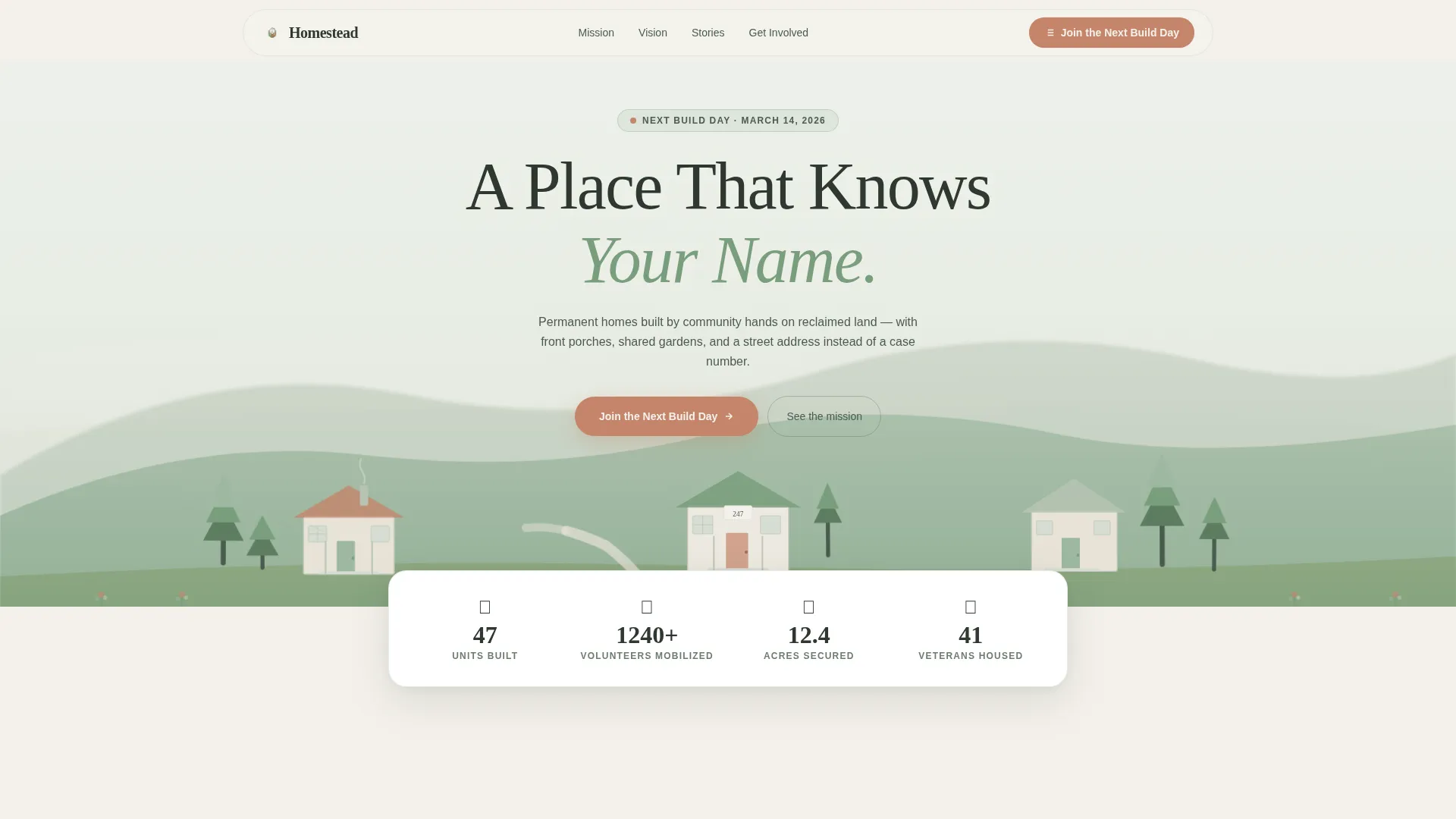
Panoramic Custom Illustration Header
The header spans the full page width and presents a hand-drawn panoramic scene in soft ink and muted watercolor wash. A hillside of small timber-frame homes, native trees, a winding footpath, and a single figure at the trailhead set the tone immediately. The headline "A Place That Knows Your Name" emerges from the sky portion of the illustration like morning light.
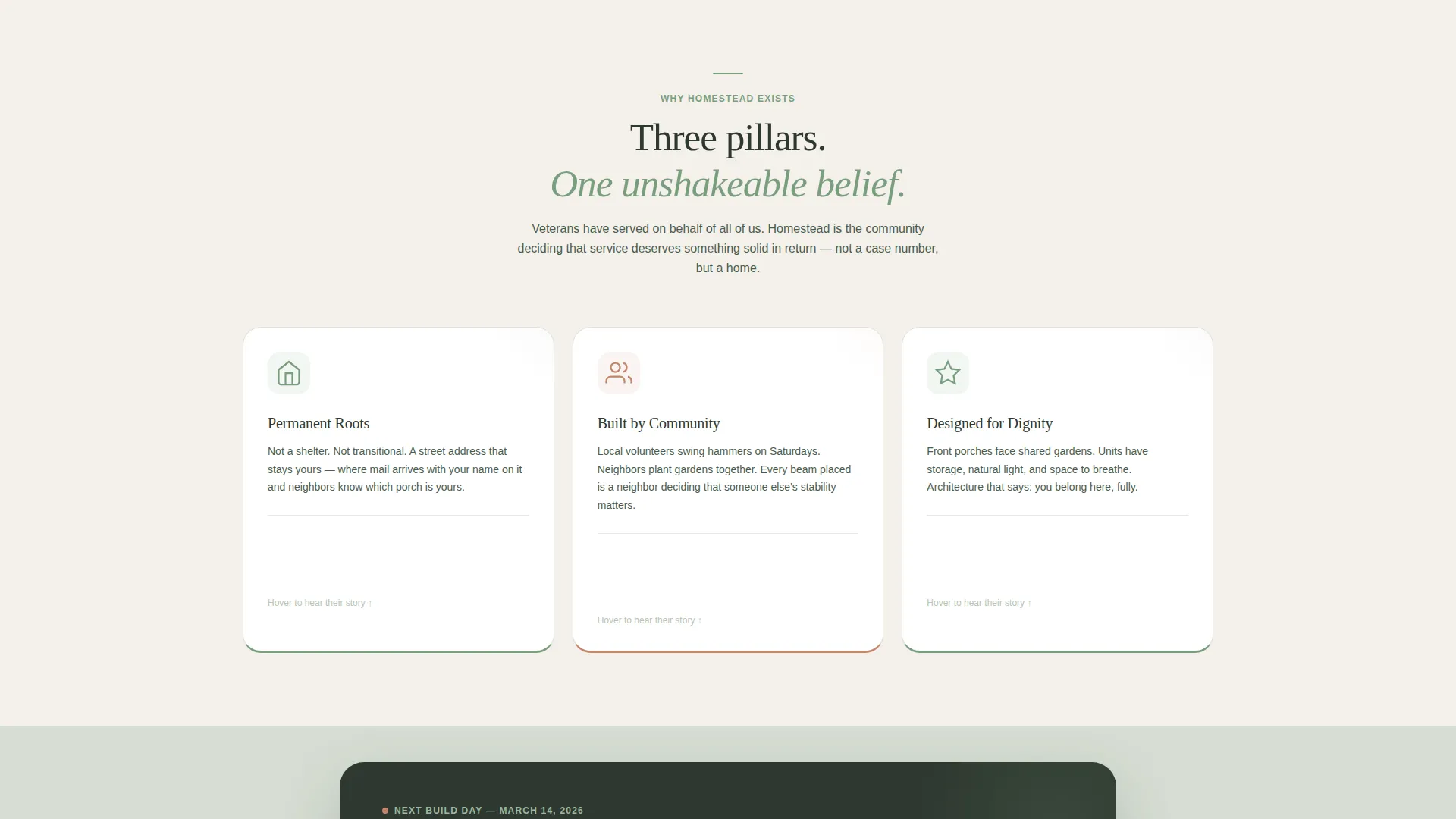
Hover-Lift Mission Pillar Cards
Three modular cards present the program's core pillars: Permanent Roots, Built by Community, and Designed for Dignity. Each card lifts on hover to reveal a single veteran's one-sentence story, making the mission feel personal rather than institutional.
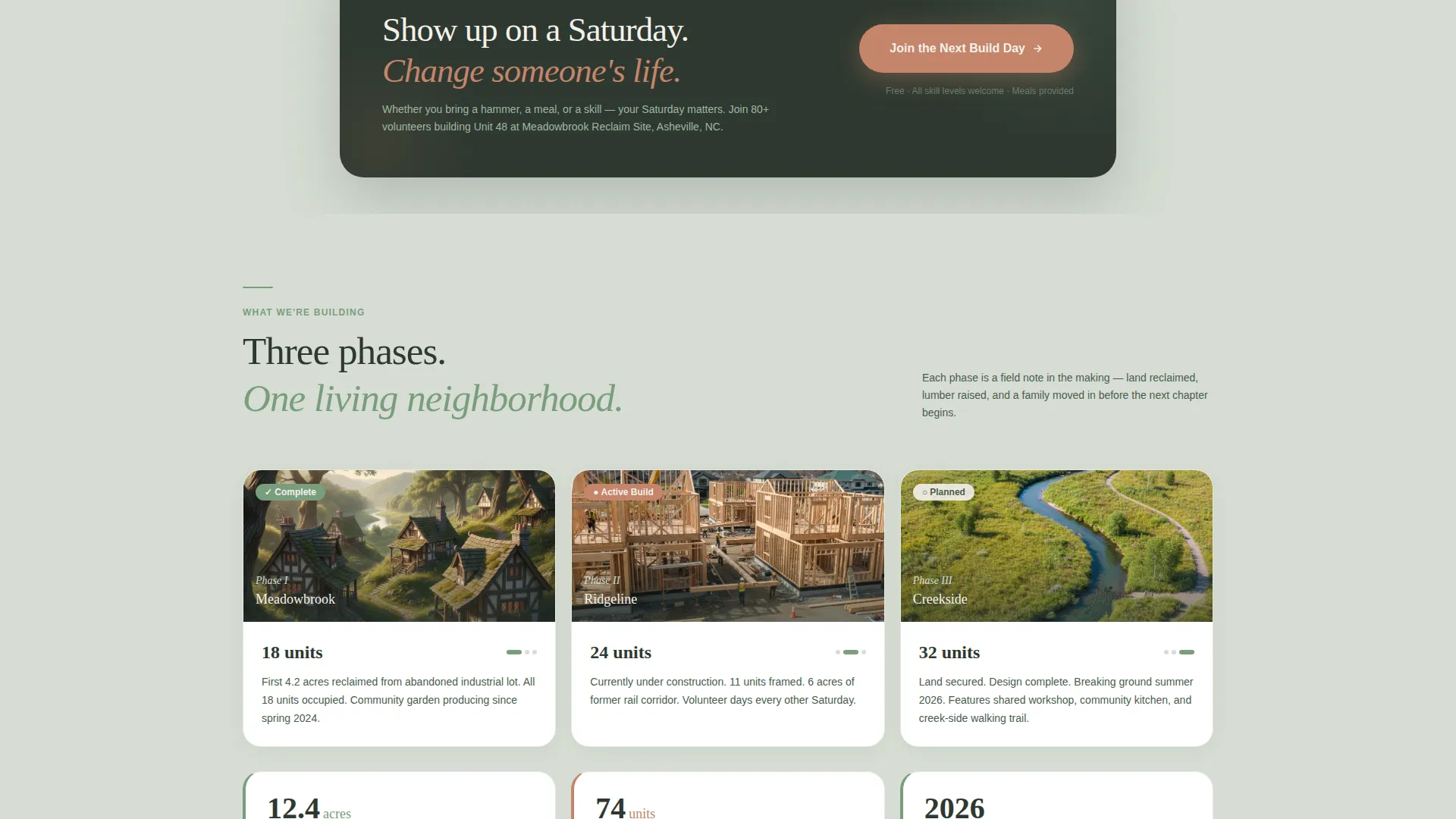
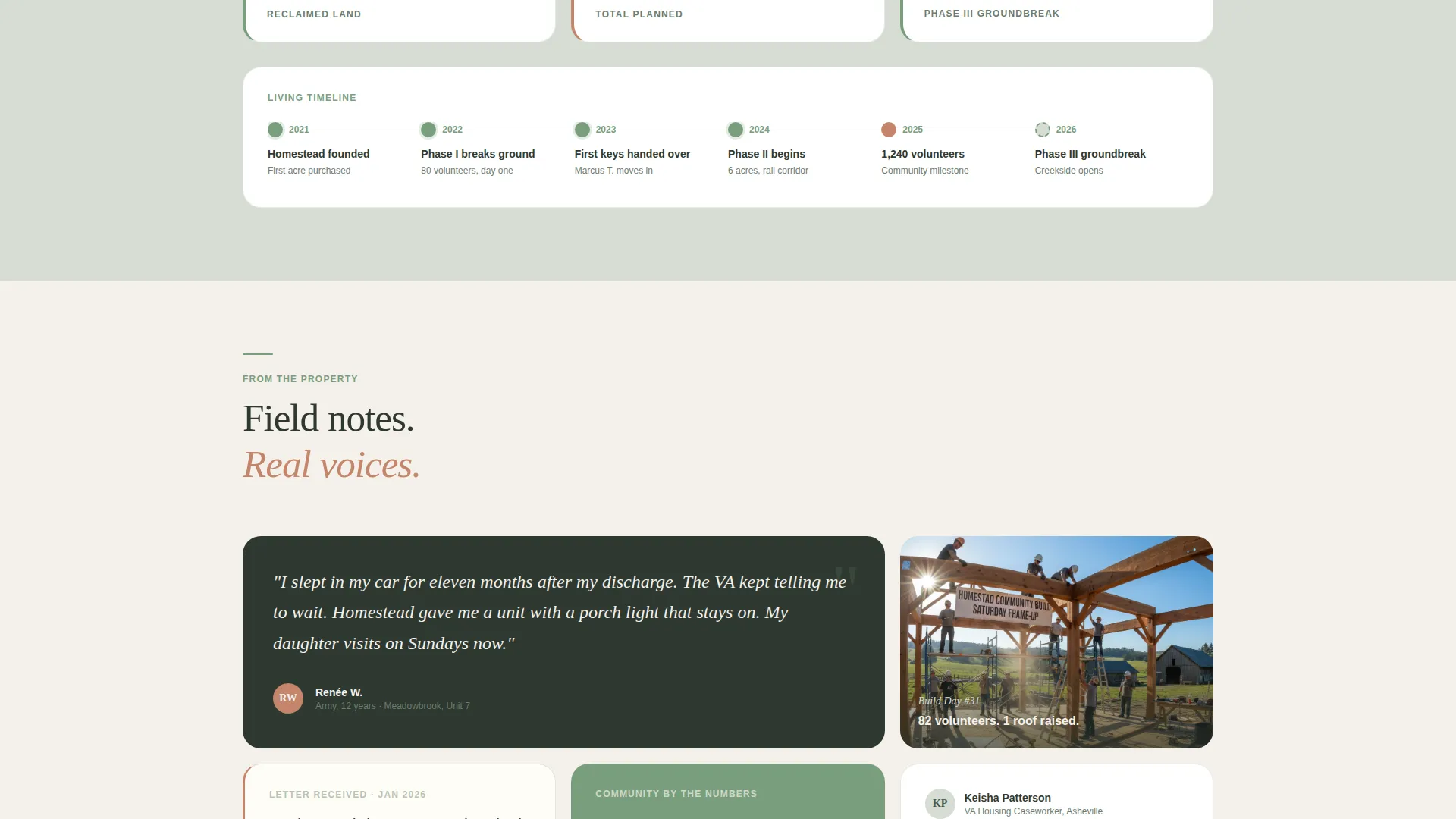
Bento-Style Vision and Timeline Grid
A mixed-format bento grid displays phase renderings, land parcel details, and a left-to-right living timeline. Data cards showing units built, volunteers mobilized, and acres secured alternate with narrative field-note cards holding quotes, photos, and hand-written letter excerpts.
Dynamic Veteran or Volunteer Registration Form
The Build Day registration form opens with first name and email, then presents a single toggle: "I'm a veteran" or "I'm a volunteer." Veterans see a housing-stage dropdown; volunteers see a skill-set checklist. The form adapts in real time based on the visitor's selection.
Floating Stats Strip and Persistent Call to Action
A stats strip anchors above the fold and a "Join the Next Build Day" button appears both in the top-right header area and as a full-width card after the mission section and again at the page close, keeping the primary action visible throughout the scroll.
Illustrated Site Map Secondary Path
A quieter text link beneath the registration form reads "Not ready yet? Walk the property virtually." This leads to an illustrated site map, offering a low-pressure alternative engagement route that keeps hesitant visitors on the page longer.
Page sections overview
| Section | Purpose |
|---|---|
| Illustrated panoramic header | Set emotional tone and surface primary call to action |
| Floating stats strip | Anchor credibility with real program metrics above the fold |
| Mission pillar cards | Communicate program values through hover-revealed veteran stories |
| Vision and timeline grid | Show program phases, land data, and progress in a tactile bento layout |
| Social proof blocks | Build trust through alternating quotes, photos, and letter excerpts |
| Build Day registration | Convert veterans and volunteers through a dynamic, adaptive form |
| Virtual site map path | Retain undecided visitors with a low-commitment illustrated exploration |
| Minimal footer | Close with clean horizontal layout and essential program links |
Design & branding system
The visual identity follows a nature-inspired direction that feels like a watercolor field sketch left open on a windowsill. Nothing competes for attention; every element guides the eye forward like a trail marker in a quiet wood.
- Color system: birch bark white (#F4F1EB) and fog gray (#D6DDD3) alternate as section backgrounds; lichen green (#7A9E7E) anchors dividers and iconography; muted terracotta (#C4856A) is reserved for buttons and interactive card borders; all body text sits in deep forest charcoal (#2E3830)
- Typography: Fraunces serif headlines carry warmth and weight; DM Sans handles body copy with clean, readable clarity at every screen size
- Illustration style: architectural sketch meets botanical illustration, rendered in soft ink and muted wash, warm and unhurried with generous white space throughout
Mobile & speed optimization
The layout is built desktop-first with a strong mobile fallback, recognizing that VA caseworkers frequently access resources on mobile devices in the field. Interactive components are separated from static sections to keep rendering efficient.
- Server Components handle all static sections including the header illustration, mission cards at rest, and the footer, while Client Components manage the interactive form toggle and scroll-triggered animations
- GSAP ScrollTrigger drives staggered card reveals and counter animations, with CSS and SVG handling illustration details to keep asset weight low
- The modular card grid reflows cleanly for tablet and mobile viewports so the bento vision grid and mission cards remain readable and tappable at smaller sizes
How this template helps you convert
The page is designed so that every scroll stage moves a visitor closer to one clear action without ever feeling like a pressure campaign.
- The illustrated header and hoverable mission cards build emotional trust early, so visitors arrive at the registration form already believing in the program rather than evaluating it skeptically.
- The dynamic form toggle reduces friction by showing each visitor only the fields relevant to them, making the registration feel personal and fast rather than generic and exhausting.
- The illustrated site map secondary path ensures that visitors who are not yet ready to register stay engaged on the page, increasing the chance they return or share the program with someone who needs it.
Other information about this template
Homestead is part of the Community and Nonprofit category, specifically designed for the Veteran and Military Support subcategory. It fits organizations working within the veteran housing program niche in the United States.
- The template style is Card Grid (Modular), making individual sections easy to reorder, expand, or replace as the program grows and new phases launch
- The creative direction follows a Vision and Mission flow, the header concept is a Custom Illustration, and the primary landing page direction is Event Registration, all of which are baked into the structure rather than requiring manual assembly
- The Soft Mist color system was chosen specifically to avoid the visual language of crisis communications, presenting the program as stable, dignified, and community-rooted rather than urgent or desperate
Theme
Nature-Inspired
Creative direction
Vision & Mission
Color system
Soft Mist
Style
Card Grid (Modular)
Direction
Event Registration
Page Sections
Panoramic Custom Illustration Header
Hover-lift Mission Pillar Cards
Bento-style Vision and Timeline Grid
Dynamic Veteran or Volunteer Registration Form
Floating Stats Strip and Persistent Call to Action
Illustrated Site Map Secondary Path
Related questions
Who are the three audiences this landing page is designed for?
How does the registration form handle veterans and volunteers differently?
Can someone explore the page without signing up right away?
What does the bento vision grid section display?
Is this template suitable for a program still in its early phases?