Premium Hackers Landing Page Template
Convene is a masonry-layout landing page template built for indie hacker peer advisory boards. It combines a candid documentary hero photo, a founding-charter preamble, and a mosaic of principle cards and member testimonials. The page drives applications through an amber-accented "Apply for a Seat" form and a secondary email-capture path for a downloadable charter PDF.
by Rocket studio
Quick summary
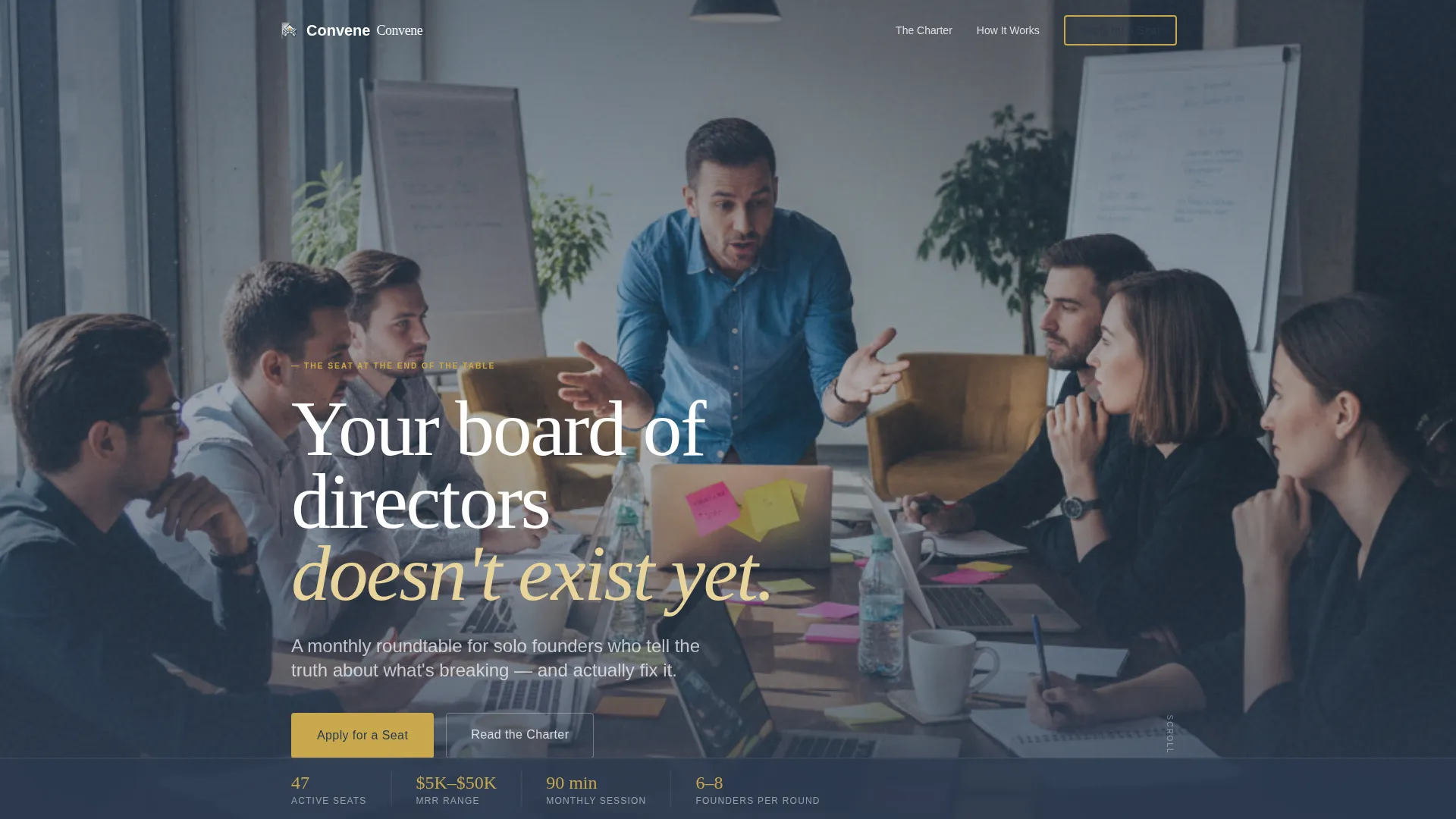
Convene is a single-page template designed for bootstrapped founder communities. It opens with a grainy, candid team photo and fades in the line "Your board of directors doesn't exist yet." A masonry grid of principle cards and peer testimonials follows, leading visitors toward an application form built around one honest question: what decision are you stuck on right now?
Who this template is for
This template is for community organizers and founders building a structured peer council for independent builders. It fits both the person running the community and the developer setting up the page.
- Bootstrapped SaaS founders launching a peer advisory board for fellow solo builders
- Plugin developers or newsletter operators who want a credible, editorial-style landing page to recruit founding members
- Pre-revenue founders preparing a community presence ahead of their first cohort
What problem this template solves
Solo founders rarely have a trusted room to speak plainly about what is breaking. Most community pages either look like corporate conference sites or feel too casual to earn trust. Neither converts serious founders.
- Generic community templates lack the editorial weight needed to attract high-intent, revenue-generating founders
- Standard form layouts do not signal that the organizer cares about individual applicants, only about volume
- Typical hero sections talk at visitors rather than inviting them to take the empty seat at the table
What you get with this template
You get a complete, section-led landing page that moves from a documentary hero moment through a charter philosophy section and into a conversion-ready application form. Every element is designed to feel deliberate and readable rather than performative.
- A cinematic hero block with a candid team photo treatment and a fade-in headline
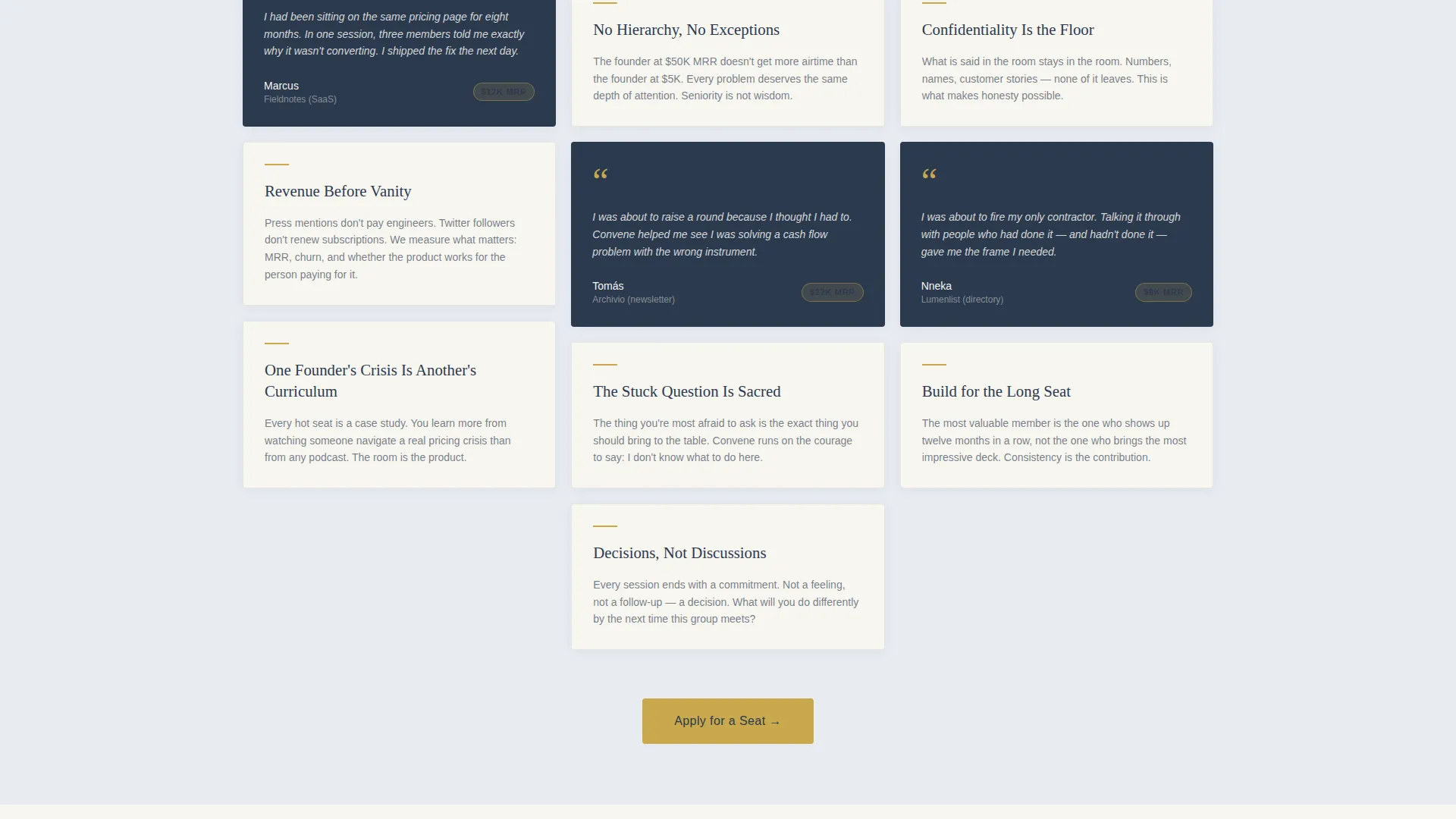
- A masonry card grid mixing principle cards and member testimonial cards, each carrying equal visual weight
- An application form with a dropdown MRR range selector and an open-text question field, plus a secondary email-capture path for a charter PDF download
Feature list
A paragraph introducing the feature list: The following features ship as part of the Convene template and are drawn directly from the design brief and section plan described above.
Documentary Hero Block
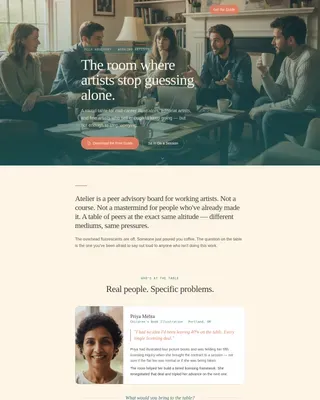
The hero displays a wide, slightly grainy candid photo of eight founders around a long table. The composition is shot from the empty chair at the table's end, placing the visitor in the scene. A single line fades in over the image on scroll entry.
Masonry Principle and Testimonial Grid
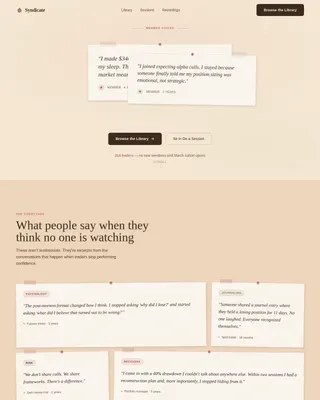
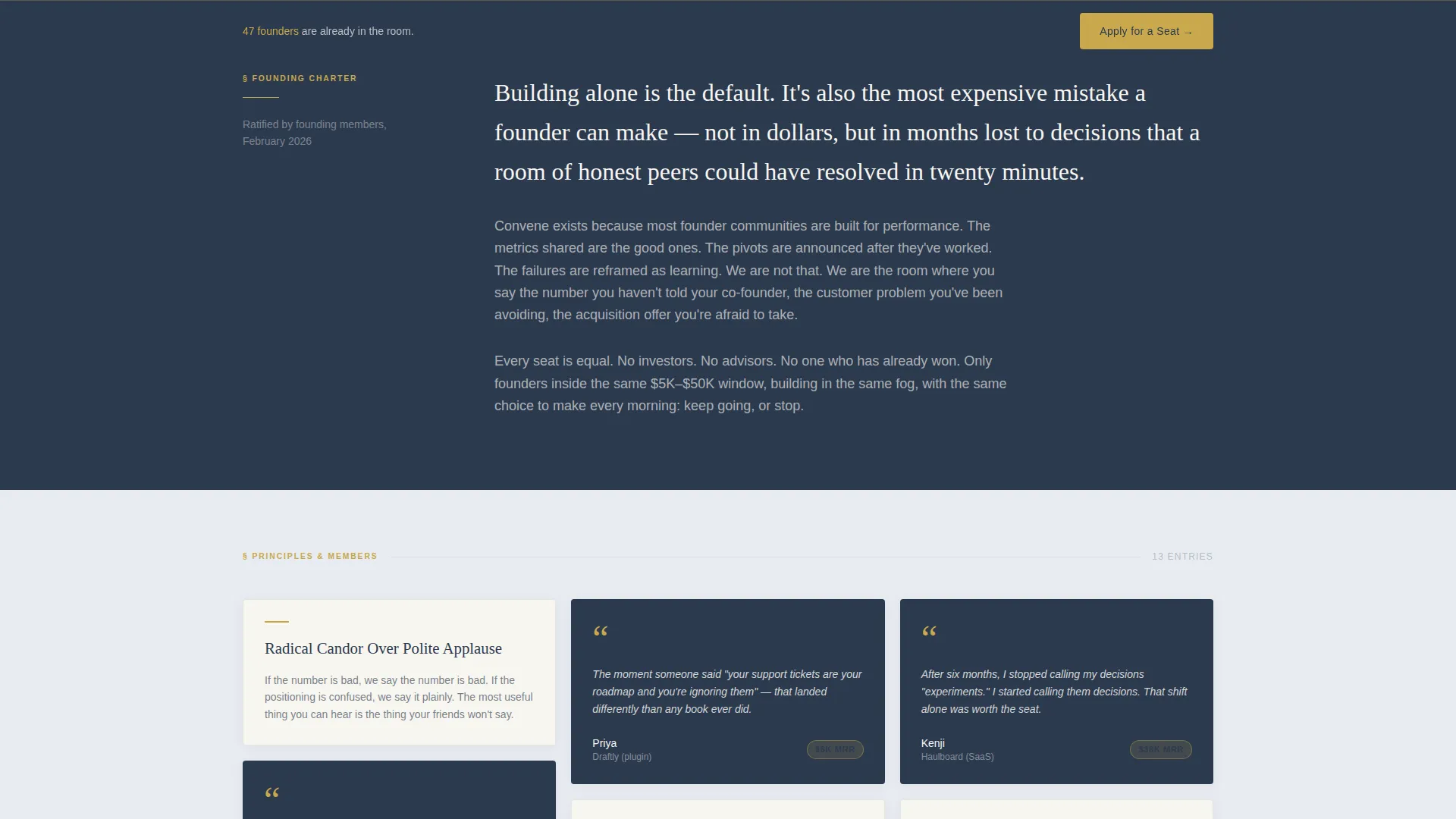
Cards tile outward in a masonry layout with no enforced hierarchy. Principle cards carry short conviction statements such as "Radical Candor Over Polite Applause." Testimonial cards show a member's first name, product name, monthly recurring revenue range, and one sentence about what changed after joining.
Charter Preamble Section
Below the hero, a short editorial preamble states what the board believes about building alone versus building in council. It reads like a founding charter and sets the philosophical tone before the masonry grid begins.
"Apply for a Seat" Application Form
The primary form collects first name, product URL, a monthly recurring revenue range via dropdown (pre-revenue, under $5K, $5K to $20K, $20K to $50K), and one open-text field asking what decision the applicant is currently stuck on. A persistent amber-bordered call-to-action button appears after the third row of cards.
Charter PDF Email Capture
A secondary conversion path invites visitors to "Read the Charter" as a downloadable PDF. This path captures an email address and serves founders who are not yet ready to apply but want to stay connected.
Civic Editorial Design System
Typography pairs Fraunces serif headlines with DM Sans body text. The color system uses a fog gray page canvas, navy body text, parchment card backgrounds, and amber reserved exclusively for badges, vote-count indicators, and call-to-action borders.
Page sections overview
| Section | Purpose |
|---|---|
| Hero photo block | Establishes documentary tone and fades in the founding headline |
| Charter preamble text | States the board's core beliefs about peer counsel |
| Masonry principles grid | Tiles conviction statements and member testimonials without hierarchy |
| "Apply for a Seat" form | Captures applications with MRR dropdown and open-text question |
| Charter PDF capture | Collects email addresses via secondary downloadable PDF path |
| Linear footer row | Closes the page with a clean single-row footer |
Design & branding system
The visual identity follows a Civic Service theme. Every design decision prioritizes readability and trust over visual performance. The palette feels like the letterhead of a small-town public library, unhurried and built for sustained reading.
- Colors: fog gray (#E8ECF1) canvas, worn ballot-box navy (#2C3A4F) for all body text, civic parchment (#F7F5F0) for card backgrounds, and muted amber (#C9A84C) used only for badges, vote counts, and call-to-action borders
- Typography: Fraunces serif for headlines and DM Sans for body copy, creating an editorial contrast that reads naturally at any card size
- Animation: low-to-medium intensity with fade-in on scroll, staggered card reveals as the masonry grid loads, and subtle hover states on cards
Mobile & speed optimization
The template is designed desktop-first, reflecting the real behavior of its audience. Founders typically review community pages during work hours on a laptop. A strong mobile fallback ensures the page remains fully usable on smaller screens.
- The masonry grid collapses gracefully to a single-column layout on mobile without breaking card hierarchy
- Static content sections use server components to minimize JavaScript load, keeping the page light on slower connections
- Animation intensity is kept low to medium so the page feels responsive rather than heavy
How this template helps you convert
The Convene template is built around two clear conversion paths. Every layout decision is designed to move a founder from recognition to action without pressure.
- The persistent amber-bordered "Apply for a Seat" button appears after the third row of masonry cards, catching founders who have read enough to commit. The open-text question in the form signals genuine interest in the individual applicant, not just their revenue number.
- The "Read the Charter" PDF download provides a lower-friction entry point. Founders who are not ready to apply still leave an email address, creating a warm follow-up audience for future cohort openings.
Other information about this template
This template was built specifically for the indie hacker peer advisory board niche within the broader community and nonprofit category. It suits any organizer running a structured roundtable for solo founders at the $5K to $50K monthly recurring revenue stage.
- The template style is Masonry/Pinterest, making it well-suited for communities that want a mosaic of voices rather than a ranked or tiered layout
- The Soft Mist color system and Civic Service theme make the page feel approachable to founder audiences who distrust overly polished marketing
- The footer uses a linear single-row pattern, keeping the page exit clean without distracting from the two conversion paths above it
- The page is localized for English-language audiences using USD and US date formatting
Theme
Civic Service
Creative direction
Vision & Mission
Color system
Soft Mist
Style
Masonry/Pinterest
Direction
Lead Generation
Page Sections
Documentary Hero Block
Masonry Principle and Testimonial Grid
Charter Preamble Section
Apply for a Seat Application Form
Charter PDF Email Capture
Civic Editorial Design System
Related questions
Can I edit the principle cards and testimonials myself?
Does the application form connect to any external service?
Can I use this template before my community has any members?
What if I do not have a charter PDF ready at launch?
Is this template suitable for peer communities beyond monthly roundtables?