Ethiopian Cooking Class Landing Page Template
Injera is a gallery and detail landing page designed for Ethiopian cooking class hosts who want to fill seats, not just post schedules. It leads with a UGC photo wall, expands into clickable class cards, and closes with a spot-reservation form and a gift-a-class option. The template feels like a community bulletin board that rewards every scroll with more warmth.
by Rocket studio
Quick summary
Injera is a single-page template built for Ethiopian cooking class hosts who want every visitor to feel invited before they ever reach a booking form. The layout moves from a mosaic photo wall through a gallery of class cards, deep-dive detail panels, a testimonial strip, and a gift-a-class conversion path. It is designed to show the experience first and ask for commitment second.
Who this template is for
This template is for anyone running hands-on Ethiopian food experiences in neighborhood kitchens, community spaces, or pop-up venues. It suits hosts who want guests to feel the warmth of the room before they read a single line of copy.
- Diaspora chefs and home cooks teaching Ethiopian cooking classes to local communities
- Experience hosts offering couples, families, or small groups a weekend evening in the kitchen
- Culinary educators who want a mobile-first booking page that matches the intimacy of their classes
What problem this template solves
Most cooking class pages read like event ticketing forms. They list a date, a price, and a location, and then they stop. Visitors who have never eaten Ethiopian food from a shared platter have no context for what the evening actually feels like. The template solves this by letting the experience speak first.
- Visitors scroll through real student photos before they see a booking button, so the page earns trust early
- Each class card opens into a detail panel with the instructor story, the full menu being cooked, and take-home items, so no one misses context
- The scarcity-driven "X spots left" indicator and a date picker make it easy to move from curiosity to commitment
What you get with this template
The template delivers a complete, ready-to-customize landing page with all major sections already structured and connected. Every component is designed to carry the warmth of a neighborhood cooking session into a digital format.
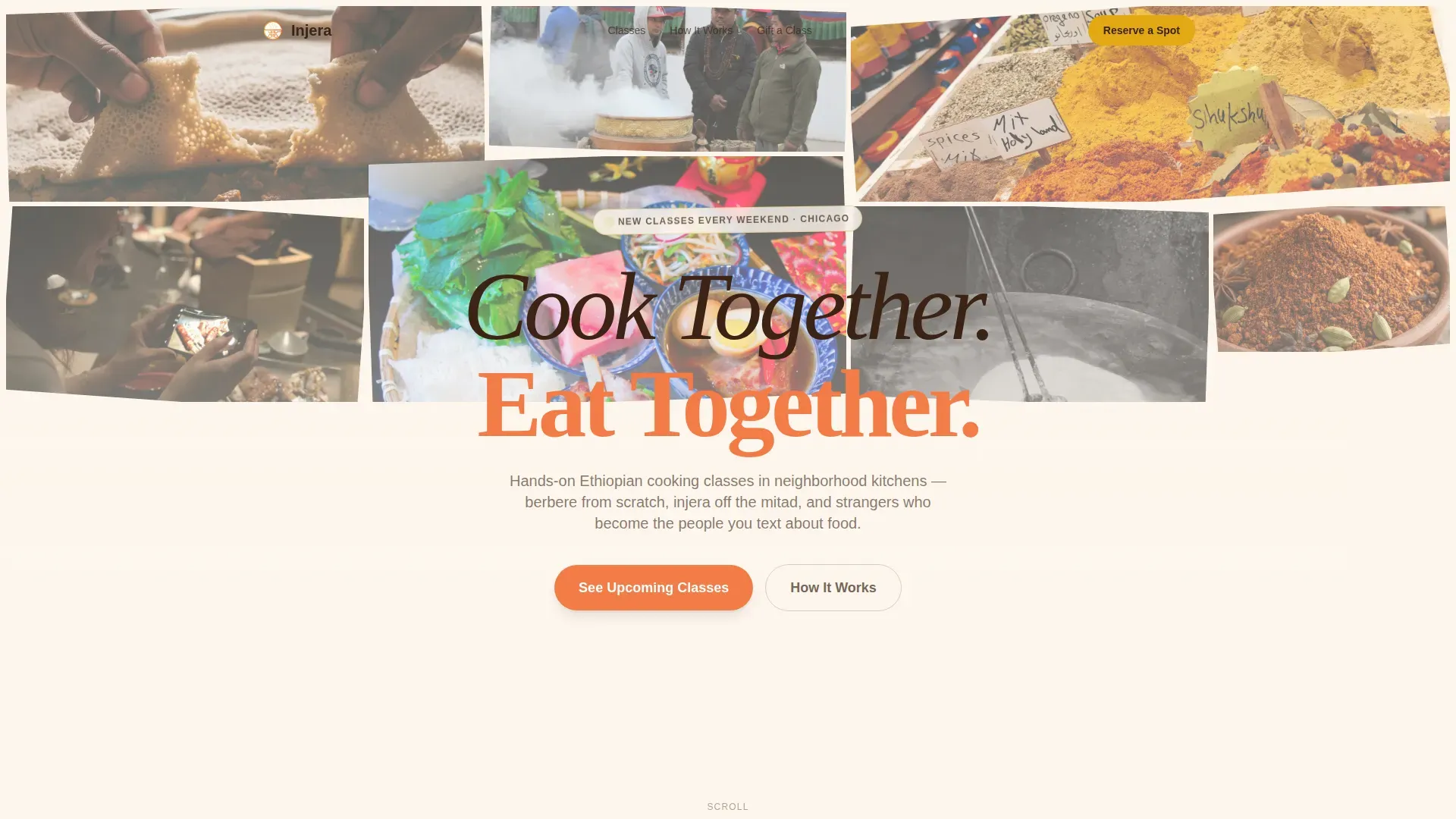
- A UGC photo wall hero with a handwritten-style floating headline and a live class badge
- An expandable class gallery grid, a class detail panel, a testimonials marquee, and a gift-a-class section
- A booking form per class card with a date picker, group size selector, and dietary note field
Feature list
UGC Photo Wall Hero
The header is a loose, slightly overlapping mosaic of real student photos. Flour-dusted hands, laughing groups around a steaming pot, and a child stirring shiro with a wooden spoon too big for their grip all appear here. A handwritten-style headline floats over the mosaic: "Cook Together. Eat Together." The grain and warmth of phone cameras is the intended aesthetic, not a compromise.
Expandable Class Cards
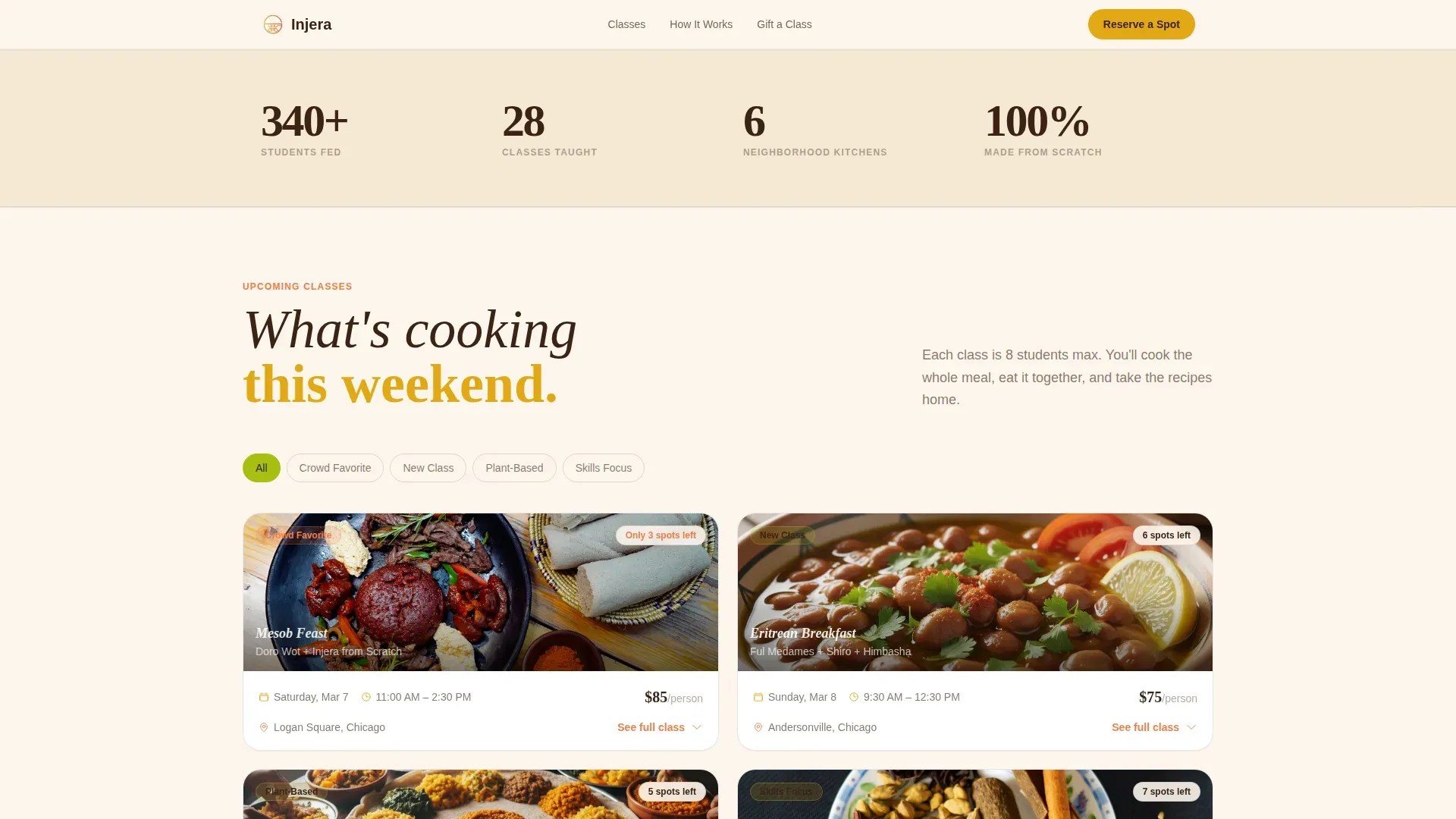
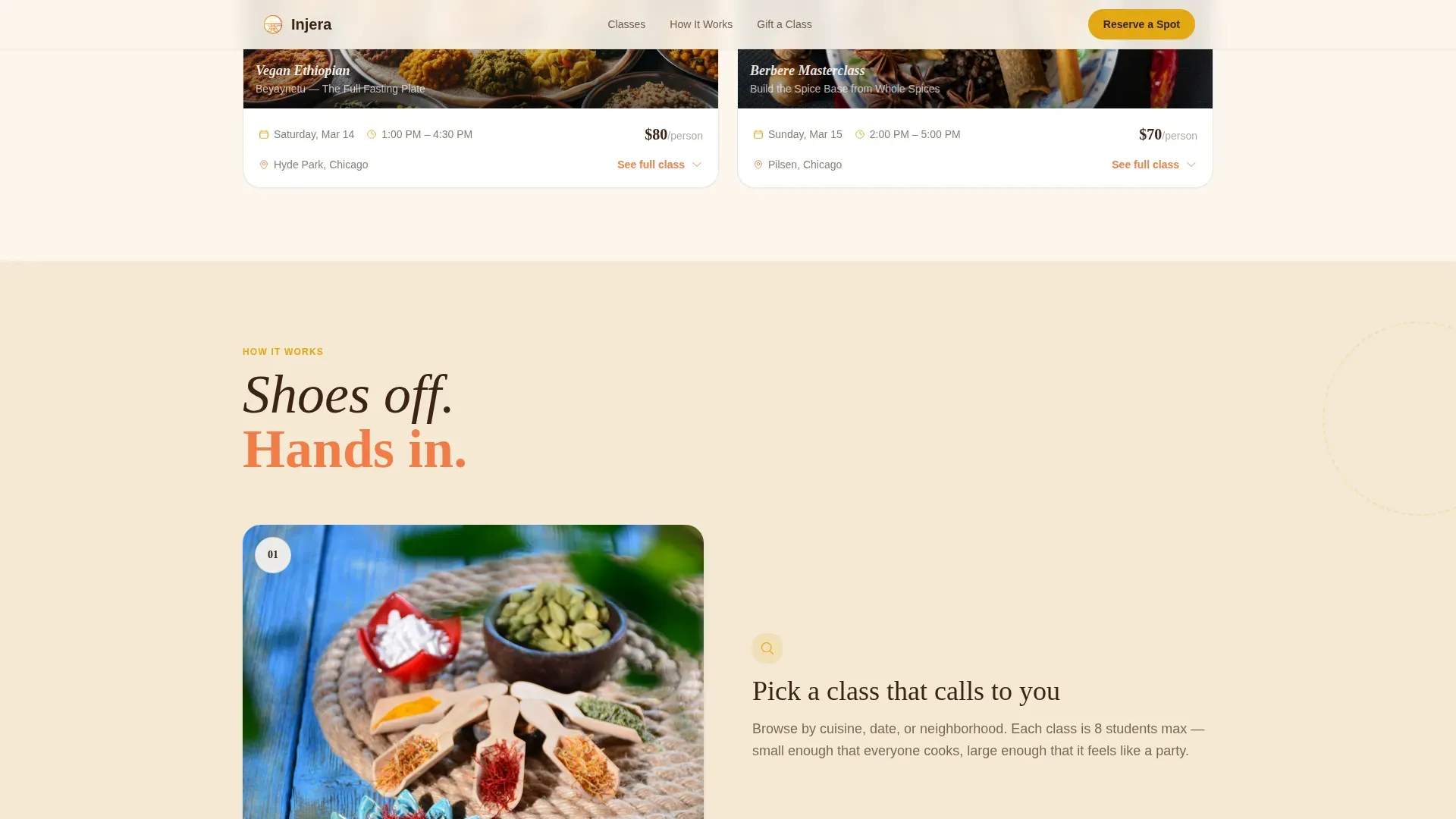
The class gallery grid shows upcoming classes with a thumbnail image, a cuisine focus tag such as vegan Ethiopian or Eritrean breakfast, and a neighborhood venue name. Clicking any card expands a detail panel inline. The panel reveals the instructor's story, the full menu being cooked that evening, what students take home, and three student photos from past sessions. Visitors can view everything they need without leaving the page.
Per-Card Booking Form
Each class card carries its own "Reserve Your Spot" button. The booking form includes a date picker, a group size selector for solo, pair, or group of four, and a dietary note field. This design lets guests choose the class format that suits them and add relevant dietary information before they post a reservation.
Testimonials Marquee Strip
A horizontally scrolling marquee displays student quotes alongside their photos. The strip runs between the class gallery and the gift section, adding social proof exactly where visitors are weighing whether to commit. The motion is designed to feel lively without being distracting.
Gift a Class Section
A secondary conversion path at the bottom of the page lets visitors send a class as a gift. The section includes a recipient email field and an optional personal message. This opens a second reason to convert for visitors who are not ready to book for themselves but want to share the experience with someone else.
GSAP Scroll Animations and Beam Borders
The template uses medium-level GSAP scroll reveals throughout the page. Class cards animate into view as the user scrolls. Beam borders add subtle structure to section transitions. These details create the feeling of a bulletin board coming to life as you explore it, without making the page feel heavy.
Page sections overview
| Section | Purpose |
|---|---|
| UGC Photo Wall Hero | Opens the page with real student moments and a floating handwritten headline |
| Live Class Badge | Signals active availability and adds urgency at the top of the page |
| Class Gallery Grid | Displays upcoming classes as browsable cards with cuisine tags and venue names |
| Class Detail Panel | Expands on click to show instructor story, menu, take-home items, and past photos |
| Testimonials Marquee | Scrolls student quotes and photos as warm social proof before the booking ask |
| Gift a Class | Secondary conversion path with recipient email and optional message field |
| Page Footer | Horizontal flow footer with navigation and contact links |
Design & branding system
The visual identity follows a Pastoral Calm theme built around the Citrus Burst color system. The palette feels like a wooden bowl of sliced citrus resting on a hand-woven mesob basket: bright without being loud, warm without being heavy. Berbere red tones and turmeric gold together create the kind of warm, inviting color environment that suits Ethiopian dining culture naturally.
- Turmeric gold (#E2A813) and ripe papaya (#F47C48) alternate as section accents; fresh lime leaf (#A8BF12) appears only on hover states and active class tags
- Deep coffee-ceremony brown (#3B2314) anchors all body text against a soft cream (#FDF6EC) background
- Fraunces serif display type is used for headlines; DM Sans handles body copy for comfortable reading at all sizes
Mobile & speed optimization
The template is designed mobile-first because most guests discover cooking class experiences on their phones through social media. Every section reflows cleanly for smaller screens, and the booking form is easy to complete with one hand. Images are lazy-loaded, and static sections use Server Components to keep the page responsive.
- The UGC photo wall mosaic adapts to a stacked layout on small screens without losing its community-bulletin-board feel
- Class cards and their expanded detail panels are touch-friendly and sized for comfortable mobile interaction
- The testimonials marquee and gift section are both fully functional at mobile viewport sizes
How this template helps you convert
The template is built to create a warm invitation rather than just listing logistics. It earns the click by showing the finished dishes and the people who made them long before it asks for a booking.
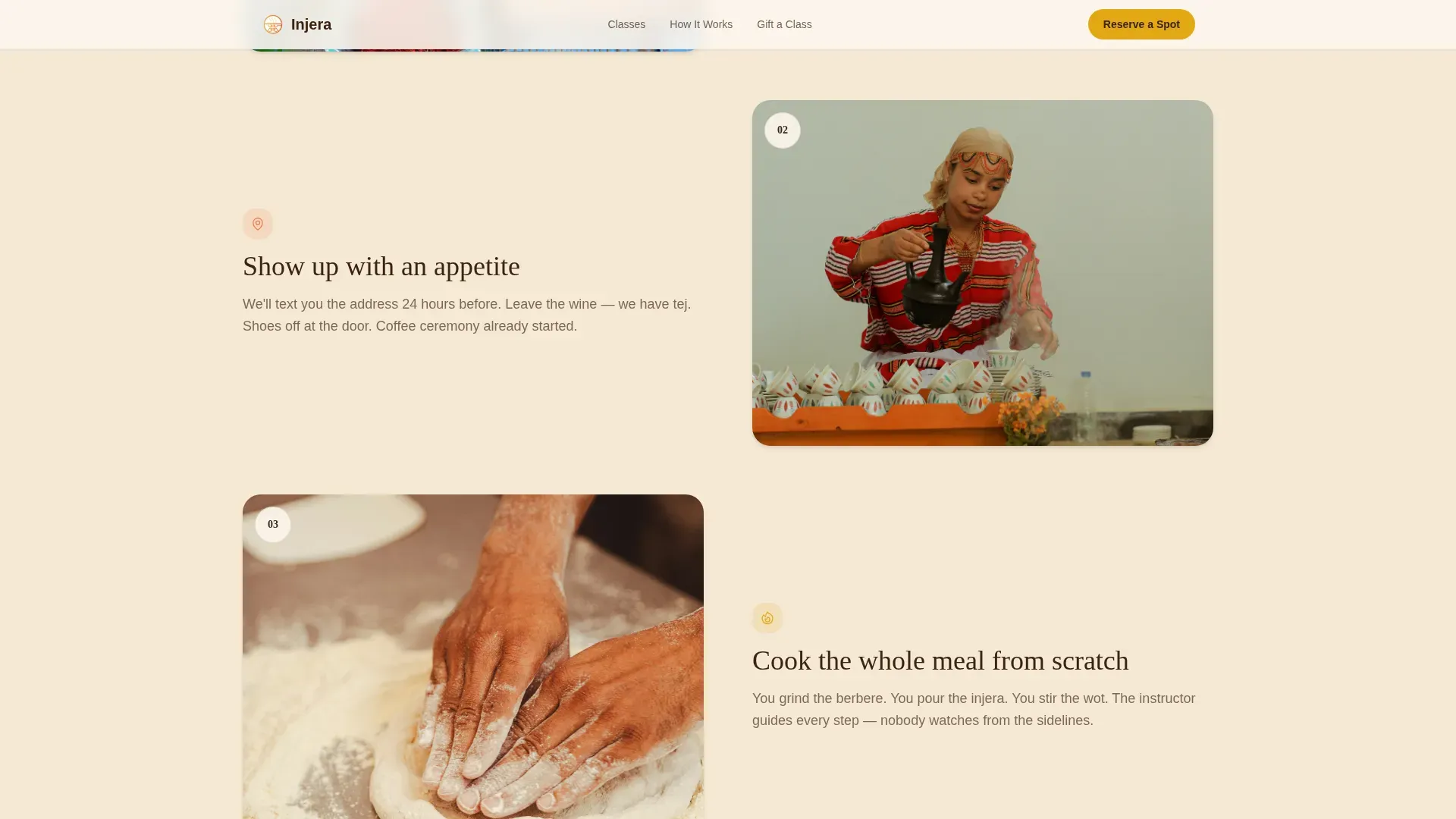
- Real student photos appear at the top of every class card and inside each detail panel, so visitors see proof that strangers walked in and a community sat down to eat before they reach any call to action
- Scarcity indicators such as "X spots left" and a per-card date picker create gentle urgency that makes it easy to go from browsing to reserving a spot in a single scroll session
Other information about this template
This template is well suited for hosts who run beginner-friendly workshops focused on making injera from scratch. Injera is the traditional Ethiopian flatbread that serves as both a plate and an eating utensil at the table. It is made from teff flour, a gluten-free grain that is among the tiniest in the world, with roughly 150 grains of teff equaling the size of a single kernel of wheat.
Making injera starts with preparing a fermented batter. The teff flour mixture is combined with water and a small amount of salt, then left to ferment in a warm place until the dough develops its characteristic sour flavor. When the batter is ready and free of lumps, it is swirled into a hot skillet or cast iron pan and cooked on one side only. Bubbles form across the surface, the edges lift from the pan, and the result is a spongy, flexible flatbread cooked to a light golden brown.
Guests at a workshop learn to build the Ersho starter for tangy flavor, practice the Absit gelatinization technique for the right texture, and cook on a traditional mogogo or cast iron skillet over a stove. Each piece of injera is cooled completely before stacking to prevent the pieces from sticking together. Students take home the injera they cooked during the class session.
When served, injera acts as an edible tablecloth spread across a large communal platter. Guests tear pieces of the flatbread and use them to scoop up stews, berbere-spiced dishes, and vegan sides. Berbere spices are central to Ethiopian cooking, and the class covers how to build the berbere base that gives doro wot and other dishes their depth. Injera has a sour flavor that stands in contrast to the richness of the stews it is eaten with, and that combination is what makes communal Ethiopian meals so distinctive.
The template is also relevant context for anyone designing an Ethiopian restaurant menu. Ethiopian restaurant menus benefit from celebrating communal dining traditions, using spice-forward dish descriptions, and applying a warm color palette that echoes berbere red and warm gold tones. A generous communal layout with geometric patterns inspired by woven baskets suits the shared, platter-style nature of Ethiopian food. A single-column layout can help emphasize each communal dish without visual clutter. The same warmth and cultural storytelling that makes this template effective for cooking classes translates directly into thoughtful menu design for Ethiopian restaurants.
Teff is a nutritional powerhouse. It is rich in calcium, iron, fiber, and protein. Injera made from just teff flour carries these benefits and is also probiotic, making it nutrient-dense in a way that distinguishes it from ordinary sourdough bread or wheat-based flatbreads. Letting workshop guests know that cooked injera stays fresh for several days adds real take-home value to the class.
The Injera Cook Together Ethiopian Cooking Class Landing Page Template is designed for promoting communal dining experiences rooted in Ethiopian food culture. It features components that support cultural storytelling and event conversion, making it a practical starting point for any host who wants a page that feels like a neighbor's kitchen rather than an event ticketing portal.
- The template supports scarcity-driven registration, helping hosts fill spots consistently
- It is designed to replace the generic event listing with a culturally specific, story-led experience page
- Hosts can add their own class photos, instructor bio, and menu details directly into the provided component structure
Theme
Pastoral Calm
Creative direction
Local & Neighborhood
Color system
Citrus Burst
Style
Gallery + Detail
Direction
Marketplace/Multi
Page Sections
UGC Photo Wall with Floating Headline
Expandable Class Cards with Detail Panels
Per-card Booking Form with Group Options
Testimonials Marquee Strip
Gift a Class Conversion Section
GSAP Scroll Reveals and Beam Borders
Related questions
Does the template include a booking form for each class?
Can I use this template if I teach classes beyond injera?
Is the template suitable for beginners to set up?
How does the gift-a-class section work?
What makes this template different from a standard event page?