Jeweler & Bench Worker Business Reviews & Social Proof Website Template
The Bench template is a split-screen customer review landing page built for hand-bench jewelers. It uses cinematic case-study storytelling, a dark luxury visual system, and an escalating sequence of named testimonials to build trust and drive consultation bookings. Each scroll section pairs a close-up repair photograph with a customer's own words, guiding visitors toward a single "Bring Your Piece In" call to action.
by Rocket studio
Quick summary
Bench is a single-page, split-screen landing page template designed for artisan jewelers and bench workers who need to convert hesitant visitors into booked consultations. The page leads with a dark, full-bleed macro photograph, a slow-fade headline, and a live repair counter. Four escalating case-study review sections follow, each pairing a close-up problem photograph with a named customer quote. A sticky call-to-action button appears after the third review, and a full-width bar closes the page.
Who this template is for
This template is built for any jeweler, goldsmith, or bench worker whose reputation is built on named, specific work rather than mass retail. It suits professionals who want to move visitors past passive browsing and into a real conversation about a real piece. The page architecture assumes a depth of craft that most jewelry stores cannot match.
This template is a strong fit for:
- Independent bench jewelers and goldsmith studios handling custom jewelry, estate restoration, and emergency ring sizing
- Jewelers who work with engagement rings, wedding bands, and heirloom pieces and need social proof that reads as credible and specific
- Studio owners who create custom piece designs from scratch, including work with platinum, rose gold, white gold, and yellow gold, and want that process to feel visible and trustworthy to new visitors
What problem this template solves
A jeweler's reputation is hard to communicate digitally. Photographs alone do not explain why the work costs what it costs. Generic five-star ratings without context feel hollow, especially when a client is deciding whether to hand over a grandmother's brooch or a damaged engagement ring. Most jewelry landing pages either look too retail or too sparse to earn the trust that fine jewelry clients need before they walk through the door.
This template solves that trust gap directly:
- It replaces generic review grids with narrative case studies that describe the exact problem, the exact service, and the customer's own words alongside their name and the repair performed
- It gives visitors a reason to stay and scroll by escalating the emotional stakes across four review sections, from a simple repair to a full custom piece built from a hand-drawn sketch
- It provides a clear, unhurried path to booking without forcing a form, so visitors who are ready can act immediately and those who are not can browse the portfolio gallery instead
What you get with this template
You get a fully structured, single-page landing template with every section designed around the idea that trust is earned by specificity. The layout is split-screen throughout, pairing visual evidence with human testimony at every scroll point. The design system is dark and precise, modeled on the visual language of a private jeweler's presentation case.
Key deliverables included in this template:
- A dark, full-bleed hero with a macro jeweler-at-work photograph placeholder, a three-second fade-in headline, and an animated repair counter that quietly builds authority before the visitor reads a single review
- Four split-screen case-study review sections, each formatted with a close-up problem photograph on the left and a large-serif customer quote, full name, service performed, and five-star gold rating on the right
- A sticky gold-outlined call-to-action button anchored bottom-right that appears after the third review, plus a full-width "Bring Your Piece In" bar after the final case study, and a secondary "See Our Bench Work" text link for visitors not yet ready to commit
Feature list
This section describes each major built-in feature of the Bench template in practical detail.
Dark Full-Bleed Hero with Glow Effect
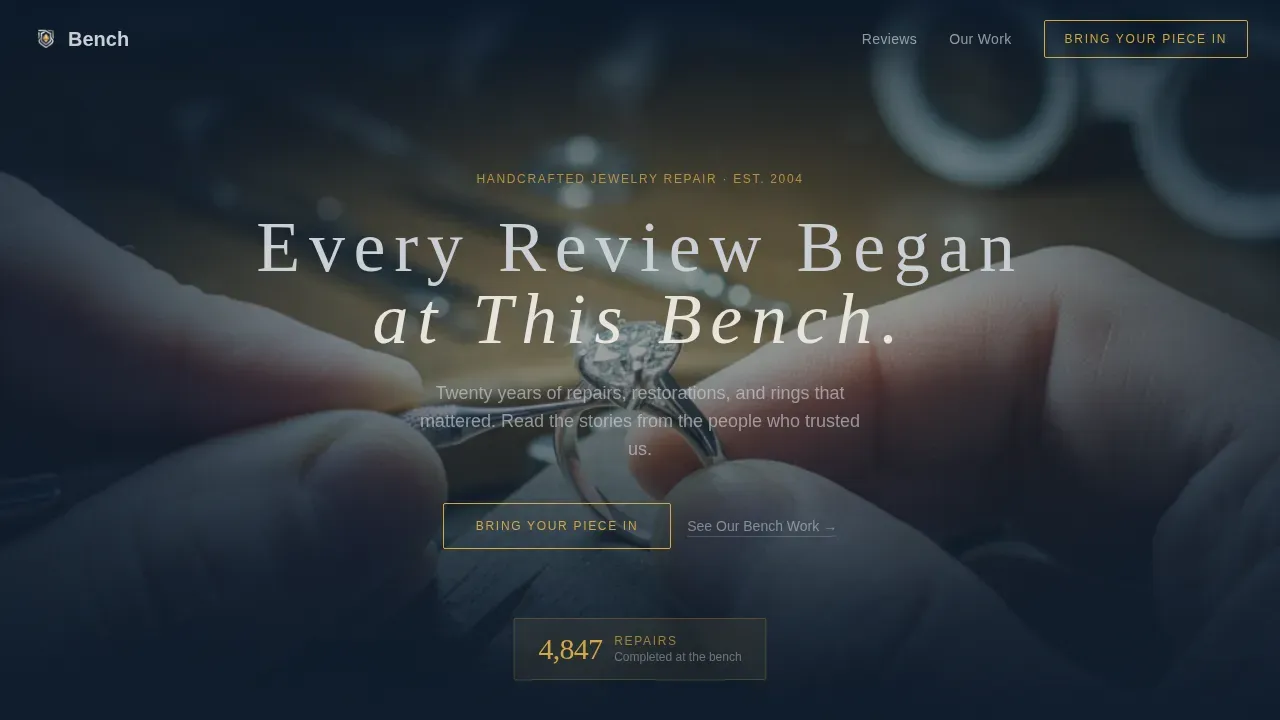
The hero section fills the entire viewport with a macro photograph placeholder shot on black at shallow depth of field. A three-second fade-in headline reads "Every Review Began at This Bench" in thin, tracked-out rhodium-silver type. A soft gold caustic glow radiates from the stone in the image, creating an immediate sense of craftsmanship and precision. A running counter of total repairs completed sits quietly at the top of the frame, beginning its animation as soon as the page loads, giving visitors an instant measure of expertise and volume before they scroll.
Split-Screen Case Study Review Sections
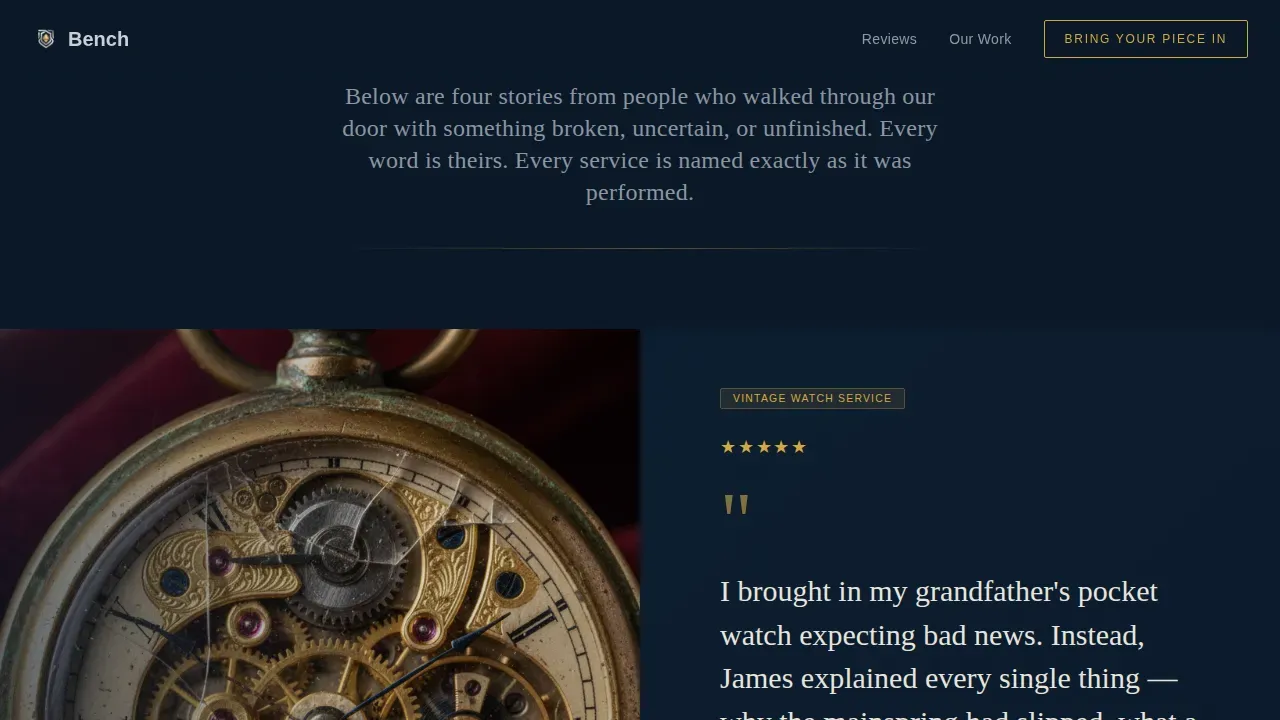
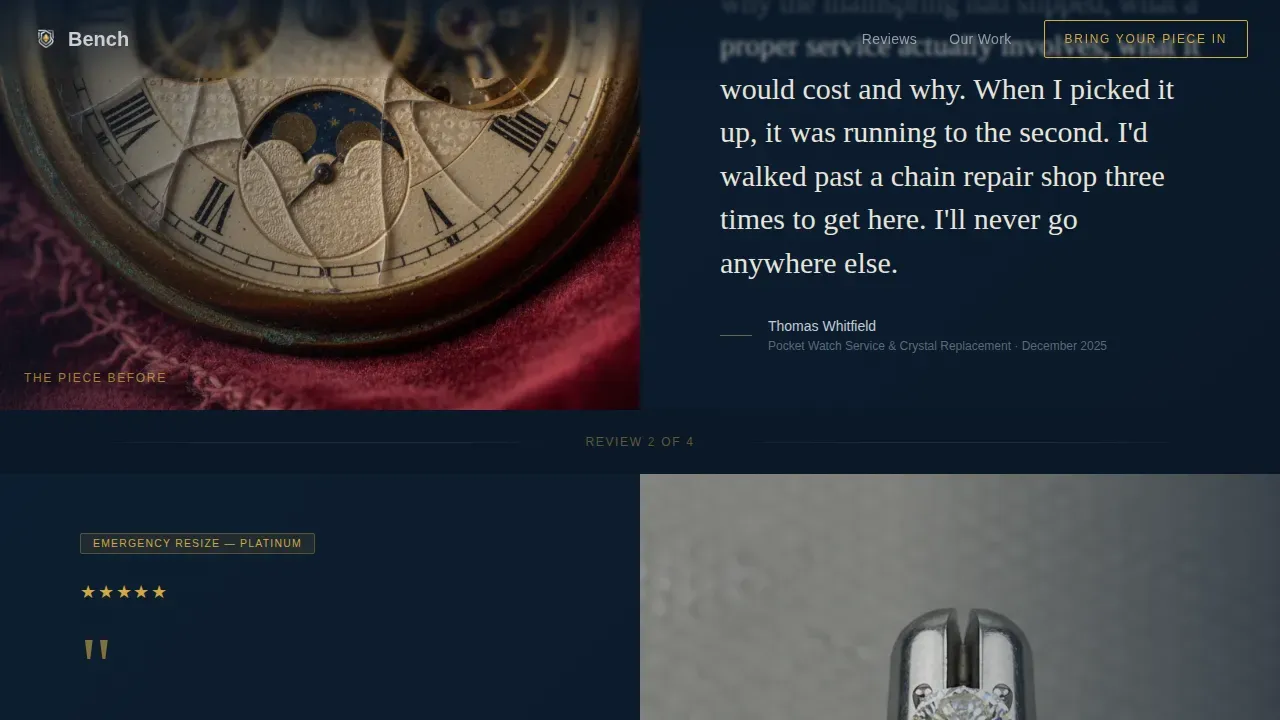
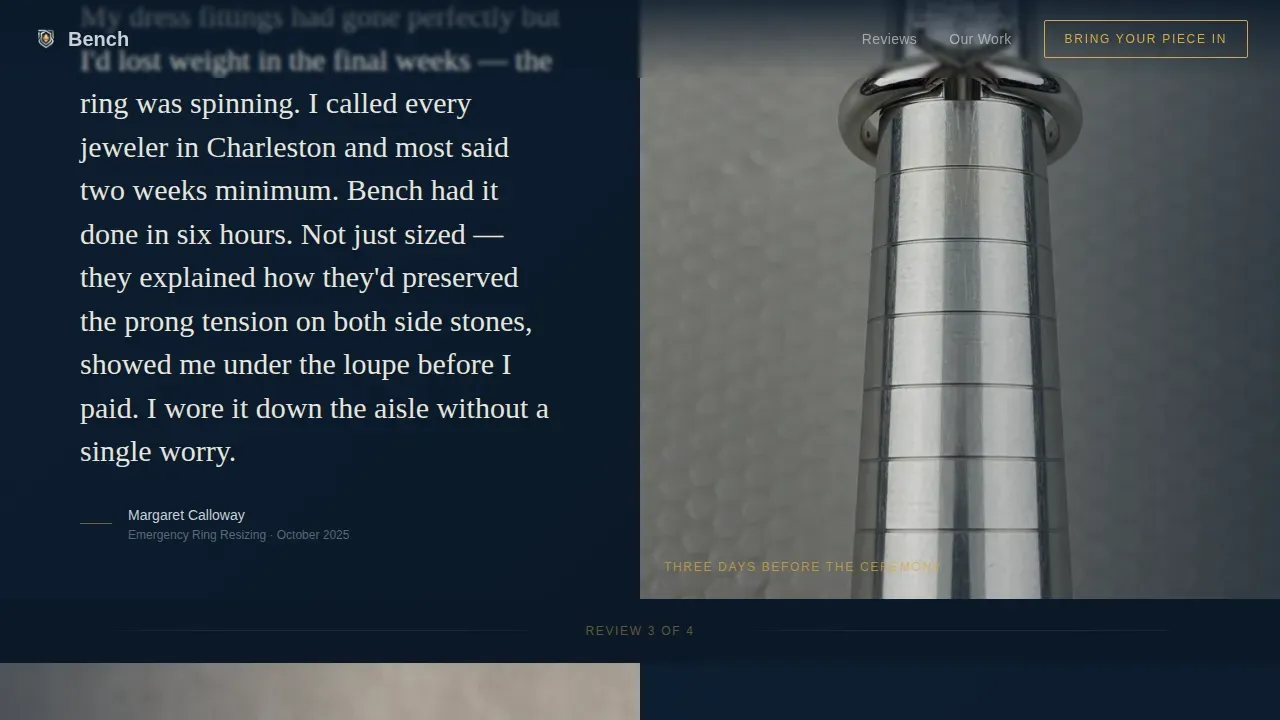
Four full-height split-screen sections structure the core of the page. Each section dedicates the left panel to a close-up photograph of the problem piece on a dark background, and the right panel to the customer's testimony in large serif type over midnight vault navy. Every review includes the customer's full name, the exact service performed, and a five-star row rendered in warm 18k gold. This pairing of visual evidence with named, specific testimony is the foundation of the template's trust architecture. The design avoids anonymous or generic testimonials entirely, because specificity is what separates this page from a standard review carousel.
Escalating Emotional Narrative Structure
The four review sections are sequenced by emotional weight. The first covers a simple repair. The second covers an emergency ring resize three days before a wedding. The third covers an estate brooch evaluation and is where the sticky call-to-action anchor appears. The fourth covers a fully custom engagement ring created from a sketch on a napkin. This escalating structure means that by the time visitors reach the final call to action, they have already watched the jeweler handle the kind of work that matters most. The story builds trust the same way a real jeweler earns it: incrementally, with evidence.
Scroll-Linked Cross-Dissolve Transitions
Each section transition uses a slow cross-dissolve animation that mimics the feeling of a jeweler rotating a piece under the lamp to inspect the next facet. The transitions are not purely decorative. They give visitors a moment to absorb each story before the next one appears, preventing the page from feeling rushed. The animation timing reinforces the unhurried confidence of a craftsperson who knows the work speaks for itself. These scroll-linked reveals are built as client-side animations with static content server components handling the rest, so the page loads quickly and the motion layer runs independently.
Dual Call-to-Action Architecture
The template uses two distinct call-to-action moments. The first is a subtle gold-outlined button anchored to the bottom-right corner of the viewport. It appears silently after the visitor passes the third review, without interrupting the story. The second is a full-width "Bring Your Piece In" bar that appears after the final case study, giving visitors a clear, confident moment to act. A secondary text link, "See Our Bench Work," provides a lower-commitment path for visitors who are engaged but not yet ready to book. No form appears on this page; the click passes directly to a booking and consultation page.
Navy Authority Color System with Gold Accent Logic
The color palette is precise and purposeful. Midnight vault navy (#0B1929) forms the dominant background. Polished rhodium silver (#C9CED6) handles headline and body type. Deep case-lining charcoal (#1E2A38) structures panel backgrounds and section dividers. Warm 18k gold (#D4A843) is used exclusively for star ratings, pull-quote marks, and hover states, never as a background fill. This restraint means that every time gold appears, it carries weight. Visitors learn quickly that gold means something important is happening on screen.
Page sections overview
| Section | Purpose |
|---|---|
| Dark Hero Viewport | Full-bleed macro photo, fade-in headline, animated repair counter |
| Case Study One | Simple repair story, split-screen photo and named customer quote |
| Case Study Two | Emergency resize story, escalating emotional stakes |
| Case Study Three | Estate brooch evaluation, sticky call-to-action anchor activates |
| Case Study Four | Custom ring from sketch, highest emotional weight review |
| Full-Width call to action Bar | Final "Bring Your Piece In" call to action across full page width |
| Vercel Flow Footer | Horizontal footer pattern with secondary navigation and text link |
Design & branding system
The visual identity follows an Executive Suite theme built around the Navy Authority color system. The palette was designed to feel like opening a private jeweler's presentation case in a wood-paneled room, where a single directional lamp makes everything on the counter matter. Typography pairs Fraunces, a high-contrast serif, for headlines and pull quotes, with DM Sans for all body text and interface elements.
Core design decisions built into this template:
- The four-color palette (midnight vault navy, polished rhodium silver, deep case-lining charcoal, and 18k gold accent) is locked by function: gold appears only for star ratings, pull-quote marks, and hover states, while charcoal separates panels without breaking the dark luxury atmosphere
- Fraunces headlines render in tracked-out, thin weight to suggest precision and restraint, while large-serif customer quotes in the right-panel create an intimate, human contrast to the dark photographic panels on the left
- Professional lighting and close-up photography placeholders are built into every case-study section, with each image frame sized and positioned to highlight the texture of metal, the facets of gemstones, and the specificity of each individual repair
Mobile & speed optimization
The template is desktop-first by design, built around the 50/50 split-screen layout that gives each case-study section equal visual weight on a wide screen. On smaller screens, the split-screen stacks vertically, placing the repair photograph above the customer quote. This maintains the narrative logic of the layout even on a phone, where each story still reads as: here is the problem, here is what the customer said.
Built-in responsive and performance considerations:
- The split-screen layout collapses to a single-column vertical stack on mobile, preserving the photograph-then-testimony sequence so the case-study narrative reads correctly on any screen size
- Static content is handled by server components while client-side animations, including the hero fade, the cross-dissolve transitions, and the counter animation, are isolated to prevent them from blocking the initial page load
- High-resolution photography placeholders are sized for the layout dimensions used in each section, so images load at the resolution the design actually needs rather than at unnecessary excess
How this template helps you convert
This template is built around one conversion goal: getting a visitor who is holding a damaged, inherited, or imagined piece of jewelry to click "Bring Your Piece In" and begin a real conversation. Every design and content decision supports that single outcome.
Here is how the conversion architecture works in sequence:
- The hero section establishes authority immediately with the animated repair counter, the macro photograph, and the slow-fade headline. Visitors understand within three seconds that this is not a retail page and that the person behind the bench has done this work at scale. The value proposition is visible before the visitor reads a word of copy.
- Each case-study review section builds on the last, using named clients, exact services, and close-up photographs to show visitors that real people with real pieces trusted this jeweler and got exactly what they needed. By the third section, a subtle gold-outlined call-to-action button appears at the bottom-right corner of the screen, present but not aggressive, ready for visitors who are already convinced.
- The full-width call-to-action bar after the final case study gives visitors who have read every story a clear, confident moment to act. The secondary "See Our Bench Work" text link gives those who want more evidence a path to a portfolio gallery, keeping them close rather than losing them to indecision.
Other information about this template
This template is part of a library built for jewelers, goldsmiths, and studio bench workers who need a jewelry landing that performs as well as the work it represents. The design system and section structure can support a wide range of fine jewelry service contexts beyond what is shown in the default placeholder content.
Additional practical details worth knowing before you build:
- The case-study review sections can be adapted for any service category a bench jeweler offers: engagement rings, custom jewelry commissions, wedding bands, estate restoration, engraving, prong re-tipping, stone replacement, and more. Each section is structured to accept a photograph, a customer name, an exact service description, and a five-star rating row.
- The template's visual language is equally effective for jewelers who work with a wide range of precious metals and gemstones. Whether your bench work focuses on platinum, rose gold, white gold, yellow gold, or sterling silver pieces, the dark luxury palette and macro photography placeholders present any metal and any stone with equal authority. Sapphires, diamonds, and colored gemstones all read well against the midnight vault navy background.
- The jewelry design context built into this template supports multiple service types: custom piece creation from Computer-Aided Design (CAD) cad designs and cad rendering, heirloom transformation work where family stones are re-set into new designs, and repair services ranging from a snapped shank to a full estate rebuild. The running repair counter and named-review format mean that visitors can determine the jeweler's volume and range without reading a single marketing claim.
- Bench jewelers who handle daily wear pieces, bracelets, necklaces, initial necklaces, and earrings alongside high-ticket custom work will find the template's review format equally useful for low-stakes and high-stakes services. A review about a simple battery replacement sits in the same trusted frame as a review about a custom engagement ring built from a napkin sketch.
- The in house bench jewelers context built into this template is specifically useful for studio owners who want to distinguish their work from chain jewelry stores and other jewelers who send repairs offsite. The case-study format makes it immediately clear that the work happens here, at this bench, under this jeweler's loupe.
- Visitors who are evaluating whether to purchase a custom piece, commission wedding rings or wedding bands, or bring in a two rings reset project will feel confident by the time they reach the call to action. The page is structured so that each review answers the question: "Is this jeweler careful enough with something that matters to me?"
- The template can support review content featuring lab grown diamonds alongside natural diamonds. Both stone types read well in the macro photography format, and the final piece shown in each case study can reflect whatever materials and center stone choices the jeweler works with most.
- For jewelers whose clients regularly ask about materials, the template's review content can naturally reference choices like white gold versus platinum, the durability of sapphires for daily wear engagement rings, or why gold jewelry is typically crafted from 14k gold or higher for lasting wearability. These details help visitors feel confident without requiring a separate education page.
- The page does not include a form. All click-through traffic routes directly to a separate booking and consultation page, keeping this landing page focused exclusively on trust-building and conversion momentum.
- Gold must be alloyed with harder metals to achieve the durability needed for jewelry that is worn every day. Platinum is a pure metal and is often the right choice for clients with nickel sensitivities. Sterling silver, while beautiful for certain pieces, is generally not recommended for engagement rings given its softness. These material realities are the kind of context that makes review content feel credible when referenced by name in customer quotes.
- The four C's of diamonds, Cut, Color, Clarity, and Carat, are a natural reference point for any case study involving diamond work. Including this language in review quotes helps visitors who are researching diamonds feel confident that the jeweler speaks their language.
- Repurposed diamonds carry a lower environmental impact than lab grown diamonds according to current material ethics frameworks, and this is worth noting when your review content references estate restoration or stone repurposing work.
- CAD modeling is a key part of the custom jewelry creation process, particularly for heirloom jewelry transformation projects where a client wants to preserve family stones while creating something entirely new. The template's final case-study section, built around a custom ring created from a hand-drawn sketch, is the natural home for any review that references the CAD design and production process.
- Heirloom jewelry transformation can include integrating two rings or multiple inherited pieces into a single cohesive design that honors the originals. This kind of work is often invisible to the naked eye in the final piece, and customer reviews are the best way to make that invisible craftsmanship visible to new visitors.
- Emotional storytelling in jewelry landing pages works best when it describes the inspiration behind the work and emphasizes the heirloom aspect: pieces that last for generations, that carry the weight of a family's history, that are absolutely worth repairing rather than replacing.
- This is a bench heirloom jeweler customer review landing page template designed to help artisan jewelers build trust at scale. The page architecture is proof-first: every section earns the call to action before it appears.
Theme
Executive Suite
Creative direction
Case Study Narrative
Color system
Navy Authority
Style
Split Screen (50/50)
Direction
Click-Through
Page Sections
Dark Full-bleed Hero with Animated Counter
Split-screen Case Study Reviews
Escalating Narrative Sequence
Scroll-linked Cross-dissolve Transitions
Dual Call-to-action Architecture
Navy Authority Color System with Restricted Gold Accent
Related questions
Can I use this template for a jeweler who offers multiple services, not just repairs?
Does this template include a contact form or booking system?
How does the escalating review structure work in practice?
Can I adapt the color system if my studio uses different brand colors?
Is this template suitable for jewelers who work with a range of precious metals and gemstones?