Colombia Travel Booking Website Template
Camino is an immersive Colombia travel guide landing page template built for travel blogs, experience marketplaces, and trip-planning platforms. It uses a horizontal scroll layout, a painterly illustrated map header, and three parallel conversion paths: an itinerary builder quiz, a bookable experience marketplace, and long-form regional guides. The Sunset Mesa color palette and Organic Flow visual identity make every section feel like a new destination.
by Rocket studio
Quick summary
Camino is a single-page horizontal scroll template designed for Colombia-focused travel guides and experience marketplaces. It opens with a hand-illustrated, parallax map of the country, then carries visitors through five regional panels, each shifting gradient, tone, and content to reflect a distinct Colombian ecosystem. Three conversion paths run in parallel throughout the journey, giving every type of traveler a clear next step.
Who this template is for
This template is built for creators and businesses who want to craft a rich, authentic Colombia travel presence. It works best for people who have real, ground-level knowledge to share and want a design that reflects that depth.
- Travel bloggers and content creators focused on Colombia or broader South America itineraries
- Experience operators and tour curators offering bookable adventure, culture, or coffee-region services
- Remote-work guides, heritage trip planners, and community travel platforms connecting travelers with local communities
What problem this template solves
Most travel landing pages feel generic. They show the same stock photos, the same top-ten lists, and the same broad itinerary suggestions that could apply to any country on the continent. Travelers who are serious about their journey, gap-year backpackers, Colombian-American families on heritage trips, remote workers seeking slow-travel bases, need more. They need a destination guide that proves it knows the unmarked trails, the lancha schedules, and the names of the towns that no aggregator site has indexed.
- Generic travel sites cannot demonstrate the depth of knowledge that builds trust with experienced travelers
- Visitors leave quickly when they cannot find a clear path: plan a trip, browse experiences, or read the guide
- A flat, static layout fails to communicate the variety and adventure that Colombia offers across its diverse regions
What you get with this template
Camino delivers a full single-page layout with a structured content hierarchy designed for a travel marketplace audience. Every section has a defined role in the visitor journey, from discovery to conversion. The design is editorial, warm, and specific to Colombia's visual identity.
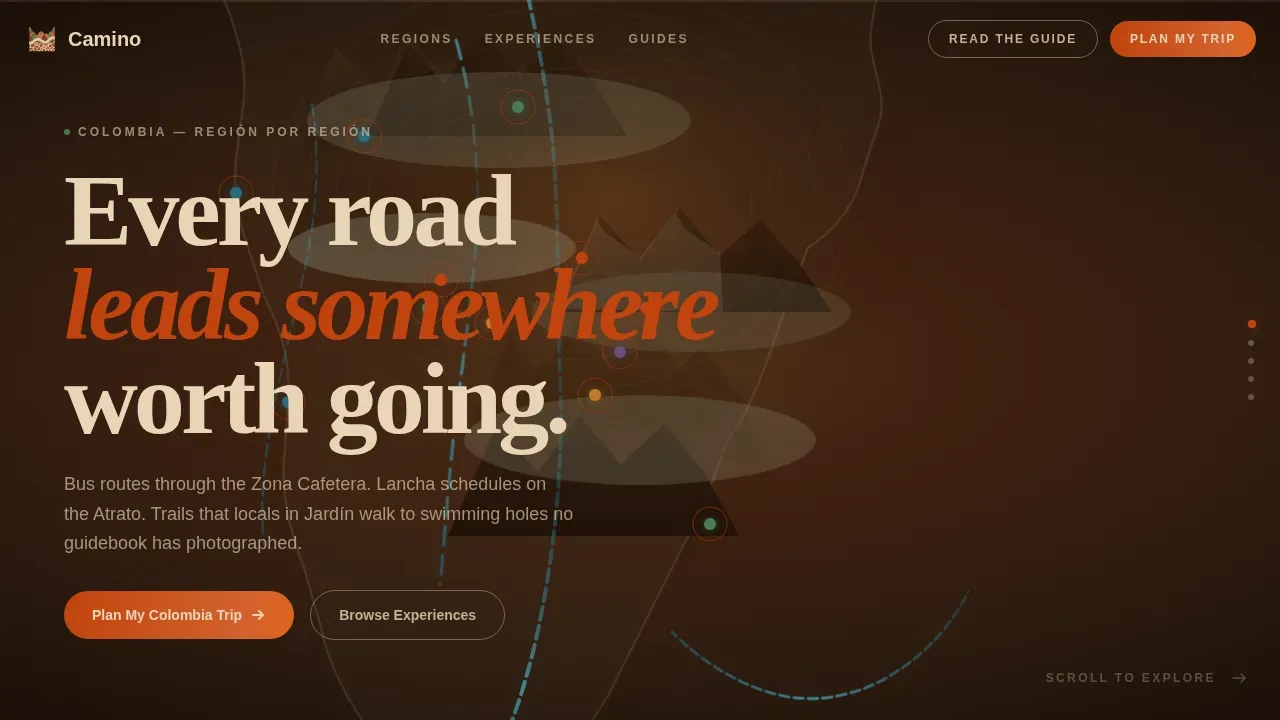
- A hand-illustrated, interactive Colombia map header with 12 pulsing region dots and parallax mountain layers
- Five horizontal scroll region panels (Caribbean, Andes, Coffee Axis, Pacific, Amazon) with scroll-linked gradient transitions
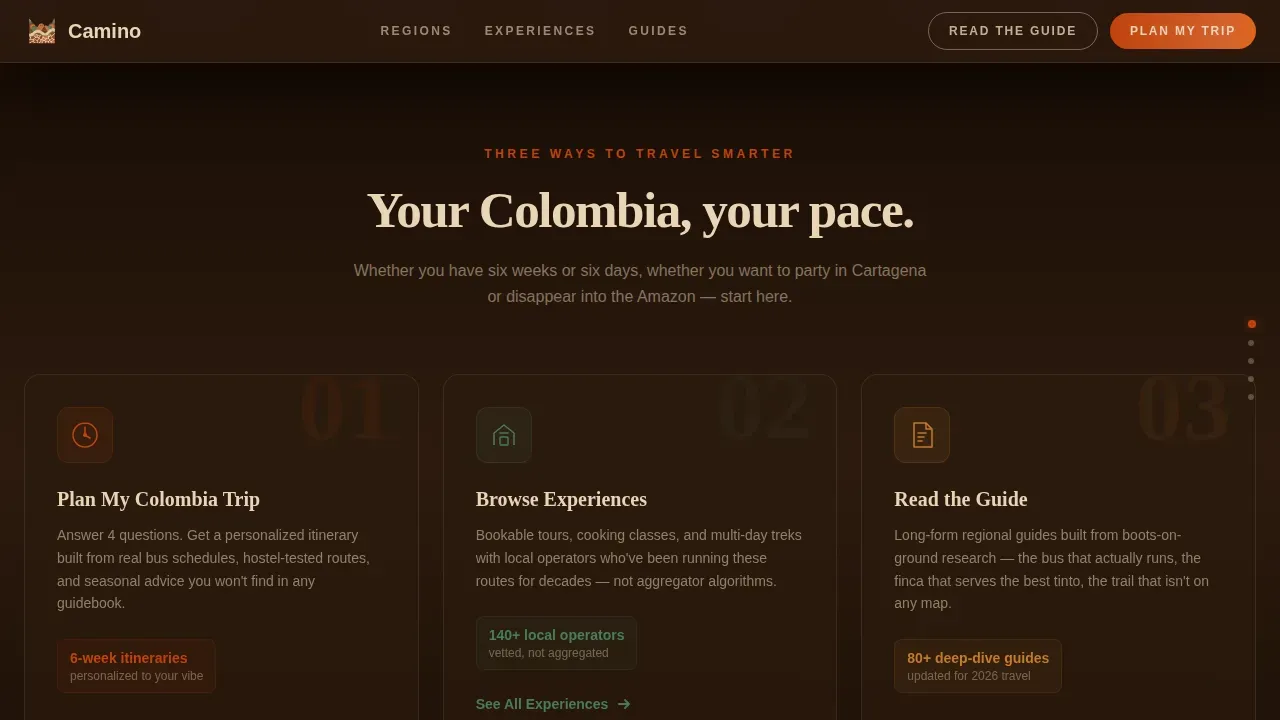
- Three parallel conversion paths: "Plan My Colombia Trip" quiz, "Browse Experiences" marketplace cards, and "Read the Guide" blog funnels
Feature list
This template includes a focused set of built-in layout components and interactive systems. Each feature is designed to reflect boots-on-the-ground knowledge and move visitors toward a clear action.
Illustrated Interactive Map Header
The hero section is a hand-drawn, painterly map of Colombia that fills the entire viewport. Mountain ranges layer in subtle parallax. Rivers carry a slow CSS shimmer animation. Twelve clickable region dots pulse in terracotta, and each dot reveals a thumbnail and a one-line hook on hover. This is not a stock image or a maps embed, the illustration is the brand identity.
Horizontal Scroll Region Panels
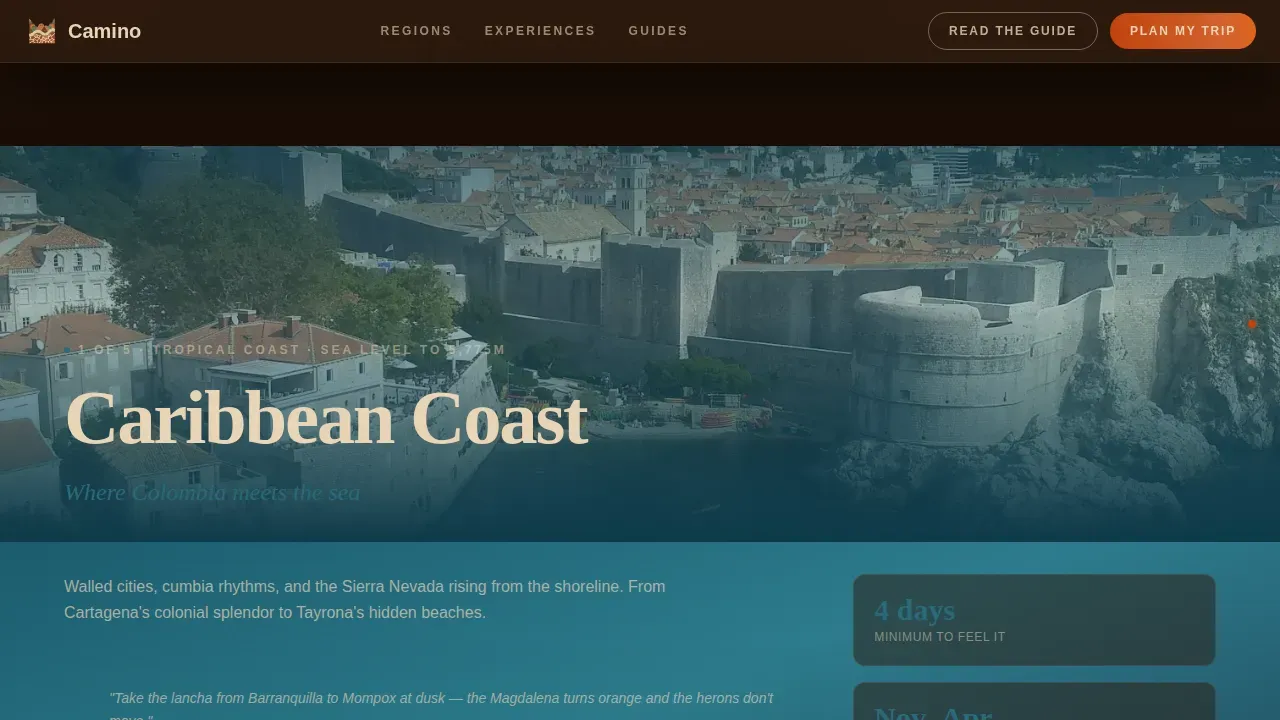
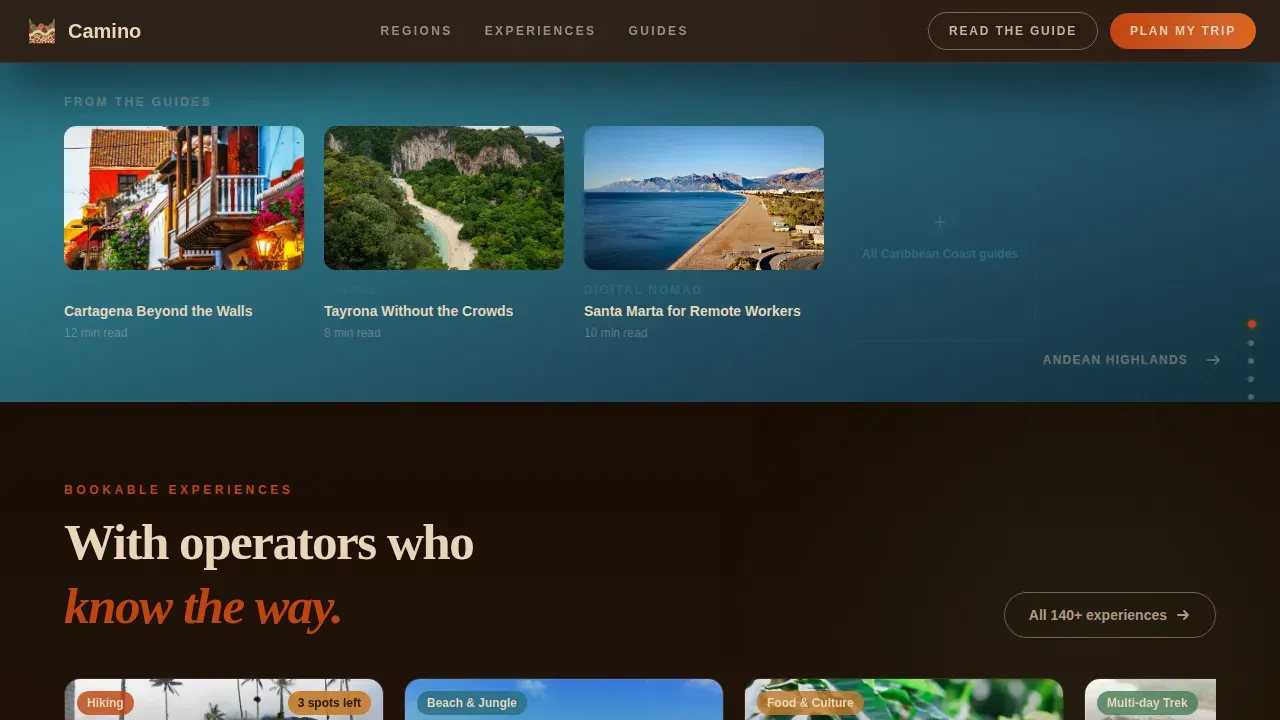
Five full-width panels walk visitors westward through the country: Caribbean coast, Andean highlands, Coffee Axis, Pacific lowlands, and Amazon basin. Each panel transition shifts the background gradient to match the ecosystem, from ocean turquoise to cloud-forest mist to river-basin amber. Within each panel, content layers vertically across a hero photograph, a curated guide grid, and bookable experience cards.
Three-Path Conversion Panel
A dedicated horizontal conversion section presents three parallel paths side by side. The primary call to action, "Plan My Colombia Trip," leads to a quiz-style itinerary builder. Visitors choose travel dates, group size, and vibe preference: adventure, culture, beach, or all of it. The secondary path, "Browse Experiences," links to bookable operator cards. The tertiary path, "Read the Guide," funnels visitors into long-form regional content.
Bookable Experience Cards
The experience marketplace section displays operator cards with price, duration, and a single review quote per card. Cards cover multi-day treks, cooking classes, and guided tours. The layout is designed to focus the visitor's attention on one experience at a time, reducing decision fatigue.
Itinerary Builder Call-to-Action Block
A dedicated itinerary builder call-to-action section uses a quiz-style form to capture visitor preferences. Travelers answer questions about travel dates, group size, and vibe. The block is designed to feel personal rather than algorithmic, reflecting the idea that a good Colombia itinerary should reflect the traveler's own values and rhythm.
Scroll-Linked Gradient Theme System
The template uses CSS custom properties to shift color themes as visitors scroll between regional panels. Each ecosystem gets its own gradient, so the page itself becomes a sensory journey through the country. GSAP ScrollTrigger powers the animations, including parallax layers, pulsing dots, and the horizontal scroll snap.
Page sections overview
| Section | Purpose |
|---|---|
| Hero Illustrated Map | Introduce Colombia visually; invite region exploration via pulsing dots |
| Three Conversion Paths | Present three parallel user journeys clearly and simultaneously |
| Caribbean Region Panel | Showcase beach destinations, vibrant music culture, and local stories |
| Andean Region Panel | Highlight capital city context, cloud-forest nature, and hiking routes |
| Coffee Axis Panel | Feature coffee plantation experiences and scenic valley attractions |
| Pacific Region Panel | Reflect coastal nature, Afro-Colombian culture, and off-grid adventure |
| Amazon Region Panel | Present rainforest journeys, indigenous cultures, and river-basin life |
| Experience Marketplace | Display bookable operator cards with price, duration, and review quotes |
| Itinerary Builder call to action | Capture trip preferences through a quiz-style form block |
| Footer | Provide navigation and site structure using a horizontal flow layout |
Design & branding system
The visual identity follows an Organic Flow theme with the Sunset Mesa color system. Every color choice is grounded in a specific Colombian reference, which gives the palette a story rather than just a mood.
- Terracotta clay (#C1440E) drawn from the adobe walls of Barichara; deep cacao (#2C1A0E) evoking a tinto at a roadside finca; warm sand (#E8D5B7) carrying the bleached light of the Tatacoa Desert; jungle vine green (#4A7C59) reserved for interactive elements and hover states
- Typography pairs Fraunces (a serif display face with organic, editorial character) with DM Sans for body text, creating a contrast between warmth and clarity
- All visuals use original illustration rather than stock photography, reinforcing the sense that this guide comes from real presence in the country
Mobile & speed optimization
The template is designed desktop-first to support its horizontal scroll architecture. The horizontal scroll snap and parallax animations are engineered for desktop viewports. A responsive mobile fallback converts the layout to a vertical scroll experience, preserving all content and conversion paths on smaller screens.
- GSAP ScrollTrigger manages parallax layers, scroll-snap transitions, and region gradient shifts
- CSS custom properties enable real-time theme changes between regional panels without page reloads
- The mobile fallback stacks all five region panels vertically and preserves the three conversion paths and experience cards in full
How this template helps you convert
Camino is built around the idea that trust earns the click. Every design decision is meant to prove depth before asking for action. The three-path conversion model means no visitor is left without a clear next step, regardless of where they are in their planning journey.
- The illustrated map and regional panels demonstrate editorial credibility immediately, so visitors who arrive skeptical quickly discover that this is not a surface-level listicle but a guide built from real, local knowledge.
- The quiz-style itinerary builder captures preferences in a way that feels personal, converting passive readers into active trip planners who form a connection with the platform before they leave the page.
- The experience marketplace cards present social proof through real review quotes, and the clear price and duration details enable confident decisions without requiring visitors to click away to a separate site.
Other information about this template
Camino is the template name and the design philosophy behind this layout. The word reflects the idea of a path taken with intention, which aligns with the mindful travel philosophy woven into the content structure.
- The Camino de Santiago is one of the world's most famous walking journeys. The Camino de Santiago draws travelers who value walking as a form of reflection and deeper connection with their surroundings. The Camino de Santiago experience has shaped how modern travelers think about slow, purposeful journeys. This template captures that same spirit of intentional travel and applies it to Colombia. The Camino de Santiago mindset: walk with focus, build new friendships, and let the journey reflect your values. Guided experiences modeled on the Camino de Santiago help travelers cultivate meaningful connections with local communities and loved ones.
- Villa de Leyva is one of Colombia's most beloved colonial towns, with cobblestone streets, whitewashed walls, and a vast central plaza. Villa de Leyva's preserved old town and proximity to the salt cathedral at Zipaquirá make it a natural pairing destination for travelers flying into Bogotá. Both sites connect visitors to the history and craft of the Andean interior.
- The best times to visit Colombia are December to March and June to August, which are the dry seasons. These windows are ideal for hiking, beach trips, and multi-day treks. Planning your itinerary around dry-season windows helps you protect the quality of outdoor experiences, especially in the Amazon and Pacific regions.
- Traveling by bus in Colombia is easy, affordable, and rewarding. Colombia's public transport network provides access to many destinations that direct flights do not reach. Slow travel by bus also lets you discover towns like Guane, which features a stone church and a small paleontological museum, or stop at a mirador that no itinerary has ever listed.
- Walking the Camino Real, a restored 17th-century indigenous trail through the Chicamocha Canyon, takes roughly two to three hours. The cable car over the canyon offers a dramatic view of the same region for those who prefer a scenic alternative. The journey to the Lost City requires climbing 1,200 ancient stone steps through the lands of the Kogui people, one of Colombia's most significant indigenous cultures. The Cocora Valley is home to the world's tallest palm trees, and the hike among them is one of the most celebrated adventures in the coffee region.
- San Basilio de Palenque is the first free slave town in the Americas. Visitors can join music, drum, and dance classes including Mapalé. Cartagena's walled city and Getsemaní neighborhood offer street art, local restaurants, bars, and art galleries just inside the city walls. The old town of Cartagena is one of the most photographed destinations in South America.
- The Metrocable in Medellín is an affordable cable car system that connects upper comunas to the metro network. A local guide in Comuna 13 can walk you through community-led graffiti tours that reflect the area's transformation. These are the kinds of authentic, on-the-ground stories that make Colombia a country where magical realism feels real.
- Grassroots community initiatives across Colombia focus on environmental defense and the protection of local cultures. Colombians care deeply about their country, and sustainable travel choices create a positive impact for local communities. Women-led cooperatives, Afro-Colombian cultural groups, and indigenous-run tour services all offer travelers a deeper connection to the places they visit.
- Colombia ranked third among the fifty most naturally beautiful countries in the world in a 2022 report. With Caribbean beaches, Andean cloud forests, coffee valleys, Pacific coastline, and Amazon jungle all within one country, the landscape changes constantly. Every itinerary can mix and match these regions to create a scenic route that fits individual preferences, group size, and travel pace. Personalized itineraries can include celebratory dinner experiences, cooking classes, or multi-day treks, and can be designed to reflect the traveler's own sense of joy and adventure.
Theme
Organic Flow
Creative direction
Immersive Visual
Color system
Sunset Mesa
Style
Horizontal Scroll
Direction
Marketplace/Multi
Page Sections
Illustrated Interactive Map Header
Horizontal Scroll Region Panels
Three-path Conversion Panel
Bookable Experience Marketplace Cards
Quiz-style Itinerary Builder Block
Scroll-linked Gradient Theme System
Related questions
What type of business is this template designed for?
Can I customize the regional content and itinerary quiz?
Does the template support multiple conversion goals at once?
Is this template suitable for mobile users?
What makes this template different from a standard travel landing page?