Tribal Court Landing Page Template
The Sovereignty landing page template is built for tribal court justice hubs that serve tribal members, enrolled citizens, outside counsel, and federal attorneys. It combines a hub and spoke anchor navigation structure with an illustrated topographic map header, five scrollable spoke sections, an interactive filing questionnaire, and a downloadable court guide, all styled in a high-desert Educational Guide aesthetic rooted in cultural identity and self-determination.
by Rocket studio
Quick summary
This sovereignty tribal court justice hub landing page template gives tribal courts a single, authoritative web page that educates every visitor about jurisdiction, procedures, and resources. It opens with a stylized map of jurisdictional boundaries, moves through five anchor-linked spoke sections, and closes with two clear conversion paths, a printable PDF guide and an interactive filing questionnaire, all free and behind no registration wall.
Who this template is for
This template is built for any tribal court, tribal government office, or indigenous justice organization that needs a public-facing resource hub. It serves communities where tribal sovereignty is the foundation of every legal matter handled on ancestral lands.
- Tribal members navigating custody modifications, land allotments, or water rights disputes
- Outside counsel seeking pro hac vice admission or federal attorneys coordinating Indian Child Welfare Act handoffs
- Tribal administrators and court staff who need to present public records and court division information clearly
What problem this template solves
Indigenous peoples in the United States have historically faced barriers to legal information that is both accurate and culturally grounded. Most government website templates treat law as purely procedural, ignoring the cultural context that tribal courts exist to protect. This template solves that gap directly.
- Visitors arrive without knowing which court division handles their case or what rules govern their situation
- No single page currently exists that defines jurisdiction clearly, identifies the correct forms, and connects procedure to the tribe's broader mission of self determination
- Outside counsel and federal attorneys waste time waiting for basic jurisdictional clarity that a well-structured hub page can provide instantly
What you get with this template
You get a fully designed, single-page hub that balances legal information with cultural identity. Every section is built to preserve trust, support understanding, and advocate clearly on behalf of the communities this court serves.
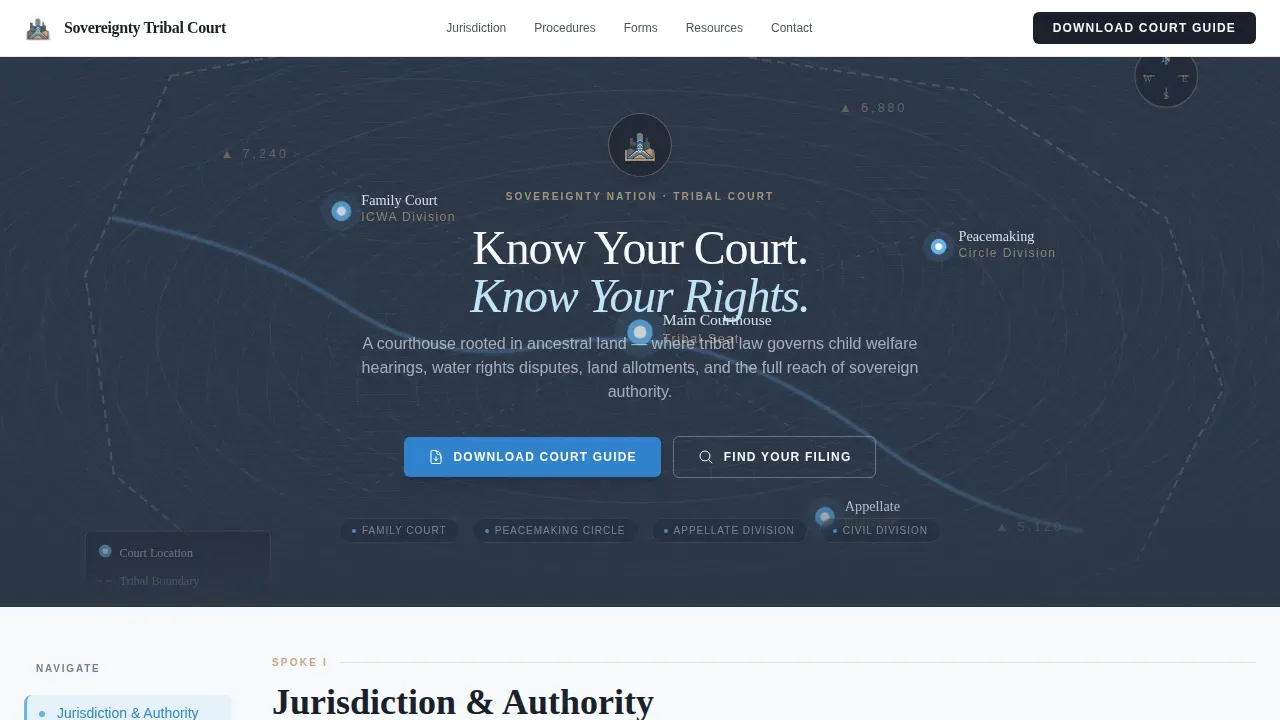
- A map-based hero header with illustrated topographic contour lines and sky-blue jurisdictional pins for each court location
- Five anchor-linked spoke sections covering Jurisdiction and Authority, Court Procedures, Forms and Filing, Legal Resources, and Contact and Hours
- An interactive "Find Your Filing" questionnaire and a primary "Download Court Guide" call to action, both free with no login required
Feature list
This template includes the following built-in capabilities, all grounded in the source brief.
Illustrated Jurisdictional Map Header
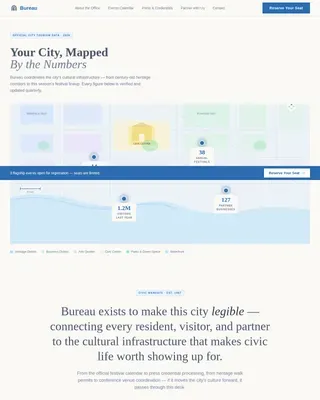
The hero section displays a stylized topographic map of the tribal nation's reservation geography. Key court locations are marked with glowing sky-blue pins. Labeled regions pulse subtly to identify Family Court, Peacemaking Circle, and Appellate Division, giving visitors immediate geographic and structural context.
Left-Rail Anchor Navigation
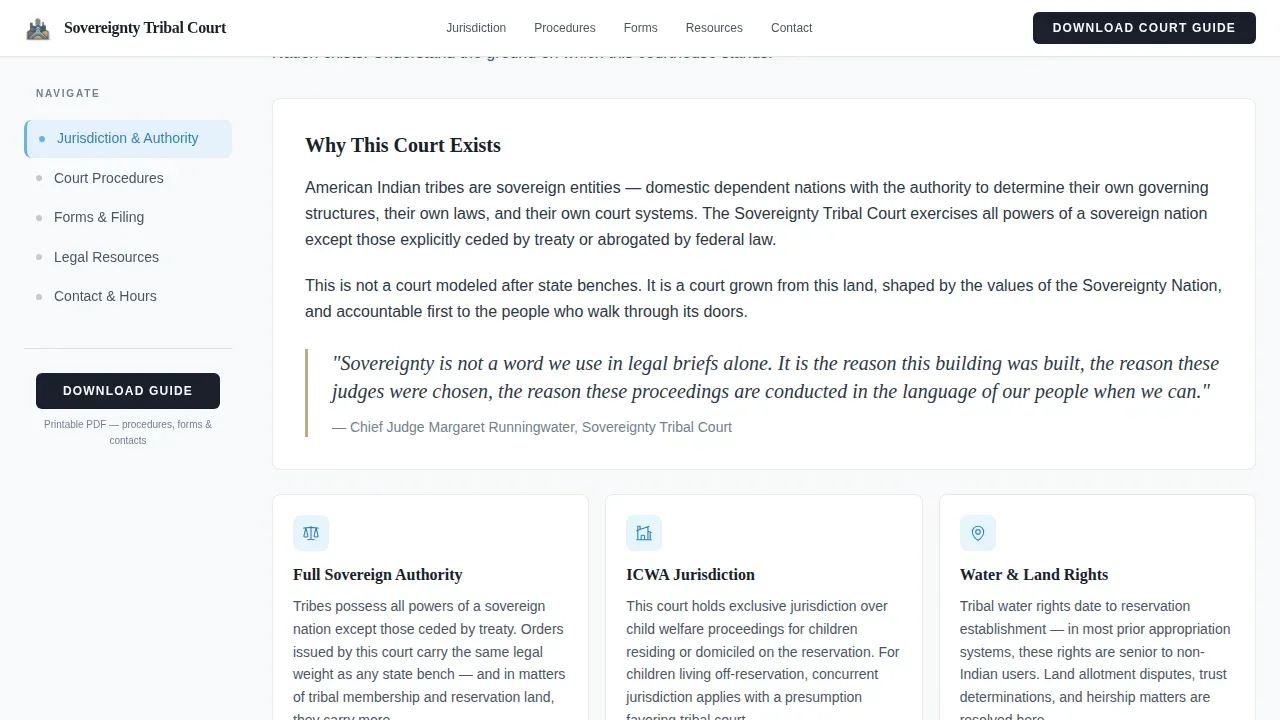
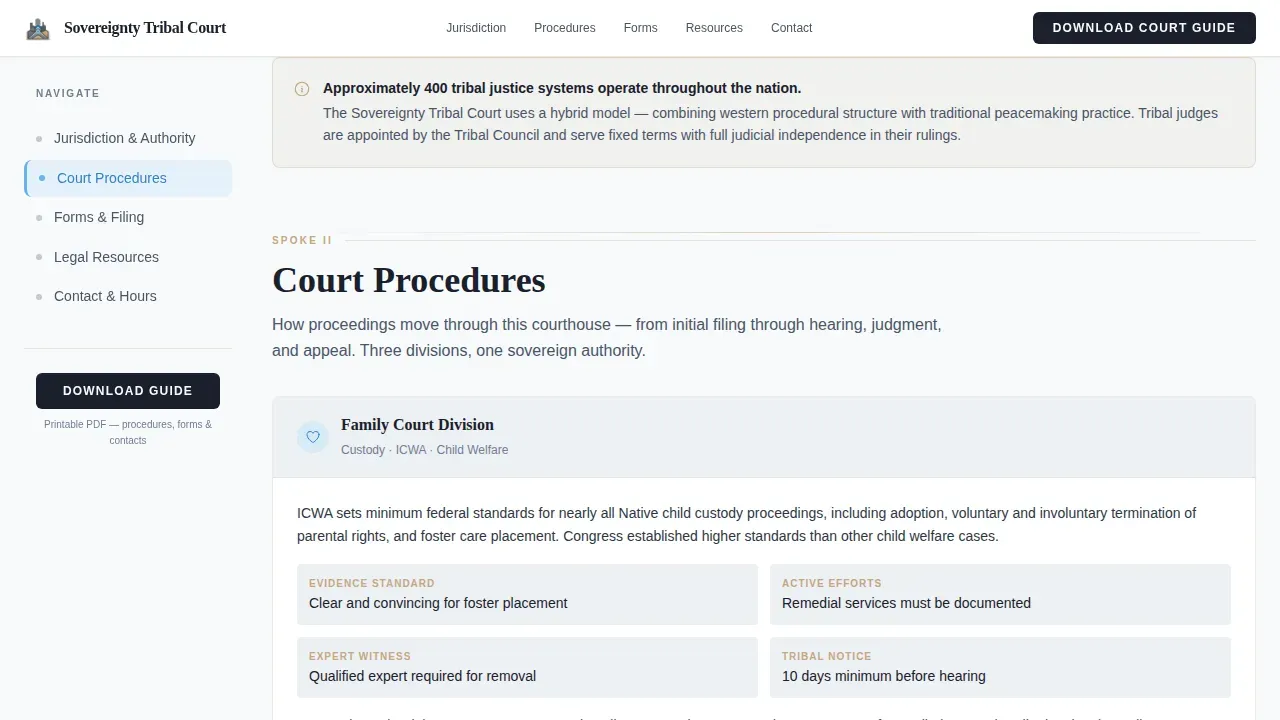
A fixed left-rail navigation spine highlights each of the five spoke sections as the visitor scrolls. This structure helps tribal members, counsel, and federal attorneys move quickly to the section most relevant to their process without losing their place on the page.
Interactive Find Your Filing Questionnaire
The Forms and Filing spoke includes a guided questionnaire that asks visitors about case type, tribal membership status, and legal representation. The questionnaire routes each visitor to the correct forms and instructions, reducing errors and the time spent waiting for clerical guidance.
Downloadable Court Guide (Primary Conversion)
The Legal Resources spoke features a prominent call to action to download a printable PDF guide covering procedures, forms, and key contacts. This guide acts as the page's primary conversion, giving visitors something tangible they can act on immediately.
Pull Quote Social Proof Blocks
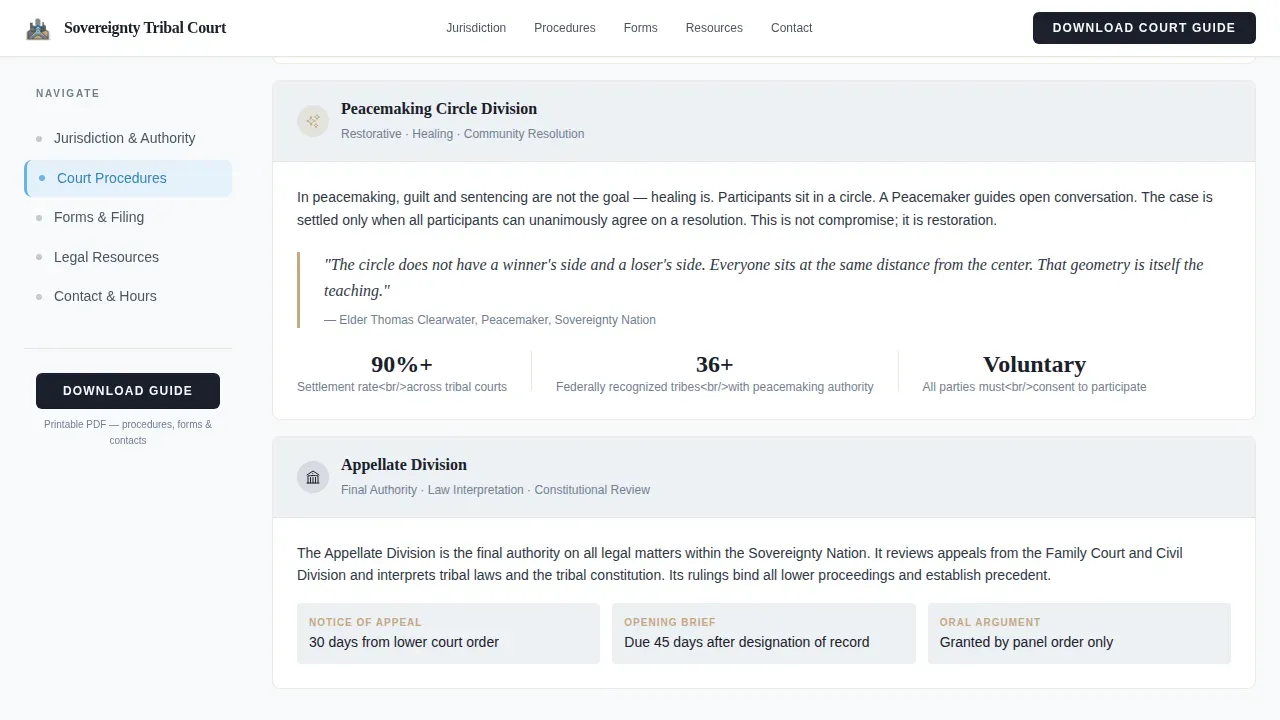
Quotes from tribal elders and sitting judges are displayed throughout the page with sandstone-bordered pull-quote styling. These blocks break up procedural density and strengthen the cultural argument that this court exists to serve, not solely to govern.
Vision and Mission Opening Spoke
The first spoke section grounds every visitor in why this court exists before any procedural content appears. Sovereignty, cultural justice, and community recognition are stated clearly, recognizing that indigenous justice work begins with purpose, not paperwork.
Page sections overview
| Section | Purpose |
|---|---|
| Hero Map Header | Display jurisdictional boundaries and court locations visually |
| Jurisdiction and Authority | Explain tribal sovereignty, Indian Child Welfare Act scope, and jurisdictional rules |
| Court Procedures | Cover family court, Peacemaking Circle, appellate process, and transfers |
| Forms and Filing | Host the interactive questionnaire and direct links to court forms |
| Legal Resources | Display pull quotes, elder voices, and the downloadable guide call to action |
| Contact and Hours | List court divisions, operating hours, pro hac vice process, and federal coordination |
Design & branding system
The template uses an Educational Guide visual theme styled after the high-desert mesa at midday. Every design choice is earned by function, not decoration, which reflects the cultural seriousness of indigenous justice work.
- Color system: weathered slate (#4A5568) for structural elements, deep charcoal (#1A202C) for primary text, open-sky blue (#63B3ED) for active anchor links and resource highlights, horizon white (#F7FAFC) for content backgrounds, and quiet sandstone (#C4A882) for dividers and pull-quote borders
- Typography: Fraunces serif headings for authority and cultural weight; DM Sans body text for clean, accessible readability across all visitors
- Culturally responsive imagery uses topographic contour lines and muted tones that reflect the land and culture of the tribe, not generic stock photography
Mobile & speed optimization
The template is built desktop-first to serve attorneys and administrators working at full screen, with a strong mobile fallback that keeps all spoke sections and the filing questionnaire functional on smaller devices.
- Static content architecture using Server Components keeps page load fast, which matters for visitors on reservation networks or limited connections
- Low-to-medium animation approach: map pin pulse, anchor highlight on scroll, and pull-quote fade are subtle by design and do not impede performance
- The left-rail navigation collapses gracefully on mobile so tribal members can still access all five spoke sections without friction
How this template helps you convert
This template is designed as a content and resource destination. Conversion means a visitor gets the information or document they need and leaves more informed than when they arrived.
- The primary conversion path is the "Download Court Guide" button in the Legal Resources section, which gives visitors a printable PDF covering procedures, forms, and key contacts with no login required.
- The secondary conversion path is the "Find Your Filing" questionnaire, which routes each visitor to the exact forms they need based on case type and membership status, reducing confusion and abandoned visits.
Other information about this template
This template was designed to act as a clearinghouse for tribal legal, policy, and cultural resources on a single hub page. It is rooted in the understanding that indigenous peoples deserve barrier-free access to the law that governs their lives, particularly on ancestral lands where tribal courts assert inherent authority. The page is designed to be accessible and user-friendly so all community members can engage with the content without waiting for assistance.
- Jurisdiction clarity is built into the template structure: the Jurisdiction and Authority spoke defines geographic boundaries and covers civil, criminal, and juvenile case categories so visitors can identify where they stand
- The template supports indigenous justice advocacy by making tribal codes, constitutional references, and public records visible without requiring users to navigate away to separate websites
- Brand context: organizations like the American Civil Liberties Union of Washington have worked in Washington state to protect tribal sovereignty and strengthen indigenous justice work through advocacy, lawsuits, and legislation; this template gives tribal courts a direct channel to communicate their own authority and mission without relying on third-party advocacy organizations
- The hub design can expand to include videos, reading lists, and journey maps as the court's digital presence grows
- Pull quotes from community members and sitting judges play a meaningful role in building trust, which is how real indigenous justice work is measured: by relationships, not solely by legal outcomes
Theme
Educational Guide
Creative direction
Vision & Mission
Color system
Slate & Sky
Direction
Content/Resource
Page Sections
Illustrated Jurisdictional Map Header
Left-rail Anchor Navigation Spine
Interactive Find Your Filing Questionnaire
Downloadable Court Guide Conversion
Elder and Judge Pull Quote Blocks
Vision and Mission Opening Spoke
Related questions
Who is this landing page template designed for?
Does the template require visitors to create an account to access resources?
Can I customize the jurisdictional map and spoke sections for my specific tribe?
What types of legal matters does the filing section cover?
Is this template suitable for a court that integrates traditional restorative justice practices?