Manufacturing Processes Professional Website Template
Kerf is a dashboard-style landing page template built for precision waterjet cutting service providers. It combines a full-screen video header with live-style telemetry overlays, data-card sections, and a material capability matrix to brief engineers and fabricators on shop capability. The design uses a dark carbon fiber palette and drives qualified visitors toward an RFQ file upload.
by Rocket studio
Quick summary
Kerf is a single-page, data-driven landing page template designed for precision waterjet cutting shops. It presents shop capability through telemetry overlays, material matrices, tolerance comparison charts, and a job capacity gauge. The visual identity feels like an HMI control panel. Every section builds operational proof and guides the visitor toward submitting a cut file.
Who this template is for
This template is built for waterjet cutting service providers who serve technically demanding clients. It speaks directly to buyers who arrive with a DXF file and a deadline, not a general inquiry.
- Precision waterjet shops serving aerospace, motorsport, and architectural metalwork clients
- Fabrication businesses that cut steel, aluminum, titanium, glass, or stone to tight tolerances
- Shop owners or marketing leads who want to replace a generic website with a capability-first landing page
What problem this template solves
Most fabrication shops present capability through a list of services and a phone number. That approach fails with aerospace procurement engineers or motorsport fabricators who need proof before they submit a file. This template solves that gap.
- It replaces vague service descriptions with data cards, tolerance charts, and material matrices that speak an engineer's language
- It removes hesitation by displaying format support and a four-hour quote turnaround directly before the call-to-action
- It positions the shop as a precision operation rather than a commodity vendor, reducing price-first conversations
What you get with this template
You get a complete, production-ready landing page layout engineered for a waterjet cutting service context. Every section is a deliberate data point, not decorative filler.
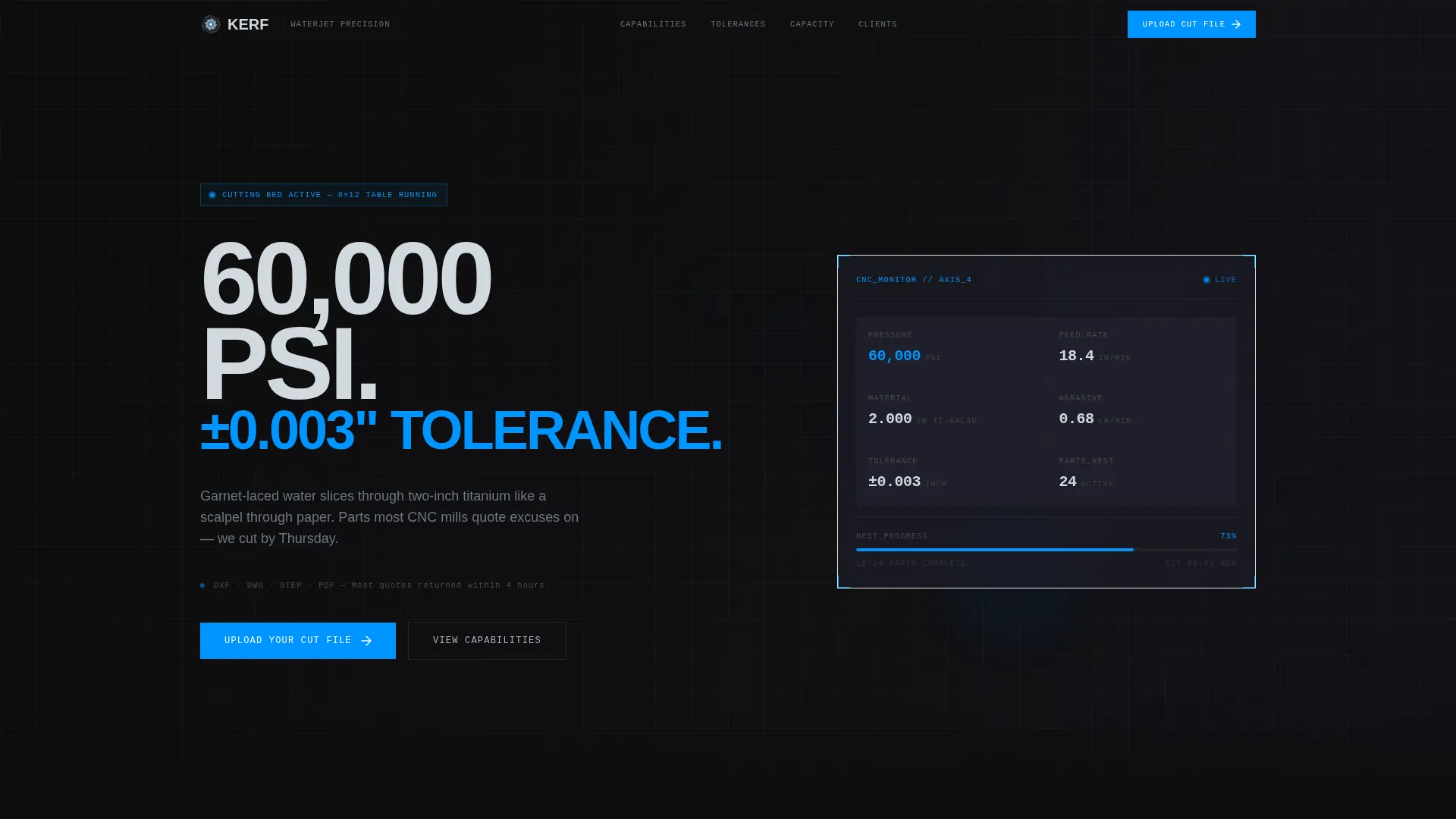
- A full-screen video background header with monospaced telemetry overlays showing pressure, feed rate, material thickness, and part count
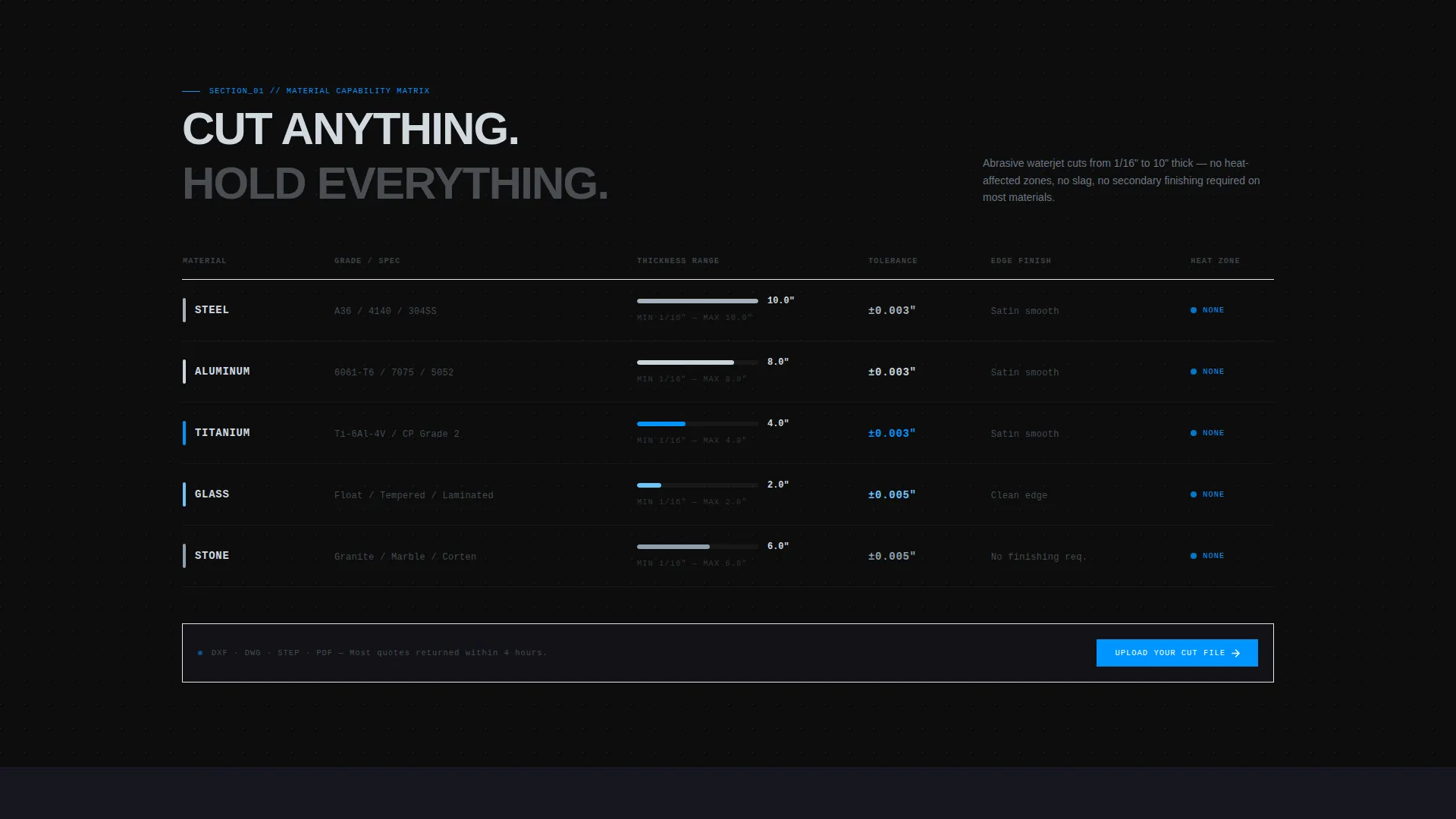
- A scrollable data-card grid including a material capability matrix, tolerance comparison chart, lead-time histograms, and a live-style job capacity gauge
- A persistent mobile bottom bar and three strategically placed "Upload Your Cut File" calls-to-action with a reassurance strip listing accepted file formats
Feature list
This template was designed around a single principle: prove capability so completely that uploading a file feels like the obvious next step.
Full-Screen Video Header with Telemetry Overlay
The header opens on a tight macro shot of a waterjet head piercing stainless steel. Monospaced telemetry data fades in over the footage, displaying PSI, feed rate, material thickness, and part count. The camera pulls back to reveal a full 6x12 cutting bed running a complex multi-part nest.
Material Capability Matrix
A dedicated data card shows cut thickness ranges across steel, aluminum, titanium, glass, and stone. Engineers can scan the matrix instantly and confirm the shop handles their material before submitting anything.
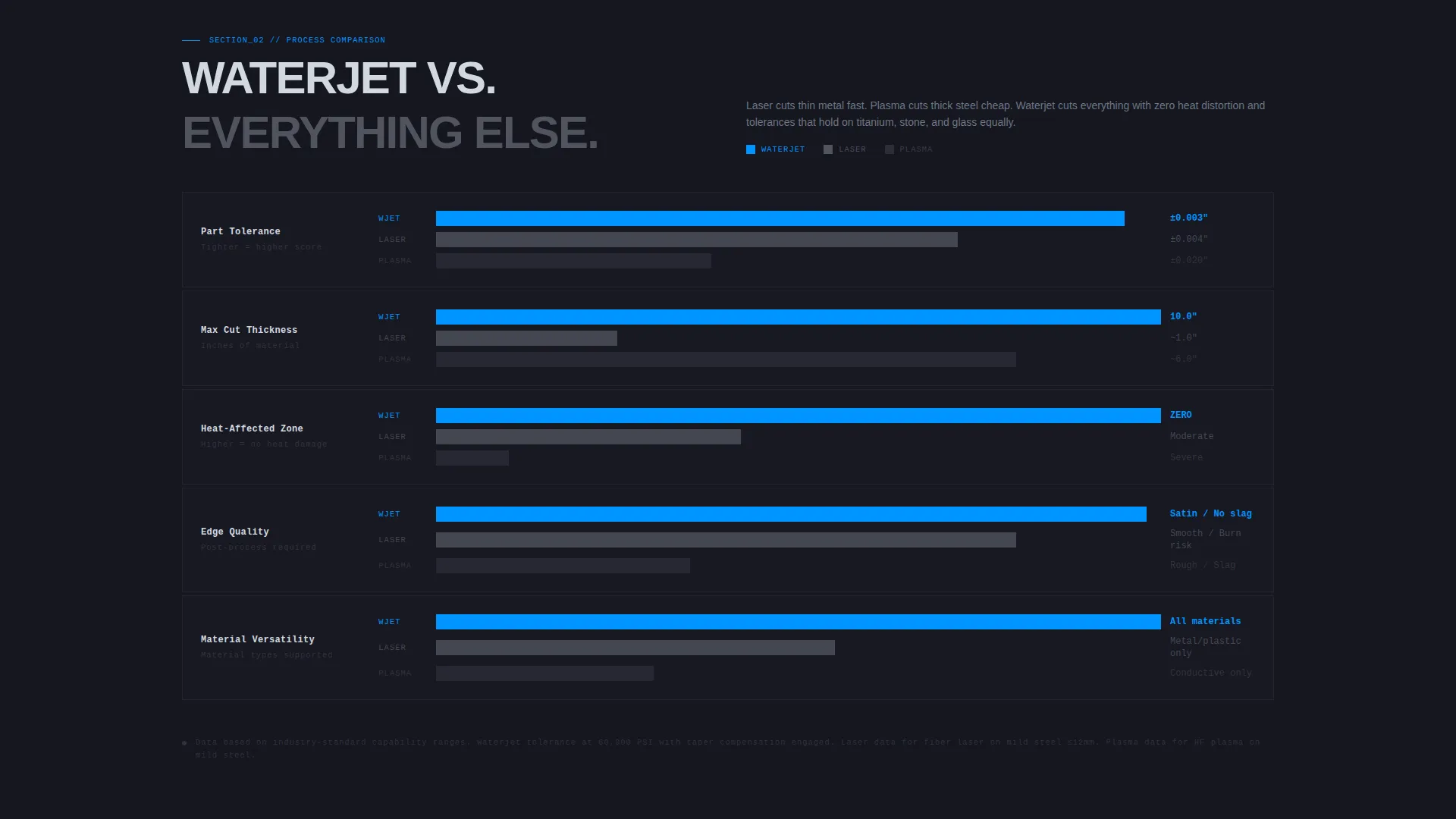
Tolerance Comparison Chart
This section pits waterjet cutting directly against laser and plasma processes. It gives procurement engineers and fabricators a clear, visual basis for choosing waterjet when tolerances and material integrity matter most.
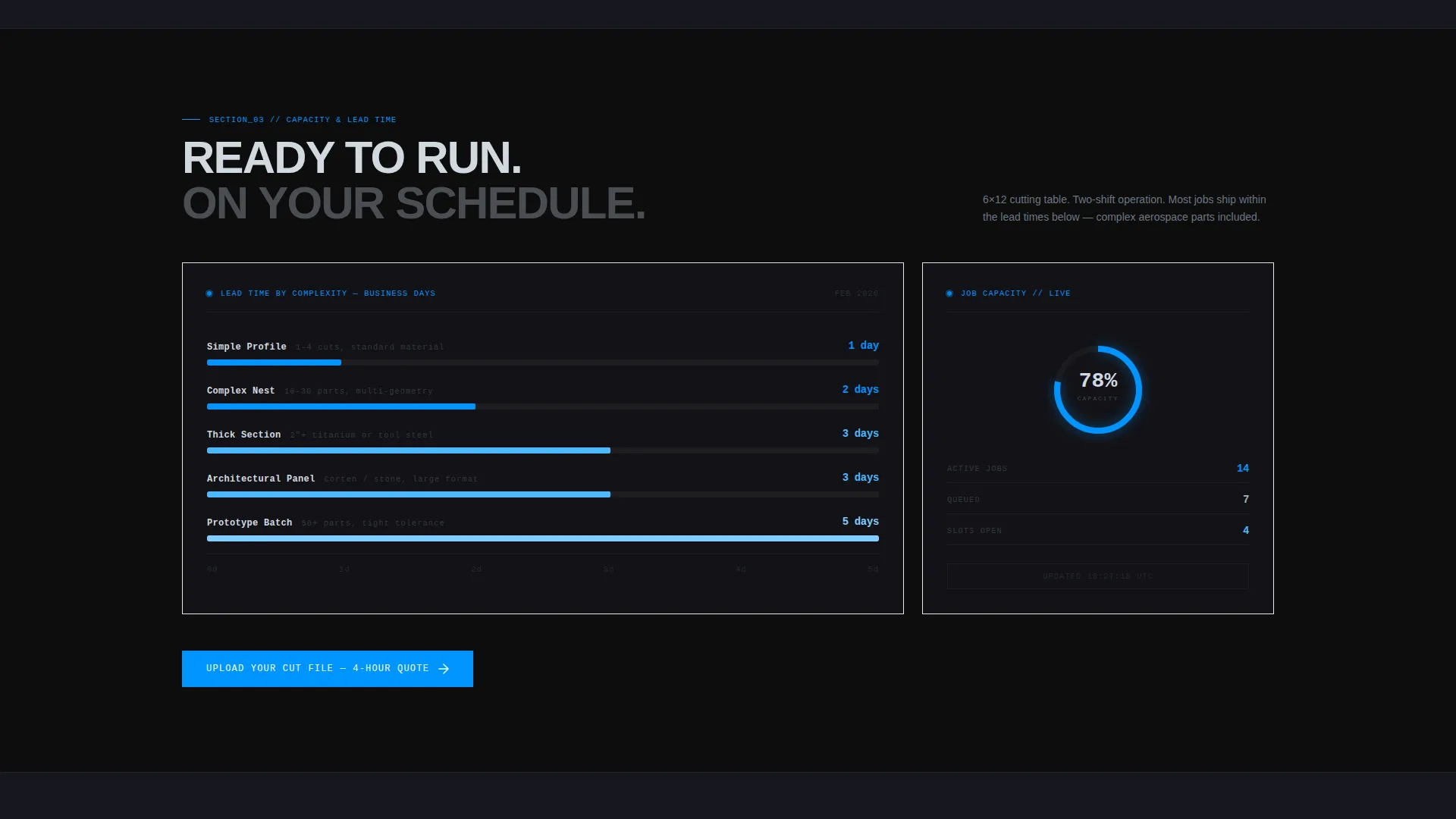
Lead-Time Histogram Panels
Average lead-time data is displayed as histogram-style visuals segmented by part complexity. This helps time-sensitive clients, such as motorsport fabricators with Thursday deadlines, self-qualify before reaching out.
Live-Style Job Capacity Gauge
A status-monitor-inspired gauge communicates current cutting capacity. It adds an operational urgency layer that encourages visitors to act rather than bookmark and return.
Persistent RFQ Call-to-Action Bar
The primary call-to-action, "Upload Your Cut File," appears three times: in the header, after the material matrix, and as a fixed bottom bar on mobile. A single-line reassurance strip confirms accepted formats including DXF, DWG, STEP, and PDF, and notes that most quotes are returned within four hours.
Page sections overview
| Section | Purpose |
|---|---|
| Video Header | Opens on waterjet cutting footage with live-style telemetry data overlay |
| Telemetry Strip | Displays PSI, feed rate, thickness, and part count in monospaced type |
| Material Matrix | Shows cut thickness ranges across five material categories |
| Tolerance Comparison | Benchmarks waterjet precision against laser and plasma cutting |
| Lead-Time Histograms | Visualizes average turnaround segmented by part complexity |
| Capacity Gauge | Communicates current job capacity in a live status monitor style |
| RFQ Reassurance Strip | Lists accepted file formats and four-hour quote turnaround |
| Primary call to action Section | Drives visitors to upload a cut file via the RFQ portal |
| Mobile Bottom Bar | Persistent fixed bar keeps the upload call to action reachable while scrolling |
Design & branding system
The visual identity follows a Data Command theme built on a Carbon Fiber color system. Every color choice has a functional role, mirroring the logic of an HMI panel on a multi-axis cutting table.
- Deep carbon black (#0D0D0D) and machined graphite (#1E1E2A) form the background layers, keeping the interface dense and focused
- Coolant-channel silver (#A8B2BD) carries all body text and labels, maintaining readability against dark backgrounds
- High-pressure indicator blue (#0094FF) is reserved exclusively for live data points, hover states, and primary call-to-action elements, directing the eye only where action is needed
Mobile & speed optimization
The template is structured to stay functional and navigable on smaller screens without losing its data-dense character. The mobile experience keeps critical information accessible while preserving the industrial visual tone.
- The persistent bottom bar keeps the "Upload Your Cut File" call-to-action fixed and reachable throughout the entire scroll on mobile devices
- Data cards and matrix tables are structured to reflow cleanly on narrow viewports, preventing the information-dense grid from becoming illegible on phones or tablets
How this template helps you convert
Kerf earns the click by removing every layer of doubt before asking for it. The conversion path is deliberate and sequential.
- The video header and telemetry overlay immediately establish credibility, signaling to engineers and fabricators that this shop operates at a professional level and understands their language
- The data-card grid builds progressive proof through the scroll, each section adding another operational fact until submitting a cut file feels like a logical conclusion rather than a risk
- The reassurance strip, format list, and four-hour quote promise remove the final friction point directly before the call-to-action, making the upload decision straightforward and low-commitment
Other information about this template
This template is part of a niche-specific design approach for the manufacturing and industrial sector. It is built for waterjet cutting operations where the sales cycle begins with technical proof, not brand storytelling.
- The template style is classified as Dashboard and Data Grid, designed to surface operational data in a scannable, report-style layout
- The creative direction follows an Industry Report approach, structuring the page like a technical briefing rather than a promotional pitch
- The header concept is a Full-Screen Video Background, suited to shops that have footage of their cutting process available
- The landing page direction is Click-Through, with every design and copy decision oriented toward driving a qualified visitor to the RFQ portal
- This template fits waterjet shops that handle complex geometries, tight tolerances such as plus or minus 0.003 inches, and materials that other cutting processes struggle with
Theme
Data Command
Creative direction
Industry Report
Color system
Carbon Fiber
Style
Dashboard/Data Grid
Direction
Click-Through
Page Sections
Full-screen Video Header with Telemetry Overlay
Material Capability Matrix
Tolerance Versus. Process Comparison Chart
Lead-time Histogram Panels
Live-style Job Capacity Gauge
Persistent RFQ Call-to-action System
Related questions
What kind of business is this template designed for?
Do I need video footage to use this template effectively?
What file formats does the reassurance strip reference?
Can I update the data in the material matrix and tolerance chart?
Is this template suited to shops that offer services beyond waterjet cutting?