Ceramics & Glass Manufacturing Reviews Website Template
Kiln is a precision industrial ceramics manufacturer landing page template built for technical B2B sales. It guides procurement engineers and R&D leads through a structured qualification journey, from certification badges and tolerance tables to resistance matrices and case studies, before asking them to download a gated Material Selection Guide. The design speaks the language of the engineer reviewing it.
by Rocket studio
Quick summary
Kiln is a single-page, zigzag-layout template designed for industrial ceramics manufacturers. It presents each stage of a procurement engineer's qualification checklist as a dedicated section, certifications, tolerances, resistance data, and case studies, building evidence before requesting contact details. The goal is a Material Selection Guide download, earned through proven technical fluency.
Who this template is for
This template is built for B2B manufacturers whose customers arrive with technical requirements, not general questions. It serves businesses that need to demonstrate precision, compliance, and delivery capability before a lead will fill out a single form field.
- Procurement engineers sourcing wear-resistant ceramic components under a firm deadline
- R&D leads qualifying new ceramic substrates for medical device or semiconductor filings
- Plant managers who need to replace a failed part before a production line goes dark
What problem this template solves
Most industrial manufacturers lose qualified leads because their landing page reads like a brochure, not a technical document. Engineers need evidence, not promises. This template solves that by presenting the page as a living due-diligence folder, each scroll answering the next question on the buyer's internal checklist.
- Visitors bounce when they cannot quickly find certification details or precise tolerance data
- Generic layouts fail to build the trust that industrial buyers require before sharing work contact details
- Without a clear content-led path, the download call to action feels premature and unconvincing
What you get with this template
The template delivers a complete, structured landing page ready to represent a high-precision ceramics operation. Every section is purposefully sequenced to move a technical buyer from awareness to action.
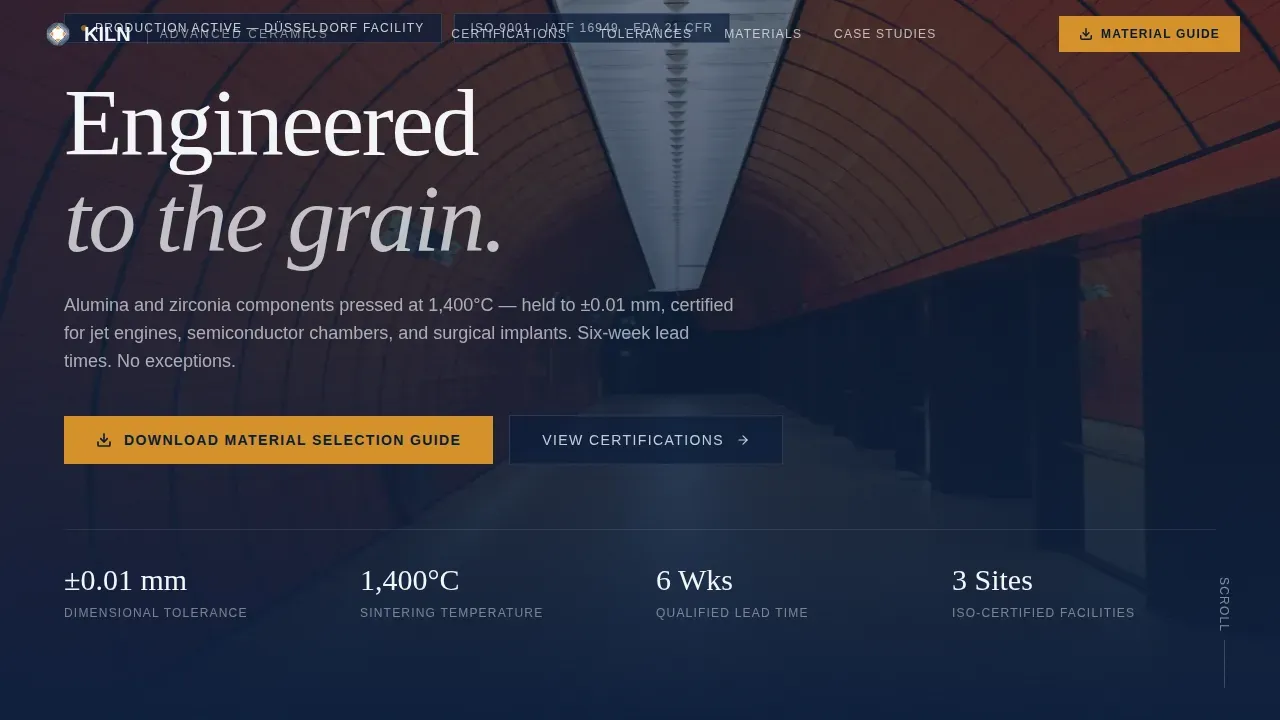
- A cinematic hero section with a production-line video concept and a dual call-to-action layout
- Six zigzag content sections covering certifications, dimensional tolerances, resistance data, case studies, and a gated form
- A Navy Authority color system, Corporate Precision typography pairing, and a technical data-sheet visual style throughout
Feature list
This template is built around one principle: prove competence before asking for anything in return. Each feature below serves that purpose directly.
Cinematic Behind-the-Scenes Hero
The header opens with a slow dolly-shot video concept moving through the production line. The camera passes spray-dried granules, an isostatic press, glowing kilns, and a finished part held against a micrometer. A single headline, "Engineered to the grain," resolves over the final frame. The section includes a dual call-to-action layout designed to capture both ready-to-act buyers and early-stage researchers.
Certification Trust Panel
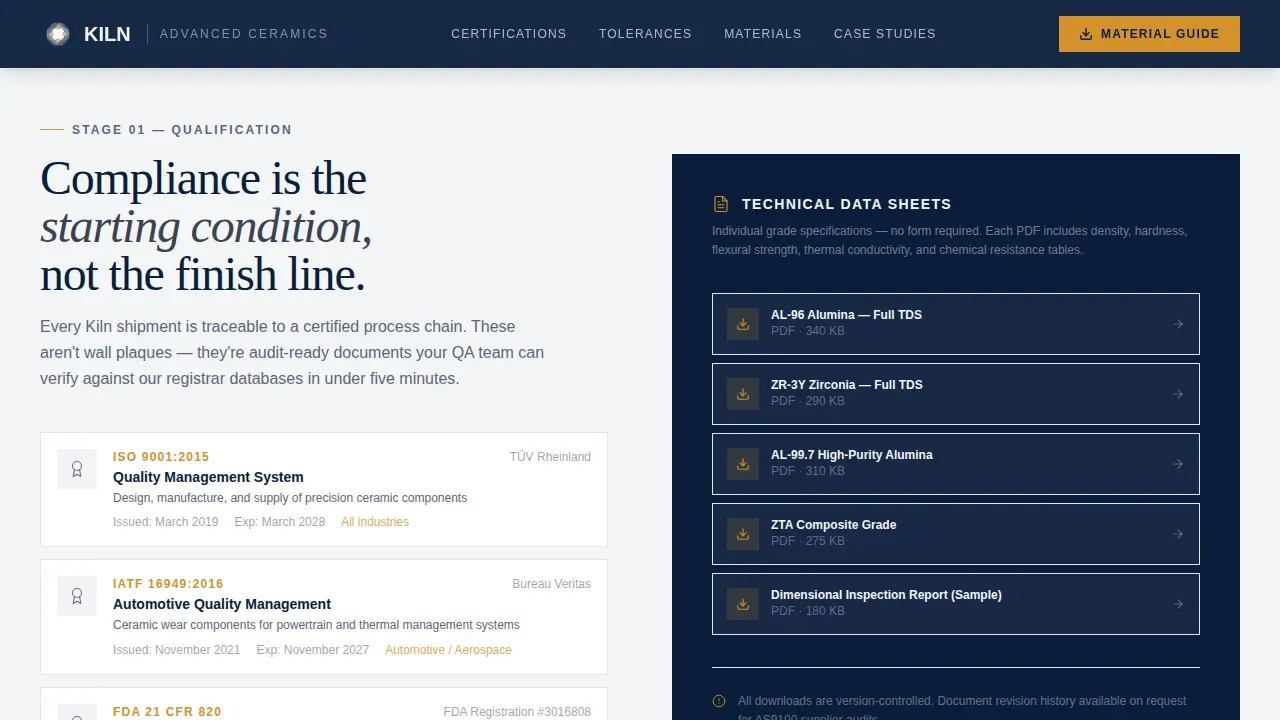
This zigzag section places ISO, IATF, and FDA compliance badges on one side and downloadable certificate PDFs on the other. It is designed to meet the first question any procurement engineer asks: are you certified to supply into my industry? The layout makes those credentials immediately scannable and verifiable.
Interactive Tolerance Slider
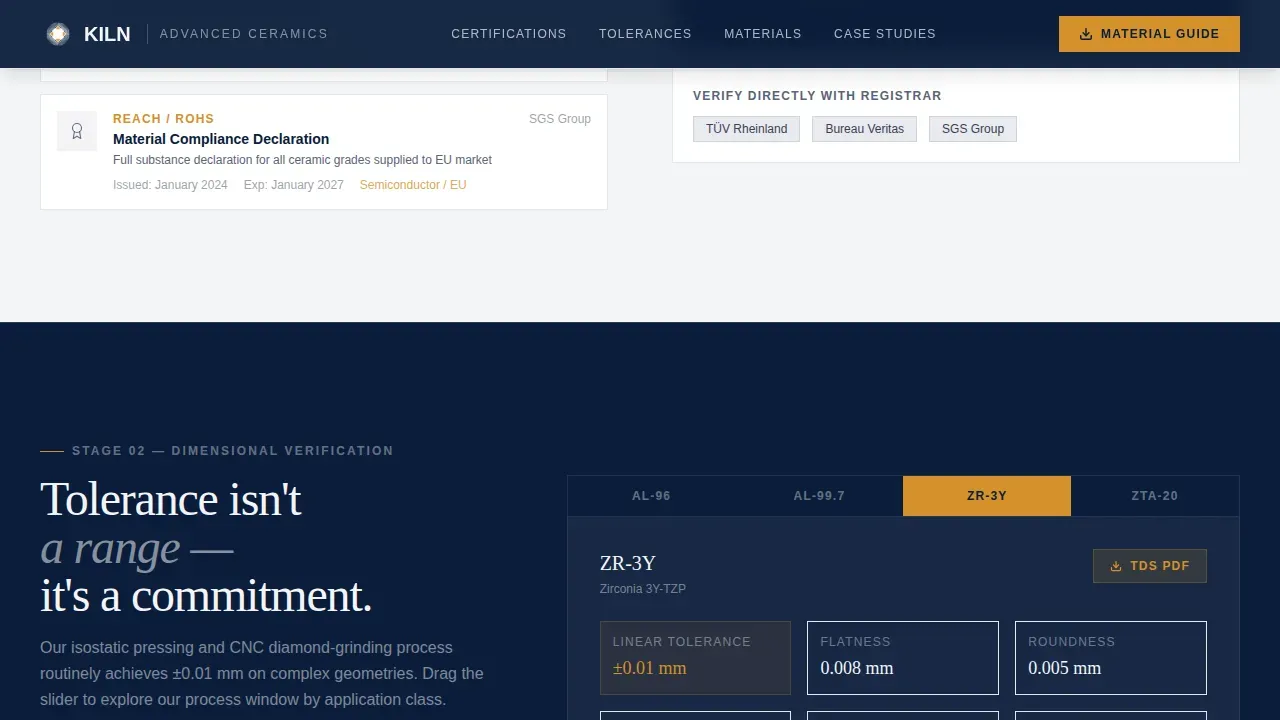
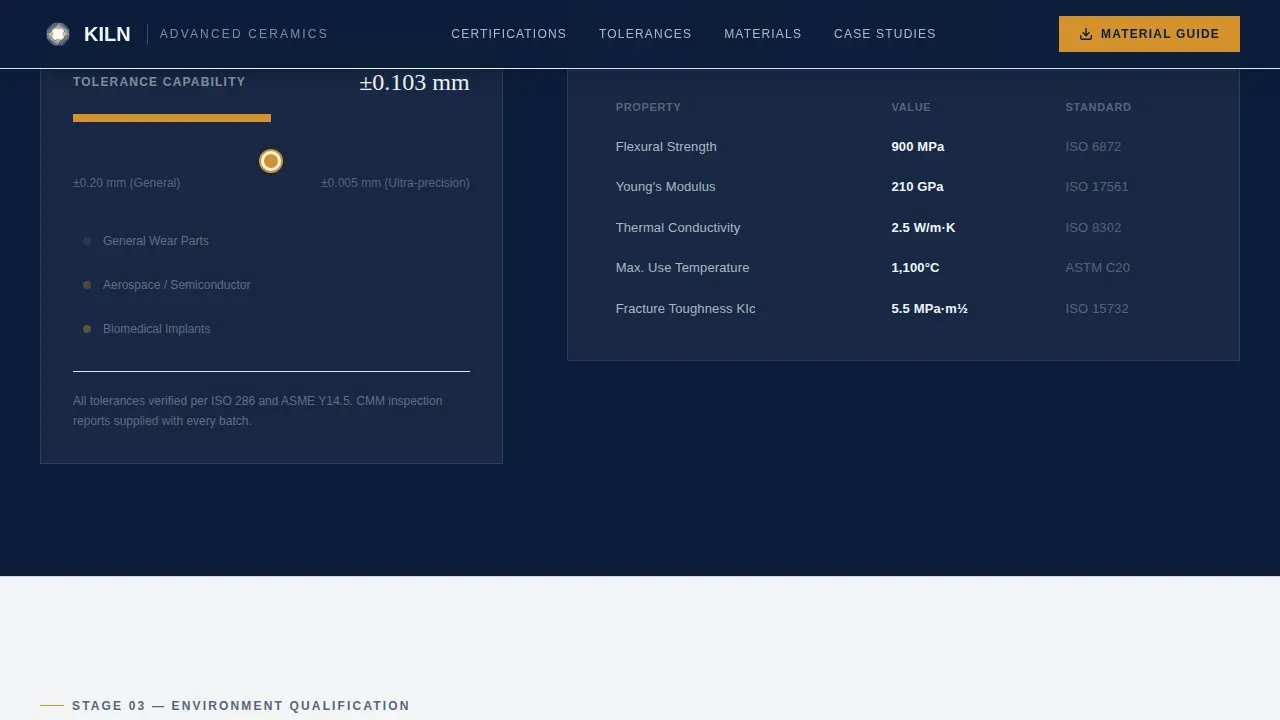
A dimensional capability table sits alongside an interactive slider showing plus-or-minus 0.01 mm capability. Precision capabilities like high-precision machining, grinding, and lapping are surfaced here in a way that engineers can test directly. This section builds the kind of trust that a static spec sheet rarely achieves on its own.
Thermal and Chemical Resistance Matrix
Visitors toggle operating environments across a resistance matrix to see how ceramic components perform under specific heat, chemical, and pressure conditions. This is especially useful for customers qualifying materials for aerospace, defense, medical, or semiconductor applications where performance data must be precise.
Case Study Comparison Panel
Each case study section shows a failed competitor part beside the ceramic replacement, with measurable uptime gains displayed clearly. This format gives procurement teams the social proof and quantified benefits they need to build an internal business case for purchase approval.
Gated Material Selection Guide Form
The primary call to action is a lean gated form requesting work email, component application type via dropdown, and annual volume range. By the time a visitor reaches this form, the page has already demonstrated enough technical depth that the download feels like the next logical step in a due-diligence process they are already running.
Page sections overview
| Section | Purpose |
|---|---|
| Hero production line | Opens with cinematic video concept and dual call to action |
| Certification trust panel | Displays ISO, IATF, FDA badges with downloadable cert PDFs |
| Tolerance capability table | Shows dimensional accuracy with interactive slider |
| Resistance environment matrix | Toggle cards for thermal and chemical environment data |
| Case study comparison | Failed part versus ceramic replacement with uptime gains |
| Material guide form | Gated download form with lean field structure |
| Footer linear row | Single-row footer with navigation links and contact details |
Design & branding system
The visual identity follows a Corporate Precision theme. The aesthetic is deliberately close to a technical data sheet printed on heavy bond paper, the kind of document an engineer trusts enough to specify from without a follow-up call. Minimalist layout with ample whitespace keeps attention on the data.
- Command navy (#0B1D3A) as the primary structural color, machined graphite (#3B4252) for secondary panels, and kiln-white (#F4F5F7) as the base canvas
- Specification amber (#D4912A) reserved for callouts, download icons, and interactive audit elements only
- Manrope for body text and interface labels, paired with Fraunces serif for hero headlines and section anchors
Mobile & speed optimization
The template is designed desktop-first, reflecting the reality that procurement engineers review detailed technical specifications on workstations. Interactive elements such as the tolerance slider and toggle matrices are built as client-side components, while static content sections use a server-component approach to keep load behavior efficient.
- Desktop-first layout prioritizes wide-screen readability for data tables, tolerance sliders, and resistance matrices
- Scroll-reveal animations and stagger effects are set at medium intensity to stay professional without slowing page feel
- High-quality product visuals are specified as precise ceramic part imagery rather than generic stock photography
How this template helps you convert
The template is built on a content-led conversion model. It earns the download by proving technical fluency at every stage before presenting the form. This approach works for industrial buyers who distrust pages that ask before they give.
- Each zigzag section answers one stage of the engineer's mental qualification checklist, moving them steadily toward the call to action with growing confidence
- The gated form is deliberately lean, requesting only the fields essential to qualify the lead, work email, application type, and volume range, reducing friction at the final step
- Individual technical data sheets per ceramic grade are available as ungated secondary links, giving early-stage visitors a lower-commitment path that still captures intent signals
Other information about this template
This template is one of the more specialized options available for the ceramic industry. It was designed specifically for manufacturers who operate industrial kilns at scale and need their landing page to reflect that operational weight. Industrial kilns are typically much larger and more powerful than studio or home kilns, and commercial kilns are built for mass production at high capacity. The template's structure reflects that scale.
Ceramic manufacturing covers a wide variety of materials and processes. The full sequence from milling and batching through mixing, forming, drying, and sintering processes shapes the final product's mechanical integrity. Each phase matters. Sintering involves subjecting dried components to extreme heat inside specialized ovens or kilns, bonding the ceramic's oxides to achieve final hardness and durability.
Technical ceramics are engineered for high-performance application in aerospace, defense, military, medical, automotive, and construction industries. Key engineering materials include Alumina, Zirconia, Silicon Nitride, and Silicon Carbide, each chosen for specific benefits such as hardness, thermal shock resistance, and biocompatibility. Industrial ceramics are produced in large quantities for applications requiring high resistance and superior insulation, including electronic components found in semiconductor and power systems.
Industrial kiln controllers play an essential role in this process. They must be capable of executing a variety of complex firing schedules with precise control. Advanced controllers offer responsive touchscreen interfaces and the ability to integrate with relay-controlled kilns or ovens to manage firing cycles. Precision tools like these empower innovation and craftsmanship across a broad range of industrial processes.
Choosing the right manufacturer matters deeply. Selecting one with proven expertise ensures components meet strict specifications and durability requirements within required timeframes. Long-term access to replacement parts and expert technical assistance is important when evaluating any kiln manufacturer for a critical supply relationship. The Kiln precision industrial ceramics manufacturer landing page template gives manufacturers in this space a credible, conversion-ready starting point for developing that relationship online.
- Industrial kilns are used across medical, pharmaceutical, electronic, automotive, military, and aerospace sectors
- Commercial kilns consume more power than studio kilns and are more expensive to purchase and operate at scale
- Ceramic products range from structural ceramics and refractories to whitewares and technical ceramics
- Ceramics provide higher hardness, longer lifespans, and better resistance to heat, corrosion, and wear than metals or polymers
- Porcelain and glass are among the broader category of ceramic materials, though this template focuses on engineered industrial grades
- The landing page website structure removes navigation to keep visitors focused on a single conversion goal
Theme
Corporate Precision
Creative direction
Checklist & Audit
Color system
Navy Authority
Style
Zigzag/Alternating
Direction
Content/Resource
Page Sections
Cinematic Production-line Hero
Certification and Compliance Panel
Interactive Dimensional Tolerance Slider
Thermal and Chemical Resistance Matrix
Case Study Comparison Panels
Gated Material Selection Guide Form
Related questions
Who is this template designed for?
What sections does this landing page include?
Can the gated form be customized for different ceramic grades or applications?
How does the checklist-style layout help with B2B conversion?
Is this template suitable for manufacturers offering multiple ceramic grades?