Handcrafted Brick Fabricator Landing Page Template
Kiln is a gallery and detail landing page template built for custom brick fabricators. It guides restoration architects, landscape designers, and general contractors through the full fabrication sequence, from raw clay to finished brick, using an animated hero, a click-to-expand process gallery, specification data cards, and a focused lead generation form.
by Rocket studio
Quick summary
Kiln is a single-page template for custom brick fabricators that need to earn technically demanding clients before the first conversation. The page walks visitors through the complete fabrication process, displays detailed specification data, and closes with a structured lead form. Every section is designed to prove quality rather than simply claim it.
Who this template is for
This template is built for fabricators whose work demands proof, not promises. It speaks directly to clients who read spec sheets before making calls.
- Restoration architects sourcing exact-match brick for historic preservation projects
- Landscape designers specifying handmade clay pavers for estate or heritage garden work
- General contractors who need a discontinued brick profile matched and documented
What problem this template solves
Custom brick fabrication is a high-trust, long-lead purchase. Buyers need evidence before they commit to a six-week production cycle. Most fabricator websites offer a phone number and a portfolio. That is not enough for an architect comparing clay body compositions across three suppliers.
- Visitors leave without understanding why the fabrication process justifies the lead time
- Specification-driven clients cannot find the technical detail they need to move forward
- There is no clear entry point for leads at different stages, from early spec phase to active project
What you get with this template
The template delivers a complete, structured landing page that moves a technically sophisticated buyer from first impression to qualified lead submission. Every section serves a specific role in that journey.
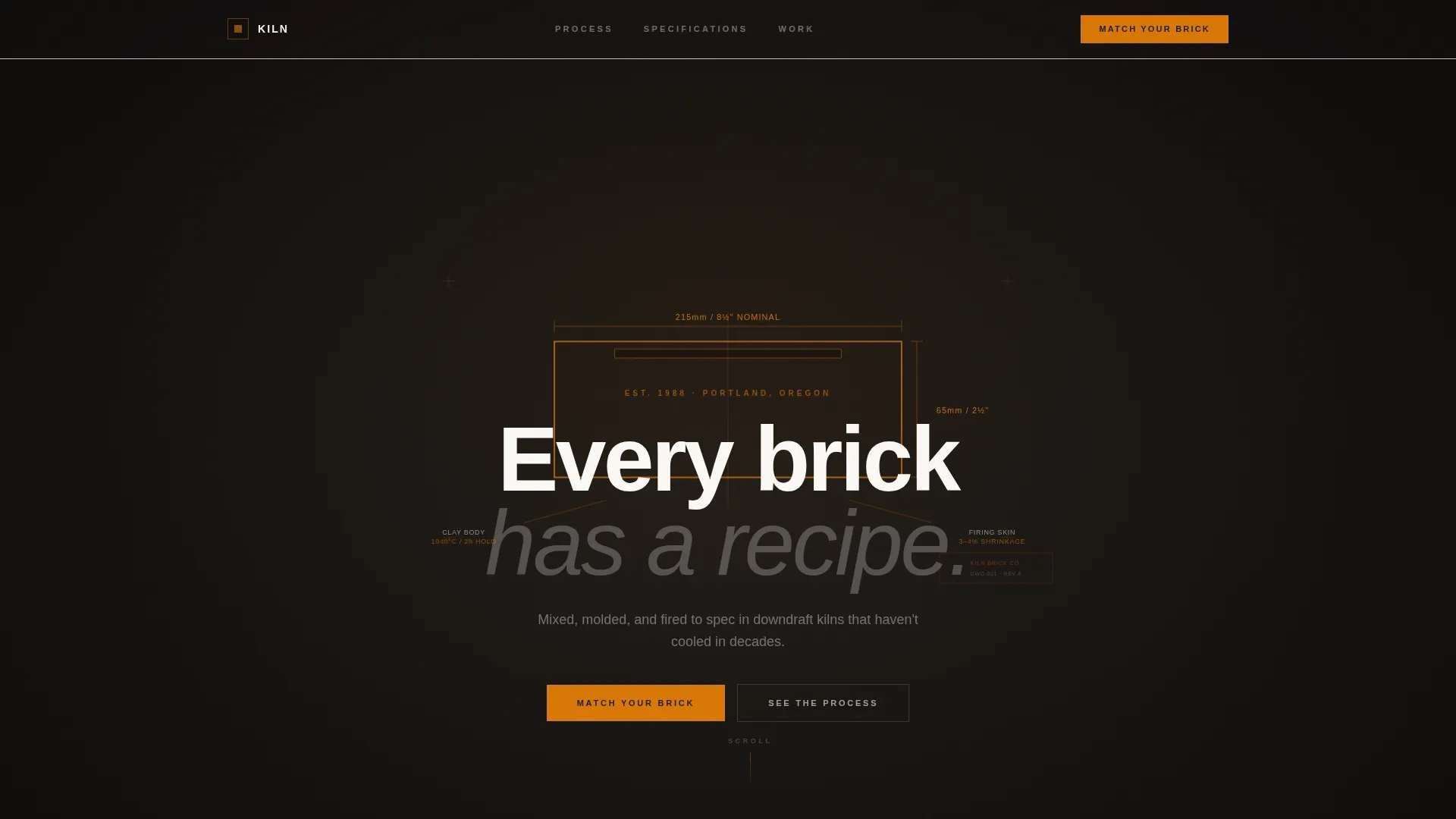
- An animated hero section with an SVG line art brick cross-section and a bold opening headline
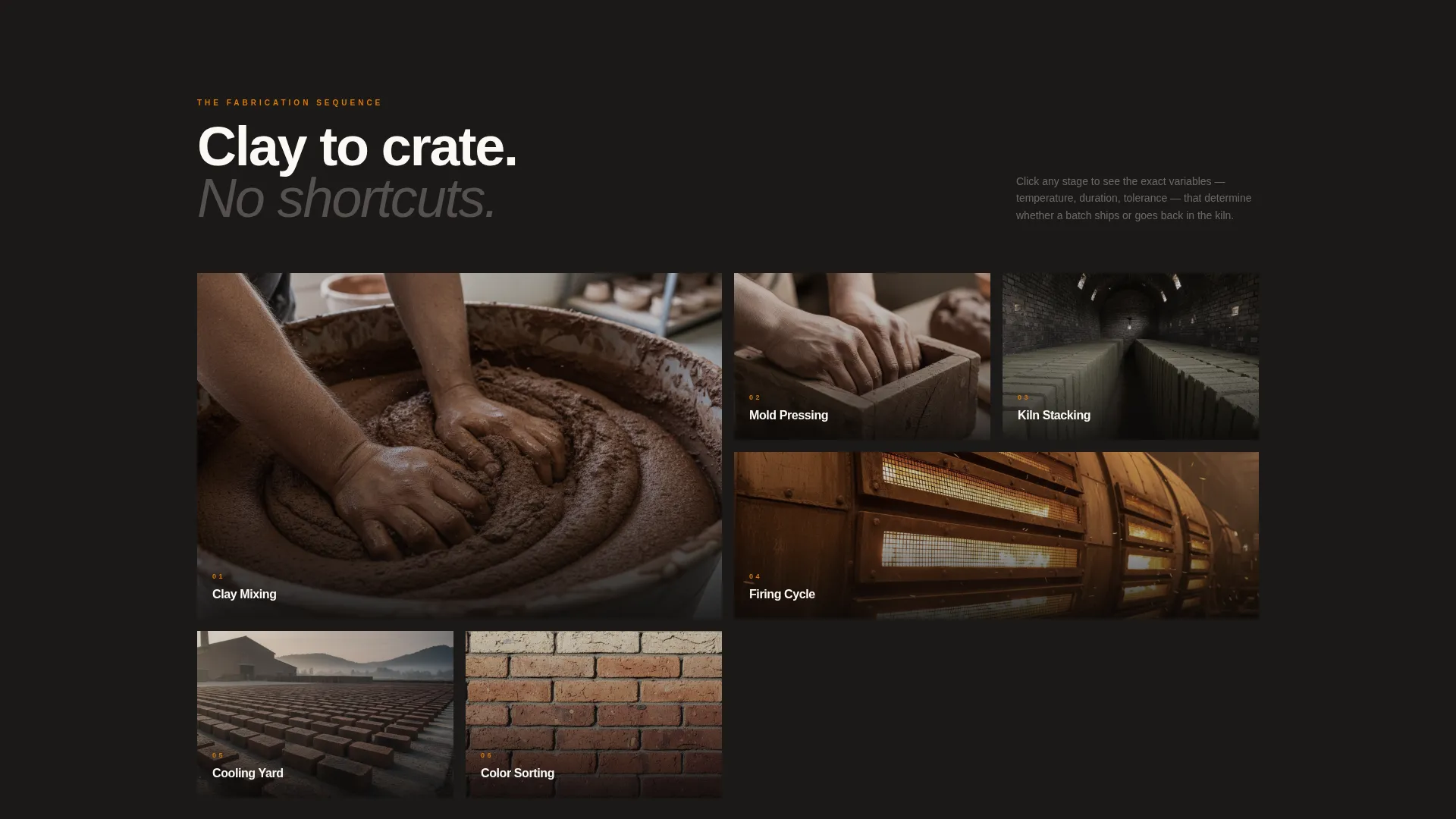
- A bento-grid process gallery with click-to-expand detail panels showing clay body data, firing temperature, and shrinkage percentage
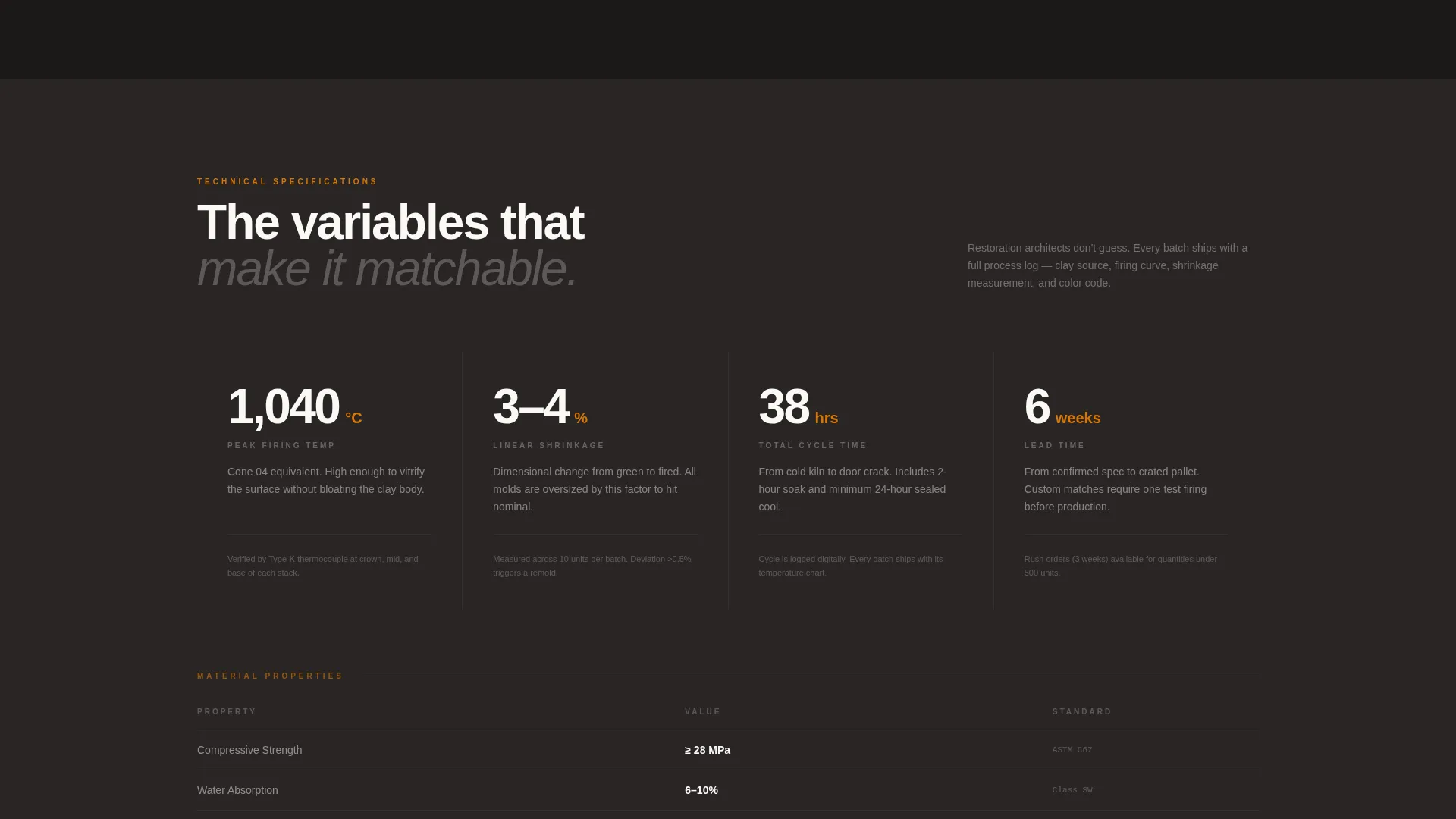
- Specification data cards, a testimonials section, a dual-path lead form, and a clean single-row footer
Feature list
This template is built around one core idea: the scroll proves the work. Each feature below supports that through structure, interactivity, or layout.
Animated SVG Hero with Line Art Illustration
The full-viewport hero opens with a technical elevation drawing of a brick cross-section rendered in thin amber strokes on a kiln-black background. On load, the clay body fills in grain by grain, the firing skin appears, and dimensional callouts extend outward with real measurements. The headline, "Every brick has a recipe," fades in below.
Click-to-Expand Process Gallery
A bento-grid gallery displays close-up photographs of the full fabrication sequence: clay mixing, mold pressing, kiln stacking, cooling yard, and color sorting. Clicking any thumbnail opens a detail panel showing the specific variables for that stage, including clay body composition, water ratio, firing temperature, burn duration, and shrinkage percentage.
Specification Data Cards
Dedicated data cards present technical fabrication variables with amber accent styling. Each card surfaces the kind of documented detail a restoration architect or specification-driven contractor needs before approving a source.
Dual-Path Lead Generation Form
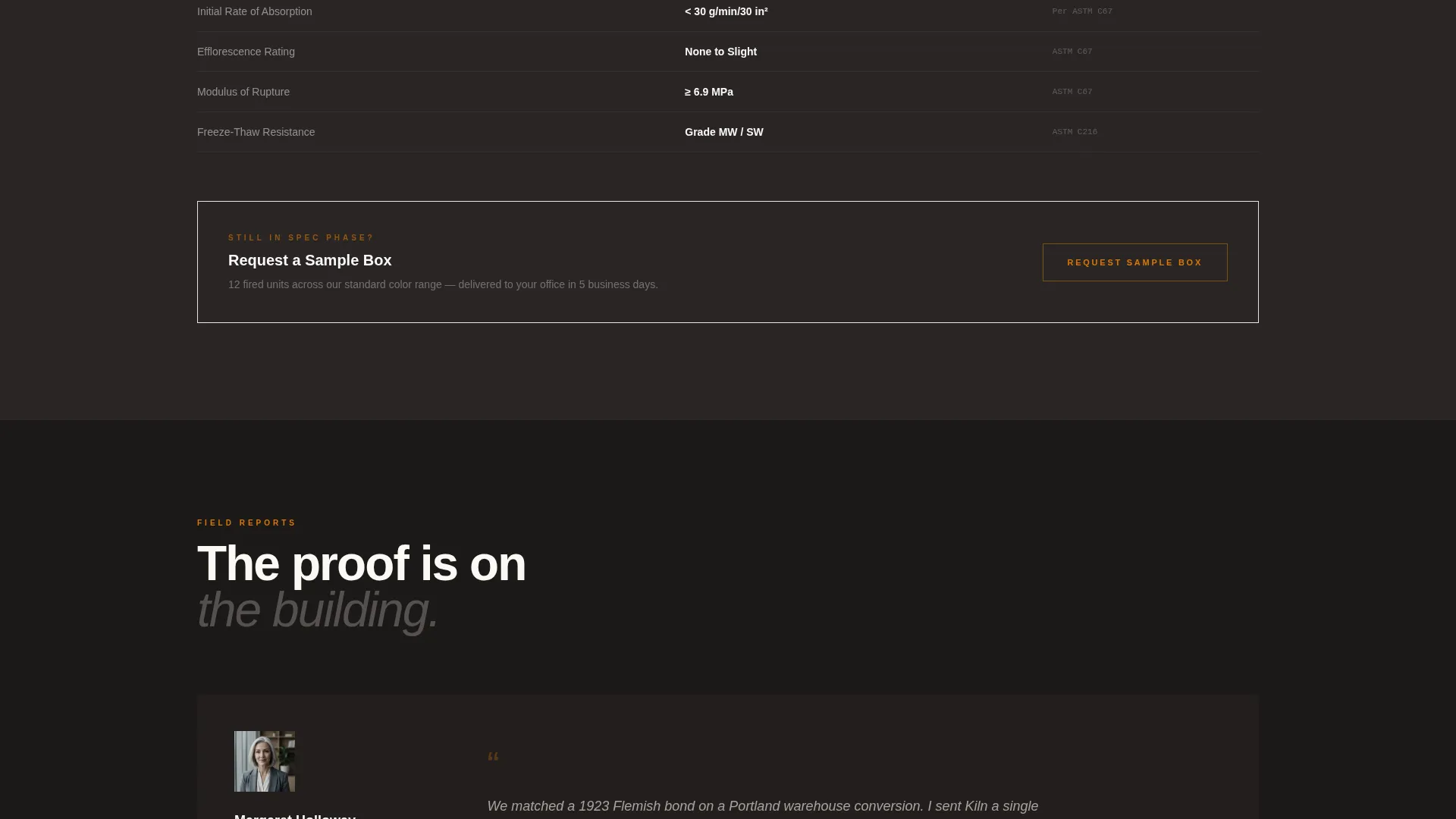
The primary call to action, "Match Your Brick," anchors to a form collecting project type, a photo upload of the brick to be matched, quantity estimate, and zip code for shipping calculation. A secondary path, "Request a Sample Box," serves buyers still in the early specification phase.
Testimonials Section
Named testimonials from restoration architects, landscape designers, and general contractors are displayed with context. Each quote reflects a different buyer role, reinforcing trust across the full target audience.
Scroll-Triggered Reveals and Magnetic Buttons
Scroll-triggered section reveals and staggered gallery animations keep the page feeling alive as visitors move through the fabrication sequence. Magnetic button behavior adds tactile responsiveness to the primary calls to action.
Page sections overview
| Section | Purpose |
|---|---|
| Hero with animation | Opens with SVG line art brick animation and headline |
| Process gallery grid | Shows fabrication sequence with click-to-expand panels |
| Specification data cards | Displays clay body, temperature, and shrinkage data |
| Testimonials section | Builds trust through named client quotes |
| Match Your Brick form | Captures qualified leads with photo upload and project details |
| Single-row footer | Closes the page with minimal, clean navigation |
Design & branding system
The visual identity follows an Industrial Raw theme. The palette reads like the interior of a downdraft kiln at dawn: soot-dark walls, fading ember glow, and morning light slicing through vent slots.
- Core colors: kiln-black (#1C1917) for backgrounds, ash gray (#44403C) for supporting surfaces, fired amber (#D97706) for hover states, active gallery borders, and accent lines, and slip-white (#FAF9F6) for text and negative space
- Typography: DM Sans for headings and display text, Plus Jakarta Sans for body copy
- Amber appears only where the page is live: buttons, progress indicators, selected gallery borders; charcoal dominates everything else
Mobile & speed optimization
The template is designed desktop-first, reflecting how restoration architects and specification-driven contractors typically review technical content. It is fully responsive and adapts cleanly to smaller screens.
- Static layout sections use server components for efficient rendering; animations and gallery interactions run as client components
- SVG path draw animations, scroll-triggered reveals, and staggered gallery loads are structured to avoid layout shift during page entry
How this template helps you convert
The page is structured so the gallery does the selling. By the time a visitor reaches the form, they have already moved through the complete fabrication sequence and seen the documented proof behind every variable.
- The animated hero and headline establish the fabricator's precision from the first second on the page, setting the standard before a word of copy is read.
- The process gallery and specification data cards build technical credibility across the scroll, answering the detailed questions a restoration architect or contractor will have before reaching out.
- The dual-path form meets buyers where they are: active project leads use "Match Your Brick" while early-stage specifiers choose "Request a Sample Box," reducing friction at both entry points.
Other information about this template
This template is localized for the United States market, using English copy, USD pricing references, and imperial measurements throughout. It is built for the construction and home category, specifically for the brick products and services niche, with a gallery and detail template style that suits industrial artisan manufacturing and B2B lead generation.
- Project types supported by the form include restoration, new construction, and landscape applications
- The template is delivered as a single-page layout with a linear single-row footer pattern
- Animation intensity is high by design; the SVG draw sequence, staggered gallery, and magnetic button interactions are core to the Transparent Process creative direction
Theme
Industrial Raw
Creative direction
Transparent Process
Color system
Charcoal & Amber
Style
Gallery + Detail
Direction
Lead Generation
Page Sections
Animated SVG Hero Section
Click-to-expand Process Gallery
Specification Data Cards
Dual-path Lead Generation Form
Named Testimonials Section
Scroll-triggered Animations
Related questions
Who is this template designed for?
What sections are included in this template?
How does the click-to-expand gallery work?
Is there a path for buyers who are not ready to place an order?
What information does the lead form collect?