Martial Arts & Combat Sports Booking Website Template
Kimura is a nature-inspired Brazilian Jiu-Jitsu academy landing page template built on a modular card grid. It features an interactive three-question quiz that reshuffles class cards, instructor profiles, and schedule blocks in real time. A persistent registration bar drives event sign-ups, while the Alpine Fresh color system and organic typography create a forest-trail atmosphere that earns trust before a visitor reads a single word.
by Rocket studio
Quick summary
Kimura is a single-page, card-grid landing page template designed for Brazilian Jiu-Jitsu academies that want to feel alive, personal, and rooted in nature. The page opens with a parallax testimonial hero, flows through a personalized quiz, and ends with a frictionless event registration form. Every section works together to move a curious visitor toward booking their first class.
Who this template is for
This template is built for BJJ academy owners and martial arts instructors who want a landing page that does more than look good. It is equally useful for studio managers who handle their own marketing and for freelance web designers building client sites in the wellness and fitness space. Anyone who needs a page that feels welcoming to a white belt on day one and credible to a seasoned black belt will find the right tone here.
This template suits:
- Brazilian Jiu-Jitsu academies targeting adult beginners, office workers, parents, and former athletes
- Martial arts schools that teach gi and no gi classes and want to highlight both tracks
- Designers or developers building a nature-inspired, community-driven academy presence
What problem this template solves
Most martial arts landing pages feel like a sports-equipment catalog. They list class times and belt ranks but give no sense of the room, the people, or the journey. A prospective student who has never stepped onto a mat cannot picture themselves there. That disconnect costs sign-ups every single day.
This template solves that by:
- Replacing generic hero banners with a testimonial card that places a real student mid-roll at the top of the page, signaling authenticity immediately
- Using an interactive quiz to surface the right class types, instructor profiles, and schedule blocks for each visitor, so the page feels personally built for them
- Attaching a persistent registration bar post-quiz that turns curiosity into a confirmed booking in under sixty seconds
What you get with this template
This template delivers a complete, ready-to-customize landing page structure for a Brazilian Jiu-Jitsu academy. Every section is pre-designed inside a modular card grid, so you can rearrange, replace, or extend cards without touching the overall layout. The page is built mobile-first, reflecting the fact that effective landing pages for BJJ often see over 76% of traffic from mobile devices.
Included in this template:
- A parallax testimonial hero card with grain texture overlay and handwritten-style quote placement
- A three-question interactive quiz with real-time card grid reshuffling based on visitor answers
- A persistent bottom registration bar with a date picker and a "Bring a Training Partner" secondary path
Feature list
This template packages several distinct capabilities into one cohesive landing page. Each feature is grounded in the brief and built to serve a specific conversion or trust goal.
Parallax Testimonial Hero with Grain Texture
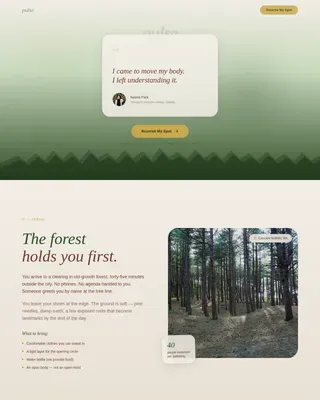
The header is a single oversized testimonial card. A candid photo of a student mid-roll sits beneath a soft parallax layer of mountain tree canopy filtering morning light. A handwritten-style quote overlays the image. The grain texture signals authenticity before the visitor processes a single word of body copy. This approach conveys a sense of calm and natural balance rather than polished stock imagery.
Three-Question Personalization Quiz
Beneath the hero, a dedicated quiz card asks three targeted questions: what brings the visitor to the mat, how their body moves today, and when their schedule opens up. Each answer reshuffles the modular card grid below in real time. Class types, instructor profiles, and schedule blocks reorder to match the visitor's answers. By the time the quiz is complete, the page feels hand-built for one person. This personalization builds investment and makes the registration step feel like a natural continuation rather than a cold ask.
Real-Time Card Grid Reshuffling
The modular card grid is the heart of the page. Cards include class-type panels, instructor bios, technique preview snippets, program descriptions, and student testimonials. The quiz drives the order, but every card is independently designed and fully customizable. Cards float on subtle shadows that echo stones resting on moss, consistent with the nature-inspired visual language. This structure makes it straightforward to add, remove, or reorder cards as the academy's offerings grow.
Persistent Event Registration Bar
After the quiz completes, a bottom bar locks onto the screen. It carries the primary call to action "Reserve Your First Roll" and links to a short form: first name, a quiz-recommended class pre-selected, and a date picker showing the next three available intro sessions. A secondary path labeled "Bring a Training Partner" duplicates the form fields for a friend's name and email. The bar remains visible as the visitor continues scrolling, keeping the conversion path open without interrupting the reading experience.
Staggered Social Proof Strip
A dedicated section below the card grid presents staggered testimonial cards with candid student photography and short outcome-focused quotes. The staggered layout breaks the grid rhythm deliberately, drawing the eye and slowing the scroll. Each card is sized to be legible on a mobile screen without zooming. Testimonials that focus on the welcoming, calm atmosphere of the academy reinforce the community message established in the quiz section.
Alpine Fresh Color System and Organic Typography
The visual identity uses deep evergreen for all primary typography, glacier mist and white for alternating card backgrounds, exposed granite for secondary text and user interface details, and mountain wildflower violet reserved exclusively for calls to action and interactive highlights. Headlines use an organic serif typeface and body copy uses a clean, readable sans-serif. The palette conveys a sense of calm, growth, and natural balance without sacrificing legibility or conversion clarity.
Page sections overview
| Section | Purpose |
|---|---|
| Parallax Testimonial Hero | Opens page with authentic student imagery and an oversized quote overlay |
| Interactive Quiz Card | Captures visitor intent through three targeted questions |
| Personalized Card Grid | Reshuffles class, instructor, and schedule cards based on quiz answers |
| Persistent Registration Bar | Keeps the primary call to action visible post-quiz for immediate booking |
| Social Proof Strip | Staggered testimonial cards with candid photography and outcome quotes |
| Single-Row Footer | Closes page with minimal navigation and contact essentials |
Design & branding system
The design philosophy behind this template is rooted in the idea that a nature-inspired BJJ landing page should blend earthy, organic design with high-converting elements. The color palette pulls from deep greens, muted slate greys, and bright accent violet, creating a visual system that feels alive without being distracting. Ample white space prevents clutter and keeps focus on the core message at every scroll depth.
Design system details:
- Deep evergreen (#1B4332) anchors all headings and primary typography with the visual weight of old-growth timber
- Glacier mist (#D8F3DC) and pure white alternate as card and section backgrounds, creating a layered, breathing layout
- Mountain wildflower violet (#7B2D8E) appears only on call-to-action buttons and interactive quiz highlights, making conversion points unmistakable
Mobile & speed optimization
The template is built mobile-first, which directly reflects how most people discover a local martial arts academy. Prospective students often check a page between training sessions on their phones. A slow or cramped layout loses them in seconds. This template addresses that with layout and animation choices designed for the mobile context.
Mobile and speed highlights:
- All scroll-linked reveals and card shuffle animations use CSS transforms only, avoiding layout-triggering repaints
- Images use lazy loading so above-the-fold content appears quickly while off-screen photos load on demand
- The card grid stacks cleanly on small screens, and the persistent registration bar adapts to thumb-reach positioning
How this template helps you convert
A visually appealing landing page can attract new students to a Brazilian Jiu-Jitsu academy, but design alone does not close sign-ups. This template builds conversion momentum through a sequence of deliberate, trust-building steps. Each step reduces friction and increases the visitor's sense that this academy was made for them specifically.
- The quiz creates commitment before any ask appears. By the time visitors see their personalized card grid, they have already told the page who they are. The registration form feels like the natural next step rather than a cold pitch.
- The persistent registration bar keeps the primary call to action within reach at all times post-quiz. Clear calls to action using action-oriented, welcoming language encourage potential students to take the final step without hunting for a button.
- The staggered testimonial strip provides late-stage social proof. Online reviews and testimonials significantly influence potential students' decisions to join a martial arts academy, and placing them after the personalized grid means they arrive at exactly the right moment.
Other information about this template
This section covers additional context about the template's design philosophy, the martial art it represents, and how the two connect into a coherent product for academy owners and designers.
Brazilian Jiu-Jitsu (BJJ) is a martial art that focuses on ground fighting and submission grappling. It developed from judo and catch wrestling traditions, refined by the Gracie family in Brazil before spreading into gyms across the United States and beyond. Roger Gracie, widely regarded as one of the greatest competitors the art has produced, is a common example held up when instructors want to illustrate what deep technical mastery looks like. Understanding these roots helps academy owners frame their story authentically, and this template gives them the space to do exactly that.
The fundamentals of Brazilian Jiu-Jitsu include techniques such as guard, mount, and side control. A practitioner beginning their journey as a white belt learns to build a strong foundation in positional awareness before chasing submissions. The closed guard is often the first controlling position a new student learns to play and defend. From there, concepts like the turtle position, dominant position control, and grip fighting begin to make sense as a connected system rather than isolated moves. Techniques such as the arm bar, the double wristlock, and joint locks in general follow naturally once a student has developed a feel for positional hierarchy.
BJJ emphasizes technique and leverage over brute strength. This is a core principle that makes it accessible to a wide range of practitioners. Smaller students can learn to neutralize stronger opponents by focusing on position and timing rather than force. The learning process builds muscle memory over months and years. Students often realize within a few weeks that good habits formed early make every subsequent skill level easier to reach. The concept of position before submission is a fundamental principle in Brazilian Jiu-Jitsu, and it applies whether a student is training in a gi or in no gi classes.
The art draws practitioners from other disciplines and other martial arts. Athletes with backgrounds in a striking art such as Muay Thai, wrestling, or multiple styles of grappling each bring different body mechanics to the mat. BJJ rewards the kind of deep understanding that comes from deliberate drilling, consistent sparring, and patient mentorship from a black belt or senior blue belt. Building a strong foundation early in a student's journey is in their best interest and shapes how quickly they develop technical ability.
This template is designed to represent all of that context visually. It targets practitioners at every skill level, from the curious newcomer to the experienced martial artist returning after time away. The quiz section in particular helps surface the right class focus for each visitor, whether that is self defense, competition preparation, or mindful movement for stress relief.
The nature-inspired visual theme is not decorative. It reflects specific core principles of the art: patience, adaptability, and the kind of calm that develops when you work hard on the mat over a long period of time. The design should convey a sense of calm, growth, and natural balance, and the Kimura template achieves that through every color, font, and layout decision.
From a marketing perspective, building a community around the academy can enhance student retention and attract new members. Engaging content on social media can attract potential students. Hosting events or seminars creates buzz and gives the registration form a reason to exist beyond a generic intro class. This template supports all of those use cases with its event registration architecture and testimonial-forward layout.
The template also reflects the reality that technology plays a growing role in how martial arts academies operate. No-code platforms help instructors manage class schedules more efficiently, and AI-powered tools can streamline the process of building tailored training programs. This template is built for that modern operator: someone who wants a high-quality web presence without needing a development team.
Additional context and placement notes for this template:
- The Kimura nature inspired Brazilian Jiu-Jitsu academy landing page template is named after one of the most recognized submission techniques in the art, the kimura lock, itself a double wristlock applied to the shoulder
- The latest installment of this template style introduces the interactive quiz as a first-class feature, giving visitors a personalized path through the card grid from the moment they arrive
- The vast majority of academy landing pages treat all visitors the same; this template treats each one as an individual, which is the core differentiator driving its conversion design
- Self defense is a primary motivation for many students, and the quiz surfaces self defense class cards prominently when a visitor selects that as their goal
- No gi training tracks can be surfaced independently from gi classes based on quiz answers, letting academies with both programs serve each visitor correctly
- The template supports real world situations in its messaging architecture: testimonials are designed to speak to practical outcomes, not just belt promotions
- Due diligence matters when choosing a web template; this one is fully documented with a clear section structure so designers can audit every component before customizing
- The page is designed to make life easier for academy owners by combining personalization, trust-building, and registration into a single, cohesive landing page flow




Theme
Nature-Inspired
Creative direction
Quiz & Personalize
Color system
Alpine Fresh
Style
Card Grid (Modular)
Direction
Event Registration
Page Sections
Parallax Testimonial Hero Card
Three-question Personalization Quiz
Real-time Modular Card Grid
Persistent Event Registration Bar
Staggered Social Proof Testimonial Strip
Alpine Fresh Color System with Organic Typography
Related questions
Can I customize the quiz questions and answer options?
Does the card grid work for academies that offer both gi and no gi classes?
Is this template suitable for a beginner-friendly academy focused on self defense?
How does the Bring a Training Partner registration path work?
Can I replace the testimonial hero with a different header image?