Family Preschool Language Development Landing Page Template
The Babble Family First Preschool Language Learning landing page template is a warm, modular card-grid layout built for bilingual-curious families and early childhood language programs. It guides parents from first curiosity to a booked trial class through a full-bleed hero, a four-card journey grid, a trust strip, a demo video gate, and a focused booking form, all wrapped in a picture-book color palette that feels like play, not curriculum.
by Rocket studio
Quick summary
This template is built for one clear moment: a parent hears their three-year-old say a new word in a second language and wants more of that. Babble captures that feeling from the very first scroll. It is a single-page, mobile-first booking layout designed for early childhood language programs. The Cloud Canvas color system, card-flip interactions, and play-based visual tone speak directly to bilingual-curious families who want their child's language development to begin now, joyfully, and with real teachers.
Who this template is for
This landing page fits any early childhood language program or preschool language service that wants to convert warm, family-focused traffic into trial class bookings. The design and messaging are tuned for families where language is personal, not transactional.
- Bilingual-curious parents of children ages 3 to 5, including mixed-heritage households and immigrant families wanting to preserve a heritage language before kindergarten
- Grandparents and other adults who want young toddlers or preschoolers to hold onto a family language before peers and school routines crowd it out
- Early childhood educators and child care providers who need a polished, trust-building booking page for a live or virtual language program
What problem this template solves
Parents who want to support their child's language development often run into the same wall: they find a program, feel uncertain about whether it is right for their child's age, and leave without booking. The landing page must do the trust-building work fast. Most parents browse on a phone during naptime. They need to see the program's value, feel the warmth of the approach, and tap a single button before the window closes.
- No clear next step: parents arrive curious but leave without booking because the page lacks a focused, low-friction call to action
- Curriculum anxiety: families worry a language program will feel like homework rather than play, so the page must communicate a play-based, story-led approach from the first scroll
- Hesitation before commitment: some parents need to see a lesson before they book, so a soft conversion path through a demo video captures those families before they disappear
What you get with this template
You get a complete, ready-to-customize single-page booking layout that walks a parent from curiosity to a confirmed trial class slot. Every section is intentional and ordered to reduce friction and build trust at each stage of the scroll.
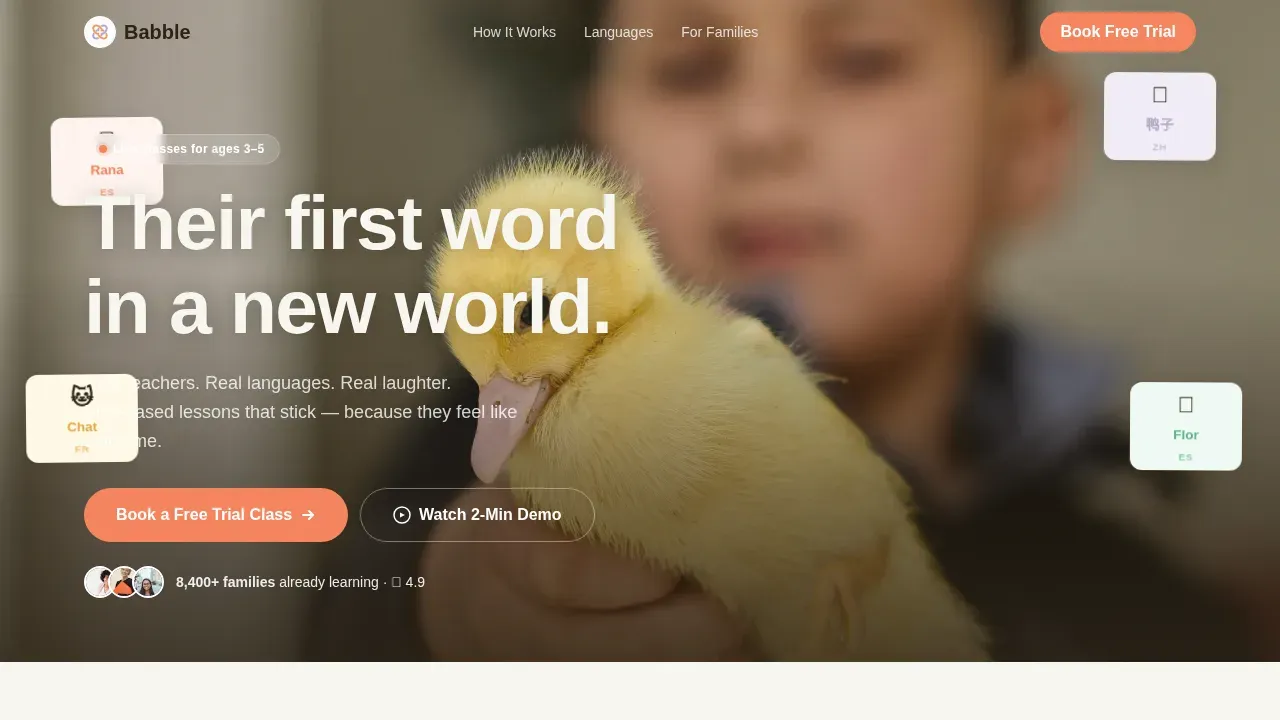
- A full-bleed hero section with a warm family photo, a headline in a rounded crayon-style typeface, and a primary "Book a Free Trial Class" call to action in crayon tangerine, plus a secondary "Watch a 2-Minute Demo Lesson" soft conversion path
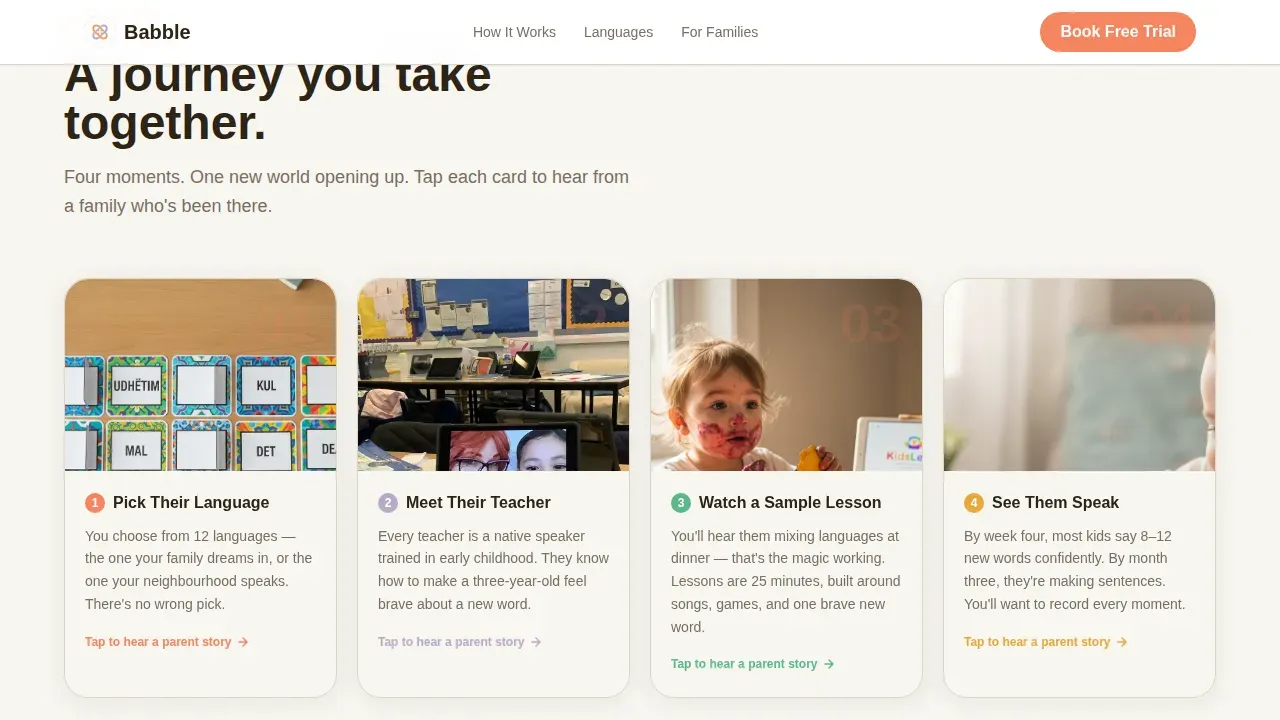
- A four-card modular journey grid with card-flip interactions, each card containing a single illustration, a short second-person paragraph, and a real parent testimonial revealed on the card's reverse side
- A booking form asking for the child's first name, age (dropdown: 3, 4, or 5), preferred language, and a time-slot picker showing the next seven days, keeping form fields focused and conversion-friendly
Feature list
This section describes the core built-in components that make the Babble template function as a complete booking experience for early childhood language programs.
Full-Bleed Hero with Dual Call to Action
The header opens with a warm, slightly overexposed family photo taken from above: a parent and toddler lying on a pale rug, surrounded by scattered flashcards in Spanish, Mandarin, and French, with the child's hand mid-reach for a card showing a yellow duck. The headline "Their first word in a new world" appears in a rounded, hand-drawn typeface at the bottom of the frame. Two calls to action sit beneath the image: the primary "Book a Free Trial Class" button in crayon tangerine, and the secondary "Watch a 2-Minute Demo Lesson" link for parents who need to see the program before they commit.
Four-Card Modular Journey Grid
The journey grid structures the scroll as a parent's own path through the program. Card One is "Pick Their Language," Card Two is "Meet Their Teacher," Card Three is "Watch a Sample Lesson," and Card Four is "See Them Speak." Each modular card holds a single illustration, a short second-person paragraph written in an encouraging and conversational tone, and a micro-interaction: flipping the card on hover or tap reveals a real parent testimonial on the back. The grid uses generous white space between cards so the experience feels like play, not a curriculum outline.
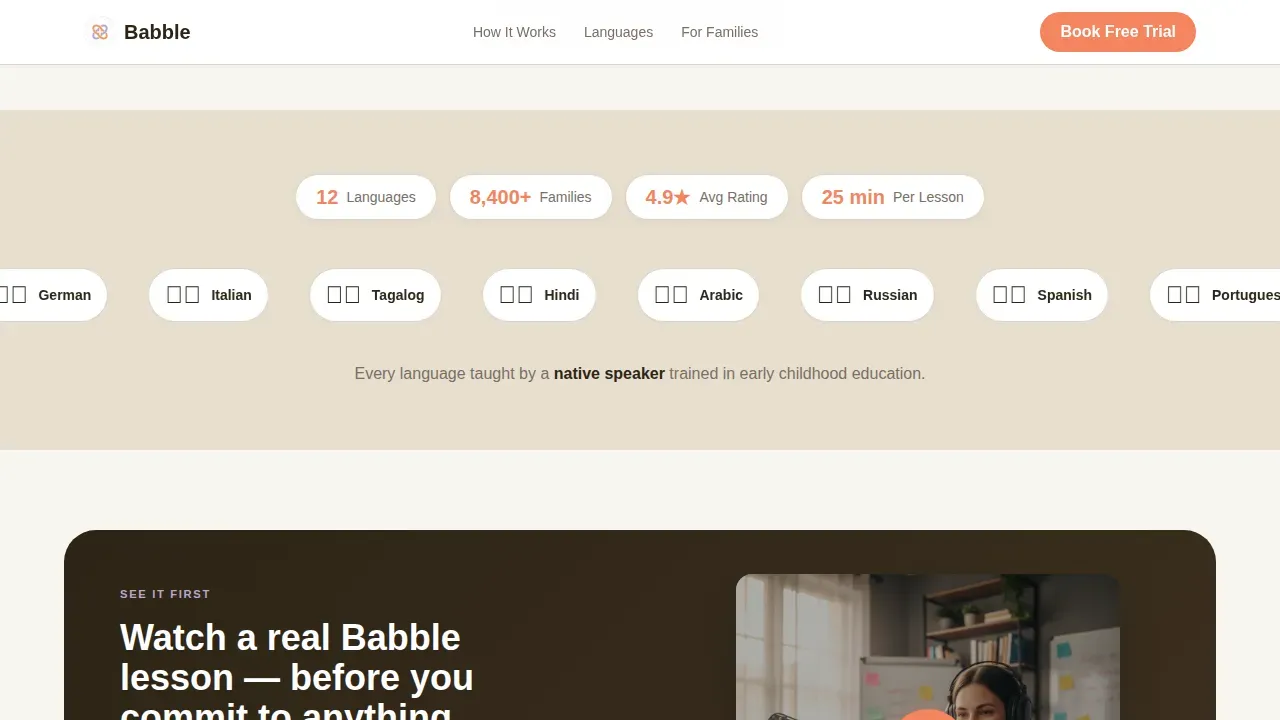
Trust Strip with Social Proof Stats
Between the journey grid and the demo video, a horizontal trust strip displays language flags, program-wide statistics (12 languages, 8,400 families, 4.9-star rating), and short parent micro-quotes. This strip gives hesitant parents the numbers and the human voices they need to feel confident. It demonstrates that thousands of families across different language backgrounds have already trusted the program with their child's language development, making the social proof feel genuine rather than promotional.
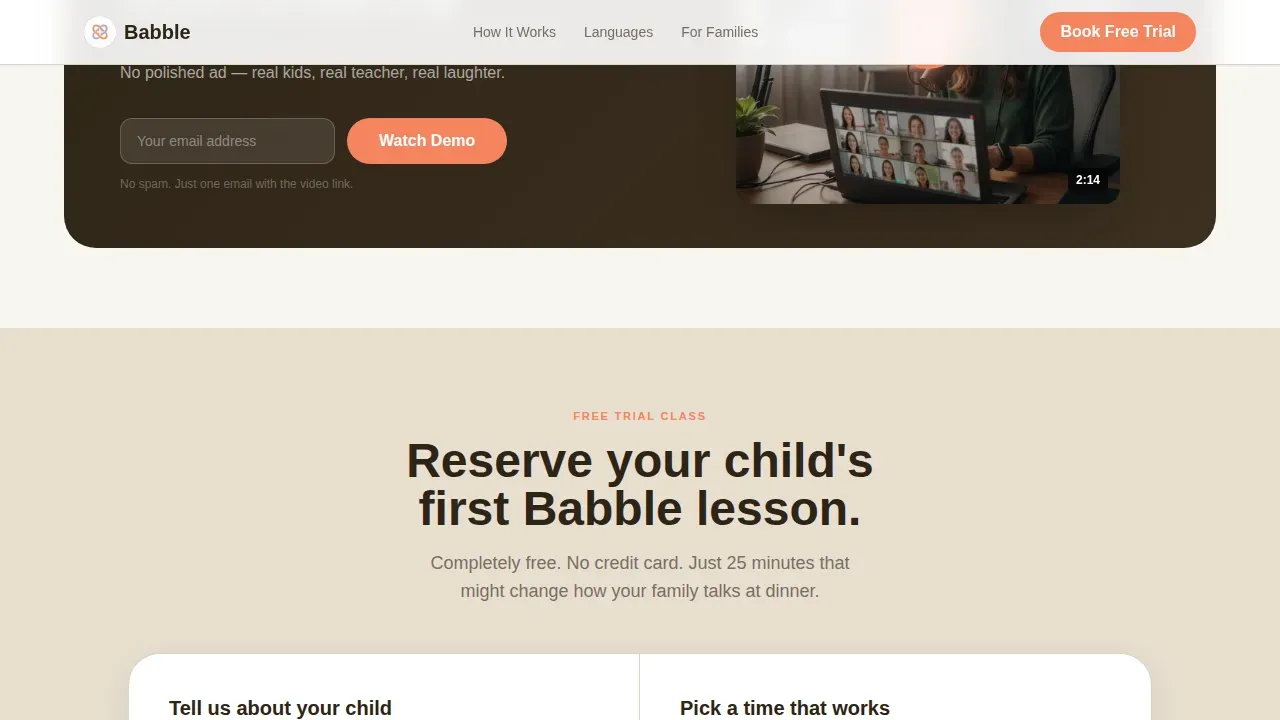
Email-Gated Demo Video
Parents who are not ready to book can tap "Watch a 2-Minute Demo Lesson." Before the video plays, a soft email-capture prompt collects an address. This two-step path warms cautious parents toward booking without pressuring them. It is a proven soft-conversion pattern that keeps families inside the experience and provides a second chance to reach them after they leave the page. The demo itself gives parents a real preview of how the program teaches through sounds, songs, and play rather than drills.
Booking Form with Time-Slot Picker
The booking form is the page's primary conversion goal. It collects the child's first name, their age via a dropdown limited to 3, 4, and 5, their preferred language, and a time-slot picker showing the next seven days in MM/DD format. Keeping the form fields to five or fewer reduces friction for busy parents. The form is designed for mobile-first interaction, so the tap targets are large and the flow feels natural on a phone screen during a short window of parental attention.
Sticky Mobile Call-to-Action Bar
On mobile screens, the primary "Book a Free Trial Class" button persists as a sticky bar at the bottom of the viewport throughout the entire scroll. Parents who decide mid-page do not have to scroll back to the top to act. This pattern ensures the most important conversion action is always one tap away, regardless of which section a parent is currently reading.
Page sections overview
| Section | Purpose |
|---|---|
| Full-Bleed Hero | Opens with a warm family photo, crayon headline, and dual call-to-action buttons |
| Journey Card Grid | Four-card flip grid guides parents step by step from language choice to first spoken word |
| Trust Stats Strip | Language flags, family counts, star ratings, and short parent micro-quotes build credibility |
| Demo Video Gate | Soft email-capture prompt before a two-minute sample lesson warms hesitant parents |
| Booking Form | Child name, age dropdown, language choice, and seven-day time-slot picker complete the conversion |
| Footer | Linear single-row footer with essential program links |
Design & branding system
The visual identity follows the Cloud Canvas color system, which draws its warmth from the inside of a well-loved picture book. Nothing shouts. Everything invites a small hand to reach out. The palette is deliberately gentle so that parents feel calm and confident, not sold to.
- Color palette: soft cloud white (#F7F5F0) as the page background, warm blanket beige (#E8DFD0) for card surfaces and section fills, story-time lavender (#B8A9C9) for accents and secondary elements, and crayon tangerine (#F4845F) reserved exclusively for primary buttons and interactive highlights
- Typography: Plus Jakarta Sans for headings, chosen for its rounded and friendly character that echoes the hand-drawn crayon headline in the hero; DM Sans for body copy, keeping reading easy and unpretentious across all devices
- Visual style: warm picture-book aesthetic throughout, with cream-toned backgrounds, gentle illustrations on each journey card, generous white space between sections, and GSAP scroll reveals plus staggered card entrance animations that make the page feel alive without feeling chaotic
Mobile & speed optimization
The template is built mobile-first because parents of preschoolers browse on phones during naptime, between pickups, and at odd hours when a desktop is nowhere nearby. Every layout decision prioritizes the phone experience first and scales up to larger screens.
- Sticky bottom call-to-action bar on mobile keeps the "Book a Free Trial Class" button persistently visible throughout the scroll, so a parent can act the moment they feel ready without hunting for the button
- Touch-friendly card-flip interactions replace hover states on mobile, so the micro-interaction that reveals parent testimonials works naturally with a tap rather than a mouse-over
- Server Components handle all static sections for fast initial load, while Client Components are scoped only to the interactive booking form and card-flip grid, keeping the page light on resources where interactivity is not needed
How this template helps you convert
The conversion architecture is layered deliberately so that every parent finds a natural entry point, whether they are ready to book immediately or need a little more warmth before they commit.
- The dual call-to-action in the hero section captures two distinct parent mindsets at once: the parent who is ready to book now taps the primary tangerine button, while the parent who wants to see proof first taps "Watch a 2-Minute Demo Lesson," triggering the soft email-capture gate and keeping them inside the program's world
- The card-flip journey grid does the trust-building work that a long text block cannot: each flip reveals a real parent voice in the context of that program step, so by the time a parent reaches the booking form they have already heard from four families who felt exactly what they are feeling now
- The booking form is intentionally short (five fields maximum) and ends with a seven-day time-slot picker so parents can see real availability and confirm a specific slot rather than submitting a vague inquiry that stalls in their inbox
Other information about this template
This section covers additional context that helps educators, program directors, and template buyers understand the research landscape and practical considerations behind a preschool language learning landing page of this type.
- The science of early language exposure is clear: the first three years of life are a period of rapid brain growth, during which trillions of connections form between neurons. Language-rich environments fuel that brain development in young children, and the quantity and quality of early language exposure influence long-term cognitive and academic outcomes. Children who hear more child-directed speech, sometimes called "parentese," develop stronger vocabulary and better self-regulation. The more back-and-forth conversation a child experiences, the stronger their neural pathways become.
- Language development from birth is shaped by responsive interactions. Caregivers play a crucial role in supporting the communication and language development of infants and toddlers from the very beginning. Responsive, conversational interactions at home help children build executive function and learn how to navigate relationships with peers and other adults. Daily routines provide rich opportunities for parent-child communication that positively influenced a child's emotional security and cognitive growth across every stage of early childhood.
- Research on speech and communication disorders offers important context for program positioning. Approximately 4% of first graders in the United States have a diagnosis of speech sound disorder (SSD). Developmental language disorder (DLD) is diagnosed in 7 to 10 percent of children in the United States. Early intervention matters: children with autism spectrum disorder can begin to benefit from early intervention as young as 12 months of age. High babble complexity levels in young infants predict stronger speech and language skills in typical child development later on. Communication disorders left unaddressed can create educational and social difficulty that compounds over time. Children who show early signs of expressive language skills challenges are often referred for evaluation before age four.
- The Babble Family First Preschool Language Learning Landing Page template is designed with these realities in mind. A program landing page that wants to earn a family's trust must demonstrate professional development in its teaching staff, show a clear curriculum approach grounded in play-based practices, and communicate that expressive language skills and overall language skills are supported together. Programs that encourage children to begin speaking simple words and simple sentences in a new language through songs, stories, and play rather than drills are aligned with the research on early childhood language learning. Children's learning thrives when school readiness goals are woven into joyful, low-pressure experiences rather than rigid instruction.
- Template buyers should consider the following practical points when customizing this layout:
- The booking form's five-field limit is intentional: research on landing page conversion practices consistently shows that fewer fields produce higher completion rates among busy parents
- The demo video email gate is a soft conversion designed to expand the program's warm audience while respecting parent hesitation
- The trust strip's statistics slots (12 languages, 8,400 families, 4.9-star rating) are placeholder values and should be replaced with the program's own verified numbers before launch
- Child care providers and program administrators can use the "Take-Home Language Resources" pattern embedded in the card grid to demonstrate that the program supports home language development and treats parents as partners in the child's journey
- Teachers featured in the "Meet Their Teacher" card should include brief notes on their language fluency and early childhood education credentials to build parent confidence
- The template's responsive layout ensures it renders cleanly across smartphones, tablets, and desktop screens, accommodating the majority of parents who browse on mobile devices
Theme
Family First
Creative direction
Step-by-Step Guide
Color system
Cloud Canvas
Style
Card Grid (Modular)
Direction
Booking/Scheduling
Page Sections
Full-bleed Hero with Dual Call to Action
Four-card Modular Journey Grid
Trust Strip with Social Proof
Email-gated Demo Video Section
Focused Booking Form with Time-slot Picker
Sticky Mobile Call-to-action Bar
Related questions
What age group is this template designed for?
Can I customize the languages offered in the booking form?
Does the card-flip interaction work on mobile devices?
How does the demo video email gate work?
Is this template suitable for heritage language preservation programs?