Student Business Checking Landing Page Template
The Ledger Executive Suite Student Business Checking landing page template is built for student founders who already have revenue. It leads with a multi-step qualifier form, walks visitors through two and three-column comparison tables, and closes with a high-contrast call-to-action. The design uses an Arctic White palette with charcoal and power-blue accents to project real business authority.
by Rocket studio
Quick summary
This landing page template gives student entrepreneurs a polished, conversion-focused page for a business checking account. The ledger template opens with a revenue-qualifier form, unfolds a comparison journey through two structured tables, and ends with a sticky call-to-action bar. Every section earns its place, and the design signals serious business infrastructure from the very first scroll.
Who this template is for
This template is built for fintech brands and student banking products targeting young founders who are already generating income. It fits teams that need a high-trust, data-led page rather than a lifestyle-image-heavy one.
- Fintech startups offering EIN-linked checking accounts to student entrepreneurs
- Student banking products competing against large-bank fee structures
- Small businesses and student-led ventures needing clear comparison evidence to convert informed visitors
What problem this template solves
Student founders outgrow personal accounts fast. They need a page that meets them at their revenue stage, not one that sells them on the idea of starting. The general ledger of a growing business demands real infrastructure, and this template makes that case without raising its voice.
- Visitors leave when they cannot quickly compare fees, transaction limits, and income tools side by side
- Generic banking pages ignore the student business owner who is already managing revenue, expenses, and contractor payments
- A weak hero wastes the first fold on imagery instead of qualifying the visitor's actual revenue stage
What you get with this template
You get a fully structured, single-page landing page that walks a visitor from revenue qualification to account opening in one confident scroll. Every element is built to reduce friction and build trust through evidence.
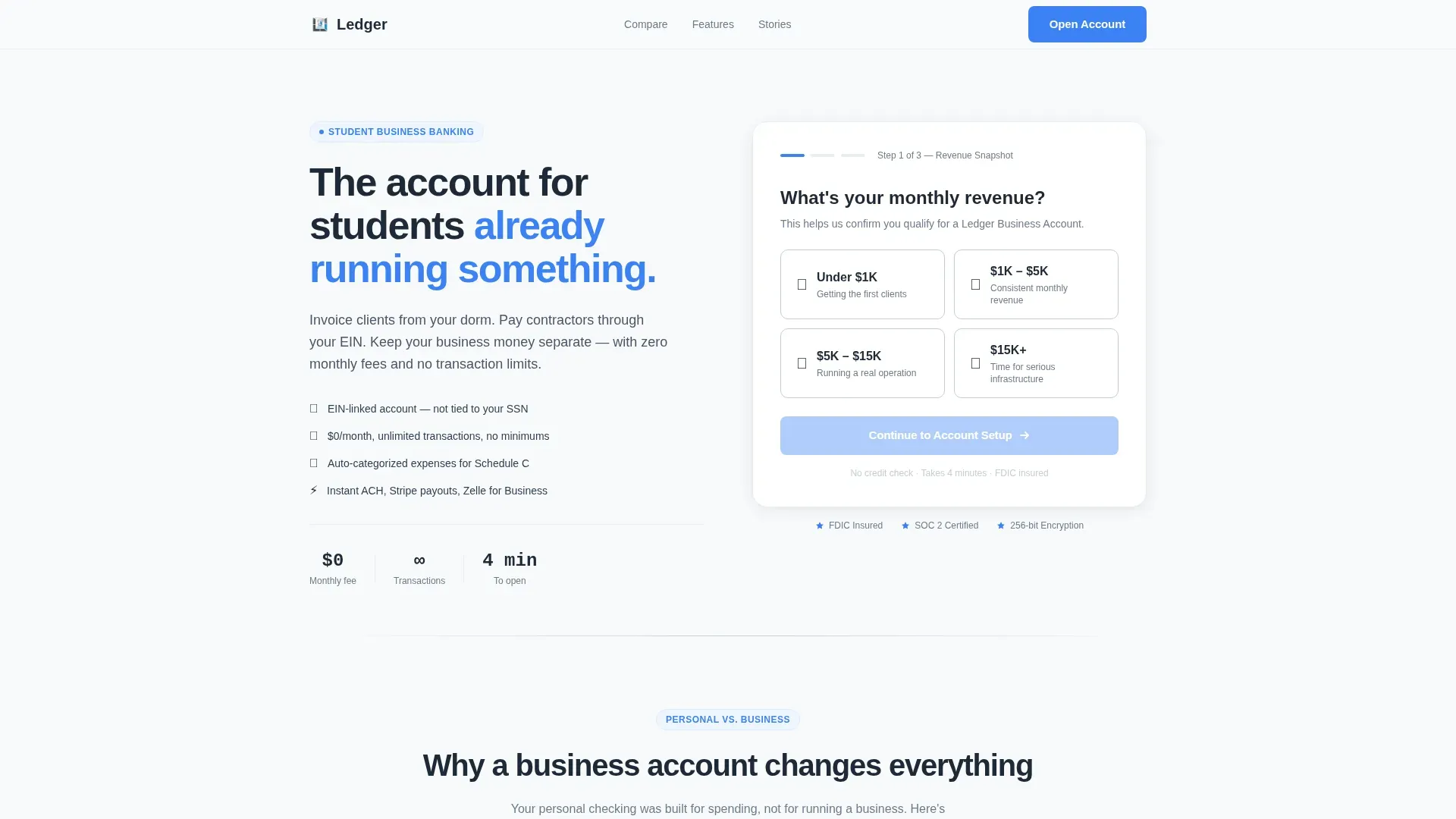
- A multi-step revenue-qualifier form styled as selectable cards, acting as the hero section
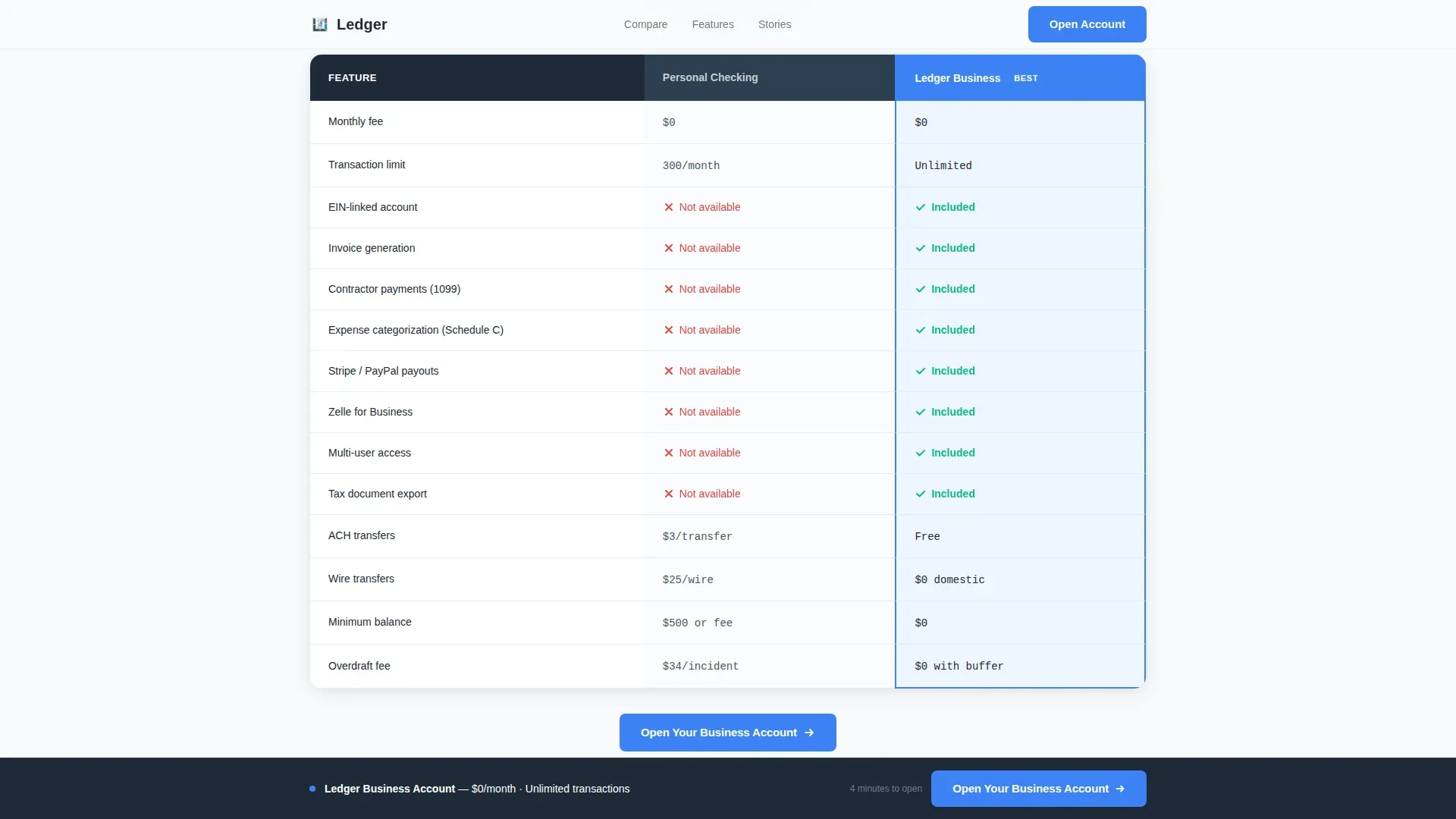
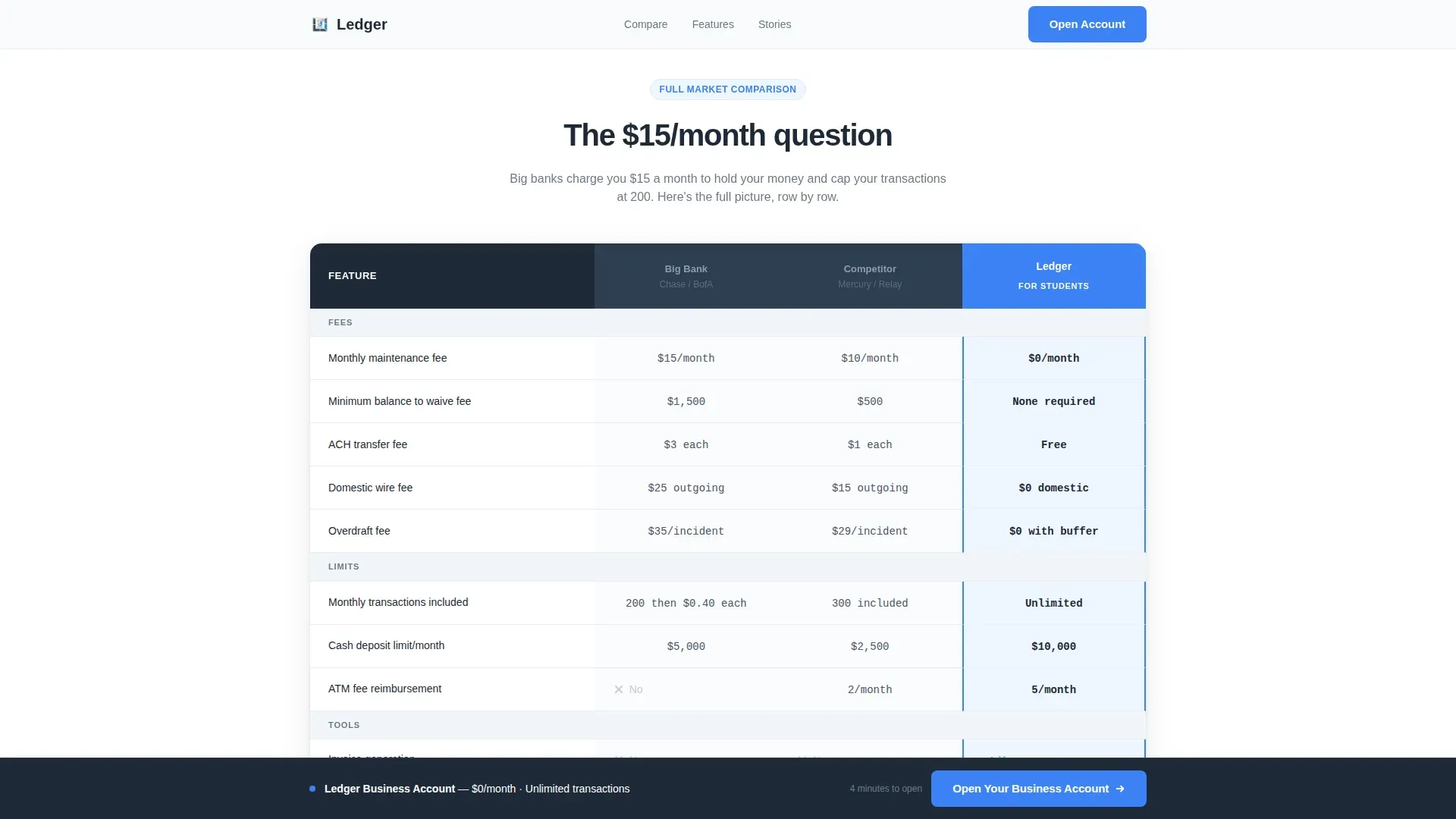
- Two comparison tables: a two-column personal-versus-business table and a three-column competitor table, both with power-blue highlights
- A sticky call-to-action bar that appears after the first fold scroll, plus a social proof section with student founder testimonials
Feature list
This section covers the core built-in capabilities of the ledger template as defined in the source brief.
Revenue-Qualifier Hero Form
The hero is a multi-step form, not a banner image. Visitors select their monthly revenue from four card-style radio options: Under $1K, $1K to $5K, $5K to $15K, and $15K or more. This signals immediately that the account is for people with active revenue. The form keeps entries minimal and focused, following the principle that a minimalist form should keep requests for user information short and straightforward.
Two-Column Comparison Table
The first table contrasts personal checking against student business checking. It covers fee structures, transaction limits, tax reporting, and invoice tools. The business column is highlighted in power-blue. This structured layout helps visitors record a clear mental ledger of differences. Debits and credits of value are visible at a glance, making the case through data alone.
Three-Column Competitor Table
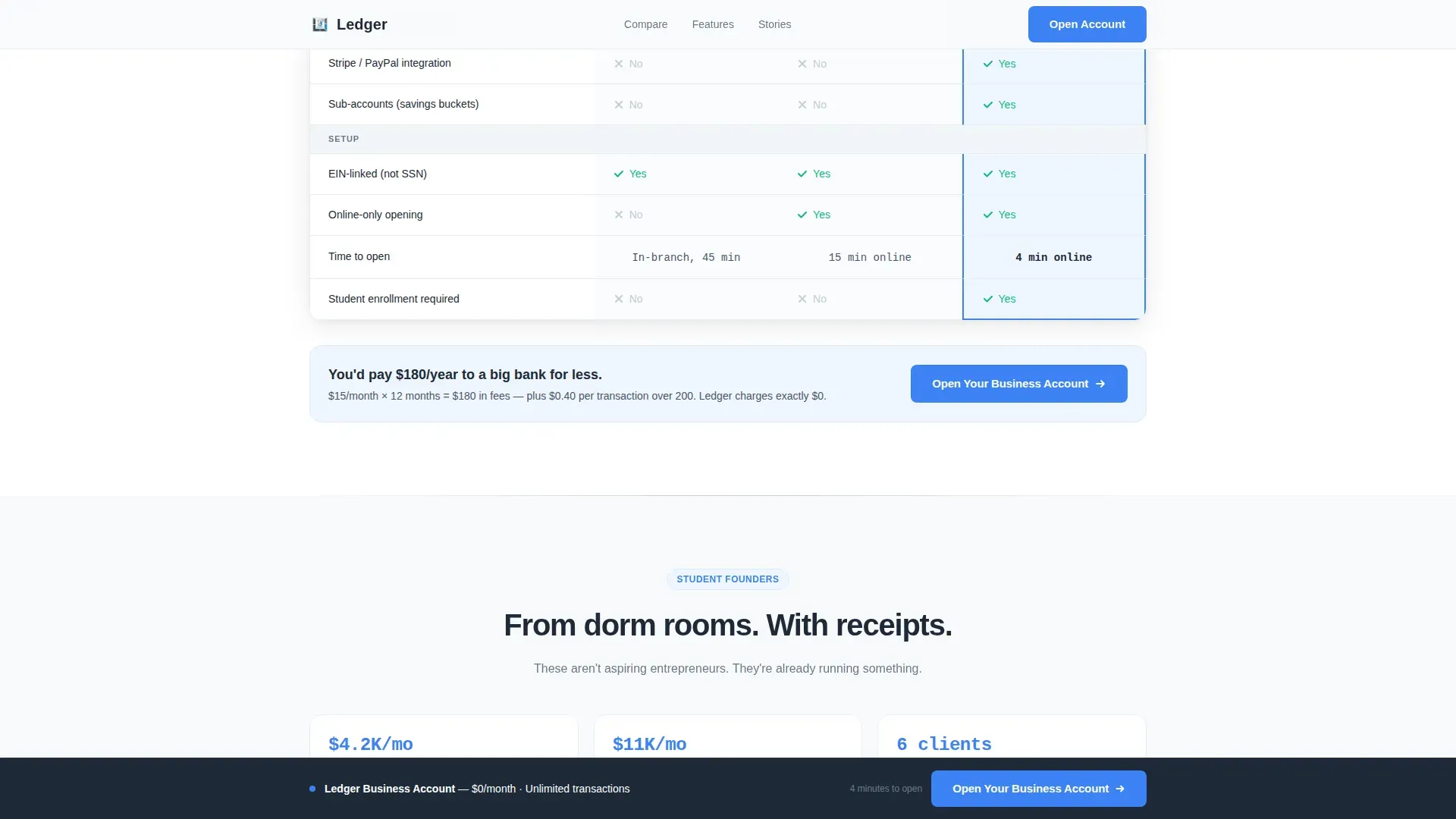
The second table widens the view. A large-bank account with a $15 monthly fee and a 200-transaction cap sits next to this product's zero-fee, unlimited structure. The layout exposes the cost gap clearly. Visitors can track financial transactions capacity and fee balance across accounts without needing to search elsewhere.
Sticky Call-to-Action Bar
A sticky bar appears once the visitor scrolls past the first fold. It carries the primary call-to-action: "Open Your Business Account." This keeps the conversion prompt visible throughout the comparison journey without interrupting the reading flow. A single, prominent, high-contrast call-to-action button is essential for conversion, and this template delivers exactly that.
Social Proof Section
The template includes a dedicated testimonials block. Student founder testimonials with specific dollar amounts and roles build credibility. Trust signals and social proof are incorporated to establish confidence at a critical point in the decision flow, just before the final call-to-action.
Linear Single-Row Footer
The footer uses a Pattern 1 linear single-row layout. It keeps the page clean and maintains focus on the conversion goal. Removing excessive navigation helps visitors stay on the path toward opening an account.
Page sections overview
| Section | Purpose |
|---|---|
| Revenue Qualifier Form | Qualifies visitor by current monthly revenue stage |
| Two-Column Table | Contrasts personal versus student business checking |
| Three-Column Table | Exposes competitor fee and transaction limits |
| Social Proof Block | Builds trust with student founder testimonials |
| Call-to-Action Section | Drives account opening with primary call to action button |
| Sticky call to action Bar | Keeps conversion prompt visible after first scroll |
| Linear Footer | Closes page with minimal single-row layout |
Design & branding system
The design follows an Executive Suite visual identity built on an Arctic White color system. The palette feels like a freshly pressed white shirt under a dark blazer: clean authority with zero clutter.
- Glacier White (#F8FAFB) backgrounds, Charcoal Suiting (#1E2A38) for primary text and table headers, Polished Silver (#C4CDD5) for divider lines and inactive states
- Power Blue (#3B82F6) reserved for highlighted comparison columns and all call-to-action elements
- Typography uses Plus Jakarta Sans for bold headings, DM Sans for body text, and JetBrains Mono for numerical data such as fees and transaction counts
Mobile & speed optimization
The template is built desktop-first with full mobile responsiveness. Comparison tables collapse gracefully on smaller screens so the data remains readable without horizontal scrolling.
- Scroll-reveal animations and staggered table row entries are set to medium intensity to keep the experience smooth without distraction
- The multi-step form and sticky call-to-action bar use client-side behavior; static sections use server components for efficient rendering
- Mobile-first responsiveness is addressed throughout, as most traffic reaches fintech landing pages from mobile devices
How this template helps you convert
This template is designed around a single conversion goal: moving a qualified visitor into the account opening flow. Every section reduces hesitation and builds the case through structured evidence.
- The revenue-qualifier form at the top filters for serious visitors and sets an executive tone before a single line of copy is read, addressing the pain point that most banking pages never qualify their audience
- The sequential comparison tables layer the argument row by row, so by the time visitors reach the call-to-action, the evidence is already complete and the click feels like a logical conclusion
- Testimonials with specific outcomes and the sticky call-to-action bar keep the conversion prompt present and credible throughout the entire scroll journey
Other information about this template
The Ledger Executive Suite Student Business Checking landing page template sits at the intersection of fintech conversion design and practical accounting context. Visitors who arrive already understand revenue, expenses, and the difference between personal and business accounts.
- A general ledger is the central record of all financial transactions within a business, and this template uses that framing to position the checking account as real business infrastructure, not a student perk
- The general ledger template concept underpins the comparison structure: debits and credits, income and liabilities, assets and equity are all implied in the row-by-row table layout
- A ledger template used in Excel or Google Sheets typically tracks entries by transaction date, account name, description, debits, credits, and running balance; this page mirrors that structured clarity in its visual design
- The general ledger account framework, covering accounts receivable, accounts payable, fixed assets, and cash management, maps directly to the real needs of a student founder tracking business transactions
- A trial balance confirms total debits equal total credits across all accounts; the comparison tables in this template apply the same logic to fee and feature parity, making the zero balance argument for this account visually obvious
- The accounting ledger template principle of maintaining an accurate record of all the transactions for each general ledger account informs the page's tone: no fluff, just the following details a founder needs to decide
- Free general ledger templates in Excel or Google Sheets help small businesses track financial data without enterprise software; this landing page serves a parallel purpose by surfacing that data in a format that converts
- The general ledger serves as the basis for financial statements including income statements and balance sheets; journal entries feed into owner's equity and equity positions across different accounts
- Keeping track of spending patterns, cash flow, and daily transactions is an essential tool for any small business owner, and the comparison evidence on this page reinforces that a proper business account makes that easier
- Template selection for a general ledger depends on monthly transaction volume; similarly, this landing page's revenue-qualifier form aligns the visitor's volume stage with the right account tier
- Free general ledger options in spreadsheet tools saves time for early-stage founders, but this page makes the case that a real business ledger account provides a more detailed record and better financial health visibility
- The overall financial health of a student-run business depends on accurate financial records, proper accounting method choices, and tools that surface financial activity clearly; this template communicates all of that through structure rather than claims
- Accountants working with small businesses often recommend migrating from manual ledger shows to structured systems when transaction volumes grow; the money ledger framing here supports that progression narrative
- Professional accountants can process structured spreadsheet data from an asset account or liability account, but may recommend dedicated business accounts as complexity increases; the comprehensive list of features in the comparison table makes that recommendation visual
- More templates in the broader library may cover complementary finance and insurance use cases for student-focused fintech products
Theme
Executive Suite
Creative direction
Comparison Journey
Color system
Arctic White
Style
Comparison Table
Direction
Click-Through
Page Sections
Revenue-qualifier Multi-step Form Hero
Two-column Personal Versus. Business Comparison Table
Three-column Competitor Comparison Table
Sticky Call-to-action Conversion Bar
Student Founder Social Proof Block
Executive Suite Arctic White Design System
Related questions
What type of page is this template designed for?
Can I customize the comparison table content for my own product?
Does the template include a sticky navigation bar or a sticky call-to-action?
Who are the intended end users shown in the testimonials section?
Is this template suited for a fintech product competing against large-bank accounts?