Stats-First Bookkeeper frequently asked question Resource Hub Landing Page
Ledger is a stats-first bookkeeper frequently asked question and resource hub landing page for small business owners who need plain-spoken answers about receipts, payroll, and quarterly filings. Built on an editorial Navy Authority design system, it pairs trust-building stats with lead capture forms and a downloadable checklist, turning a chaotic financial situation into a clear, confident next step.
by Rocket studio
Quick summary
Ledger is a single-page resource hub that translates bookkeeping complexity into calm, expert answers. It uses a stats-first editorial layout, navy, parchment, and teal, to build credibility before the primary call to action appears. Every section leads with a striking number, then delivers the story and the resource. The result feels like a well-thumbed financial reference guide, not a sales pitch.
Who this template is for
This landing page is built for bookkeepers and financial professionals who serve overwhelmed small businesses. It speaks directly to the audience those professionals want to reach and convert.
- Solo founders doing their own books late at night, craving reassurance and clarity
- Office managers who have been handed the accounting software login and need a structured starting point
- Growing e-commerce sellers who just received their first sales tax notice and need immediate, reliable guidance
What problem this template solves
Most bookkeeper websites bury the most useful information behind a generic "Contact Us" form. Visitors leave before they trust the service. This landing page fixes that by leading with proof and education first.
- Visitors arrive anxious and leave with specific answers, building the trust needed to share their contact details
- The stats-first structure replaces vague promises with hard numbers that frame the bookkeeper as a proven expert
- A dual conversion path captures both ready-to-talk leads and nurture-ready visitors who want a free checklist
What you get with this template
This ledger template delivers a complete, editorial-style landing page structure. Every section is purposefully sequenced to move a skeptical visitor toward confident action.
- A press mentions hero section with oversized stats, a lead capture form gated behind trust-building frequently asked question sections, and a secondary checklist download
- A full stats impact strip, three themed frequently asked question resource sections, and a linear single-row footer
- A Navy Authority design system with DM Sans headlines, Fraunces pull-quote type, and JetBrains Mono number styling
Feature list
This ledger template includes several purpose-built features that make it effective for bookkeeper lead generation and financial education.
Stats-First Hero with Press Mentions Banner
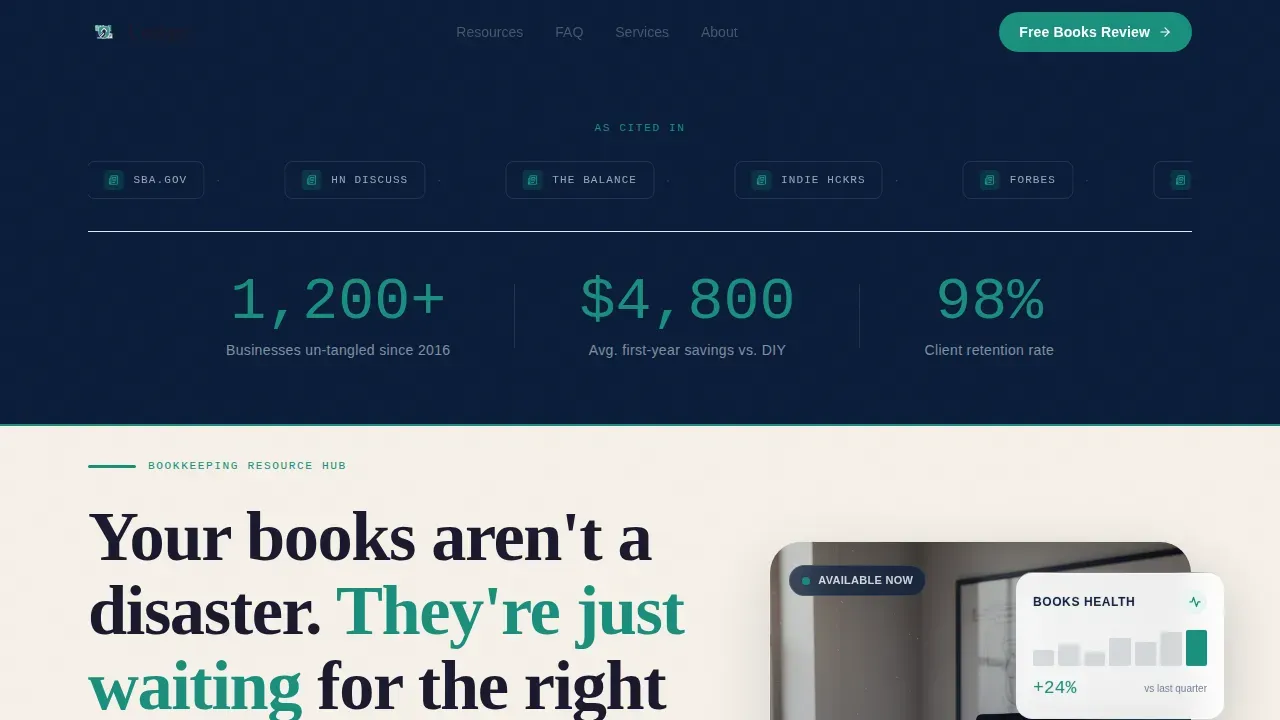
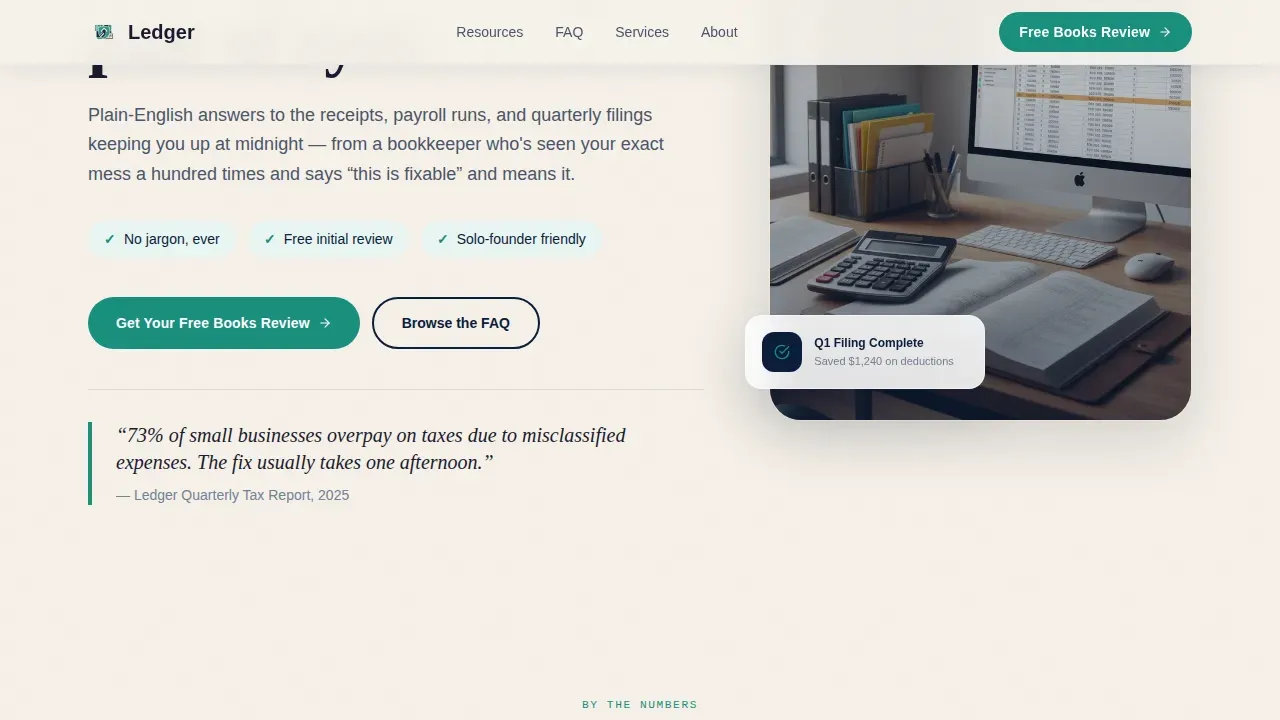
The header opens with a typographic masthead showing press citation logos alongside a bold teal stat, "1,200+ businesses un-tangled since 2016", set on warm parchment. There is no competing imagery. Earned credibility fills the frame, and the general ledger narrative begins from the very first scroll.
Themed frequently asked question Accordion Sections
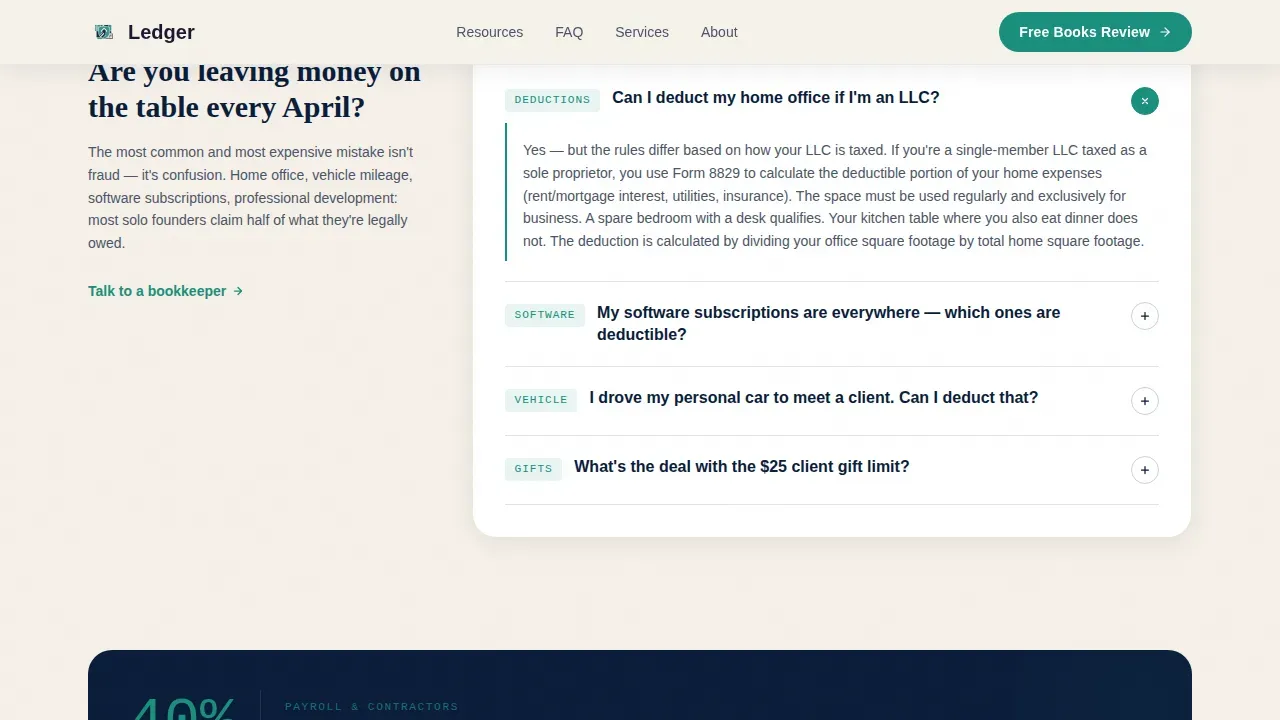
Three thematic frequently asked question resource sections cover deductions, payroll, and quarterly filings. Each section leads with a striking statistic before the explanation arrives, stat, story, resource. The accordion layout keeps the page clean. Questions are grouped by theme, such as Ledger Maintenance and Reporting, to reduce cognitive load for readers who are scanning rather than reading every word.
Dual Conversion Lead Capture
The primary call to action, "Get Your Free Books Review," appears after the third frequently asked question section when trust is fully earned. The form collects first name, business type, monthly transaction volume, and email. A secondary path offers a downloadable Quarterly Bookkeeping Checklist gated by email only, catching visitors who are not yet ready to talk.
Editorial Stats Impact Strip
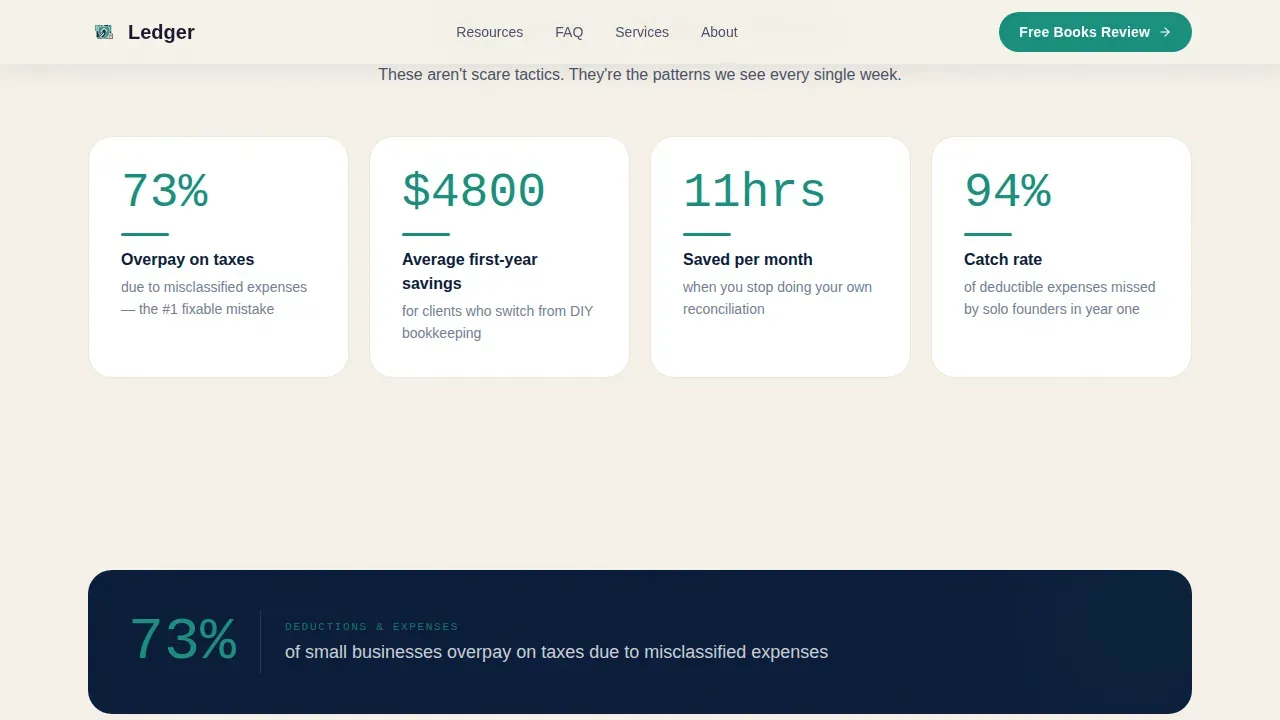
A dedicated section below the hero presents key metrics in an editorial grid format. Numbers like average first-year client savings anchor each panel. This reinforces the stats-first philosophy and keeps financial data front and center throughout the page experience.
Navy Authority Design System
The visual identity follows an Educational Guide theme. Deep institutional navy (#0B1D3A), warm parchment (#F5F0E8), slate paragraph text (#4A5568), and confident teal (#1A8F7D) for links, buttons, and pull-quote borders create an authoritative-yet-approachable reference-book aesthetic.
Page sections overview
| Section | Purpose |
|---|---|
| Press Mentions Hero | Opens with credibility logos and an oversized teal stat to establish immediate authority |
| Stats Impact Strip | Presents key metrics in an editorial grid to reinforce the stats-first approach |
| frequently asked question: Deductions | Leads with a striking stat, then answers common deduction questions in accordion format |
| frequently asked question: Payroll | Covers payroll questions using the stat-story-resource rhythm for each entry |
| frequently asked question: Quarterly Filings | Addresses filing anxiety with plain-spoken, themed answers grouped for easy scanning |
| Free Books Review Form | Primary lead capture placed after trust is fully earned across three frequently asked question sections |
| Checklist Download | Secondary conversion for nurture-ready visitors, gated by email only |
| Linear Footer | Single-row footer pattern with essential links and contact information |
Design & branding system
The design draws on an editorial magazine aesthetic, the kind of authoritative financial reference you return to each quarter. Typography carries as much weight as layout, and every color choice is intentional.
- Color palette: deep navy (#0B1D3A) for structure, warm parchment (#F5F0E8) for warmth, slate (#4A5568) for body text, and teal (#1A8F7D) for interactive elements and pull-quote borders
- Typography stack: DM Sans for headlines, Fraunces for pull quotes and stats, JetBrains Mono for numeric data, a combination that makes financial figures feel precise and readable
- Animation: staggered scroll reveals, stat counter animations, and hover micro-interactions keep the page dynamic without distracting from the educational content
Mobile & speed optimization
The template is designed desktop-first to match the focused, research-oriented behavior of business owners reviewing their financial records at a desk. Full mobile parity is built in so the experience holds on any screen.
- Static server components handle all non-interactive content, keeping the page lightweight and fast on mobile connections
- Client components are minimal and reserved for the frequently asked question accordion, the lead capture form, and the checklist download gate
- The accordion frequently asked question layout is fully touch-friendly, keeping the page clean and navigable on smaller screens without sacrificing content depth
How this template helps you convert
The conversion strategy is deliberately sequenced. Trust is built through education before any ask is made. Every scroll section earns the next.
- The press mentions hero and stats impact strip establish immediate authority, so visitors stay on the page long enough to engage with the frequently asked question content
- Three themed frequently asked question sections deliver real bookkeeping knowledge, deductions, payroll, quarterly filings, so visitors feel genuinely helped before the primary lead form appears
- The dual conversion structure captures both high-intent visitors ready for a free books review and lower-intent visitors willing to exchange an email for the downloadable Quarterly Bookkeeping Checklist
Other information about this template
This template is well suited for bookkeepers and accounting professionals who want a comprehensive collection of trust signals and educational content in one structured landing page. Several additional details are worth noting.
- The general ledger template approach used here reflects best practices: a well maintained ledger tracks every debit and credit, supports a clean trial balance, and makes tax preparation straightforward
- The accounting cycle begins with recording each journal entry, then posting to the general ledger, and ends with producing reliable financial statements, this page teaches that rhythm in plain language
- The general ledger account structure shown in the frequently asked question sections covers appropriate accounts including the cash account, accounts receivable, accounts payable, owner's equity, and expense accounts like office supplies
- The chart of accounts framework referenced in the frequently asked question content groups every ledger account by account type, with each account name and account number providing consistent account information across reporting periods
- A subsidiary ledger can be used for detailed tracking within specific accounts, the template's frequently asked question sections explain when this matters for small businesses managing multiple revenue streams or fixed assets
- The double entry bookkeeping system ensures every transaction affects at least two accounts; total debits must always match total credits, and the trial balance confirms this balance at the close of each reporting period
- The general ledger acts as the master record for all business transactions; from daily transactions to cash transactions, every entry supports accurate financial reporting and a dependable audit trail
- Reconciling with bank statements monthly is a core best practice this page reinforces; the phrase "reconcile regularly" appears in the checklist download, helping visitors form lasting habits
- Track financial transactions consistently using digital ledgers or a printed accounting ledger, the frequently asked question content explains both a journal entry approach and how to post transactions into the correct general ledger account
- This ledger stats first bookkeeper faq resource hub landing page template is built on Google Sheets-compatible data conventions and can be adapted for teams already using Microsoft Excel or other spreadsheet-based accounting workflows
- The running balance column in each ledger account section makes it easy to spot cash flow issues, monitor cash management decisions, and see whether business finances are trending toward profit or loss
- A consistent system for financial records reduces the risk of losing money to missed deductions or misclassified entries, the very small businesses this page targets benefit most from that discipline
- The profit and loss statement, balance sheet, and financial statements referenced throughout this page are the natural output of a well maintained general ledger; the template is designed to make that connection clear and actionable
- When ledgers break down due to inconsistent entries or missing data, accurate financial statements become impossible to produce, this page positions the bookkeeper as the expert who prevents that from happening
- The page supports smarter business decisions by pairing financial data with plain-spoken context, so visitors leave with both knowledge and confidence to take the next step
Theme
Educational Guide
Creative direction
Stats-First Impact
Color system
Navy Authority
Style
Editorial/Magazine
Direction
Lead Generation
Page Sections
Stats-first Hero with Press Mentions
Themed Frequently Asked Question Accordion Sections
Dual Conversion Lead Capture
Editorial Stats Impact Strip
Navy Authority Design System
Related questions
What is a general ledger and why does it matter for small businesses?
How does this ledger template handle the debit and credit system?
Can this template help me capture leads from visitors who are not ready to book a consultation?
What kinds of financial questions does the frequently asked question content cover?
Is this landing page suitable for very small businesses or solo freelancers?