Cultural & Heritage Organization Professional Website Template
The Steward Family First heritage preservation landing page template is built for community organizations that keep ancestral stories alive. It combines a parallax UGC photo wall header, emotionally driven zigzag mission sections, an event registration form, and a secondary photo submission path into one warm, archive-quality single-page experience rooted in the Soft Mist color system.
by Rocket studio
Quick summary
The Steward template gives a heritage preservation society a landing page that feels like opening a cedar chest in your grandmother's attic. Every scroll reveals another layer of history, from a living mosaic of member-submitted family photographs to zigzag mission sections that move visitors from personal nostalgia to urgent community responsibility. The page drives event registrations and photo contributions in one focused flow.
Who this template is for
This template is made for people who understand that history is not an abstraction. It is a face, a surname, a handwritten note tucked inside a family Bible. If you lead, run, or are building a heritage preservation organization, this template was designed with your audience in mind.
It is especially well-suited for:
- Retired educators, church historians, and community leaders who have spent years cataloging county records and managing local historic sites
- Young parents experiencing a first time hunger for roots after a child arrives, and adult children who have recently inherited boxes of family photographs and documents
- Nonprofit groups and cultural organizations that host scanning workshops, oral history recording sessions, cemetery restoration days, and annual heritage picnics
What problem this template solves
Heritage preservation organizations face a specific set of challenges that generic website templates cannot solve. The stories they steward are deeply personal, the audiences they serve span multiple generations, and the calls to action they need go beyond a simple newsletter signup. A template built for a retail brand or a tech startup will always feel wrong for this kind of work.
This template solves those challenges directly:
- It replaces cold, impersonal page layouts with a warm heirloom visual system that helps visitors feel the weight and beauty of family history before they read a single word
- It gives organizations a clear, single-goal structure that focuses every section on one outcome: moving the visitor toward registering for an event or submitting a family photograph to the living archive
- It provides distinct sections for mission storytelling, program details, event registration, and photo contribution so that the organization can serve both action-ready visitors and those who simply want to participate without committing to an in-person event
What you get with this template
This template delivers a complete, single-page layout built around the specific needs of a heritage preservation society. Every design choice, from typeface to color to section order, comes from the source brief and serves the organization's core purpose.
Here is what is included:
- A full-page UGC photo wall header with parallax drift animation, a centered headline in archival ink, and staggered image load behavior powered by GSAP scroll reveals
- Five distinct content sections covering the hero mosaic, WHY zigzag mission panels, HOW program panels, an event registration block with a multi-field form, and a secondary photo submission section, plus a linear single-row footer
- The complete Soft Mist design system including heirloom linen, faded pressed-flower mauve, archival ink, and hearth-amber color tokens applied consistently across backgrounds, typography, and interactive elements
Feature list
This section describes the core built-in capabilities of the Steward template.
Parallax UGC Photo Wall Header
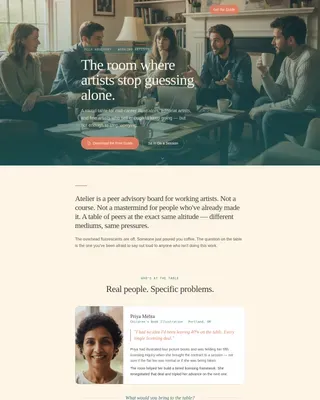
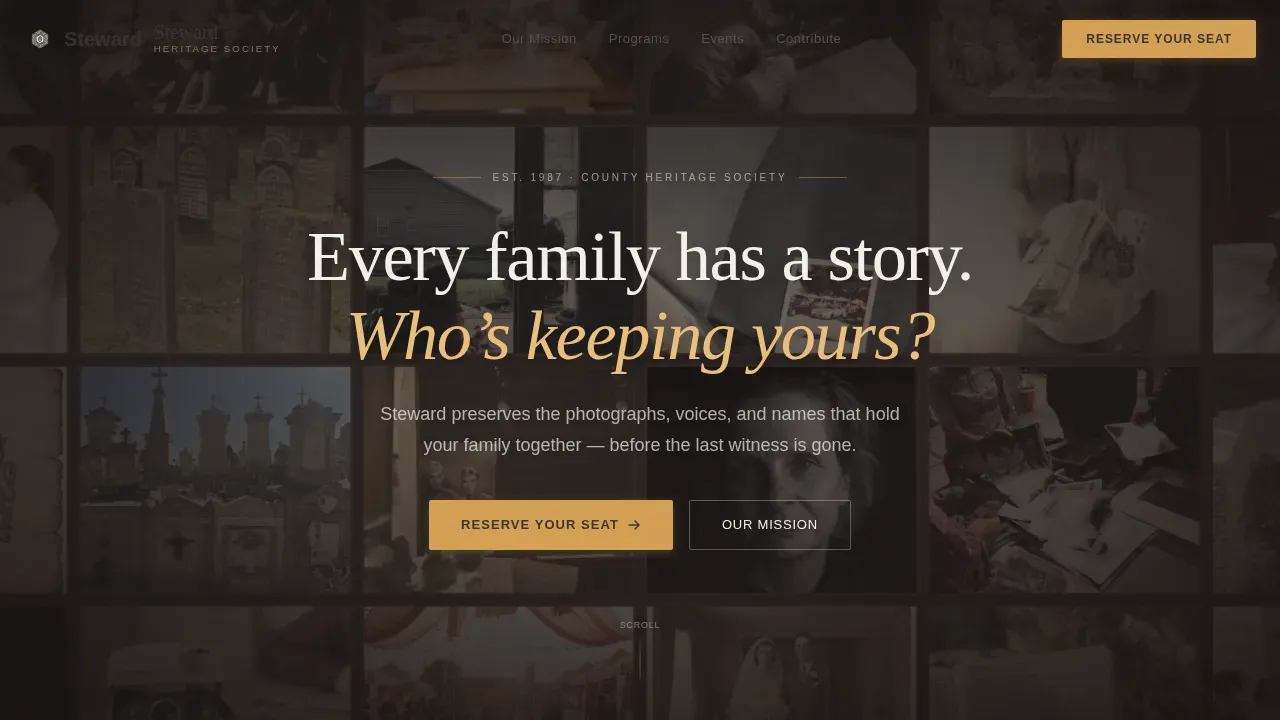
The header is a full-width mosaic of real member-submitted family photographs arranged in an organic, slightly overlapping grid. Images drift gently with parallax motion as the visitor scrolls, creating the sensation that memory itself is in motion. A single centered headline fades in over the mosaic: "Every family has a story. Who's keeping yours?" The effect arrests the scroll immediately and sets the emotional tone for everything that follows.
Zigzag Mission and Program Sections
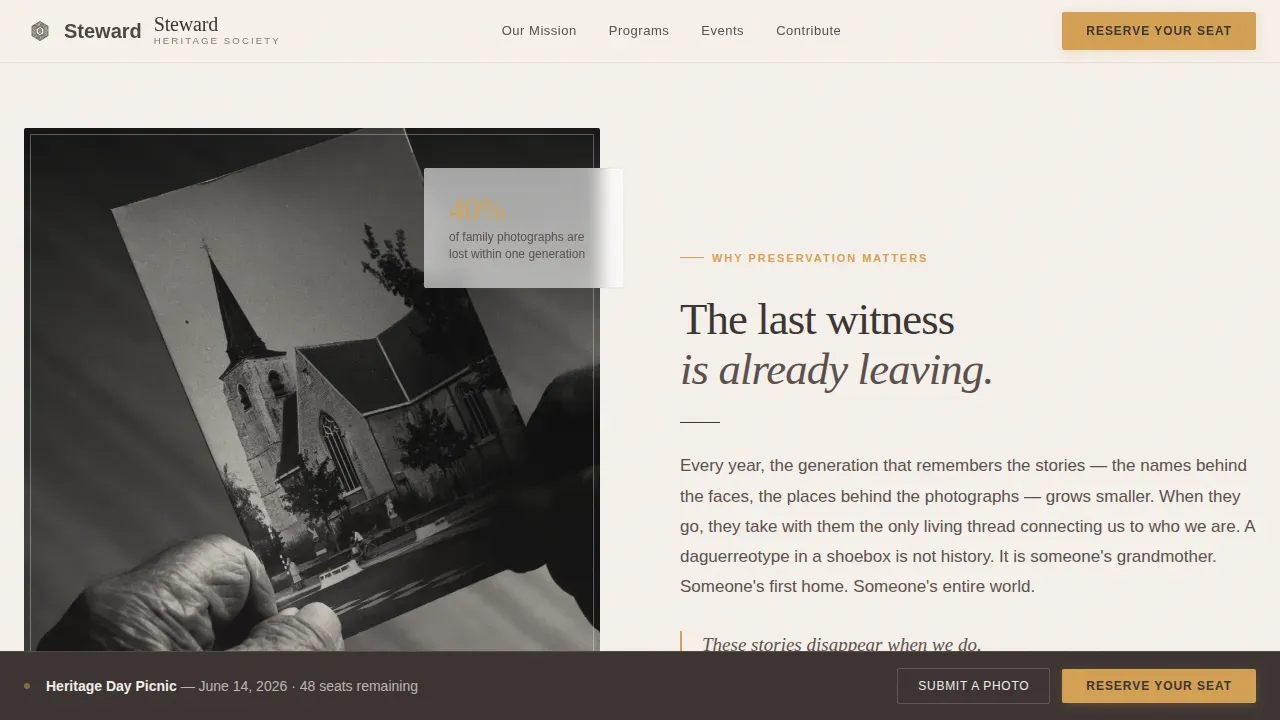
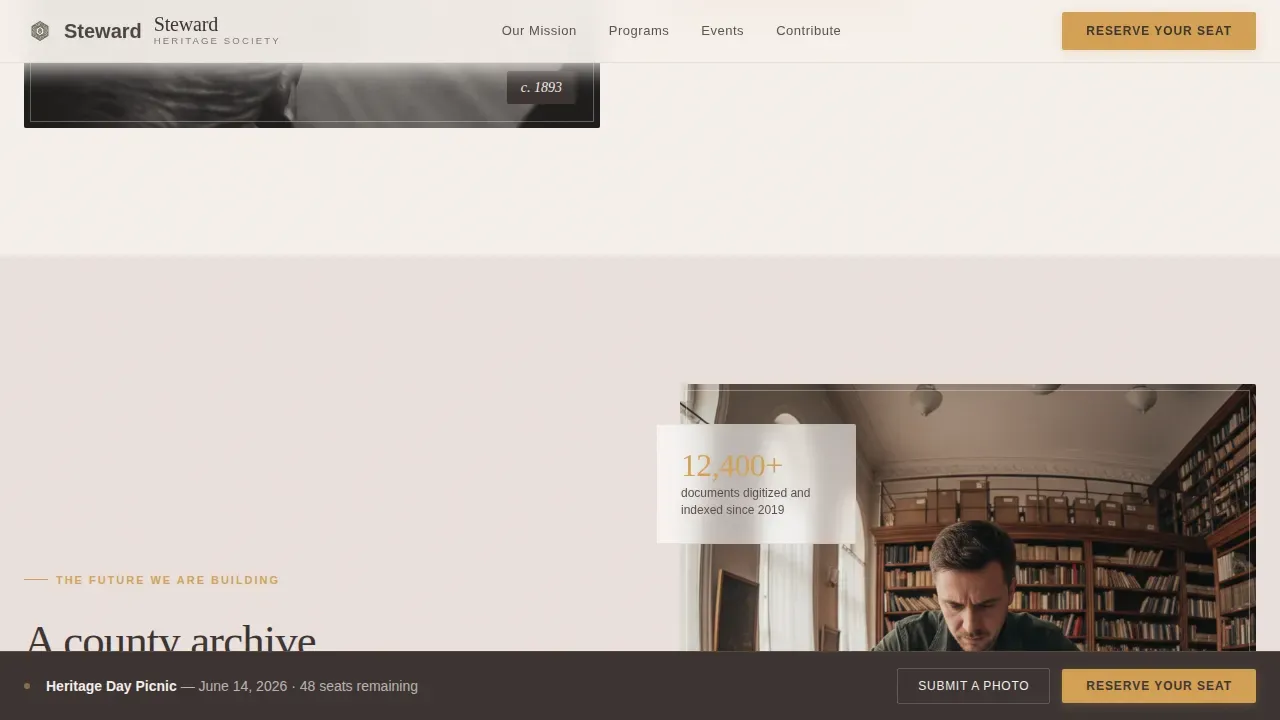
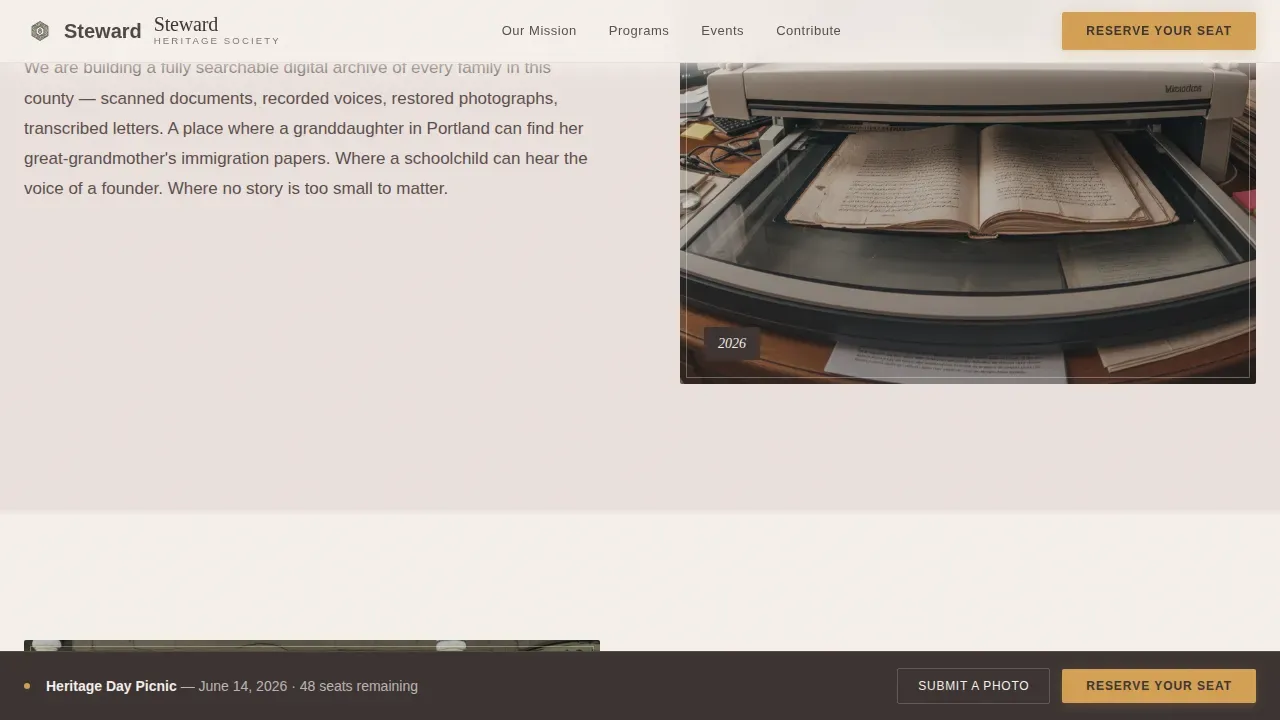
The page uses a zigzag alternating layout to create a clear rhythm of WHY and HOW. Left-image panels pair emotional close-ups, such as weathered hands holding a tintype or children tracing names on a monument, with right-side mission statements about why preservation matters. Right-image panels pair action photography of the society at work with left-side vision statements about the future they are building. Each alternating pair escalates the emotional stakes from personal nostalgia to community responsibility to urgency.
Event Registration Form with Dropdown Selection
The primary call to action is "Reserve Your Seat," anchored to the organization's next Heritage Day gathering. The registration form collects first name, family surname or surnames of interest, email address, and an event selection from a dropdown menu. The available event options are Heritage Day Picnic, Scanning Workshop, Oral History Training, and Cemetery Restoration Saturday. The call to action is repeated after the mission section and appears again in a subtle scroll-triggered bottom bar.
Secondary Photo Submission Path
Visitors who are not ready to attend an event can still participate through a secondary contribution path. The "Submit a Family Photo" section invites them to upload a photograph and add a short story field. This converts curiosity into participation with minimal friction, growing the living photo wall while building a sense of belonging before any in-person commitment is made.
Soft Mist Heirloom Color System
The entire page is built on a four-token color palette: heirloom linen (#F5F0EB), faded pressed-flower mauve (#C4A6A0), archival ink (#3B3332), and hearth-amber (#D4A054). Backgrounds alternate between linen and a barely-there mauve wash. Archival ink anchors all headlines and body text. Hearth-amber is reserved exclusively for buttons, dates, and highlighted names, so the eye is drawn to action elements without competing visual noise.
Scroll-Triggered Bottom Registration Bar
A subtle registration bar appears at the bottom of the viewport as the visitor scrolls past the hero section. It stays visible throughout the page, giving visitors a persistent but non-intrusive path back to the "Reserve Your Seat" action at any point in their reading. This behavior is built into the template's interactivity layer alongside the photo upload and event form components.
Page sections overview
| Section | Purpose |
|---|---|
| UGC Photo Wall Hero | Opens with a living mosaic of family photographs and a centered headline to arrest scroll and set emotional tone |
| Mission Zigzag Panels | Alternates emotional close-up imagery with WHY statements about preservation urgency |
| Programs Zigzag Panels | Alternates society action photography with HOW vision statements about the archive and youth programs |
| Events Registration Block | Houses the primary "Reserve Your Seat" call to action and the multi-field event registration form |
| Photo Submission Section | Provides the secondary contributor path with a photo upload field and a story text area |
| Linear Single-Row Footer | Closes the page with organization information in a clean, minimal single-row footer layout |
Design & branding system
The visual identity of this template is built to feel like a handwritten letter found inside a family Bible. Every design decision reinforces the sense that history is warm, tactile, and worth protecting. The palette, typefaces, and layout rhythm all work together to create that cedar chest moment the moment a visitor opens the page and feels they already belong.
Key design elements include:
- Typography uses Fraunces, a contemporary serif with old-soul warmth, for all headlines, paired with DM Sans for body text to keep long passages readable without losing the archival character of the design
- Backgrounds alternate between heirloom linen (#F5F0EB) and a faded mauve wash (#C4A6A0) across sections, with archival ink (#3B3332) as the universal text color and hearth-amber (#D4A054) applied only to interactive and highlighted elements
- The overall visual style is described in the brief as warm heirloom, archival, and handcrafted, with an organic photo grid that mimics snapshots pinned to a corkboard rather than a polished gallery layout
Mobile & speed optimization
The template is designed desktop-first with full mobile responsiveness built in. The source brief specifies a device priority of desktop-first and confirms that the layout adapts for mobile users. This matters especially for a heritage preservation audience that includes older members who may access family photographs from a phone for the first time, as well as younger members who discover the page through a social share on a mobile device.
Performance-focused build choices include:
- Image lazy loading is specified in the template to defer off-screen photographs until the visitor scrolls toward them, reducing initial page load weight for the large UGC photo mosaic
- All animations use CSS transforms exclusively, which keeps motion rendering at 60 frames per second without triggering expensive browser repaints
- GSAP-powered scroll reveals and staggered image loads are implemented in a way that preserves the visual richness of the parallax photo wall while keeping the interaction layer lightweight
How this template helps you convert
Every section of this template is arranged to earn the visitor's trust before asking for their commitment. The page does not open with a form. It opens with faces, with history, with a question that makes visitors feel their family story belongs here.
Here is the conversion path the template creates:
- The UGC photo wall and centered headline create an immediate emotional connection, making visitors feel they are already part of the community before they have scrolled past the hero section
- The alternating zigzag mission and program sections raise the emotional stakes with each panel, moving visitors from personal nostalgia to a sense of community responsibility, so that by the time they reach the registration form they feel a genuine reason to act
- The dual call-to-action structure, with "Reserve Your Seat" as the primary path and "Submit a Family Photo" as the secondary path, ensures that visitors at different levels of readiness both have a meaningful way to participate, maximizing the total number of people who take an action before leaving the page
Other information about this template
The Steward Family First heritage preservation landing page template is designed with awareness of the broader landscape of historic preservation work in the country. Organizations that use this template may explore grant resources relevant to their projects and programs. The following facts and context items are useful for anyone putting this template to work for their organization.
- The Descendant and Family Stewardship Initiative, part of the African American Cultural Heritage Action Fund, empowers descendant-led and family-led organizations to preserve historic places and provides specialized consultation and best practices support for a period of two years to grantees
- The Action Fund has issued more than 380 small grants totaling $1.9 million, which have acted as seed money leveraging more than $20 million in total; eligible applicants include organizations with direct ties to a historic place
- National heritage areas, which are created by local residents to promote cultural, historical, and natural resources, operate under their own unique provisions and do not impose land-use restrictions on residents; their goal is to establish long-term, multi-partnership community and conservation projects
- Stewards play a crucial role in the preservation and management of historic places by engaging in collaborative efforts with descendant communities and families; the role of stewards in historic preservation is increasingly recognized as vital for maintaining the cultural and historical integrity of sites
- Stewards often work in partnership with organizations like the National Park Service to leverage resources and support; the Office of Historic Preservation also serves communities by building identity through the stories of local people
- National parks and state parks across the country serve as anchors for historic preservation work; many parks house restored historic sites, and stewards regularly partner with parks departments to develop interpretive programming and governance frameworks for these places
- Programs like the Future Leaders Youth Program connect students and underserved teens with preservation projects, providing them with job skills and a sense of community responsibility; bringing kids into the work of historic preservation is one of the most exciting and sustainable strategies an organization can pursue
- The Essex National Heritage Commission has issued numerous small grants to support local heritage projects; Pioneer Village in Massachusetts was revitalized through a community effort that preserved its historical significance and educational value for students and families
- An impact statement on any heritage preservation page should clearly state what is being done, with a focus on stewardship; authenticity markers, high-contrast colors, and accessible design details help ensure the page serves all members of the community regardless of age or device
- The Steward Family First initiative mirrors the philosophy behind programs like Preserve America Stewards, which recognize that active stewardship, not passive documentation, is what keeps historic places alive and meaningful for future generations
Theme
Family First
Creative direction
Vision & Mission
Color system
Soft Mist
Style
Zigzag/Alternating
Direction
Event Registration
Page Sections
Parallax UGC Photo Wall Header
Zigzag Mission and Program Layout
Event Registration Form with Dropdown
Secondary Photo Submission Path
Soft Mist Heirloom Color System
GSAP Scroll Reveals and Staggered Loads
Related questions
What kind of organization is this template built for?
Can I use this template if my organization is applying for a preservation grant?
How does the dual call-to-action structure work?
Is this template suitable for first time visitors unfamiliar with heritage preservation?
What events can be listed in the registration form dropdown?